
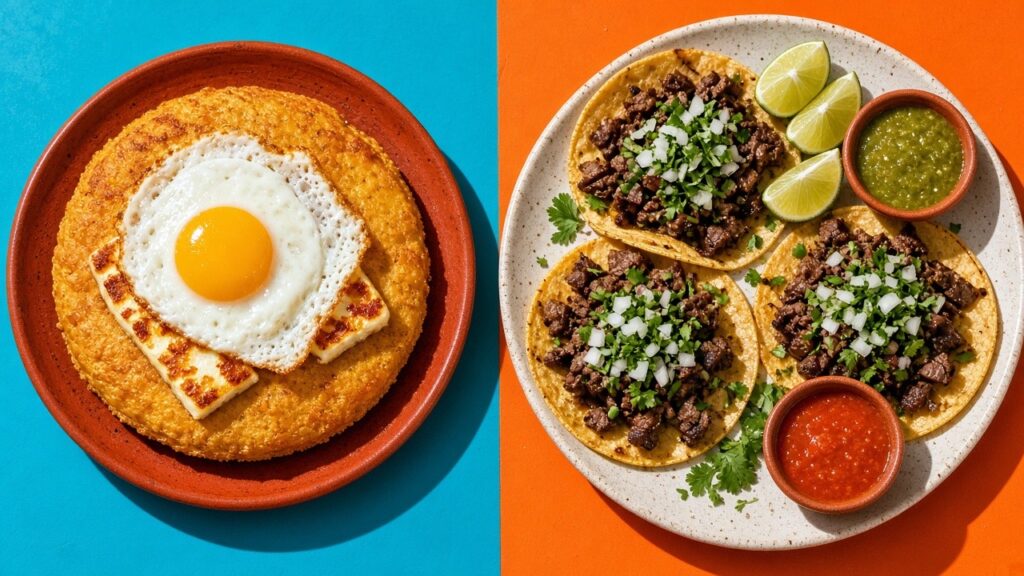
People in Chicago often assume Panamanian food is close to Mexican food. Both are Latin American, both use corn, and both have tamales and tortillas, so the mix-up makes sense. But sit down to a Panamanian plate after a Mexican one and the differences are obvious: more rice, more plantain, less chile, and a coastal, Caribbean feel.
Panamanian food is built on rice, plantains, root vegetables like yuca and ñame, beans, chicken, beef and seafood, seasoned with culantro, onion, garlic and sweet peppers, with heat added at the table from ají chombo hot sauce. Mexican food is built on corn (as nixtamalized masa for tortillas and tamales), beans and a wide range of fresh and dried chiles, with salsas and moles central to the cooking. Panamanian tortillas are thick and fried or griddled; Mexican tortillas are thin flatbreads for tacos. Panama’s food also carries strong Afro-Caribbean and Chinese influences, which Mexican cooking doesn’t.
I’m Panamanian and I live in Chicago, one of the best Mexican-food cities in the country, so I cook and eat both. Below: staples, spice, tortillas, tamales, soups, breakfast, drinks and desserts compared side by side, why the two cuisines turned out so different, and where to try both in Chicago.
Panamanian food vs Mexican food: the short answer
| Panamanian food | Mexican food | |
|---|---|---|
| Main starch | Rice, eaten at almost every meal | Corn, mostly as tortillas |
| Other staples | Plantains, yuca, ñame, otoe, beans, pigeon peas | Beans, squash, potatoes, rice as a side |
| Signature herb | Culantro | Cilantro, epazote, Mexican oregano |
| Heat | Mild; hot sauce on the side | Often spicy; chiles cooked into dishes |
| Signature sauces | Sofrito, ají chombo hot sauce | Salsas, moles, adobos |
| Tortillas | Thick, fried or griddled, eaten with cheese | Thin, soft, the base of tacos |
| Iconic dish | Sancocho de gallina | Tacos, mole, pozole (it varies by region) |
| Key influences | Indigenous, Spanish, African, Afro-Caribbean, Chinese | Indigenous Mesoamerican, Spanish |
The short version: Panamanian food is a mild, rice-and-plantain cuisine with Caribbean roots. Mexican food is a corn-and-chile cuisine with deep Mesoamerican roots and huge regional variety. For more on Panama’s side, start with my guide to Panamanian food.
Staples compared (corn, rice, plantain, roots, beans)
Corn
Corn matters in both kitchens, but in very different amounts. In Mexico, corn is the foundation. It’s nixtamalized (cooked with lime, the mineral calcium hydroxide) and ground into masa for tortillas, tamales, sopes, tlacoyos and more. A meal without tortillas is unusual.
In Panama, corn shows up in specific foods rather than every meal: tortillas, tamales, bollos, almojábanos and the corn drink chicheme. Traditionally, Panamanian cooks make masa from dried corn cooked until soft and ground, and many home cooks now use masa harina for convenience.
Rice
This is the biggest difference. Rice is the center of the Panamanian plate. Lunch is often white rice with beans or lentils, a stew, a salad and plantain. We make arroz con pollo, arroz con guandú, arroz con coco and the soupy rice stew guacho.
In Mexico, rice is usually a side, often red rice (arroz rojo) cooked with tomato, served next to the main dish rather than as its base.
Plantains
Plantains are everyday food in Panama: sweet fried maduros, smashed and fried green patacones, and plantain in sancocho. In Mexico, plantains (plátano macho) appear mostly in the south and along the Gulf coast, in Veracruz, Tabasco and Oaxaca, and less in the rest of the country.
Roots
Panama uses yuca, ñame and otoe the way many cuisines use potatoes, especially in soups. Yuca also becomes the dough for carimañolas. Mexican cooking uses potatoes, jícama and chayote more than tropical roots, with yuca showing up mainly in the south.
Beans and legumes
Both love beans. Mexico favors pinto beans and black beans, often refried. Panama cooks red beans, lentils and guandú (pigeon peas) as stewy sides poured over rice. Refried beans are not a typical Panamanian food.
Spice and heat
Mexican food has a reputation for heat, and many dishes do cook chiles directly into the food: jalapeños, serranos, chipotles, guajillos, anchos, habaneros in the Yucatán and dozens more. Just as important, chiles give Mexican food flavor, not only heat. A mole can use several kinds of dried chile, and many are not very hot at all.
Panamanian food is mild. Our flavor comes from sofrito, the base of onion, garlic, sweet peppers and culantro. Heat comes from the bottle: ají chombo hot sauce, made with a Scotch bonnet-type pepper, mustard and vinegar, added at the table by whoever wants it. I explain this in detail in is Panamanian food spicy?.
The herb difference matters too. Mexican food uses a lot of cilantro. Panamanian food prefers culantro, a related herb with long, serrated leaves and a stronger flavor. Here’s my explanation of culantro vs cilantro.
Tortillas: Panamanian vs Mexican
Same word, different food.
| Panamanian tortilla | Mexican tortilla | |
|---|---|---|
| Thickness | Thick, about ½ inch | Thin, about ⅛ inch or less |
| Size | Small, about 4 inches across | 6 inches (tacos) to 12 inches or more (flour, in the north) |
| Cooking | Fried in oil or cooked on a griddle | Cooked dry on a comal |
| Texture | Crisp outside, soft and dense inside | Soft and flexible |
| How it’s eaten | As the main part of breakfast, topped with cheese | As a wrapper or utensil for other food |
| Flour version? | Not traditional | Yes, especially in northern Mexico |
A Panamanian tortilla is closer in shape to a Colombian or Venezuelan arepa or a thick Mexican gordita than to a taco tortilla. We eat it hot for breakfast with queso blanco (fresh white cheese), a fried egg, bistec picado or salchicha guisada. You wouldn’t fold one around taco fillings; it’s too thick.
Tamales: Panamanian vs Mexican
Both countries make tamales, and both are holiday food, but they look and taste different.
- Wrapper: Panamanian tamales are wrapped in plantain or bijao leaves. Mexican tamales are usually wrapped in dried corn husks, though banana leaves are used in the south, as in Oaxacan tamales.
- Masa: Panamanian masa is seasoned with sofrito and broth and often colored with achiote. Mexican masa is beaten with lard or shortening until light, and the result is fluffier.
- Filling: Panamanian tamales usually contain chicken or pork in a stewy sauce with olives, capers, raisins and sometimes prunes, which gives a sweet-salty Spanish flavor. Mexican fillings vary widely: pork in red chile, chicken in green salsa, cheese with rajas (poblano strips), mole, or sweet tamales.
- Size: Panamanian tamales are usually large, flat rectangles. Many Mexican tamales are smaller.
- When: In Panama, tamales are a Christmas food. In Mexico, they’re eaten year-round and especially at Christmas and on Candlemas (Día de la Candelaria, February 2).
Soups: sancocho vs pozole and caldo
Panama’s national dish is a soup: sancocho de gallina, a clear chicken soup with ñame, yuca or otoe, corn on the cob and plenty of culantro, served with white rice on the side or in the bowl. It’s what you eat when you’re sick, hungover or celebrating.
Mexico’s soups are bolder. Pozole is a hominy stew with pork or chicken, in red, green or white versions, topped with shredded cabbage, radish, oregano, lime and chile. Caldo de res is a beef and vegetable soup, and menudo is tripe in a red chile broth. They share the idea of a big pot of soup on weekends, but pozole tastes of chile and hominy, while sancocho tastes of culantro and root vegetables.
Panamanians also make sopa de carne, beef soup with vegetables, which is closer to caldo de res.
Breakfast compared
Breakfast may be where the two cuisines differ most.
Panamanian breakfast is fried and filling: thick tortillas, hojaldras (fried dough), carimañolas, empanadas, almojábanos, fried cheese, eggs, bistec, salchicha guisada and coffee. See what Panamanians eat for breakfast.
Mexican breakfast usually centers on eggs, tortillas and salsa: chilaquiles (tortilla chips simmered in salsa), huevos rancheros, huevos a la mexicana, molletes, tamales with atole, and pan dulce with coffee or hot chocolate.
Both are hearty. Mexican breakfasts tend to be saucier and spicier; Panamanian breakfasts are fried dough and corn with meat and cheese.
Drinks and desserts
Drinks
| Panama | Mexico |
|---|---|
| Chicha: fresh fruit drinks (passion fruit, tamarind, papaya) | Aguas frescas (jamaica, tamarindo, horchata) |
| Chicheme: sweet corn and milk drink | Atole and champurrado: warm corn drinks |
| Raspao: shaved ice with syrup and condensed milk | Raspados and paletas |
| Seco Herrerano: sugarcane spirit | Tequila and mezcal: agave spirits |
The fruit drinks are similar, and both countries have corn drinks. The national spirits differ: Panama has seco, made from sugarcane, and Mexico has tequila and mezcal, made from agave. More in the national drink of Panama.
Desserts
Tres leches cake is loved in both countries, and both make arroz con leche and flan. Panama’s desserts also include cocadas (coconut sweets), sopa borracha (rum-soaked cake for weddings and Christmas) and Panamanian fruit cake. Mexico adds churros, pan dulce like conchas, cajeta (goat’s milk caramel), and many regional candies made from tamarind, pumpkin and milk.
Why they’re different
Geography
Panama is a narrow isthmus between the Caribbean and the Pacific. Nowhere in the country is far from the sea, so seafood, coconut and tropical crops like plantain and yuca are everywhere. Panamanian ceviche, usually made with corvina, is a common snack.
Mexico is huge, with deserts, mountains, highlands and two long coasts. That’s why Mexican food varies so much by region, from flour tortillas and beef in the north to moles in Oaxaca and achiote-marinated pork in the Yucatán. When people compare Panamanian food with “Mexican food,” they’re often comparing it with Mexican-American food, which is just one slice of Mexico’s cooking.
Indigenous roots
Mexican cuisine grew from Mesoamerican civilizations that domesticated corn and developed nixtamalization thousands of years ago, along with chiles, beans, squash, tomatoes and cacao. That foundation still shapes most Mexican cooking. Panama’s Indigenous peoples also grew corn, roots and other crops, but their cooking didn’t become the backbone of the national cuisine in the same way.
African and Afro-Caribbean influence
Panama’s food has deep African roots, from enslaved Africans brought during Spanish rule and from the West Indian workers, many from Jamaica and Barbados, who came to build the railroad and the canal. Coconut rice, fried fish, patacones, spicy hot sauces and Caribbean dishes in Colón and Bocas del Toro come from this history.
Chinese influence
Chinese immigrants have been part of Panama since the 1850s railroad era, and Chinese-Panamanian food is part of everyday life: fried rice, chow mein, wontons and corner stores and restaurants run by Chinese-Panamanian families. This influence is much smaller in mainstream Mexican cooking.
The canal
The canal and its long American presence also brought American foods and habits, adding one more layer to the mix.
Where to try both in Chicago
For Mexican food, Chicago is spoiled. Pilsen and Little Village are the classic neighborhoods for taquerías, panaderías, carnitas, tamales and more. My Pilsen food guide is a good place to start, and my Chicago food neighborhoods guide covers more areas.
Panamanian food is harder to find in Chicago. Look for Panamanian pop-ups, events and restaurants, plus Colombian, Venezuelan, Puerto Rican and Caribbean places for similar dishes like patacones, empanadas and sancocho-style soups. My guide to Panamanian food in Chicago has tips, and for the rest, cooking at home with ingredients from Latin markets works well.
If you want to compare them yourself, try this:
- Eat tacos al pastor and a bowl of pozole in Pilsen.
- Make sancocho, white rice and patacones at home.
- Taste them side by side and notice the chile versus culantro, and corn versus rice.
Common mix-ups
- “Panamanian tortillas are like taco shells.” No. They’re thick, small and soft inside, eaten with cheese.
- “Panamanian food is spicy because it’s Latin American.” No. It’s mild, with hot sauce on the side.
- “Panamanians eat burritos.” Burritos are a northern Mexican and Mexican-American food, not Panamanian.
- “Tamales are the same everywhere.” Panamanian tamales are in leaves with olives and raisins; Mexican tamales vary by region.
- “All Latin food uses cilantro.” Panama prefers culantro.
FAQ
Is Panamanian food Mexican?
No. Panamanian food is its own cuisine. It shares some ingredients with Mexican food, like corn, beans and tamales, but it’s built on rice, plantains and root vegetables, it’s much milder, and it has strong Afro-Caribbean and Chinese influences. It’s closer to Colombian and Caribbean food than to Mexican food.
Is Panama in Central America food-wise?
Geographically, Panama is in Central America, and it shares some dishes with its neighbors, such as tamales, rice and beans and fried plantains. But food-wise, it also looks south and east. Sancocho, patacones, hojaldras and coconut rice connect it to Colombia and the Caribbean. Many Panamanians describe their food as a crossroads cuisine.
Is Panamanian food spicier than Mexican food?
No. In general, Mexican food is spicier because chiles are cooked into many dishes. Panamanian food is mild, and you add ají chombo hot sauce if you want heat.
Do Panamanians eat tacos?
Not as traditional food. You can find tacos and other Mexican dishes in Panama City, but they’re imported favorites, not part of the traditional Panamanian kitchen.
What’s the closest Panamanian dish to a Mexican dish?
Tamales are the closest, followed by beef soups like sopa de carne and caldo de res. Both cuisines also share tres leches, flan and arroz con leche.
Which is healthier, Panamanian or Mexican food?
It depends on the dish. Both have fried foods and fresh, simple dishes. A bowl of sancocho, ceviche or rice and beans is a balanced meal, and so is a Mexican caldo or grilled fish with salsa. The fried breakfasts of both countries are treats.