
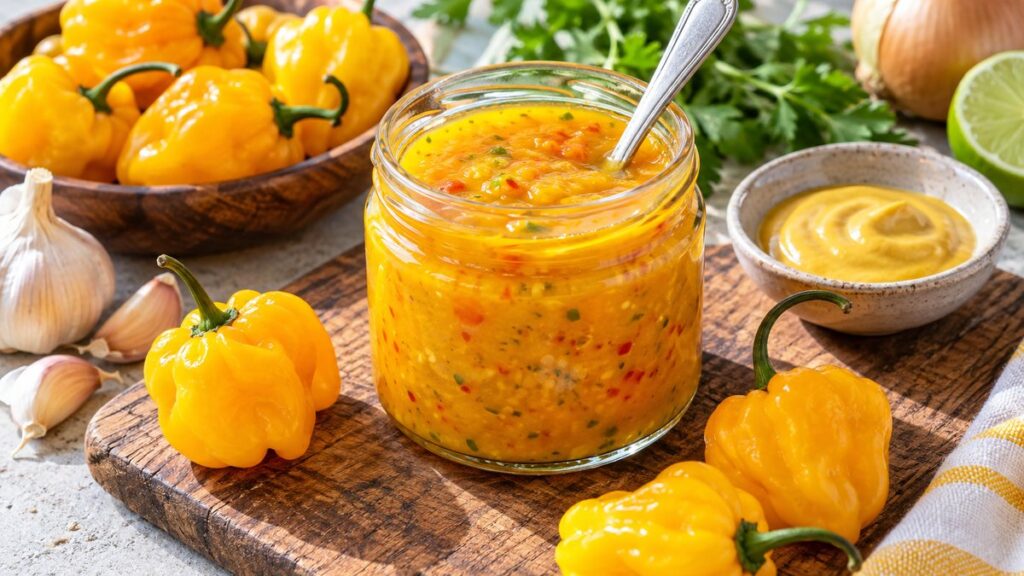
On a Panamanian table, the sancocho comes with rice, and the rice comes with a little bottle of yellow hot sauce. That bright, mustardy, fruity heat is ají chombo. The best-known bottled version is D’Elidas, and you can find it online, but homemade takes 15 minutes and you choose how hot it is.
Panamanian hot sauce is a yellow sauce made by blending ají chombo peppers (scotch bonnets or habaneros in the US) with yellow mustard, white vinegar, onion, garlic and salt, then simmering it for 5 minutes. It’s tangy, fruity and hot, and keeps about a month in the fridge.
What is ají chombo?
Ají chombo is what Panamanians call the small, lantern-shaped hot pepper of the Capsicum chinense family, the same family as the scotch bonnet and habanero. It’s fruity and very hot. In Chicago I buy scotch bonnets or habaneros at Latin and Caribbean markets, and either one works. Yellow or orange peppers keep the sauce its classic sunny color.
Don’t confuse it with ají dulce, the small sweet pepper that looks similar but has almost no heat. That one goes in sofrito, not hot sauce.
Bottled vs homemade
D’Elidas Picante Chombo, the Panamanian bottle you’ll see in many homes and fondas, lists habanero (chombo) peppers, white wine vinegar, roasted tomatoes, onion, mustard, salt and spices, and it’s sold in 2, 5 and 10-ounce bottles. Many Panamanians abroad order it online. Homemade lets you choose the heat and skip the wait; the bottle is what tastes like a fonda table.
How hot is ají chombo?
Habaneros and scotch bonnets usually measure about 100,000 to 350,000 Scoville heat units, compared with roughly 2,500 to 8,000 for a jalapeño. So one ají chombo can be 40 times hotter than a jalapeño. In a mustard-and-vinegar sauce the heat is spread out, which is why a few drops are enough.
Ingredients
Makes about 1½ cups (360 ml).
- 8 to 12 yellow or orange scotch bonnet or habanero peppers (ají chombo), stems removed
- ½ small onion, chopped
- 2 garlic cloves
- ½ cup (120 ml) yellow mustard
- ½ cup (120 ml) white vinegar
- ¼ cup (60 ml) water
- 1 tsp salt
- 1 tsp sugar
- Optional: 1 small carrot, cooked, for a milder, thicker sauce
- Optional: ¼ tsp ground turmeric for an even brighter yellow
How to make it
- Protect yourself. Wear gloves to cut the peppers and keep your hands away from your eyes. Open a window; the fumes are strong.
- Prep the peppers. For the hottest sauce, leave seeds in. For a medium sauce, remove the seeds and white ribs from half the peppers.
- Blend. Put the peppers, onion, garlic, mustard, vinegar, water, salt, sugar and the optional carrot and turmeric in a blender. Blend until very smooth, 1 to 2 minutes.
- Simmer. Pour into a small stainless steel or enamel saucepan and simmer gently for 5 minutes, stirring. This softens the raw onion and garlic and brings the sauce together.
- Cool and bottle. Let it cool, taste for salt, then pour into a clean glass bottle or jar. Refrigerate.
The flavor gets better after a day in the fridge.
How hot is it, and how to control the heat
Scotch bonnets and habaneros are among the hottest peppers you’ll find in a regular store. To adjust:
- Milder: use 4 to 6 peppers, remove all the seeds and ribs, and add the cooked carrot.
- Hotter: use 12 peppers with seeds.
- Too hot after blending? Add more mustard and vinegar, or a little more carrot.
Variations
- With roasted tomato: blend in 1 roasted plum tomato, like the bottled style.
- Fruity Caribbean style: add ½ cup (80 g) ripe mango or papaya for a sweeter, rounder sauce.
- Red sauce: use red scotch bonnets or habaneros and skip the turmeric.
- Pickled chombo peppers: fill a jar with whole peppers, sliced onion and a few garlic cloves, cover with hot vinegar and a teaspoon of salt, and refrigerate a week. Splash the vinegar on soups and beans.
Hot sauce troubleshooting
- Too sour: add more mustard and a pinch more sugar, or blend in a cooked carrot.
- Bitter: the peppers’ white ribs or the garlic scorched. Simmer gently, don’t boil hard.
- Separating in the jar: normal. Shake before using, or blend in ¼ teaspoon xanthan gum for a smooth, bottled-style texture.
- Burning skin after cutting peppers: rub a little oil or whole milk on your hands, then wash with dish soap. Next time, wear gloves.
How Panamanians use it
- A few drops on sancocho. This is the classic.
- On white rice, arroz con pollo and beans.
- With fried food: carimañolas, empanadas, patacones and hojaldras.
- On Panamanian ceviche, which already has a little ají chombo in it.
Storage
Keep it in a clean, closed glass bottle in the fridge for up to 1 month. Always use a clean spoon. If it smells off, grows mold or bubbles, throw it out.
Recipe card: Panamanian ají chombo hot sauce
Yield: about 1½ cups (360 ml) · Prep: 10 minutes · Cook: 5 minutes · Total: 15 minutes
Ingredients
- 8–12 scotch bonnet or habanero peppers (ají chombo)
- ½ small onion; 2 garlic cloves
- ½ cup (120 ml) yellow mustard
- ½ cup (120 ml) white vinegar; ¼ cup (60 ml) water
- 1 tsp salt; 1 tsp sugar
- Optional: 1 cooked carrot; ¼ tsp turmeric
Instructions
- Wearing gloves, stem the peppers (seed some for less heat).
- Blend everything until smooth.
- Simmer 5 minutes in a nonreactive pan.
- Cool, bottle and refrigerate.
Storage: Fridge, up to 1 month.
FAQ
Is Panamanian hot sauce the same as Caribbean scotch bonnet sauce?
They’re cousins. The Panamanian style is yellow and mustard-based, with fewer fruits and spices than many Caribbean sauces.
Can I can it to keep it longer?
I keep mine in the fridge. Low-acid ingredients like onion and carrot need a tested canning recipe, so if you want a shelf-stable sauce, follow a tested recipe from a canning authority.
Where can I buy ají chombo in Chicago?
Scotch bonnets and habaneros are sold at most Latin and Caribbean markets, and many supermarkets carry habaneros. See my Chicago shopping guide.
Why is it called ají chombo?
It’s simply the Panamanian name for this pepper; in the rest of the Caribbean you’ll hear scotch bonnet or habanero.
Can I use jalapeños?
You can, but it won’t taste like ají chombo. Jalapeños are much milder and lack the fruity flavor.
Can I skip the mustard?
Then it’s a pepper-vinegar sauce, which is also used in Panama, but the yellow mustard sauce is the one most people picture.
More from the Panamanian table
This sauce belongs next to almost everything in my guide to Panamanian food. Start with a pot of Panamanian sancocho and a plate of arroz con guandú.
¡Buen provecho!