
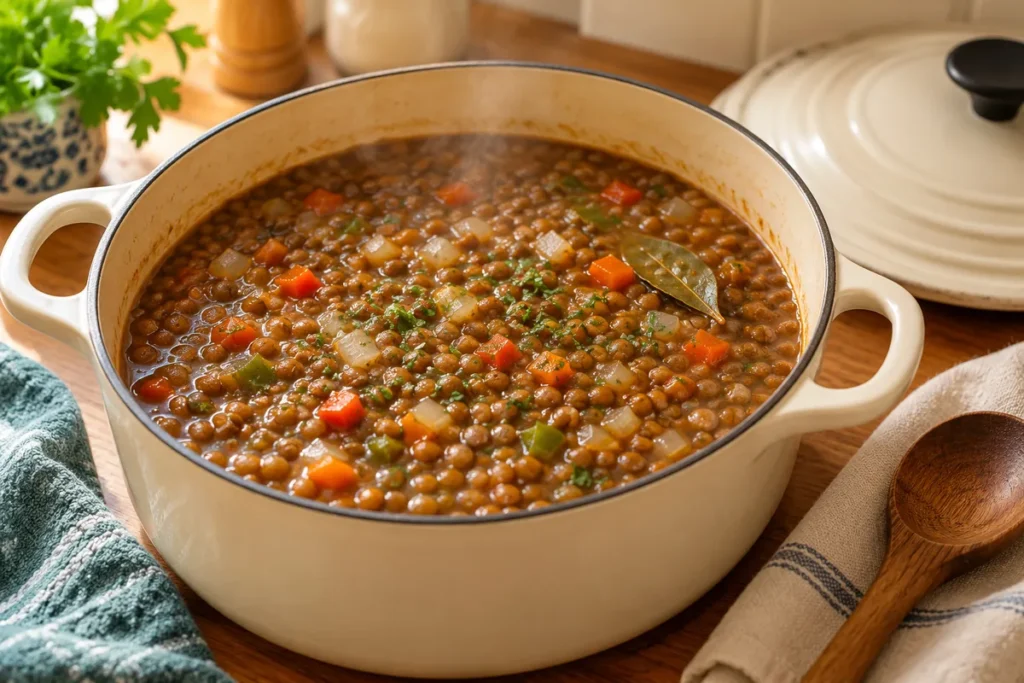
In Panama, December smells like arroz con guandú. It’s the rice of Christmas Eve and New Year’s, the big pot that sits next to the tamales and the pernil. But I don’t wait for December. In Chicago I make it any time I want a plate that tastes like a celebration.
Panamanian arroz con guandú is long-grain rice cooked with pigeon peas (guandú), coconut milk, a sofrito of onion, garlic and sweet pepper, and culantro, often with a little pork or ham. It cooks in one pot in about 40 minutes and comes out fluffy, creamy and lightly sweet.
What is arroz con guandú?
Guandú is the Panamanian word for pigeon peas, small round legumes that grow on bushes all over the tropics. Puerto Rico calls them gandules, and the Dominican Republic and other countries also call them guandules. They taste nutty and earthy, a bit like a cross between a pea and a lentil.
What makes the Panamanian version special is coconut milk. On the Caribbean side of the country and in many homes everywhere, the rice is cooked “con coco,” which makes it creamy and a little sweet. Some families cook it without coconut, with just sofrito and pork. Both are Panamanian. Mine has coconut.
Fresh, frozen, dried or canned guandú?
| Type | Where to find it | How to use it |
|---|---|---|
| Fresh green guandú | Rare in the US; sometimes in Caribbean markets in season | Simmer 20–30 min before adding rice |
| Frozen green guandú | Freezer case of Latin markets (Goya and other brands) | Simmer 15–20 min first |
| Canned guandú/gandules | Latin aisle of most supermarkets | Drain and rinse; add with the rice |
| Dried guandú | Latin and Indian markets (sold as toor dal when split) | Soak overnight, simmer 45–60 min |
In Chicago I usually buy frozen green guandú because it tastes closest to fresh. When I’m in a hurry I use canned, and I have a whole post on arroz con guandú de lata, the canned shortcut.
Why arroz con guandú is a Christmas rice
In Panama, the main guandú harvest starts in December and runs into March, so fresh green pigeon peas fill the markets right when families are cooking for Nochebuena and New Year’s. Panamanian news covers the price of a pound of guandú every December the way US news covers turkey. That’s how a humble rice became the holiday rice. You’ll still see it all year at fondas and Sunday lunches, especially next to stewed chicken and potato salad.
Arroz con guandú vs arroz con gandules, moro and congrí
| Dish | Where | Key differences |
|---|---|---|
| Arroz con guandú (con coco) | Panama | Coconut milk, sofrito, culantro, a little pork; creamy, lightly sweet |
| Arroz con gandules | Puerto Rico | Sofrito, sazón (achiote), olives, capers and pork; orange-red rice, no coconut |
| Moro de guandules | Dominican Republic | Tomato paste and herbs, often coconut milk too (“moro de guandules con coco”) |
| Rice and peas | Jamaica and the Caribbean | Kidney beans or pigeon peas, coconut milk, thyme and Scotch bonnet |
| Congrí | Cuba | Red or black beans cooked with the rice, no coconut |
Green guandú or dark guandú?
Fresh and frozen pigeon peas are green and give a pale, golden rice. Mature, dried peas and many canned ones are brown or purplish and tint the rice a soft brown. You’ll hear Panamanians talk about arroz con guandú verde and darker versions; both taste good. The green ones are sweeter and more delicate, the dark ones earthier.
Ingredients
Serves 6 to 8 as a side.
- Long-grain white rice: 2 cups (400 g). Rinse it until the water runs mostly clear.
- Guandú: 2 cups cooked or frozen green pigeon peas, or 1 can (15 oz) drained and rinsed.
- Coconut milk: 1 can (13.5 oz / 400 ml), full fat, well shaken.
- Water or the guandú cooking liquid: about 1½ cups (360 ml). See the ratio note below.
- Pork: 4 oz (115 g) diced ham, bacon or salted pork (optional but traditional).
- Oil: 2 tablespoons.
- Onion: 1 medium, finely chopped.
- Garlic: 3 cloves, minced.
- Sweet pepper: ½ green bell pepper or 3 ají dulce, finely chopped.
- Tomato: 1 small, chopped, or 2 tablespoons tomato sauce.
- Culantro: 4 leaves, finely chopped (or 3 tablespoons chopped cilantro).
- Salt: 1½ teaspoons, to taste.
- Optional: a pinch of sugar to round the coconut, a pinch of ground achiote for color.
The rice-to-liquid ratio
This is where most arroz con guandú goes wrong. Count all the liquid, coconut milk included. For 2 cups of long-grain rice, I use about 3 cups of total liquid: one can of coconut milk (about 1⅔ cups) plus 1⅓ to 1½ cups water. If your guandú is wet from cooking, use the lower amount.
How to make Panamanian arroz con guandú
1. Cook the guandú (if frozen or fresh)
Put frozen or fresh guandú in a pot with water to cover by an inch and a pinch of salt. Simmer 15 to 20 minutes until tender. Drain, but save the cooking liquid. It’s full of flavor and you can use it instead of water. Skip this step for canned.
2. Brown the pork and make the sofrito
In a heavy pot or caldero with a tight lid, heat the oil over medium heat. Add the ham or bacon and cook 3 to 4 minutes until it gives off its fat. Add the onion and pepper and cook 4 minutes, until soft. Add the garlic, tomato and half the culantro and cook 2 more minutes.
3. Add the guandú, rice and liquid
Stir in the guandú. Add the rinsed rice and stir for a minute so every grain is coated. Pour in the coconut milk and water (or guandú liquid) and add the salt. Taste the liquid: it should be a little saltier than you want the rice to be.
4. Cook uncovered, then cover
Bring it to a boil and let it bubble, uncovered, until the liquid drops to the level of the rice and you see little holes on the surface, about 6 to 8 minutes. Stir once, gently, from the bottom.
5. Steam low and slow
Turn the heat to the lowest setting. Cover tightly (a sheet of foil under the lid helps) and cook 20 to 25 minutes without lifting the lid. Coconut milk can stick, so low heat is important.
6. Rest and fluff
Turn off the heat and let it rest, covered, 5 to 10 minutes. Fluff with a fork, folding in the rest of the culantro.
If you want the crispy layer at the bottom of the pot, the concolón, leave it on medium-low for the last 5 minutes. Every Panamanian family fights over it.
Don’t skip the concolón
The crisp, golden layer of rice stuck to the bottom of the pot has a name in Panama: concolón. Puerto Ricans call it pegao. In many families people fight over it. To get a good one:
- Use a heavy pot (cast aluminum or cast iron).
- After the rice is cooked and fluffed off the top, turn the heat to medium for 3 to 5 minutes, uncovered, until you hear a light crackle.
- Let it sit off the heat 5 minutes, then scrape it up with a metal spoon.
Coconut milk browns quickly, so watch it. Golden is perfect; black is burned.
Troubleshooting
- Rice is mushy: too much liquid, or the lid was lifted and stirred. Next time use less water and leave it alone.
- Rice is hard on top: not enough liquid, or the lid wasn’t tight. Sprinkle 2 to 3 tablespoons of water on top, cover and steam 10 more minutes.
- Bottom burned: the heat was too high for coconut milk. Use a heavy pot and the lowest flame.
- Bland: under-salted cooking liquid. Taste the liquid before covering.
What to serve with arroz con guandú
At Christmas it goes with Panamanian tamales, pernil (roast pork shoulder), turkey or ham, and pink potato salad. The rest of the year, I serve it with:
- Pollo guisado (stewed chicken)
- Fried fish and lime
- Ropa vieja or any saucy beef
- Patacones and a simple salad
I write about the whole holiday table in traditional Panamanian Christmas food.
Variations
- Without coconut: Replace the coconut milk with chicken broth or water. The rice will be lighter and more savory.
- Without pork: Skip it and add a little extra oil and a pinch of smoked paprika.
- With chicken: Some cooks make it a full meal with browned chicken pieces cooked in the rice. That’s close to Panamanian arroz con pollo.
- With bacon (tocino): Use 4 slices of bacon instead of salted pork; brown it, then cook the sofrito in the fat.
- With leftover ham: After the holidays, dice ½ cup of Christmas ham into the sofrito.
- With canned coconut cream instead of milk: Use half cream, half water; it’s richer, so cut back slightly on oil.
Storage and reheating
Cool the rice quickly and refrigerate within 1 to 2 hours, in a shallow container. Cooked rice left at room temperature too long can make people sick, so don’t leave it on the counter overnight. It keeps 3 to 4 days in the fridge. Reheat with a sprinkle of water, covered, in the microwave or a pan, until steaming hot. It freezes for up to 2 months.
Recipe card: Panamanian arroz con guandú
Yield: 6–8 side servings · Prep: 15 minutes · Cook: 40 minutes (plus 15–20 minutes to pre-cook frozen guandú) · Total: about 1 hour
Ingredients
- 2 cups (400 g) long-grain white rice, rinsed
- 2 cups (about 300 g) cooked or frozen green guandú, or 1 can (15 oz / 425 g), drained
- 1 can (13.5 oz / 400 ml) full-fat coconut milk
- 1⅓–1½ cups (320–360 ml) water or guandú cooking liquid
- 4 oz (115 g) diced ham, bacon or salted pork (optional)
- 2 tbsp oil
- 1 medium onion, finely chopped
- 3 garlic cloves, minced
- ½ green bell pepper or 3 ají dulce, finely chopped
- 1 small tomato, chopped
- 4 culantro leaves (or 3 tbsp cilantro), chopped
- 1½ tsp salt
Instructions
- If using frozen or fresh guandú, simmer it in salted water 15–20 minutes; drain and keep the liquid.
- Brown the pork in the oil in a heavy pot. Add the onion and pepper, cook 4 minutes; add the garlic, tomato and half the culantro, cook 2 minutes.
- Stir in the guandú and rice. Add the coconut milk, water and salt.
- Boil uncovered until the liquid reaches the surface of the rice, 6–8 minutes. Stir once.
- Cover tightly, reduce heat to the lowest setting and cook 20–25 minutes without lifting the lid.
- Rest 5–10 minutes, then fluff with the rest of the culantro.
Storage: Refrigerate within 2 hours; 3–4 days in the fridge; freezer 2 months.
Arroz con guandú FAQ
How do you say arroz con guandú in English?
Rice with pigeon peas, or Panamanian coconut rice with pigeon peas.
Where is arroz con guandú from?
Pigeon peas came to the Americas from Africa and Asia, and rice with pigeon peas is cooked all over the Caribbean. The coconut version is the Panamanian signature, especially in Colón, Bocas del Toro and Panama City.
What do Panamanians eat arroz con guandú with?
Pollo guisado and potato salad are the classic pair, with tajadas (fried sweet plantain) on the side. At Christmas: tamales, ham, pernil or turkey.
Why is my arroz con guandú mushy?
Too much liquid, especially with canned coconut milk, or stirring after it’s covered. Measure the liquid with the coconut milk included.
What’s the difference between arroz con guandú and arroz con gandules?
Mostly the name and the cook. Arroz con gandules is Puerto Rican, usually with sofrito, sazón and olives and no coconut. Panamanian arroz con guandú often has coconut milk and culantro.
Are pigeon peas the same as black-eyed peas?
No. They’re different legumes, though both are used in Caribbean rice dishes.
Can I use brown rice?
Yes. Use about ½ cup more water and cook 40 to 45 minutes.
Can I make it in a rice cooker?
Yes. Make the sofrito in a pan first, then put everything in the rice cooker with the same liquid amount and use the regular white rice setting.
When do Panamanians eat arroz con guandú?
All year, but especially on Christmas Eve (Nochebuena) and New Year’s Eve.
More Panamanian rice and holiday cooking
Affiliate disclosure: Some links in this section are affiliate links. If you buy through them, I may earn a commission. As an Amazon Associate I earn from qualifying purchases.
Arroz con guandú is one of the rice dishes in my guide to Panamanian food. Next, try my Panamanian sancocho, or plan your holiday table with Panamanian Christmas food. My Panamanian recipes also live in my cookbook, Ultimate Cookbook of Panama: Secrets of the Tropical Kitchen by MarGo.
As an Amazon Associate I earn from qualifying purchases.
¡Buen provecho, y felices fiestas!