
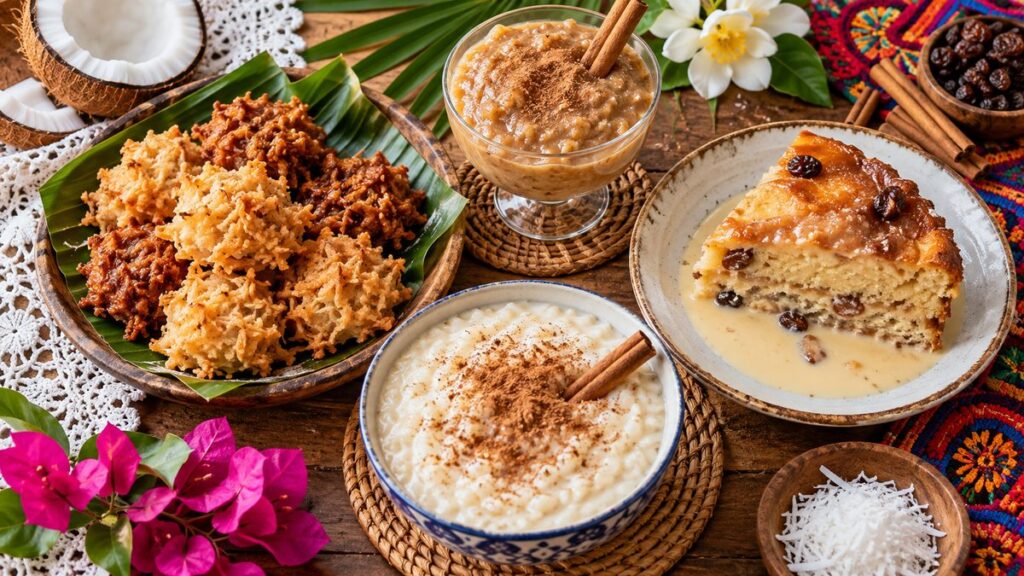
Panamanian sweets are simple and generous: coconut, milk, rice, panela, tropical fruit and, for celebrations, a little rum. Many of them come from home kitchens and street vendors, not bakeries. Here are the desserts I love most, what each one is, and twelve recipes you can make in any US kitchen: cocadas, mamallena, sopa borracha, plátano en tentación, arroz con leche, bolitas de tamarindo, bienmesabe, pesada de nance, raspao, manjar blanco, huevitos de leche and dulce de papaya verde. After the recipes: a comparison table of all 21, what to make first, troubleshooting, a holiday calendar and substitutions.
Classic Panamanian desserts include sopa borracha (rum-soaked cake), mamallena (bread pudding), cocadas (coconut candies), arroz con leche, bienmesabe, pesada de nance, raspao (shaved ice with condensed milk), dulce de papaya verde, cabanga and Panamanian fruit cake at Christmas.
21 Panamanian desserts to know
1. Sopa borracha
The celebration dessert. Its name means “drunken soup,” but it’s sponge cake soaked in a syrup with rum or sweet wine, cinnamon, raisins and prunes. It’s made for weddings, baptisms and the holidays.
2. Mamallena
Panamanian bread pudding made from day-old bread, milk, eggs, sugar, raisins and spices. It’s thrifty, comforting and baked in a pan, then sliced. Recipe below.
3. Cocadas
Small mounds of grated coconut cooked with panela or sugar until sticky, sometimes with ginger. Sold by street vendors and in little bags at the corner store. Recipe below.
4. Arroz con leche
Rice simmered with milk, sugar and cinnamon until creamy. Panamanians eat it warm or cold, often with raisins.
5. Bienmesabe
A thick, sweet cream made with rice (or rice flour), milk and raspadura (panela). The Panamanian version is different from Spain’s or Venezuela’s, and it’s especially linked to Chiriquí.
6. Pesada de nance
A pudding made from nance, a small yellow tropical fruit with a strong, cheesy-sweet smell, cooked with sugar and thickened with cornstarch or flour. Look for frozen nance in Latin markets.
7. Raspao
Shaved ice with fruit syrup and a drizzle of sweetened condensed milk. Raspao carts are everywhere in Panama on hot afternoons.
8. Dulce de papaya verde
Green papaya cooked slowly in syrup with cinnamon and cloves until translucent. Simple and very sweet.
9. Cabanga
A traditional candy of grated coconut and green papaya cooked with panela, usually wrapped in a leaf. It’s associated with Holy Week (Semana Santa).
10. Huevitos de leche
Little milk candies made from milk, sugar and butter, shaped like small eggs.
11. Panamanian fruit cake
A dark, rum-soaked cake full of dried fruit, baked for Christmas. Here’s my Panamanian fruit cake recipe.
12. Chicheme
Technically a drink, but sweet enough to be dessert: hulled corn, milk, sugar and cinnamon. See how to make chicheme.
13. Tres leches
Not invented in Panama, but no Panamanian birthday is complete without it: a sponge cake soaked in evaporated milk, condensed milk and whole milk or cream, topped with whipped cream or meringue and sometimes fruit.
14. Flan
Caramel custard, baked in a water bath. Panamanian cooks often flavor it with vanilla and a little lime zest or cinnamon, and some make it with coconut milk. I also make a keto flan with a sugar-free caramel.
15. Bolitas de tamarindo
Tamarind pulp rolled with sugar into sticky, sour-sweet balls and rolled again in sugar. Two ingredients, and the taste of every Panamanian corner store.
16. Plátano en tentación
Very ripe plantains simmered in butter, brown sugar or raspadura and cinnamon until glossy. It’s served as a side with the Christmas roast, but it’s dessert in every way that matters. Recipe below.
17. Bocado de la reina
A dense bread-and-milk cake, a cousin of mamallena, flavored with cinnamon and sometimes raisins. “The queen’s bite” is what you make when there’s old bread and a crowd coming.
18. Manjar blanco
Milk and sugar cooked slowly until thick and caramel-colored, Panama’s name for what much of Latin America calls dulce de leche. It’s eaten with a spoon, spread on crackers or used to fill cakes.
19. Suspiros and merengues
Crisp baked meringues, sometimes tinted in pastel colors, sold in bags at bakeries and made at home for parties.
20. Orejitas
Crisp, sugary puff-pastry “little ears” (palmiers) from Panamanian bakeries, for coffee time.
21. Duro
The Panamanian frozen treat of childhood: fruit juice or a milky mix frozen in a small plastic bag or cup. You bite off a corner and suck it while it melts. Neighbors sell them from home freezers.
Recipe 1: Panamanian cocadas
Yield: about 20 cocadas · Prep: 10 minutes · Cook: 25 minutes · Total: 35 minutes, plus cooling
Ingredients
- 3 cups (about 250 g) freshly grated coconut, or unsweetened shredded coconut
- 1 cup (200 g) packed grated panela or dark brown sugar
- ¾ cup (180 ml) water
- 1 tsp freshly grated ginger (optional, but very Panamanian)
- 1 cinnamon stick
- Pinch of salt
Instructions
- Line a tray with parchment and lightly oil it.
- In a heavy pan, simmer the panela, water, ginger, cinnamon and salt until the panela dissolves, about 5 minutes.
- Add the coconut. Cook over medium-low heat, stirring often, 15 to 20 minutes, until the mixture is thick, sticky and pulls away from the pan.
- Remove the cinnamon. Drop tablespoons onto the tray and let them cool and firm, about 1 hour.
Storage: Airtight at room temperature for 3 days or in the fridge for 1 week.
Tip: If they don’t hold together, the mixture needed a few more minutes on the heat.
Recipe 2: Mamallena (Panamanian bread pudding)
Yield: one 9×9-inch (23×23 cm) pan, 9 pieces · Prep: 15 minutes, plus 20 minutes soaking · Bake: 50–60 minutes
Ingredients
- 8 cups (about 400 g) day-old white bread, torn into pieces
- 3 cups (720 ml) whole milk
- 1 can (12 oz / 354 ml) evaporated milk
- 3 eggs
- ¾ cup (150 g) sugar
- 4 tbsp (55 g) butter, melted, plus more for the pan
- 1½ tsp vanilla
- 1 tsp ground cinnamon; ¼ tsp nutmeg
- ½ cup (75 g) raisins
- Optional: 2 tbsp rum
Instructions
- Butter the pan. Soak the bread in the milk and evaporated milk for 20 minutes, then mash with a fork.
- Heat the oven to 350°F (175°C).
- Whisk the eggs, sugar, butter, vanilla, cinnamon, nutmeg and rum. Stir into the bread with the raisins.
- Pour into the pan and bake 50 to 60 minutes, until set in the center and golden on top.
- Cool at least 30 minutes before slicing. Serve warm or cold.
Storage: Covered in the fridge for 4 days.
Recipe 3: Sopa borracha (Panamanian rum-soaked cake)
Serves: 12 · Active: 30 minutes · Soak fruit: overnight (or at least 2 hours) · Rest: 4 hours
Sopa borracha is party food, and every family has its own syrup. This is the version I make with a store-bought cake, which is how many Panamanian home cooks do it.
Ingredients
- ½ cup (75 g) pitted prunes, halved, and ½ cup (75 g) raisins
- ¾ cup (180 ml) dark or golden rum, or sweet wine, or a mix
- 1 plain pound cake or sponge cake, about 1 lb (450 g), a day old, cut in 1½-inch (4 cm) cubes
- 2 cups (480 ml) water
- 1½ cups (300 g) sugar
- 2 cinnamon sticks, 6 whole cloves, and a long strip of lime peel
- Optional: colored sprinkles or a few maraschino cherries for decoration, the way bakeries in Panama do
Instructions
- Put the prunes and raisins in a jar with the rum. Soak overnight, or at least 2 hours.
- Make the syrup: simmer the water, sugar, cinnamon, cloves and lime peel for 10 minutes, until slightly thickened. Cool 10 minutes, then remove the spices and peel.
- Strain the rum from the fruit and stir it into the warm syrup.
- Layer the cake cubes in a glass dish (or in individual glasses for a party). Spoon the syrup over each layer, scattering the fruit between them. Use all the syrup; it will look like too much and soak in.
- Cover and refrigerate at least 4 hours, ideally overnight. Serve cold, with the fruit on top.
Storage: 3 days in the fridge. Without alcohol: use the syrup alone with a splash of vanilla and orange juice; it won’t be “borracha,” but kids love it.
Recipe 4: Plátano en tentación
Serves: 4–6 · Total: 30 minutes
- 3 very ripe plantains (the skin should be mostly black), peeled and cut in 1½-inch (4 cm) diagonal pieces
- 3 tbsp (45 g) butter
- ½ cup (100 g) packed brown sugar or grated raspadura
- 1 cinnamon stick and 3 cloves
- ¾ cup (180 ml) water
- Optional: 2 tbsp rum, a pinch of salt
- Melt the butter in a wide skillet over medium heat and brown the plantain pieces lightly, 2 minutes per side.
- Add the sugar, spices, water and salt. Bring to a simmer, lower the heat and cook uncovered 15 to 20 minutes, turning once, until the plantains are soft and the syrup is thick and dark.
- Stir in the rum for the last 2 minutes. Serve warm.
If your plantains are still yellow, they’ll be firmer and less sweet; add a few extra minutes and a little more water.
Recipe 5: Panamanian arroz con leche
Serves: 6 · Total: 45 minutes
- 1 cup (200 g) short- or medium-grain white rice
- 3 cups (720 ml) water, 1 cinnamon stick, a strip of lime peel and a pinch of salt
- 1 can (12 oz / 354 ml) evaporated milk and 1 can (14 oz / 397 g) sweetened condensed milk
- 1 cup (240 ml) whole milk (or coconut milk for a Caribbean version)
- ½ cup (75 g) raisins, 1 tsp vanilla, ground cinnamon for the top
- Simmer the rice in the water with the cinnamon, peel and salt until the water is almost absorbed, about 18 minutes.
- Add the three milks and raisins. Cook over low heat, stirring often, 15 to 20 minutes, until creamy and thick.
- Remove the cinnamon and peel, stir in vanilla, and dust with cinnamon. It thickens as it cools; loosen leftovers with milk.
Recipe 6: Bolitas de tamarindo
Makes: about 20 · Total: 20 minutes, plus drying
- 7 oz (200 g) seedless tamarind pulp (sold in blocks at Latin and Asian markets)
- About 1½ cups (300 g) sugar, plus more for rolling
- Break up the pulp, pick out any seeds or fibers, and knead in the sugar a little at a time until you have a firm, sticky dough that holds a ball.
- Roll into 1-inch (2.5 cm) balls and roll each in sugar.
- Let them dry on a tray for a few hours. Keep in a jar for weeks.
Want heat? Panamanian kids love a pinch of chile powder in the rolling sugar.
Recipe 7: Bienmesabe panameño (rice and panela cream)
Serves: 6 · Total: 1 hour
- ½ cup (100 g) white rice, soaked 30 minutes and drained (or ⅓ cup rice flour)
- 2 cups (480 ml) water and 4 cups (960 ml) whole milk
- 8 oz (225 g) panela or raspadura, grated (or 1 cup dark brown sugar)
- 1 cinnamon stick, 4 cloves, a pinch of salt
- Blend the soaked rice with 1 cup of the water until very fine. (With rice flour, just whisk it into the water.)
- In a heavy pot, simmer the rest of the water with the panela, cinnamon, cloves and salt until the panela melts.
- Add the milk and the rice mixture. Cook over low heat, stirring constantly with a wooden spoon, 35 to 45 minutes, until it’s thick enough to leave a trail on the bottom of the pot and turns a deep caramel color.
- Remove the spices. Pour into small bowls and serve warm or cold, with ground cinnamon on top.
Tip: it catches easily. A heavy pot, low heat and a spoon that scrapes the corners are not optional.
Panamanian vs. other bienmesabes: the name (“tastes good to me”) is shared across the Spanish-speaking world, but the desserts are different. Panama’s is a rice-and-panela cream; Venezuela’s is a coconut cream layered with cake; Spain’s Antequera version is almond-based.
Recipe 8: Pesada de nance
Serves: 6 · Total: 40 minutes, plus chilling
- 1 lb (450 g) frozen or fresh nance
- 4 cups (960 ml) water
- ¾ to 1 cup (150–200 g) sugar, to taste
- ¼ cup (30 g) cornstarch dissolved in ½ cup cold water
- 1 cinnamon stick and a pinch of salt
- Simmer the nance in the water for 15 minutes, until very soft. Mash, then press through a sieve to remove the pits and skins. You should have about 4 cups of thin pulp.
- Return to the pot with the sugar, cinnamon and salt and bring to a simmer.
- Stir in the cornstarch mixture and cook, stirring, 5 to 8 minutes until thick and glossy.
- Pour into a dish or cups and chill until set, about 3 hours. Serve with ground cinnamon.
Some cooks thicken with flour or with masa instead of cornstarch, which gives a heavier, more “pesada” (heavy) texture; that’s where the name comes from.
Recipe 9: Raspao at home, with homemade syrup
Serves: 4
- Fruit syrup: 1 cup (240 ml) fruit juice or pulp (tamarind, passion fruit, strawberry, pineapple, guava), 1 cup (200 g) sugar. Simmer 5 minutes until slightly thick; cool.
- Ice: 6 cups of ice, shaved in an ice shaver, or pulsed in a strong blender in batches until fluffy, like snow.
- To finish: sweetened condensed milk and, if you want it like the carts, a spoonful of powdered milk on top.
Pack the ice into cups, pour on the syrup, then drizzle the condensed milk. Eat it fast.
Recipe 10: Manjar blanco
Makes: about 1½ cups · Total: 1½ to 2 hours (mostly stirring)
- 8 cups (2 L) whole milk
- 2 cups (400 g) sugar
- ¼ tsp baking soda (keeps the milk from curdling and helps it brown)
- 1 cinnamon stick and 1 tsp vanilla
- In a wide, heavy pot, bring the milk, sugar, baking soda and cinnamon to a simmer, stirring to dissolve the sugar.
- Simmer uncovered over medium-low heat, stirring every few minutes at first and constantly near the end, until it has reduced to a thick, light caramel-colored paste, 1½ to 2 hours.
- Stir in the vanilla and remove the cinnamon. It thickens as it cools.
Shortcut: simmer a can of sweetened condensed milk, opened and poured into a heavy pan, over low heat, stirring constantly, 25 to 35 minutes. Storage: in a jar in the fridge for 2 weeks.
Recipe 11: Huevitos de leche
Makes: about 25 · Total: 20 minutes, plus drying
- 2 cups (about 250 g) powdered whole milk, plus more as needed
- 1 can (14 oz / 397 g) sweetened condensed milk
- 1 tbsp butter, softened
- Sugar, for rolling
- Mix the powdered milk, condensed milk and butter into a soft dough that doesn’t stick to your hands; add powdered milk a spoonful at a time if it’s sticky.
- Pinch off pieces and roll into small egg shapes, about the size of a quail egg.
- Roll in sugar and let them dry on a tray for a few hours. Store airtight for a week.
This is the no-cook home version; traditional huevitos are cooked from fresh milk and sugar until they hold a shape.
Recipe 12: Dulce de papaya verde
Serves: 8 · Total: 1½ hours
- 1 green (unripe) papaya, about 2 lb (900 g), peeled, seeded and cut into thin strips
- 1 tbsp baking soda (for soaking)
- 2 cups (400 g) sugar or grated panela
- 2 cups (480 ml) water
- 2 cinnamon sticks and 6 cloves
- Soak the papaya strips in water with the baking soda for 30 minutes, then rinse well. This firms the strips so they hold their shape.
- Simmer the sugar, water and spices until the sugar dissolves. Add the papaya.
- Cook over low heat, uncovered, 45 to 60 minutes until the papaya is translucent and the syrup is thick.
- Cool and store in jars in the fridge for 2 weeks. Serve as is, or with fresh white cheese, a classic pairing.
All 21 desserts compared
| Dessert | Main ingredients | Texture | Difficulty | Make ahead? | Season |
|---|---|---|---|---|---|
| Sopa borracha | Cake, rum syrup, prunes | Soft, soaked | Easy | Yes, 1 day | Weddings, holidays |
| Mamallena | Bread, milk, eggs | Dense pudding | Easy | Yes, 4 days | Year-round |
| Cocadas | Coconut, panela | Chewy | Easy | Yes, 1 week | Year-round |
| Arroz con leche | Rice, milks | Creamy | Easy | Yes, 3 days | Year-round |
| Bienmesabe | Rice, milk, panela | Thick cream | Medium (stirring) | Yes, 3 days | Year-round, Chiriquí |
| Pesada de nance | Nance, cornstarch | Set pudding | Easy | Yes, 3 days | Nance season, or frozen |
| Raspao | Ice, syrup, condensed milk | Icy | Easy | Syrup only | Hot afternoons |
| Dulce de papaya verde | Green papaya, syrup | Candied | Medium | Yes, 2 weeks | Holy Week, year-round |
| Cabanga | Coconut, green papaya, panela | Chewy candy | Medium | Yes | Holy Week |
| Huevitos de leche | Milk, sugar | Fudgy | Easy | Yes, 1 week | Year-round |
| Fruit cake | Dried fruit, rum | Dense cake | Project | Yes, weeks | Christmas |
| Chicheme | Corn, milk | Drink | Medium | Yes, 2 days | Year-round |
| Tres leches | Sponge, three milks | Soaked cake | Medium | Yes, 1 day | Birthdays |
| Flan | Eggs, milk, caramel | Silky | Medium | Yes, 4 days | Year-round |
| Bolitas de tamarindo | Tamarind, sugar | Sticky | Easy | Yes, weeks | Year-round |
| Plátano en tentación | Ripe plantain, sugar | Soft, glossy | Easy | Reheats well | Christmas, Sundays |
| Bocado de la reina | Bread, milk | Dense cake | Easy | Yes, 4 days | Year-round |
| Manjar blanco | Milk, sugar | Thick paste | Medium (time) | Yes, 2 weeks | Year-round |
| Suspiros/merengues | Egg whites, sugar | Crisp | Medium | Yes, 1 week dry | Parties |
| Orejitas | Puff pastry, sugar | Flaky | Easy (store pastry) | Yes, 3 days | Coffee time |
| Duro | Juice or milk mix | Frozen | Easy | Yes, weeks | Hot days |
Which Panamanian dessert should you make first?
| If you… | Make | Why |
|---|---|---|
| Have 30 minutes and a pantry | Plátano en tentación or cocadas | Few ingredients, fast |
| Need a party dessert for 12 | Sopa borracha | Store-bought cake, made a day ahead |
| Have day-old bread | Mamallena | Uses it up |
| Want a kids’ project | Bolitas de tamarindo or huevitos de leche | No cooking, lots of rolling |
| Are homesick | Bienmesabe or arroz con leche | The taste of a Panamanian kitchen |
| Have a hot day | Raspao or duros | No oven |
| Are planning Christmas | Fruit cake | Needs weeks of soaking |
Panamanian dessert troubleshooting
- Cocadas won’t hold together: undercooked. Return to the pan for 3 to 5 more minutes until the mixture pulls away from the sides.
- Cocadas hard as rock: overcooked sugar. Next time take them off sooner; this batch softens a little in an airtight jar.
- Bienmesabe or manjar blanco tastes burnt: the bottom scorched. Don’t scrape the bottom into the bowl; pour off the top into a clean pot and lower the heat.
- Arroz con leche too thick the next day: stir in warm milk a splash at a time.
- Mamallena soggy in the middle: not baked long enough. The center should barely jiggle; give it 10 more minutes.
- Sopa borracha dry: not enough syrup or not enough rest time. Spoon over more syrup and give it 4 hours.
- Flan full of holes: the oven was too hot or the water bath too shallow. Bake at 325°F (165°C) with water halfway up the mold.
- Pesada de nance runny: not cooked long enough after adding the cornstarch. It must boil gently for a few minutes to thicken.
Panamanian desserts through the year
| When | What’s on the table |
|---|---|
| Carnaval (four days before Ash Wednesday; Feb 6–9, 2027) | Raspao, duros, cocadas from street vendors |
| Holy Week (Semana Santa; Mar 21–28, 2027) | Cabanga, dulce de papaya verde, coconut sweets |
| November patriotic holidays (Nov 3, 4, 5, 10 and 28) | Party desserts at family gatherings: tres leches, sopa borracha |
| Christmas and New Year’s | Fruit cake, sopa borracha, plátano en tentación, rosca de huevo |
| Birthdays and baptisms | Tres leches, flan, sopa borracha |
Substitutions for cooks outside Panama
| Panamanian ingredient | Substitute |
|---|---|
| Raspadura or panela | Piloncillo, or dark brown sugar plus 1 tsp molasses per cup |
| Fresh grated coconut | Frozen grated coconut (best), or unsweetened shredded coconut soaked 10 minutes in warm water |
| Nance | Frozen nance from Latin markets; there’s no real substitute for the flavor |
| Green papaya | Asian markets sell it for green papaya salad |
| Panamanian rum | Any dark or golden rum |
| Bijao leaves (for wrapping) | Banana leaves or parchment |
Panamanian desserts by occasion
| Occasion | Desserts you’ll see |
|---|---|
| Weddings, quinceañeras, baptisms | Sopa borracha, tres leches, wedding cake with manjar blanco |
| Birthdays | Tres leches, flan |
| Christmas and New Year’s | Fruit cake, rosca de huevo, plátano en tentación, sopa borracha, merengues |
| Holy Week | Cabanga, dulce de papaya verde, sweets made with coconut and fruit |
| Everyday, street and corner store | Cocadas, bolitas de tamarindo, huevitos de leche, raspao, duro |
| Sunday at home | Arroz con leche, mamallena, flan |
A word about the names
Panamanian sweets have some of the best names in Spanish. Sopa borracha is “drunken soup” because the cake drinks rum syrup. Cabanga, the coconut and papaya candy, is also the Panamanian word for heartache and homesick longing, which is exactly what I feel when I see it in a photo. Huevitos de leche started in Chiriquí, where they were once called huevitos de faltriquera, after the cloth pouch people carried them in.
Where to find Panamanian dessert ingredients in the US
- Panela/raspadura: Latin markets, sold as panela or piloncillo (piloncillo is the Mexican cone; it works).
- Fresh coconut: most Latin and Asian markets. Frozen grated coconut is a great shortcut.
- Frozen nance: Latin markets with Central American products.
- Evaporated and condensed milk: every supermarket.
- Tamarind pulp: in blocks at Latin, Indian and Asian markets.
- Very ripe plantains: buy them yellow and let them go black on the counter for 5 to 7 days.
Five dessert recipe cards: timing, yield and troubleshooting
The recipes above are kept in this guide so you can compare the desserts without opening five competing versions. Here are the practical finishing details for each one.
Sopa borracha: the soak is part of the recipe
Yield: 12 servings. Active time: about 30 minutes. Advance time: at least 2 hours to soak the fruit, plus 4 hours to chill the assembled dessert; overnight fruit soaking and overnight chilling give a more relaxed schedule.
Use a plain cake with enough structure to absorb syrup without becoming paste. Add the syrup gradually across the layers, then give it time to absorb before deciding the top is dry. Different cakes absorb differently, so the desired result is thoroughly moist cake with syrup distributed through it, not cubes floating in a deep pool. If using an especially soft commercial cake, reserve a little syrup at first and check after resting.
Can it be alcohol-free? Yes: use the nonalcoholic option above and label it clearly. The standard rum version contains alcohol; adding rum to warm syrup does not make it alcohol-free. How long does it keep? Keep covered in the refrigerator and use within three days. Can I serve it in cups? Yes; divide cake, fruit and syrup evenly, then chill the cups on a tray.
Plátano en tentación: ripe fruit, gentle syrup
Yield: 4–6 servings. Prep: about 10 minutes. Cook: about 20 minutes. Total: about 30 minutes, adjusting for the ripeness of the fruit.
Choose very ripe plantains with plenty of black on the peel and flesh that gives slightly without being spoiled. Green fruit will not turn into the same soft, sweet dessert simply by adding more sugar. Keep the simmer gentle and turn pieces carefully so they remain recognizable rather than dissolving into the syrup.
Why did the sugar burn? The pan may have dried out or the heat may have been too high. Add small amounts of hot water before the syrup catches, not after it has turned bitter. Can I skip the rum? Yes; it is optional, and a brief simmer does not guarantee all alcohol disappears. Can I make it ahead? Refrigerate promptly and use within 3–4 days; reheat a portion gently with a spoonful of water until it reaches 165°F throughout.
For the difference between simple fried ripe plantains and green plantains, see maduros vs tostones.
Panamanian arroz con leche: stop while it is still loose
Yield: 6 servings. Prep: about 5 minutes. Cook: about 40 minutes. Total: about 45 minutes.
Cook the rice in water before adding the rich milks. Once the dairy is in, use low heat and stir across the bottom. Stop when the pudding is creamy but a little looser than you want to serve: rice continues absorbing liquid as it rests and chills.
Why is my rice hard but the pudding thick? The rice may not have softened sufficiently in the water stage. Add a little liquid and continue gently rather than turning up the heat under thick dairy. Can I leave out raisins? Yes. Why is it solid the next day? That is usually continued absorption; loosen a serving with milk while reheating gently.
Refrigerate in shallow containers within two hours, or one hour above 90°F, and use within 3–4 days. Rice pudding is not safe to leave out overnight just because it is sweet. Reheated leftovers should reach 165°F throughout.
Pesada de nance: remove every pit before thickening
Yield: 6 servings. Prep: about 10 minutes. Cook and straining: about 30 minutes. Chill: about 3 hours. Total: roughly 3 hours 40 minutes, with most of that chilling.
Strain the softened fruit carefully so the finished pulp has no pits or hard fragments. Re-measure the strained liquid: the recipe assumes about four cups before thickening. A much smaller or larger amount changes how firmly the cornstarch sets.
Why is it lumpy? The starch may have been added dry, or the slurry may have settled before pouring. Stir the cold-water slurry again immediately before adding it, and whisk as it goes into the hot pulp. Can I use jarred nance? Check whether it is packed in syrup, brine or alcohol; those are not interchangeable with plain fruit. Adjust sweetness thoughtfully and label alcohol-containing ingredients. How should I store it? Cover, refrigerate promptly and use within 3–4 days. Freezing can change a starch-thickened pudding’s texture.
Raspao: make the syrup ahead, shave the ice last
Yield: 4 servings. Prep and syrup cooking: about 10 minutes. Cooling: allow the syrup to become fully cold before use. Assembly: about 5 minutes immediately before eating.
A blender should be rated for crushing ice; do not force ice through a machine whose instructions prohibit it. Work in small batches, pulse, and stop before friction turns the result into watery slush. A proper ice shaver gives a lighter texture, but you can still make a pleasant home version with suitable equipment.
Why does it melt instantly? Warm syrup is usually the first thing to check. Chill the syrup and cups, and assemble only when everyone is ready. Can I make it dairy-free? Leave off condensed and powdered milk and check the syrup ingredients. Can I save assembled raspao? It is best eaten immediately; frozen assembled cups become much harder than fresh shaved ice. Store the syrup separately, covered in the refrigerator, and use a small fresh batch within a week or freeze it for later.
FAQ
What is the most popular dessert in Panama?
For parties, sopa borracha and tres leches. For every day, cocadas, arroz con leche and raspao.
Is tres leches Panamanian?
It’s eaten everywhere in Panama, especially at birthdays, but it’s shared across Latin America and its origin is usually credited to Nicaragua or Mexico.
What is a raspao?
Shaved ice with fruit syrup and sweetened condensed milk, sold from carts. At home, shave ice in a blender or ice shaver, pour on fruit syrup and finish with condensed milk.
Which Panamanian desserts have no alcohol?
All of them except sopa borracha and some fruit cakes: cocadas, arroz con leche, mamallena, flan, tres leches, bienmesabe and raspao are alcohol-free.
Which Panamanian desserts are gluten-free?
Cocadas, arroz con leche, flan, bienmesabe, bolitas de tamarindo, manjar blanco, meringues, plátano en tentación and raspao are made without wheat. Check packaged ingredients.
What is nance?
A small, round yellow fruit (Byrsonima crassifolia) with a strong, sweet, slightly cheesy smell. In Panama it’s eaten fresh, in pesada, in chicha (juice) and preserved in rum or syrup. In the U.S. look for it frozen in Latin markets.
What is raspadura?
Unrefined cane sugar boiled down and set in blocks, Panama’s everyday sweetener for bienmesabe, cocadas and coffee. Panela and piloncillo are close cousins.
How long do Panamanian desserts keep?
Candies like cocadas, bolitas de tamarindo and dulce de papaya keep 1 to 2 weeks; puddings and soaked cakes 3 to 4 days in the fridge; raspao has to be eaten right away.
Can I make Panamanian desserts dairy-free?
Cocadas, bolitas de tamarindo, dulce de papaya verde and pesada de nance are already dairy-free. Arroz con leche works with coconut milk.
What is the national dessert of Panama?
Panama doesn’t have one official national dessert, but sopa borracha is the classic for celebrations.
What Panamanian dessert is made with coconut?
Cocadas and cabanga. Coconut is also common in rice puddings.
What dessert is eaten at Panamanian Christmas?
Panamanian fruit cake and sopa borracha. See my Panamanian Christmas food guide.
More from the Panamanian kitchen
Affiliate disclosure: Some links in this section are affiliate links. If you buy through them, I may earn a commission. As an Amazon Associate I earn from qualifying purchases.
Find savory dishes, drinks and holiday food in my guide to Panamanian food. My cookbook, Ultimate Cookbook of Panama: Secrets of the Tropical Kitchen by MarGo, has more of my Panamanian home cooking.
As an Amazon Associate I earn from qualifying purchases.
¡Buen provecho!