
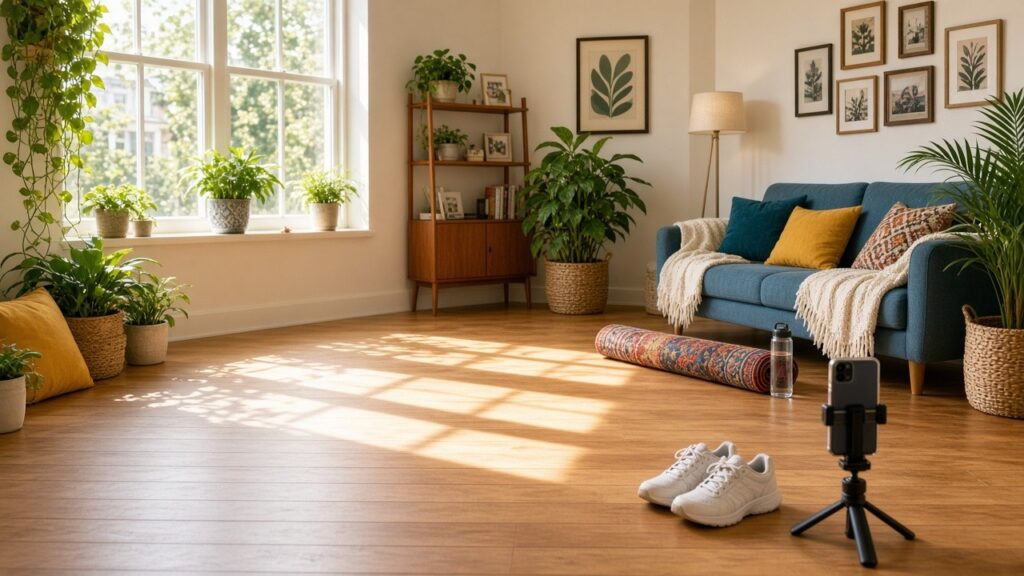
You don’t need a studio, a mirror wall or a big empty room to get better at dancing. Most of my progress between classes has happened in a small apartment, with the coffee table pushed aside and my phone propped against a stack of books. What you need is a plan, a safe patch of floor and a way to see yourself.
To practice dance at home, clear a space of about 6 by 6 feet with a smooth, non-slip floor, wear shoes suited to the style and the surface, use your phone camera or a dark window as a mirror, and follow a short routine: 5 minutes of warm-up, 10 minutes drilling specific steps or a combination slowly then at tempo, and 5 minutes of freestyle to music. Twenty minutes, three or four times a week, adds up faster than one long session.
I practice in my apartment across several styles, from salsa and bachata to Zumba and tap. Here’s how to set up a small space, practice without a mirror, a 20-minute routine, drilling vs freestyle, using online classes and slowed-down videos, practicing partner dances alone and tracking progress.
How to practice dance at home: the plan
- Choose one or two goals per week, such as a cleaner salsa basic, a new Zumba routine or a tap shuffle.
- Schedule short sessions: 15 to 30 minutes, three to five times a week.
- Warm up every time.
- Drill slowly, then build speed.
- Film yourself at least once a week.
- Freestyle at the end so practice stays fun.
- Bring questions to your next class.
Set up a small space
How much space do you need?
| Style | Minimum space | Notes |
|---|---|---|
| Zumba, cardio dance | About 6 × 6 feet | Room for side steps and arm movement |
| Salsa, bachata, merengue (solo) | About 5 × 6 feet | Basics and turns in place |
| Hip-hop | About 6 × 6 feet | Grooves and footwork; jumps need ceiling height |
| Ballet barre work | A chair or counter plus a 4-foot strip | A barre exercise doesn’t travel much |
| Tap | About 4 × 4 feet with a tap board | Protect floors and neighbors |
| Belly dance | About 4 × 5 feet | Isolations need little space |
Check ceiling height for jumps and arm extensions, and look for sharp corners, lamps and rugs that might slide.
Floor
What floor works for dancing at home?
- Best: wood, laminate or vinyl that’s smooth but not slippery.
- Good: a large piece of plywood or a portable dance floor tile over carpet.
- Avoid: thick carpet for turns (it grips your feet and twists knees), tile or concrete for jumping (hard on joints), and rugs that slide.
For tap, use a tap board or a sheet of plywood to protect floors and reduce noise. My guide to teaching yourself tap dance covers tap boards in detail.
Shoes
Wear what you’d wear in class: dance sneakers for Zumba and hip-hop, suede-soled shoes for salsa turns on smooth floors, ballet slippers for barre, tap shoes on a board. Socks on hardwood can be slippery; be careful with turns.
Noise
If you live in an apartment, be kind to neighbors:
- Practice jumps and tap at reasonable hours.
- Use a mat or board to absorb impact.
- Use headphones if music carries.
- Choose low-impact versions of high-impact moves.
Practicing without a mirror
You don’t need a mirror wall to see yourself.
- Phone video: prop your phone at hip height, about 8 to 10 feet away, and record. This is the best tool because you can watch from the front, like a teacher would.
- Window reflection: at night, a dark window with the room lights on works like a mirror.
- Glass doors or an oven door: small, but useful for checking posture.
- A full-length mirror: an inexpensive door mirror is a great investment.
- Video calls: practice in front of a friend or teacher on a call.
Mirrors are useful, but also practice without one. In class and at socials, you won’t be watching yourself; you’ll be feeling the movement.
A 20-minute home practice routine
| Time | What to do | Why |
|---|---|---|
| 0 to 5 min | Warm-up: march, joint circles, leg swings, a slow basic | Prepares your body; see my 10-minute warm-up |
| 5 to 10 min | Drill one step slowly, counting out loud | Builds clean technique |
| 10 to 15 min | Drill a short combination at half speed, then full speed | Builds memory and stamina |
| 15 to 18 min | Freestyle to one song using what you practiced | Musicality and fun |
| 18 to 20 min | Cool down and stretch gently | Recovery |
Film one round of the combination every session or once a week.
Drilling choreography vs freestyle
Drilling means repeating a step or combination until it’s automatic. It builds technique and memory. Drill when you’re learning something new or fixing a problem.
Freestyle means dancing to music without a plan. It builds musicality, confidence and your own style. Freestyle when you want to apply what you’ve learned.
Both matter. A good rule: spend about two-thirds of your time drilling and one-third freestyling. For remembering routines, see how to memorize Zumba choreography.
How to drill effectively
- Break it down into 4- or 8-count chunks.
- Learn the feet first, then add arms.
- Count out loud.
- Practice without music, then with slow music, then at tempo.
- Repeat 5 to 10 times in a row, then rest.
- Mirror both sides if the move has a left and right.
Using online classes and slowed-down videos
Online classes are one of the best tools for home practice. See are online dance classes worth it for a full comparison.
How to learn a dance from a video
- Watch it fully once without dancing.
- Slow it down. Most video players let you change playback speed to 0.5 or 0.75.
- Mirror mode: if the instructor faces you, their right is your left. Some apps offer a mirrored view.
- Loop short sections.
- Learn the counts. Pause and count the steps.
- Add arms and styling last.
- Film yourself and compare side by side.
Practicing partner dances alone
You can’t practice connection alone, but you can practice almost everything else.
- Basics and footwork: salsa, bachata and merengue basics to music.
- Turns: spotting and single turns. See how to spin in salsa.
- Shines: solo footwork patterns.
- Styling: arm lines, body movement and hip motion. See salsa ladies styling.
- Frame: practice holding your arms in a light frame while doing your basic.
- Leading or following imagination: move as if your partner were leading, for example stopping your basic for a turn prep.
For a full solo routine, see learn salsa without a partner.
Tracking progress
- Weekly video: film the same combination every week and compare.
- Practice log: a notes app with date, time and what you practiced.
- Checklist: list steps you’re learning and mark them “learning,” “comfortable” and “automatic.”
- Ask your teacher: show them your notes or video for feedback.
Progress at home can feel slow day to day, but weekly videos make it visible. For more strategies, see how to get better at dancing.
Style-by-style home practice tips
| Style | What to practice at home | Tip |
|---|---|---|
| Zumba | The four basic rhythms, then full songs | Follow along with routines at half effort first, then full |
| Salsa | Basic, side basic, turns, shines | Practice to slow songs, then faster ones |
| Bachata | Basic with tap, hip motion, body waves | Bend your knees; hips follow |
| Ballet | Barre exercises with a chair or counter, balance | Work slowly; focus on alignment, not height |
| Tap | Shuffles, flaps, ball changes on a board | Practice with a metronome |
| Hip-hop | Bounce, rock, basic grooves | Groove to a beat for a full song before adding steps |
| Belly dance | Hip drops, figure eights, shimmies | Short sets; isolations tire you quickly |
If you’re just starting, my guides to Zumba for beginners, hip-hop dance for beginners and belly dance for beginners give you steps to drill.
Staying motivated
- Put it on your calendar like a class.
- Keep shoes and a playlist ready so starting takes seconds.
- Set a tiny minimum: even 10 minutes counts on a busy day.
- Practice with a friend on a video call.
- Celebrate small wins: a clean turn, a combination remembered, a song danced start to finish.
- Change the music when practice feels stale.
Home practice mistakes
| Mistake | Fix |
|---|---|
| Practicing only what you already know | Spend most of your time on a new or difficult step |
| Never filming | Film once a week |
| Practicing too long, too rarely | Short, frequent sessions |
| Skipping the warm-up | Always 3 to 5 minutes |
| Dancing on a slippery or carpeted floor | Use a board or a better surface |
| Watching the mirror the whole time | Alternate mirror and no mirror |
How long should I practice each day?
Fifteen to thirty minutes is plenty for most adults. Three or four sessions a week will improve your dancing noticeably over a month. If you have more time, two short sessions in a day beat one long tiring one.
A sample week of home practice
| Day | Focus |
|---|---|
| Monday | Basics and footwork (20 min) |
| Tuesday | Rest or class |
| Wednesday | Turns and spotting (20 min) |
| Thursday | Combination from class (20 min) |
| Friday | Rest or social |
| Weekend | Freestyle and styling (20 to 30 min) |
FAQ
How much space do I need to practice at home?
About 6 by 6 feet is enough for most styles, and less for barre work, tap or isolations. Check ceiling height before jumping and clear sharp corners.
What floor works for dancing at home?
Smooth wood, laminate or vinyl works best. Avoid thick carpet for turns and hard tile or concrete for jumps. A plywood board or portable dance tile is a great solution, especially for tap.
How do I practice without a mirror?
Film yourself with your phone at hip height, use a dark window as a reflection at night, or buy an inexpensive full-length door mirror. Also practice without looking, to build the feel of the movement.
How long should I practice each day?
Fifteen to thirty minutes, three to five times a week, is enough to see steady progress. Short, frequent sessions are better than one long session.
How do I learn a dance from a video?
Watch it once, then slow it down, loop short sections, learn the counts, learn the feet before the arms and film yourself to compare. Use mirror mode if the instructor faces you.
Can I practice dance at home if I’m a complete beginner?
Yes. Start with one basic step from a beginner video or your first class, practice it slowly to one song, and add a new step each week. Home practice is how many adults build confidence before walking into a class.
Is it bad to practice on carpet?
Low-pile carpet is fine for gentle steps and isolations, but thick carpet grips your feet during turns and pivots, which can twist your knees. Put a board or dance tile down, or save turns for a smooth floor.