
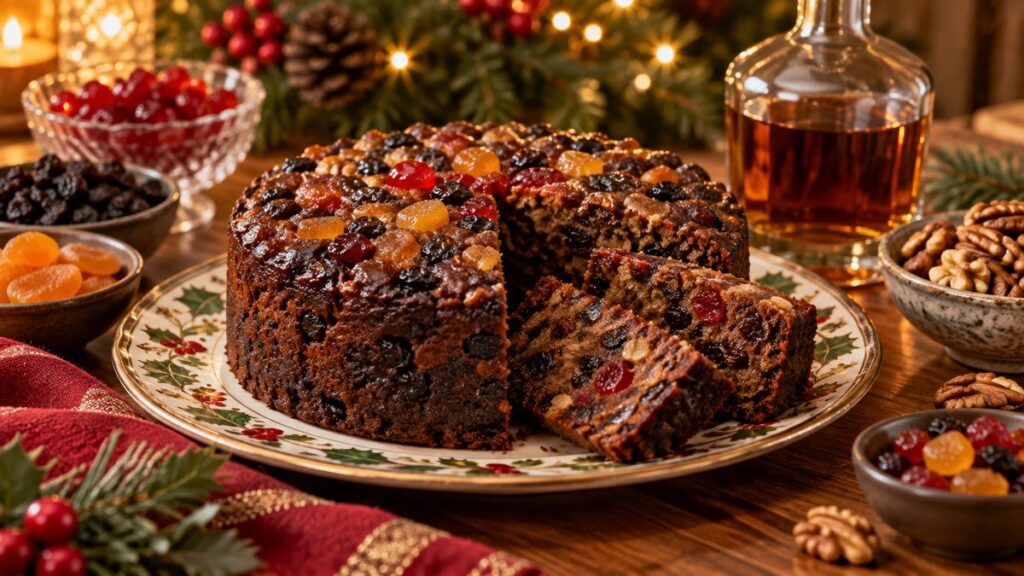
In Panama, Christmas cake season starts long before Christmas. Jars of dried fruit sit soaking in rum for weeks, and when the cakes finally bake, the whole house smells like cinnamon, brown sugar and rum. This is my Panamanian-style fruit cake, dark, moist and nothing like the dry, neon fruitcake jokes in the US.
Panamanian fruit cake is a dark, moist Christmas cake made with raisins, prunes, cherries and candied fruit soaked in rum, a batter of butter, brown sugar, molasses and warm spices, baked low and slow, then brushed with more rum for days or weeks before Christmas.
Dulce de frutas: Panama’s Christmas cake
In Panama we call it dulce de frutas, or cake or pastel de frutas, and it’s the king of the Christmas sweets. When La Prensa asked its readers in 2015, 90% said dulce de frutas rules the holiday table in their homes; the rest chose pineapple upside-down cake (volteado de piña), almond cake and others. Panamanian pastry chefs describe it as the cake you “sing happy birthday to Baby Jesus” with, a cake that stands for prosperity and the sweetness of a new season.
It came to Panama with foreigners and has been passed down and changed from generation to generation, so every family has its version: ground fruit or whole fruit, lots of raisins or extra nuts, with rum or without. Some bakers in Panama marinate their fruit in wine or rum for a whole year. Many families bake it at home; others order one from a home baker or buy a less expensive one at the supermarket, where the Christmas fruit cakes and butter cookies in tins appear by November.
It’s usually eaten on its own, or with hot chocolate, tea, a glass of ron ponche or wine after the Christmas dinner, and often saved for December 25.
What makes Panamanian fruit cake different?
The Christmas fruit cake of Panama has roots in both the Spanish and the British Caribbean baking traditions, and it’s a cousin of the Caribbean “black cake.” Compared with the US fruitcake:
- It’s dark and moist, not pale and dry, thanks to brown sugar, molasses and lots of rum.
- The fruit is soaked first, for days or weeks, so it’s plump and boozy.
- It’s “fed” with rum after baking and keeps for weeks.
- It’s eaten in thin slices, with coffee or a glass of ron ponche at Christmas.
Every family has its own blend of fruit and its own soaking time. Some use sweet wine as well as rum; some grind part of the fruit into a paste for an even darker crumb.
Ingredients
Makes one 9-inch round cake or two 8 x 4-inch loaves (about 20 thin slices).
Soaked fruit
- 1 cup (150 g) dark raisins
- 1 cup (150 g) golden raisins
- 1 cup (170 g) pitted prunes, chopped
- ½ cup (80 g) dried cherries or candied red cherries, halved
- 1 cup (180 g) mixed candied fruit (citrus peel and fruit mix)
- 1 cup (240 ml) dark rum, plus about ½ cup more for feeding
Cake
- 1 cup (225 g) unsalted butter, softened
- 1 cup (200 g) packed dark brown sugar
- 4 large eggs, room temperature
- ¼ cup (85 g) molasses
- 1 tsp vanilla extract
- Zest of 1 orange
- 2 cups (250 g) all-purpose flour
- 1 tsp baking powder
- ½ tsp baking soda
- ½ tsp salt
- 2 tsp ground cinnamon
- 1 tsp ground nutmeg
- ½ tsp ground allspice
- ¼ tsp ground cloves
- 1 cup (115 g) chopped walnuts or pecans (optional)
How to make Panamanian fruit cake
1. Soak the fruit (2 days to 4 weeks ahead)
Put all the dried and candied fruit in a clean glass jar. Pour in the rum, close it and shake. Leave it in a cool, dark place, shaking it every few days. Two days is the minimum; two to four weeks is better. The fruit drinks the rum and turns soft and glossy.
2. Prepare the pan and oven
Heat the oven to 300°F (150°C). Grease a 9-inch round pan (3 inches deep) or two loaf pans and line them with parchment, letting it come up the sides. A low oven and a lined pan keep the outside from burning during the long bake.
3. Make the batter
- Beat the butter and brown sugar until light and fluffy, 3 to 4 minutes.
- Beat in the eggs one at a time, then the molasses, vanilla and orange zest.
- Whisk the flour, baking powder, baking soda, salt and spices in another bowl.
- Add the dry ingredients to the butter mixture in two parts, mixing just until combined.
- Fold in the soaked fruit with any rum left in the jar, and the nuts.
The batter will be thick and very full of fruit.
4. Bake low and slow
Spread the batter in the pan and smooth the top. Bake about 1 hour 45 minutes to 2 hours for a 9-inch round (about 1¼ to 1½ hours for loaves), until a skewer in the center comes out clean or with a few moist crumbs. If the top darkens too fast, cover it loosely with foil.
5. Feed it
While the cake is still warm, poke holes all over the top with a skewer and brush on 3 to 4 tablespoons of rum. Let it cool completely in the pan.
6. Wrap and age
Wrap the cake in parchment, then foil, and store it in a tin in a cool place. Brush it with 1 to 2 tablespoons of rum every 4 to 7 days until Christmas. The flavor gets deeper every week.
When to make it
| If you start… | The cake will be… |
|---|---|
| Early November | Deep, mellow and perfect by Christmas (best) |
| Early December | Moist and flavorful |
| A few days before | Still delicious, just younger and lighter |
Fruit cake troubleshooting
- Why is my fruit cake dry? Overbaked, not fed, or wrapped loosely. Bake only until a skewer comes out with moist crumbs, feed it while warm, and wrap it tightly. A dry cake can be rescued: poke it and feed it 2 tablespoons of rum (or orange juice for the alcohol-free version) twice a week.
- Why is the outside burnt and the inside raw? The oven was too hot. Fruit cake needs 300°F (150°C) or lower, a lined pan, and foil on top for the last hour.
- Why did it sink in the middle? Underbaked, or too much baking powder. Check the center with a skewer, not just the edges.
- Why is it crumbly when I slice it? It was cut warm or too fresh. Let it rest at least a day, and slice with a serrated knife dipped in hot water.
- Why does it taste bitter? Too much molasses or cloves, or burnt edges. Trim the edges and reduce the molasses next time.
- Can I fix a cake that tastes too boozy? Let it rest unwrapped for a few hours; the alcohol smell eases. Next time, feed with less rum.
Variations
- Ground-fruit style (dark and smooth): blend half the soaked fruit into a paste before adding it to the batter.
- Whole-fruit style (bright and chunky): keep all the fruit whole, with more cherries and candied fruit for color.
- With wine: replace a third of the rum with sweet red wine or port.
- Extra nuts: use 2 cups of walnuts, pecans or almonds and slightly less raisins.
- Mini loaves or cupcakes for gifts: bake mini loaves 50 to 60 minutes and cupcakes 30 to 35 minutes at 300°F (150°C).
- Bundt pan: grease it very well and bake 1½ to 1¾ hours.
Giving fruit cake as a gift
Wrap each cake in parchment, then foil or cellophane, tie it with a ribbon and add a card with the date it was baked and whether it contains alcohol. Rum-fed cakes travel well; alcohol-free ones should go straight into the recipient’s fridge.
Alcohol-free Panamanian fruit cake
Soak the fruit in orange juice, apple juice or cold black tea for 1 to 2 days in the fridge instead of rum, and skip the feeding. Keep this version in the fridge and eat it within about a week, or freeze it.
How to store fruit cake
- With rum feeding: well wrapped in a cool, dark place, it keeps for weeks. Check it each time you feed it.
- Without alcohol: fridge up to 1 week.
- Freezer: wrapped tightly, up to 6 months. Thaw overnight in the fridge.
Recipe card: Panamanian fruit cake
Yield: 1 9-inch cake or 2 loaves (about 20 slices) · Prep: 30 minutes, plus 2 days to 4 weeks soaking · Bake: 1¾–2 hours · Total: about 2½ hours of active time
Ingredients
- 2 cups (300 g) raisins, dark and golden; 1 cup (170 g) prunes; ½ cup (80 g) cherries; 1 cup (180 g) candied fruit
- 1 cup (240 ml) dark rum, plus ½ cup (120 ml) for feeding
- 1 cup (225 g) butter; 1 cup (200 g) dark brown sugar; 4 eggs; ¼ cup (85 g) molasses; 1 tsp vanilla; zest of 1 orange
- 2 cups (250 g) flour; 1 tsp baking powder; ½ tsp baking soda; ½ tsp salt
- 2 tsp cinnamon; 1 tsp nutmeg; ½ tsp allspice; ¼ tsp cloves
- 1 cup (115 g) walnuts or pecans (optional)
Instructions
- Soak the fruit in 1 cup rum in a sealed jar for at least 2 days, ideally 2–4 weeks.
- Heat the oven to 300°F (150°C). Grease and line a deep 9-inch pan or two loaf pans.
- Cream the butter and sugar; beat in the eggs, molasses, vanilla and zest.
- Mix in the flour, leaveners, salt and spices; fold in the fruit, its rum and the nuts.
- Bake 1¾–2 hours (loaves 1¼–1½), until a skewer comes out clean.
- Poke and brush with 3–4 tbsp rum while warm. Cool in the pan.
- Wrap and feed with 1–2 tbsp rum every 4–7 days until serving.
Tips: Low oven, lined pan, foil tent if it browns fast. Slice thin with a serrated knife.
FAQ
What’s the difference between Panamanian fruit cake and black cake?
They’re close relatives. Caribbean black cake usually grinds the soaked fruit into a paste and uses burnt sugar for a nearly black color. Panamanian fruit cake often keeps the fruit in pieces.
What is fruit cake called in Panama?
Dulce de frutas, or cake or pastel de frutas.
How far ahead should I make Panamanian fruit cake?
Soak the fruit 2 to 4 weeks ahead and bake the cake 3 to 6 weeks before Christmas if you plan to feed it with rum. An alcohol-free cake should be baked the week of serving.
Does the alcohol cook out?
Not all of it, and the rum brushed on after baking stays in the cake. Make the alcohol-free version for children and anyone avoiding alcohol.
Can I use whisky or brandy instead of rum?
Yes. Panamanian families use rum, whisky, brandy or wine.
Which rum should I use?
A dark or gold rum. Panama makes excellent rums, so a Panamanian rum is a nice touch.
Where do I buy candied fruit in Chicago?
Supermarket baking aisles stock candied fruit mixes and red cherries from November through December. Buy early; they sell out before Christmas.
Can I use only raisins?
Yes. Use 4½ cups of mixed raisins in total.
Why did my fruit sink?
The batter was too thin or the fruit was very wet. Drain the fruit a little and toss it in 2 tablespoons of the flour before folding it in.
More Panamanian Christmas recipes
Affiliate disclosure: Some links in this section are affiliate links. If you buy through them, I may earn a commission. As an Amazon Associate I earn from qualifying purchases.
This cake belongs on the table with Panamanian tamales and arroz con guandú. See the whole menu in traditional Panamanian Christmas food, and more sweets in Panamanian desserts. My Panamanian recipes are collected in my cookbook, Ultimate Cookbook of Panama: Secrets of the Tropical Kitchen by MarGo.
As an Amazon Associate I earn from qualifying purchases.
Start soaking that fruit. ¡Feliz Navidad!