
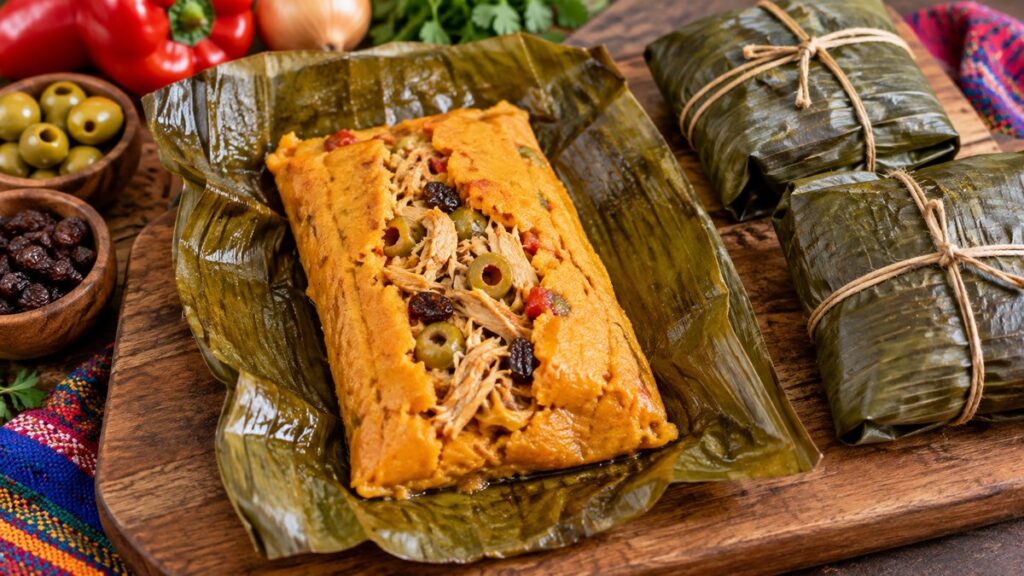
If you grew up Panamanian, you know the tamal assembly line: a table covered in leaves, a mountain of orange masa, bowls of chicken, olives and raisins, and everyone with a job. Tamales are the heart of a Panamanian Christmas, and in Chicago I still make a big batch every December and freeze them. Here’s my full method, with a shortcut masa for US kitchens.
Panamanian tamales are corn masa colored with achiote, filled with chicken or pork stewed in a tomato sofrito with olives, capers and raisins, wrapped in plantain leaves, tied with string and boiled about an hour. They’re bigger than Mexican tamales and are eaten at Christmas.
How Panamanian tamales are different
If you know Mexican tamales, Panamanian ones will surprise you:
| Panamanian tamal | Typical Mexican tamal | |
|---|---|---|
| Wrapper | Plantain/banana leaf, often with a bijao leaf outside | Dried corn husk |
| Size | Big, about the size of your hand | Smaller |
| Masa | Made from boiled, ground corn (maíz pilado), mixed with seasoned broth and achiote | Masa harina or fresh masa beaten with lard |
| Filling | Chicken or pork guisado, olives, capers, raisins, sometimes prunes, peas and sweet pepper | Red or green chile with meat, cheese and more |
| Cooking | Boiled in water | Steamed |
| Texture | Soft, moist, almost pudding-like | Fluffier, drier |
The sweet-salty mix of raisins, olives and capers is very Panamanian. It comes from our Spanish roots.
Bijao, banana or plantain leaves?
In Panama, many cooks wrap tamales in bijao, a big, waxy leaf from a wild plant related to heliconia. It gives the tamal a light, grassy, almost tea-like aroma and is strong enough to boil for an hour without tearing. Bijao is almost impossible to find in the US. Frozen banana or plantain leaves, sold in the freezer case of Latin, Filipino and Asian markets, are the substitute every Panamanian I know uses abroad. A 1-lb (450 g) package wraps about 8 to 10 large tamales once you’ve cut out the ribs and torn pieces, so buy two.
If you can’t find leaves at all, use a double layer of parchment wrapped tightly in foil. The tamal will cook and taste right, but you lose the aroma and the pretty green imprint on the masa.
Tamales around Latin America
People ask whether Panama “has tamales.” Every country from Mexico to Peru does, and each is its own thing:
| Country | Name | What makes it different |
|---|---|---|
| Panama | Tamal | Boiled corn masa with achiote, chicken or pork with olives, capers, raisins; plantain or bijao leaves; boiled |
| Mexico | Tamal | Corn husks or banana leaves; masa beaten with lard; chile-based fillings, sweet versions too; steamed |
| Guatemala | Tamal colorado, paches | Tomato-chile recado; paches use potato masa |
| Nicaragua, Honduras | Nacatamal | Pork, rice, potato and mint inside; very large |
| Costa Rica | Tamal | Pork and vegetables, Christmas tradition, wrapped in banana leaves |
| Colombia | Tamal tolimense | Peas, rice, egg and several meats, in plantain leaves |
| Venezuela | Hallaca | Thin masa with a stew of beef, pork and chicken, raisins, olives, capers; Christmas |
| Puerto Rico | Pastel | Masa of green banana and root vegetables, not corn |
The closest cousin to ours is the Venezuelan hallaca, which shares the olives, capers and raisins.
Ingredients
Makes 12 to 14 large tamales.
For the filling (guisado)
- 3 lb (1.4 kg) bone-in chicken thighs and drumsticks, or 2½ lb (1.1 kg) pork shoulder in 1½-inch cubes (or half and half)
- 5 garlic cloves, minced
- 1 tsp dried oregano
- 1 tbsp soy sauce or Worcestershire
- 2 tbsp oil
- 2 onions, chopped
- 1 green bell pepper and 1 red bell pepper, chopped
- 3 tomatoes, chopped, or 1 can (14.5 oz) diced tomatoes
- 3 tbsp tomato paste
- 6 culantro leaves, chopped (or ⅓ cup cilantro)
- 5 cups (1.2 L) water or chicken broth
- Salt and pepper
For the masa
- Traditional: 2 lb (900 g) maíz pilado (dried hulled white corn), soaked overnight
- Shortcut: 5 cups (600 g) masa harina for tamales (sold in Latin aisles)
- 3 tbsp achiote (annatto) oil, or 1 tsp ground achiote warmed in 3 tbsp oil
- 3–5 cups of the filling’s cooking broth
- 2 tbsp of the sofrito from the filling
- Salt to taste
To fill and wrap
- 1 cup pimento-stuffed green olives
- 3 tbsp capers
- ½ cup raisins
- Optional: prunes, cooked peas, strips of roasted red pepper
- 2 packs (1 lb each) frozen plantain/banana leaves, thawed
- Kitchen string
How to make Panamanian tamales
Tamales are a project. I spread it over two days: filling and corn on day one, masa and wrapping on day two.
Step 1: Make the filling
- Season the meat with garlic, oregano, soy sauce, 1½ tsp salt and pepper. Let it sit at least 30 minutes, or overnight in the fridge.
- Heat the oil in a large pot. Brown the meat in batches. Set aside.
- In the same pot, cook the onions and peppers until soft, about 6 minutes. Add the tomatoes, tomato paste and culantro and cook 5 minutes, until it looks like a thick sauce. Scoop out about 2 tablespoons of this sofrito for the masa.
- Return the meat. Add the water or broth, cover and simmer until tender: about 40 minutes for chicken, 1 to 1½ hours for pork.
- Lift out the meat. If using chicken, remove the bones and skin and pull it into large pieces. Strain and save the broth. You need it for the masa. Taste it. It should be well salted, because it seasons the corn.
Step 2: Make the masa
Traditional (maíz pilado): Drain the soaked corn, cover with fresh water and boil until very soft and you can crush a kernel between your fingers, usually 1½ to 2 hours. Drain, then grind it in a corn grinder or in batches in a food processor until it’s a smooth, thick dough.
Shortcut (masa harina): Put the masa harina in a large bowl.
Then, either way: add the achiote oil, the reserved sofrito and warm broth a cup at a time, squeezing the dough through your fingers, until it’s soft, smooth and spreadable, like thick mashed potatoes, and evenly orange. Taste it. Add salt until the masa itself tastes good.
Step 3: Prepare the leaves
Unfold the thawed plantain leaves, wipe them clean with a damp towel and cut out the hard center rib. Cut them into rectangles about 12 x 14 inches, plus some smaller 8 x 10-inch pieces for a double layer. Pass each leaf quickly over a gas flame or dip it in hot water for a few seconds. It turns bright green, glossy and flexible, so it won’t crack when you fold it.
Step 4: Fill
- Lay a small leaf on top of a large one, shiny side up. Brush the center with a little oil.
- Spread about ¾ cup of masa in a rectangle in the center.
- Add a piece of chicken or pork with a spoonful of its sauce, 2 olives, a few capers and a few raisins.
- Cover the filling with a little more masa, about 2 to 3 tablespoons.
Step 5: Wrap and tie
Fold the long sides of the leaves over the masa, one over the other, then fold the ends underneath to make a neat, flat package. Tie it with string in both directions, like a gift. It should be snug, so water can’t get in.
Step 6: Boil
Bring a very large pot of salted water to a boil. Lower the tamales in, seam side down, keeping them covered with water. Boil gently about 1 hour (masa harina tamales are done in about 45 minutes). Top up with boiling water if needed.
Lift them out and let them rest 10 to 15 minutes. The masa firms up as it cools.
How to organize a tamalada (tamale-making party)
In Panama, tamales are a family project, and they should be in your house too. With four people, 14 tamales take about an hour of assembly once the filling and masa are ready:
- Station 1, leaves: one person wipes, trims, flames and stacks leaves.
- Station 2, masa: one person spreads masa on the leaves.
- Station 3, filling: one person adds meat, sauce, olives, capers and raisins, and the masa cap.
- Station 4, wrapping: one person folds and ties.
Cook the filling and masa the day before. On tamal day, all that’s left is assembly and boiling, and the music.
More troubleshooting
- The masa is runny and won’t hold: too much broth. Knead in masa harina 2 tablespoons at a time.
- The masa is dry and cracks: add warm broth until it spreads like thick mashed potatoes.
- The leaves crack when folding: they weren’t softened. Pass them over the flame or through hot water until glossy.
- Water got inside: the package was loose or the seam faced up. Fold tighter, tie in both directions, and put seam side down in the pot.
- The center is still raw: too thick, or the water wasn’t boiling. Boil another 15 to 20 minutes and spread masa thinner next time.
Tamal de olla (no wrapping)
Same flavors, no leaves, no tying. It’s served at Christmas next to wrapped tamales, or instead of them when there isn’t time.
Serves: 8–10 · Active: 1 hour · Bake: 45 minutes
- Make the full filling from this recipe and shred the meat.
- Make the masa a little softer than for wrapped tamales.
- Oil a 9 x 13-inch (23 x 33 cm) baking dish. Spread half the masa in the bottom.
- Spread the meat and sauce over it, scatter olives, capers and raisins, then cover with the rest of the masa and smooth it.
- Cover with foil (or line the dish with plantain leaves first for aroma) and bake at 350°F (175°C) for 45 minutes, until set and steaming.
- Rest 15 minutes, then spoon or cut into squares.
Some cooks make it fully on the stove: cook the masa in a heavy pot with the broth, stirring constantly, until thick, then fold in the meat. Both are called tamal de olla.
How to serve Panamanian tamales
Untie the string and open the leaves on the plate. You eat the tamal right out of the leaf, but don’t eat the leaf. At Christmas, tamales sit next to arroz con guandú, pernil and pink potato salad. I describe the whole menu in traditional Panamanian Christmas food.
Make-ahead, freezing and reheating
- Make ahead: The filling keeps 3 days in the fridge before wrapping.
- Fridge: Cooked tamales keep 4 to 5 days.
- Freezer: Cool them completely, then freeze in their leaves in freezer bags for up to 3 months. This is how I make Christmas easy.
- Reheat: Drop them, still wrapped, into boiling water: 15 to 20 minutes from the fridge, 30 to 40 minutes from frozen. You can also steam them.
Shopping for tamales in Chicago
- Plantain/banana leaves: frozen, in Latin and Asian markets. Bijao leaves are hard to find in the US, and plantain leaves alone work fine.
- Maíz pilado: sometimes in Latin markets (look for hulled or peeled dried white corn). Otherwise use masa harina for tamales.
- Achiote: seeds or ground annatto in the spice section of Latin markets.
- Culantro: fresh in many Latin and Asian markets. See where to buy culantro in Chicago.
Recipe card: Panamanian tamales
Yield: 12–14 large tamales · Prep: 2 hours · Cook: 3 hours (filling, corn and boiling) · Total: about 5 hours, plus soaking overnight for maíz pilado
Ingredients
- 3 lb (1.4 kg) chicken thighs and drumsticks or 2½ lb (1.1 kg) pork shoulder
- 5 garlic cloves; 1 tsp oregano; 1 tbsp soy sauce; salt and pepper
- 2 tbsp oil; 2 onions; 2 bell peppers; 3 tomatoes; 3 tbsp tomato paste; 6 culantro leaves
- 5 cups (1.2 L) water or broth
- 2 lb (900 g) maíz pilado, soaked, or 5 cups (600 g) masa harina for tamales
- 3 tbsp achiote oil
- 1 cup stuffed olives; 3 tbsp capers; ½ cup raisins
- 2 lb (900 g) frozen plantain leaves, thawed; kitchen string
Instructions
- Season the meat; brown it; make the sofrito and save 2 tbsp; simmer the meat in the sofrito and water until tender. Strain and save the broth.
- Cook and grind the maíz pilado (or use masa harina). Mix with achiote oil, sofrito and warm broth to a soft, spreadable, well-seasoned masa.
- Clean, cut and soften the leaves.
- Spread ¾ cup masa on a double leaf; add meat, sauce, olives, capers and raisins; cover with a little masa.
- Fold into a flat package and tie with string.
- Boil gently in salted water about 1 hour (45 minutes for masa harina). Rest 10–15 minutes.
Storage: Fridge 4–5 days; freezer 3 months. Reheat in boiling water or steam. Eating low carb? Try my keto tamales.
Panamanian tamales vs Mexican tamales
Panamanian tamales are commonly wrapped in broad leaves such as bijao or banana leaves and filled with seasoned meat and additions such as olives, raisins or capers. Many familiar Mexican tamales use corn husks and a different masa and filling style. But Mexico has enormous regional variety, including leaf-wrapped tamales, so the wrapper alone cannot identify the country.
| Feature | A common Panamanian home-style version | Familiar Mexican examples |
|---|---|---|
| Wrapper | Bijao, banana or plantain leaf | Corn husk in many styles; banana leaf in others |
| Masa | Seasoned corn dough, often using flavorful cooking liquid | Many regional doughs, including masa harina-based versions |
| Filling | Chicken or pork; olives, raisins and capers may appear | Meat with red or green sauce, cheese, beans, vegetables and many other choices |
| Shape and size | Often a substantial folded leaf parcel | Long narrow husk parcels are familiar, but size and shape vary |
| Cooking | Boiling or steaming, depending on the recipe | Steaming is common, with important regional variations |
| Heat | Can be mild and savory | Can be mild or hot; not every filling is spicy |
Can I use Mexican masa harina for Panamanian tamales?
It can be a practical adaptation, but it does not make every package a direct swap by volume for cooked ground corn. Different products absorb liquid differently. Follow the dough method in the recipe, add liquid gradually, and test a small parcel before wrapping the whole batch if you have changed the corn product.
The target is a smooth, well-seasoned dough that cooks through without becoming dry or falling apart. Raw dough texture alone cannot tell you exactly how a substituted product will set.
Can I use corn husks instead of leaves?
You can make a tamale in a corn husk, but it changes the shape, aroma, capacity and wrapping method. This recipe’s leaf size and filling quantity are designed together. If switching wrappers, make smaller portions and follow a suitable husk-wrapping and steaming method rather than assuming the same parcel will hold together in a boiling pot.
Wrappers are removed before eating. Clean and prepare leaves according to a food-safe recipe, and do not use leaves from an unknown ornamental plant simply because they are broad and green.
Do I have to include raisins or olives?
No. These are familiar additions, not a test of whether your family is Panamanian enough. Keep the filling balanced and avoid overfilling the parcel. If serving guests, mentioning olives, capers or raisins helps them know what to expect.
For Christmas planning, return to the Panamanian Christmas food guide. The make-ahead strategy matters more than trying to assemble, cook and serve an entire celebration meal at once.
Panamanian tamales FAQ
What are Panamanian tamales made of?
Boiled, ground corn masa (or masa harina) seasoned with the stew broth and achiote, filled with chicken or pork stew, olives, capers and raisins, and wrapped in plantain or bijao leaves.
Are Panamanian tamales sweet?
Savory, with little sweet bites from the raisins (and prunes in some families).
How long do Panamanian tamales take to make?
About 5 to 6 hours in total with maíz pilado, 3½ to 4 with masa harina. Split it over two days and it’s easy.
Where can I buy Panamanian tamales?
In Panama, at markets, fondas and from neighbors who sell them in December. In the US they’re hard to find outside Panamanian communities in Brooklyn, Miami or Houston, which is why I make a batch and freeze it.
Why are my tamales watery inside?
The packages weren’t tied tightly, or the leaves cracked. Use a double layer of leaves and tie snugly.
Why is my masa bland?
The broth wasn’t salty enough. The masa needs to taste good on its own before you wrap it.
Can I use corn husks?
You can, but you’ll lose the plantain-leaf aroma, and you’d need to steam them instead of boiling.
What’s a tamal de olla?
A Panamanian “pot tamal”: the same masa and filling cooked together in a pot like a thick, rich pudding, no wrapping. It’s a great shortcut.
Are Panamanian tamales spicy?
No. Add ají chombo hot sauce at the table if you like heat.
More Panamanian Christmas cooking
Affiliate disclosure: Some links in this section are affiliate links. If you buy through them, I may earn a commission. As an Amazon Associate I earn from qualifying purchases.
Tamales are part of the holiday chapter of my guide to Panamanian food. Pair them with arroz con guandú and finish with Panamanian fruit cake. My Panamanian recipes are also in my cookbook, Ultimate Cookbook of Panama: Secrets of the Tropical Kitchen by MarGo.
As an Amazon Associate I earn from qualifying purchases.
Call your people, put on some music and make a tamal assembly line. ¡Feliz Navidad!