
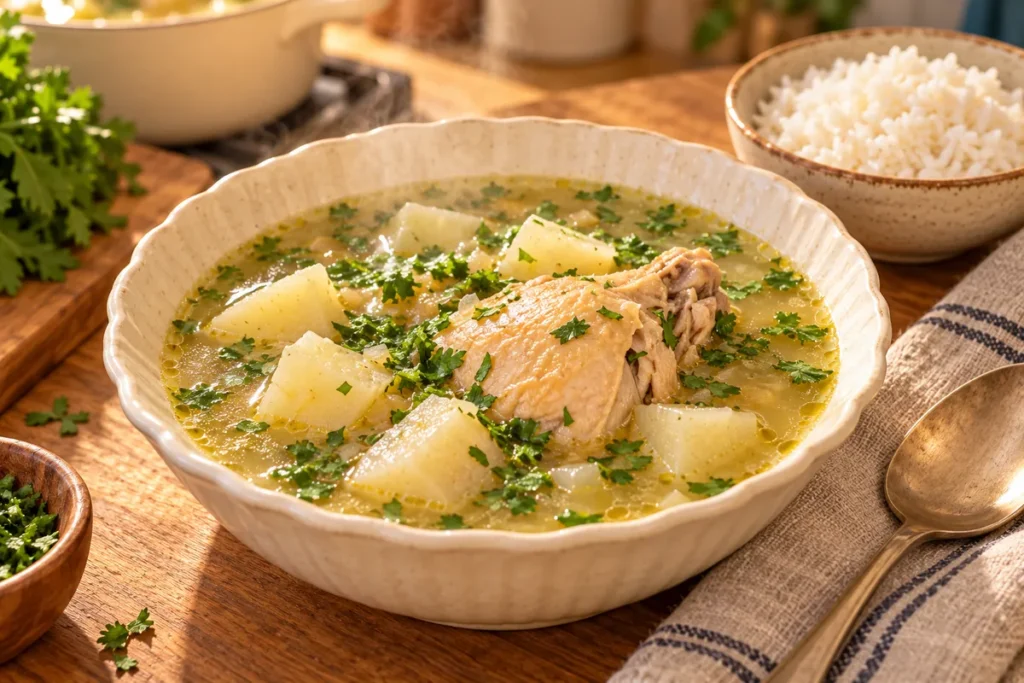
When the wind starts coming off the lake and Chicago turns gray, my kitchen smells like Panama: chicken, garlic, oregano and culantro simmering in a big pot. Sancocho is Panama’s national dish, and for me it’s the taste of home. Here’s exactly how I make it, plus everything people ask me about it.
Panamanian sancocho is a chicken soup simmered with ñame, culantro, onion, garlic and oregano until some of the ñame melts and thickens the broth. With a regular chicken it takes about 1½ hours; with a hen (gallina), closer to 3. Serve it with white rice on the side.
What makes Panamanian sancocho different?
Many Latin American countries have a sancocho, but ours is the simplest. The Panamanian version is built on three things: chicken, ñame and culantro. No beef, no pork, no long list of meats. The broth is light gold and silky, not red, and it tastes of herbs more than spices.
In Panama, the classic is sancocho de gallina, made with a hen (traditionally a “gallina de patio,” a free-range yard hen). A hen gives a deeper, richer broth, but it needs a long simmer. In Chicago I use a hen when I can find one at a Latin or Asian market, and a regular chicken the rest of the time.
You’ll also hear about regional styles:
- Azuero style (Los Santos, Herrera): the classic. Hen, ñame, culantro, onion, garlic, oregano. That’s it.
- Chiricano style (Chiriquí): the same base, often with corn on the cob and other roots like otoe and yuca.
I compare Panama’s sancocho with the Dominican and Colombian versions in is sancocho Panamanian?
Ingredients
Here’s what goes into my pot, with notes for shopping in the US.
- Chicken or hen. A 3½ to 4 lb chicken cut into 8 to 10 pieces, skin on, or a 4 to 5 lb hen (stewing hen). Bone-in thighs and drumsticks are a good shortcut.
- Ñame. 2 to 2½ lb. This is the starchy white tuber with rough, bark-like brown skin. It is NOT the orange “yam” in US supermarkets, which is a sweet potato. More in ñame vs yuca.
- Culantro. 10 to 12 leaves. Half go in whole, half get chopped for the end. Read culantro vs cilantro if you’ve never used it.
- Onion. 1 large yellow onion.
- Garlic. 5 or 6 cloves.
- Sweet pepper. 1 green bell pepper, or 4 ají dulce peppers if you find them.
- Dried oregano. 1½ teaspoons.
- Water. About 12 cups (3 quarts / 2.8 liters).
- Salt and black pepper.
- Optional: 2 ears of corn cut into rounds, 1 lb yuca, 1 small otoe (malanga).
- To serve: white rice, lime wedges, ají chombo hot sauce.
How to make Panamanian sancocho, step by step
1. Season the chicken
Pat the chicken pieces dry. Crush the garlic with 1½ teaspoons of salt into a paste, then rub it over the chicken with the oregano and some black pepper. Let it sit while you prep the vegetables, or cover it and leave it in the fridge overnight. Seasoning ahead makes the chicken itself taste good, not just the broth.
2. Start the broth
Put the chicken in a large pot (at least 6 quarts) with the onion, the sweet pepper and 5 or 6 whole culantro leaves. Add the water. Bring it to a boil over high heat, then turn it down so it simmers gently. For the first 10 minutes, skim off the gray foam that rises to the top. That keeps the broth clear and clean-tasting.
3. Simmer the chicken until tender
- Regular chicken: about 35 to 40 minutes, partly covered.
- Hen: 2 to 2½ hours, partly covered. Add hot water as needed to keep the chicken covered.
The meat should be tender but still on the bone.
4. Cut the ñame in two sizes
While the chicken cooks, peel the ñame. Its skin is rough and the flesh is slippery, so hold it with a towel. Some people get itchy hands from raw ñame, so wear gloves if your skin is sensitive. Drop the pieces in a bowl of cold water as you go so they don’t turn gray.
Here is my trick: cut about a third of the ñame into small cubes (½ inch) and the rest into big chunks (2 inches). The small cubes dissolve and thicken the broth. The big chunks stay whole for your bowl.
5. Add the roots and simmer until the broth turns golden
Add all the ñame to the pot. If you’re using yuca or otoe, add the yuca 10 minutes before the ñame because it takes longer, and the otoe with the ñame. Simmer, uncovered or partly covered, for 25 to 35 minutes, until the big ñame chunks are soft all the way through. Add corn for the last 15 minutes.
If the broth still looks thin, press a few pieces of ñame against the side of the pot with a spoon and stir. It will thicken in minutes.
6. Finish with culantro
Fish out the whole culantro leaves. Chop the remaining leaves finely, stir them in and simmer 5 more minutes. Taste and adjust the salt. Sancocho should be well seasoned, because you eat it with plain rice.
7. Serve
The chicken should read 165°F in the thickest part. Put a piece of chicken, a few chunks of ñame and plenty of broth in a deep bowl. White rice goes on the side, or in the bowl if that’s your family’s way. Squeeze in lime and add ají chombo to taste.
Where sancocho comes from, and why it matters in Panama
The word comes from the Spanish verb sancochar, to cook something in liquid, which is why so many countries have a sancocho and no two are alike. Panama calls it the national dish, and most Panamanian cooks will tell you the “real” one comes from the Azuero Peninsula, especially around Chitré in Herrera.
Sancocho is how Panama gathers. Families spend a Sunday by a river and cook it over a wood fire, the big pot (paila) set on three stones. That’s sancocho de leña, and the smoke gets into the broth. It’s what you serve the day after a wedding or a big party, what a grandmother puts on the stove when the family comes home, and what we make in Chicago when the wind off the lake makes your face hurt. When I miss Panama, this is the pot I make.
What does sancocho taste like?
Clean and savory, like the best chicken soup you’ve had, with a deep herby smell from the culantro and a broth that feels a little silky on your tongue because the ñame melts into it. It isn’t spicy and it isn’t tomato-red. The lime and hot sauce you add at the table give it brightness and heat.
What goes in Panamanian sancocho (and what doesn’t)
These are the questions I get most from friends who grew up with a different sancocho:
| Ingredient | In Panamanian sancocho? |
|---|---|
| Chicken or hen | Yes, always. It’s the only meat in the classic version. |
| Ñame | Yes. It thickens the broth. |
| Culantro | Yes. Non-negotiable. |
| Onion, garlic, oregano | Yes. |
| Yuca, otoe (taro/malanga) | Often, especially in Chiriquí style. |
| Corn on the cob | Sometimes (Chiriquí). Not in the Azuero classic. |
| Potatoes | Not traditional. Some families add them; it changes the texture. |
| Carrots | Not traditional. |
| Tomato or tomato sauce | No. That’s more Puerto Rican or Dominican. |
| Beef, pork, sausage | No. Those belong to Dominican and Colombian versions. |
| Noodles | No. |
| Rice | On the side, never cooked in the pot. |
How to eat sancocho the Panamanian way
Put chicken, ñame and broth in a deep bowl and white rice on a plate next to it. Some people eat a spoonful of soup, then a spoonful of rice; others (me, some days) tip rice straight into the bowl. Squeeze in lime, shake in a few drops of ají chombo, and pick up the chicken with your fingers when nobody important is watching. Patacones or a slice of avocado on the side are welcome.
Sancocho variations
- Chiricano sancocho: add 1 ear of corn cut in 6 pieces, plus ½ lb (225 g) each otoe and yuca, with the ñame.
- Sancocho de leña: the same recipe over a wood fire. On a grill with a lid, use a heavy pot and a few hardwood chunks for the smoky taste.
- Sancocho with chicken thighs only: the easiest Chicago version; bone-in, skin-on thighs give a rich broth in about an hour.
- Sancocho de res or de pescado: beef or fish sancochos exist in Panama, but they’re less common; if you make one, keep the ñame and culantro.
- Vegetarian sancocho: not traditional, but a vegetable broth with ñame, yuca, otoe, corn, culantro and a little achiote gives you the same herby, thick soup.
Can you use a frozen “sancocho mix”?
Yes. The frozen tropical vegetable bags sold for sancocho (usually yuca, ñame or yautía, and plantain or corn) save a lot of peeling. Two tips: check that it includes ñame, and add a little extra ñame if you can find it, because some bags lean heavily on yuca. Add them frozen; they need about 5 extra minutes.
What to serve with sancocho
- White rice. Always.
- Ají chombo hot sauce, the yellow Panamanian pepper sauce.
- Lime wedges.
- Avocado slices or a few patacones if you want more on the table.
Shopping for sancocho in Chicago
You can find everything for sancocho in Chicago, just not always in one store. Latin and Caribbean markets carry ñame, yuca, otoe and fresh culantro (often labeled recao). Asian markets often have culantro too, labeled ngo gai, and some carry stewing hens. The freezer case is your friend: frozen peeled ñame and yuca work very well and save you the peeling. I share where to look in where to buy culantro in Chicago.
Substitutions that still taste like sancocho
| Missing | Use instead | What changes |
|---|---|---|
| Ñame | Yuca | Broth a little thinner; still very good |
| Ñame | Yuca + 1 Yukon Gold potato | Closest texture to ñame |
| Hen | Bone-in chicken thighs and drumsticks | Lighter broth, much faster |
| Culantro | A big bunch of cilantro, stems included, added in the last 5 minutes | Softer herb flavor |
| Ají dulce | Green bell pepper | Fine; less fragrant |
| Fresh roots | Frozen ñame or yuca | Almost no difference |
Avoid orange sweet potatoes (“yams”) and russet potatoes as the main starch. Sweet potatoes make the soup sweet, and russets fall apart into mush.
Can you make sancocho in an Instant Pot or slow cooker?
You can. The stove gives you the most control over the broth, so that’s how I cook it, but these work:
- Instant Pot (6 or 8 quart): Cook the seasoned chicken, onion, pepper, whole culantro and 8 cups of water on high pressure for 12 minutes (a hen needs about 35), natural release for 10 minutes. Add the ñame and cook on high pressure 5 more minutes, quick release. Stir in chopped culantro on Sauté for a few minutes.
- Slow cooker: Everything except the chopped culantro goes in on low for 7 to 8 hours. Stir in the chopped culantro for the last 15 minutes.
How to store and reheat sancocho
I always make a big pot, because sancocho is even better the next day.
- Fridge: Cool it quickly in shallow containers and refrigerate within 2 hours. It keeps 3 to 4 days. I explain how to tell when it’s past its best in how long sancocho lasts in the fridge.
- Freezer: Freeze it up to 3 months. The ñame can turn a little grainy after freezing, so I freeze the broth and chicken and add a few fresh chunks of ñame when I reheat if I have them.
- Reheat: On the stove over medium heat until it’s steaming hot all the way through. The broth thickens in the fridge, so add a splash of water.
Sancocho for a crowd
Sancocho is party food in Panama. For 12 to 14 people, double everything in a 12 to 16 quart pot. Give it 10 to 15 extra minutes after the ñame goes in, because the bigger pot takes longer to come back to a simmer. Cook the rice separately in two batches.
Recipe card: Panamanian sancocho
Yield: 6 to 8 servings · Prep: 25 minutes · Cook: 1 hour 20 minutes (chicken) or about 3 hours (hen) · Total: about 1 hour 45 minutes with chicken
Ingredients
- 1 chicken, 3½–4 lb (1.6–1.8 kg), cut into 8–10 pieces, or 1 stewing hen, 4–5 lb (1.8–2.3 kg)
- 2–2½ lb (900 g–1.1 kg) ñame, peeled
- 10–12 culantro leaves
- 1 large yellow onion, chopped
- 5–6 garlic cloves
- 1 green bell pepper or 4 ají dulce, chopped
- 1½ tsp dried oregano
- 1½ tsp salt, plus more to taste
- ½ tsp black pepper
- 12 cups (2.8 L) water
- Optional: 2 ears corn, cut in 2-inch rounds; 1 lb (450 g) yuca; 1 small otoe
- To serve: cooked white rice, lime wedges, ají chombo sauce
Instructions
- Crush the garlic with the salt. Rub over the chicken with the oregano and pepper. Rest 15 minutes or overnight in the fridge.
- Put the chicken, onion, sweet pepper and 5–6 whole culantro leaves in a 6–8 quart pot. Add the water and bring to a boil. Lower to a gentle simmer and skim the foam for 10 minutes.
- Simmer partly covered until the chicken is tender: 35–40 minutes for chicken, 2–2½ hours for a hen (add hot water as needed).
- Peel the ñame. Cut a third into ½-inch cubes and the rest into 2-inch chunks. Keep them in cold water until needed.
- Add the ñame (and yuca or otoe, if using). Simmer 25–35 minutes until the chunks are soft and the broth is thick and golden. Add corn for the last 15 minutes.
- Remove the whole culantro leaves. Stir in the remaining culantro, chopped, and simmer 5 minutes. Adjust the salt.
- Check that the chicken reaches 165°F (74°C). Serve in deep bowls with white rice, lime and ají chombo.
Tips
- Cut the ñame in two sizes. The small cubes thicken the broth.
- Don’t boil hard. A gentle simmer keeps the broth clear.
- Season with enough salt. The rice on the side is plain.
Storage: Fridge 3–4 days in airtight containers. Freezer up to 3 months. Reheat until steaming hot.
What is the national dish of Panama?
Sancocho de gallina is widely regarded as Panama’s national dish. The familiar Panamanian version is a chicken or hen soup built around ñame and culantro, commonly served with white rice. Calling it the national dish describes its cultural importance; it does not mean every household follows one official recipe.
The ingredients explain why it is more specific than “chicken soup.” Ñame contributes body as some pieces soften into the broth. Culantro supplies its distinctive herbal aroma. A hen can give a deeper broth and need a longer simmer than an ordinary young chicken.
Why are there so many different sancocho recipes?
The name is used across several Latin American and Caribbean countries, but the meat, roots, vegetables and thickness vary. Even within Panama, regional and family versions differ. A bag of mixed frozen roots labeled sancocho does not automatically reproduce the Panamanian combination.
For this pot, keep your attention on the broth, the chicken, the ñame and the culantro rather than adding every vegetable associated with a different country’s version. If you enjoy corn or another family addition, say that it is your variation instead of treating it as a requirement for everyone.
Is sancocho the same as Panama’s everyday beef stew?
No. Sancocho is a broth-centered soup. Carne guisada keeps beef in chunks in a thicker vegetable sauce. Both can arrive with rice, but the shared side does not make them the same dish.
For the broader picture, start with the Panamanian food guide. If your question is whether the soup needs to be hot with chile, Panamanian food and spice levels separates the mild base from optional picante.
Sancocho FAQ
Is sancocho a soup or a stew?
In Panama it’s a soup: lots of broth, thickened only by the ñame. Dominican sancocho is much thicker and closer to a stew.
Can I use boneless chicken breast?
You can, but the broth will be weak. Use at least some bone-in pieces for flavor, and add breast meat for the last 20 minutes so it doesn’t dry out.
Why is my sancocho thin and watery?
Not enough ñame broke down. Mash a few pieces against the side of the pot now, and next time cut more small cubes.
Why is my sancocho cloudy?
It boiled too hard, or the foam wasn’t skimmed. It still tastes fine. Next time keep it at a gentle simmer.
Do Panamanians put corn in sancocho?
Some do, especially in Chiriquí. The classic Azuero version has no corn.
How long should sancocho cook?
About 2 hours with a hen, 1 to 1½ hours with a regular chicken or thighs, counting 30 to 40 minutes after the ñame goes in.
Does sancocho have potatoes or carrots?
Panamanian sancocho traditionally has neither. Puerto Rican and Colombian versions often do.
What’s the difference between sancocho and caldo?
Caldo is a broader word for broth-based soup. Sancocho is a specific, thicker soup built on tubers; in Panama, ñame and culantro.
Sancocho vs ajiaco?
Ajiaco, from Bogotá, is a chicken and three-potato soup flavored with guascas and served with capers and cream. Panamanian sancocho uses ñame and culantro and has no dairy.
How do you say sancocho?
san-KOH-choh.
Can I make sancocho ahead?
Yes, it’s better the next day. See how long sancocho is good for in the fridge.
Is sancocho gluten-free?
This recipe is. If you add bouillon cubes, check the label.
What’s the difference between sancocho and chicken soup?
Ñame and culantro. Those two ingredients give sancocho its thick broth and its unmistakable smell.
More Panamanian cooking
Affiliate disclosure: Some links in this section are affiliate links. If you buy through them, I may earn a commission. As an Amazon Associate I earn from qualifying purchases.
Sancocho is the heart of my guide to Panamanian food. If you love it, try my arroz con guandú or a weekend breakfast of hojaldras. I also collected my Panamanian home cooking in my cookbook Ultimate Cookbook of Panama: Secrets of the Tropical Kitchen by MarGo.
As an Amazon Associate I earn from qualifying purchases.
Make a big pot this weekend and tell me how it turned out. ¡Buen provecho!