
¡Hola! I’m MarGo. I grew up in Panama, and I live and cook in Chicago now. When people ask me what Panamanian food is like, they usually expect Mexican food or Caribbean food. It is a little of both, and also its own thing. This is my guide to the dishes I grew up with and still cook here, with links to every recipe as I share them.
Panamanian food is home cooking built on rice, chicken, plantains, corn, root vegetables like ñame and yuca, and fresh culantro. It mixes Spanish, Indigenous, Afro-Caribbean and Chinese influences. The best-known dishes are sancocho, arroz con pollo, hojaldras, carimañolas, ceviche and tamales.
What does Panamanian food taste like?
Panamanian food is savory, herby and comforting, not very spicy. That surprises a lot of people. The heat lives in a bottle on the table, our yellow ají chombo pepper sauce, so everyone adds as much as they like.
The flavors you taste again and again are:
- Culantro, the long, jagged-edged herb that tastes like a stronger cilantro. It is the soul of sancocho. I explain it in culantro vs cilantro.
- A sofrito of onion, garlic, sweet peppers and tomato, cooked down slowly.
- Achiote (annatto) for color, especially in rice.
- Coconut on the Caribbean side, in rice, fish and sweets.
- Lime, in ceviche, on soup, squeezed over almost anything.
- A little salsa china (soy sauce) or salsa inglesa (Worcestershire) in stews, a quiet sign of the Chinese families who have been part of Panama for generations.
The building blocks of a Panamanian kitchen
If you open a Panamanian pantry, you’ll find a lot of rice and not many spices. We cook with fresh things.
| Ingredient | What it is | Where it shows up |
|---|---|---|
| White rice | Eaten with almost every lunch and dinner | Next to stews, beans, sancocho |
| Ñame | Starchy white tuber with rough brown skin | Sancocho, soups |
| Yuca | Starchy root, also called cassava | Carimañolas, soups, fried yuca |
| Plantains (plátanos) | Green for savory, ripe for sweet | Patacones, tajadas, plátano en tentación |
| Corn (maíz) | Dried and fresh corn | Tortillas, bollos, chicheme, empanadas |
| Guandú | Pigeon peas | Arroz con guandú |
| Culantro | Long-leaf herb | Sancocho, rice, ceviche |
| Ají chombo | Yellow pepper in the Scotch bonnet family | Hot sauce, ceviche |
| Coconut | Fresh or canned milk | Rice, fish, cocadas |
If you are not sure what ñame is, I have a full guide to ñame vs yuca.
Panamanian breakfast: fried, filling and made to share
Breakfast is where Panamanian food gets most fun. A typical weekend breakfast is a plate of something fried, something stewed and a cup of coffee.
- Hojaldras (also spelled hojaldres): fried dough that puffs up crisp outside and soft inside. My favorite.
- Panamanian tortillas: thick, small corn tortillas fried until golden, nothing like a thin taco tortilla.
- Salchicha guisada: sliced sausages stewed in tomato, onion and pepper.
- Bistec picado: chopped beef in a saucy sofrito.
- Queso blanco (fresh white cheese), fried eggs and a hot cup of coffee with milk.
I wrote about the whole table in what Panamanians eat for breakfast.
Soups and one-pot meals
Sancocho, Panama’s national dish
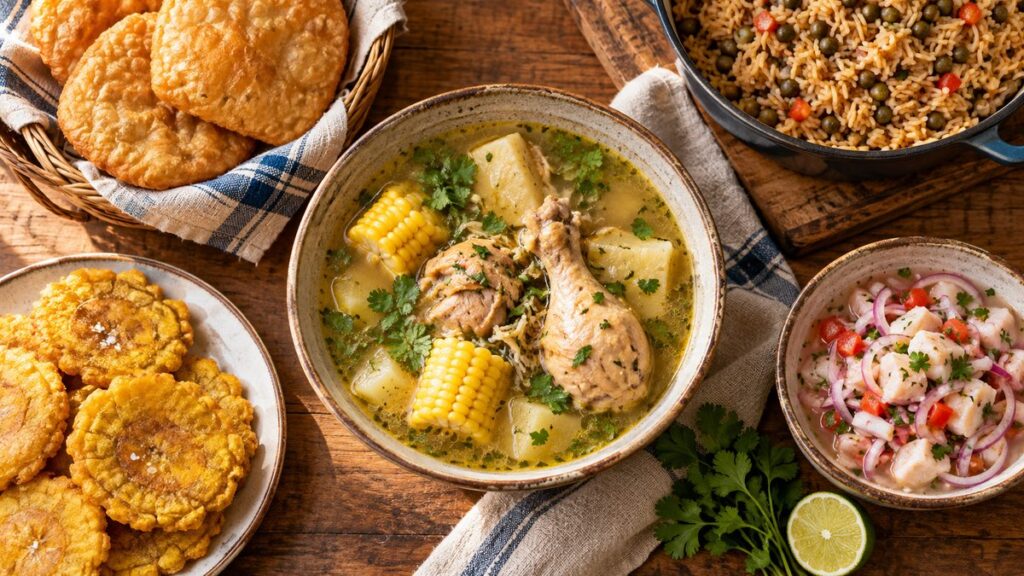
If you only cook one Panamanian dish, make sancocho. It is a chicken soup simmered with ñame, culantro, onion, garlic and oregano until the ñame breaks down and the broth turns golden and silky. You eat it with white rice on the side. People eat it on Sundays, after a party, when someone is under the weather, or simply because it’s cold. In Chicago, that’s half the year.
Is sancocho really Panamanian? Several countries have a sancocho, and they are very different. I compare them in is sancocho Panamanian. And if you make a big pot like I do, read how long sancocho lasts in the fridge.
Other soups and stews
- Guacho: a thick, soupy rice cooked with beans or pigeon peas, pork and root vegetables. Somewhere between a soup and a risotto.
- Rondón: a coconut seafood stew from the Caribbean coast, in Bocas del Toro and Colón.
- Mondongo: tripe stew, a weekend dish many families love.
- Ropa vieja: shredded beef in tomato sauce, served with rice and plantains.
Rice dishes: the center of the plate
Panamanians eat a lot of rice. A day without rice feels like a day without lunch.
- Arroz con guandú: rice with pigeon peas and coconut milk, the rice of Christmas and New Year. In a hurry, I make arroz con guandú with canned pigeon peas.
- Arroz con pollo: yellow rice with chicken, peas, olives and capers. Every Panamanian birthday party has a big tray of it.
- Arroz con coco: white rice cooked in coconut milk, especially on the Caribbean coast.
- Picadillo: seasoned ground beef that goes next to white rice.
Snacks, sides and street food
Panamanian snacks are fried, golden and made for eating with your hands. See my full guide to Panamanian street food.
- Carimañolas: torpedo-shaped yuca fritters stuffed with seasoned ground beef.
- Empanadas: we make them with corn dough or wheat dough, filled with beef, chicken or cheese.
- Patacones: green plantain slices fried, smashed and fried again. If you call them tostones, that’s fine too.
- Bollos de maíz: corn dough wrapped in husks and boiled, plain or with a little filling.
- Tajadas: ripe plantain slices fried until sweet and caramelized.
Seafood: two oceans in one small country
Panama sits between the Pacific and the Caribbean, so fish is everywhere.
- Ceviche de corvina: white sea bass cubed and “cooked” in lime juice with onion, ají chombo and culantro, eaten with saltine crackers. Panama City’s fish market made it famous.
- Pescado frito: a whole fried fish with patacones and lime.
- Fish in coconut sauce, a Caribbean-side favorite.
Panamanian Christmas food
December is when the Panamanian kitchen goes all out. The Christmas table usually has:
- Panamanian tamales, wrapped in plantain leaves, with chicken or pork, olives, capers and raisins inside.
- Arroz con guandú or arroz con pollo.
- A baked pernil (pork shoulder), ham or turkey.
- Ensalada de papa, the potato salad that turns pink from beets.
- Panamanian fruit cake, dark and soaked in rum.
- Saril, a sweet red drink made from sorrel (roselle) flowers with ginger.
Here’s the full menu, with what goes on the table and when: traditional Panamanian Christmas food.
Panamanian food by region
Panama is small, but the food changes a lot from one side of the country to the other. When someone tells me “I ate Panamanian food in Bocas” and someone else says “I ate it in Chitré,” they ate very different meals.
| Region | What it’s known for | Dishes to try |
|---|---|---|
| Azuero Peninsula and the interior (Herrera, Los Santos, Coclé, Veraguas) | The “comida típica” most Panamanians mean when they say home food: corn, rice, chicken, pork | Sancocho, tamales, bollos, hojaldras, tortillas, seco Herrerano |
| Panama City | Everything meets here; UNESCO named it a Creative City of Gastronomy in 2017 | Ceviche at the Mercado de Mariscos, fonda lunches, Chinese-Panamanian food |
| Caribbean coast (Colón, Bocas del Toro, Portobelo) | Afro-Caribbean cooking with coconut milk, seafood and spice | Rondón, rice and beans in coconut, fried fish with patacones, patí |
| Chiriquí highlands (Boquete, Tierras Altas) | Cool-climate farming: coffee, vegetables, strawberries, honey | Geisha coffee, fresh produce, trout |
| Darién and Indigenous communities (Guna, Emberá, Ngäbe) | Ancestral ingredients like plantain, fish, peach palm and cacao | Pixbae (peach palm fruit), plantain-and-fish soups, cacao drinks |
Afro-Antillean Panamanian food
Many Panamanians, especially in Colón and Panama City, descend from West Indian families who came from Jamaica, Barbados, Trinidad and other islands to build the railroad and the canal. They brought dishes that are now Panamanian too:
- Rondón (from “run down”): fish or seafood stewed in coconut milk with plantain, yuca and ñame.
- Rice and beans: rice cooked with red beans and coconut milk.
- Patí: a flaky, spiced beef patty, the Panamanian cousin of the Jamaican patty.
- Saus (souse): pig’s feet pickled in a lime and vinegar brine with onion, cucumber and hot pepper.
- Bon: a sweet, spiced bread, often with raisins.
- Plantintá: a pastry filled with sweet ripe plantain.
Chinese-Panamanian food
Chinese workers came to build the Panama Railroad in the 1850s, and Chinese-Panamanian families have run corner stores (we call them “el chino”) and restaurants ever since. That’s why soy sauce (salsa china) sits in so many Panamanian kitchens, why fried rice (“arroz frito“) is a normal Saturday takeout, and why a Panamanian stew sometimes has a quiet splash of soy in it.
A normal day of eating in Panama
People often ask what Panamanians eat in a day, not just at parties. This is a typical weekday:
- Breakfast: coffee with milk and something fried: a tortilla, an hojaldra, or eggs with bistec.
- Lunch (the big meal): at home or at a fonda, the small counter restaurants where workers eat. A plate of the day usually means white rice, a stew (chicken, beef or pork), lentils or beans, a little salad of cabbage or potato, and patacones or tajadas, with a fresh chicha to drink.
- Afternoon: a carimañola or empanada with coffee, or fruit with salt and lime.
- Dinner: lighter, often leftovers from lunch or a soup.
Lentejas (lentils) deserve a word: Panamanian lentils are simmered with sofrito, culantro and sometimes a little pork or bacon until thick, then spooned over white rice. They show up at fondas all week.
Panamanian fruits
Panama is fruit country. These are the fruits we eat fresh, blend into chichas or cook with:
| Fruit | Spanish name | How we eat it |
|---|---|---|
| Passion fruit | Maracuyá | Chicha, desserts |
| Soursop | Guanábana | Chicha, batidos (milkshakes) |
| Rambutan | Mamón chino | Fresh, peeled by hand |
| Spanish lime | Mamón | Fresh, sucked off the seed |
| Nance | Nance | Chicha, preserves, a fermented drink |
| Cashew fruit | Marañón | Chicha, the nut roasted |
| Peach palm | Pixbae | Boiled with salt, eaten warm |
| Tamarind | Tamarindo | Chicha, sweets |
| Mango, papaya, pineapple | Mango, papaya, piña | Fresh, chichas, green mango with salt |
Panamanian drinks
- Chicheme: a sweet corn drink with milk, vanilla and cinnamon. It’s like dessert in a glass.
- Chicha: fresh fruit drinks, from passion fruit (maracuyá) to tamarind to papaya.
- Saril: the red Christmas drink made from sorrel (roselle) flowers with ginger.
- Coffee: Panama grows some of the most expensive coffee in the world. The Geisha variety grown in the Chiriquí highlands around Boquete sets records at auction for its floral, tea-like flavor. At home, most Panamanians drink everyday coffee with plenty of milk.
- Seco Herrerano: the national spirit, a clear sugarcane liquor from Herrera province. People drink it with milk and ice (“seco con vaca”) or with lime and soda.
- Beer: the national lagers are Balboa, Panamá and Atlas, served very cold.
Panamanian sauces
- Ají chombo hot sauce: the yellow, mustardy pepper sauce on every table.
- Salsa china and salsa inglesa: soy sauce and Worcestershire, splashed into stews.
- Culantro and lime: not a bottled sauce, but the finishing touch on soups and ceviche.
Panamanian food vs other Latin cuisines
| Panamanian | Mexican | Colombian | Costa Rican | |
|---|---|---|---|---|
| Main starch | Rice, ñame, yuca, plantain | Corn tortillas | Rice, arepas, potato | Rice and beans |
| Heat level | Mild; hot sauce on the side | Often spicy | Mild | Mild |
| Signature herb | Culantro | Cilantro, epazote | Cilantro, guascas | Cilantro |
| National soup | Sancocho de gallina | Pozole | Ajiaco, sancocho | Olla de carne |
| Tortilla | Thick, small, fried | Thin, griddled | Arepa instead | Thin, griddled |
| Tamal wrapper | Plantain leaf | Corn husk (mostly) | Plantain leaf | Plantain leaf |
Panamanian desserts
Panamanian sweets use what grows around us: coconut, milk, plantain and sugar.
- Sopa borracha: “drunk soup,” a cake soaked in a spiced rum syrup with raisins and prunes, made for weddings and parties.
- Cocadas: chewy coconut candy.
- Arroz con leche: rice pudding with cinnamon.
- Plátano en tentación: ripe plantains cooked in syrup with cinnamon.
- Bienmesabe: a sweet, creamy rice-and-milk dessert.
I gather the ones I love in Panamanian desserts.
Panamanian food words, explained
When I cook for friends in Chicago, I end up translating half the menu. Some quick ones:
- Guisado/guisada: stewed, cooked in a sauce.
- Gallina: hen. “Sancocho de gallina” means it was made with a hen, which takes longer and tastes richer.
- Ñame: not the orange yam you see in US stores.
- Patacón: a fried, smashed green plantain.
I have a full list in salchicha guisada in English, and other Panamanian food words.
Where to find Panamanian food and ingredients in Chicago
Chicago has a big Latin community, but not many Panamanian restaurants, so I cook at home. Latin and Caribbean markets carry most of what I need: ñame, yuca, plantains, culantro (often labeled recao) and frozen pigeon peas. I share where I shop in where to buy culantro and other Panamanian ingredients in Chicago, and where I go for a taste of home in Panamanian food in Chicago.
How to start cooking Panamanian food at home
If you’re new to it, this is the order I’d cook in:
- Sancocho, because it teaches you culantro and ñame, and it’s very forgiving.
- Arroz con pollo, because it feeds a crowd.
- Hojaldras, for a weekend breakfast.
- Patacones, as a side for anything.
- Ceviche, once you can find good, very fresh fish.
My Panamanian cookbook
Affiliate disclosure: Some links in this section are affiliate links. If you buy through them, I may earn a commission. As an Amazon Associate I earn from qualifying purchases.
I put many of my Panamanian recipes, with step photos, into one book: Ultimate Cookbook of Panama: Secrets of the Tropical Kitchen by MarGo. If you like cooking from a book on the counter, that’s where the whole kitchen is.
As an Amazon Associate I earn from qualifying purchases.
Panamanian food FAQ
Is Panamanian food spicy?
Not usually. The food is seasoned with herbs and sofrito, and the heat comes from ají chombo sauce you add at the table.
What is the national dish of Panama?
Sancocho, a chicken soup with ñame and culantro.
Is Panamanian food the same as Mexican food?
No. We use corn too, but we eat much more rice, plantains and root vegetables, and less chile. Our tortillas are thick and fried, and our tamales are wrapped in plantain leaves, not corn husks. More in Panamanian food vs Mexican food.
Is Panamanian food Caribbean?
Part of it. The Caribbean coast cooks with coconut, seafood and Afro-Caribbean dishes like rondón, while the interior is more about rice, chicken, corn and sancocho.
What do Panamanians eat every day?
Rice with beans or lentils, a stewed meat or chicken, a salad or plantains, and lots of fresh fruit drinks.
What food is Panama known for?
Sancocho, ceviche de corvina, arroz con pollo, hojaldras, carimañolas, patacones and Christmas tamales, plus Geisha coffee.
What do Panamanians eat for breakfast?
Fried corn tortillas or hojaldras with eggs, cheese, salchicha guisada or bistec, and coffee with milk. More in Panamanian breakfast.
What is a fonda?
A small, inexpensive counter restaurant serving home-style lunch plates: rice, a stew, lentils or beans, salad and plantains.
What is the national drink of Panama?
Seco Herrerano, a sugarcane liquor from Herrera province, usually mixed with milk or with lime and soda. For a non-alcoholic answer, chicha.
Is Panamanian food gluten-free?
Many dishes are naturally made without wheat: sancocho, rice dishes, ceviche, corn tortillas, carimañolas (yuca dough), bollos and tamales. Hojaldras, wheat empanadas and cakes contain flour. Check sauces and packaged ingredients.
Can vegetarians eat Panamanian food?
Yes, with some care. Rice with beans or lentils, patacones, tajadas, yuca, corn tortillas with cheese, bollos and fruit chichas are all meat-free; ask whether beans or rice were cooked with pork.
What is the difference between Panamanian and Colombian food?
They share sancocho, empanadas and patacones, but Panamanian sancocho centers on ñame and culantro, and Panama’s Caribbean and Afro-Antillean dishes, its Chinese influence and its ceviche de corvina set it apart. Colombia has arepas, bandeja paisa and ajiaco, which aren’t Panamanian staples.
Where can I try Panamanian food in the US?
Brooklyn, Miami, Houston, Washington, D.C. and Los Angeles have Panamanian communities and restaurants. In Chicago it’s mostly home cooking; see Panamanian food in Chicago.
Pick one dish and start this week. I’d start with the sancocho. ¡Buen provecho!