
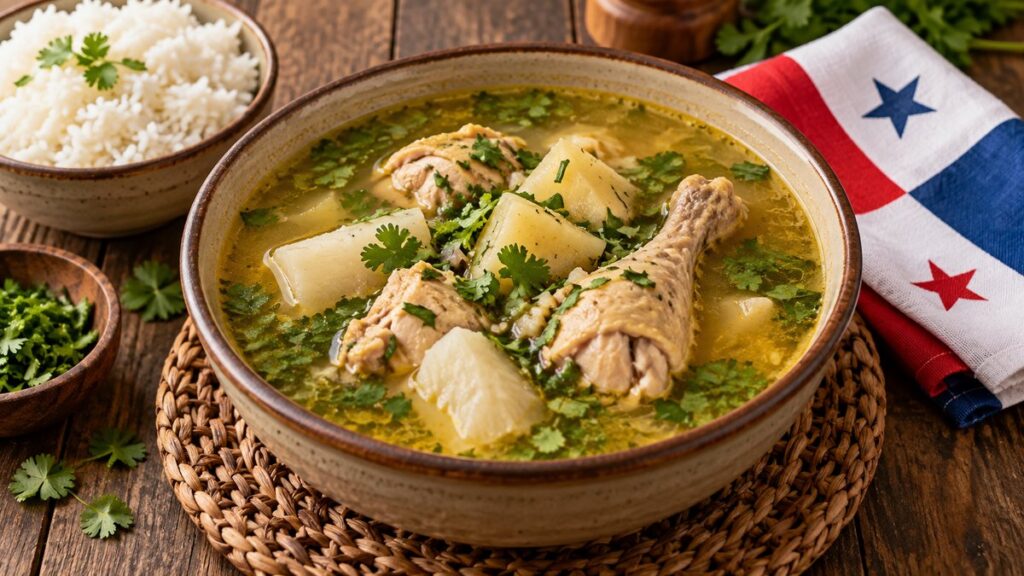
Ask a Panamanian, a Dominican and a Colombian whose sancocho is the real one, and you’d better have a free afternoon. Every one of us grew up with “the” sancocho, and every one of them is different. As a Panamanian cook in Chicago, where all three communities share the same grocery aisles, here’s my honest answer.
Yes, sancocho is Panamanian: it’s considered Panama’s national dish. But it isn’t only Panamanian. The Dominican Republic, Colombia, Puerto Rico, Venezuela and others have their own sancocho. Panama’s is the simplest: chicken, ñame and culantro in a light, golden broth.
Where does sancocho come from?
The word sancocho comes from Spanish, from the verb sancochar, which means to parboil or partly cook. Spain’s tradition of hearty boiled one-pot meals (think cocido and puchero) crossed the Atlantic and met the ingredients of the Americas and the Caribbean: yuca, ñame, plantain, corn and local herbs. Each country made it its own. Even the Canary Islands have a sancocho canario, but it’s a salt-fish dish with potatoes and mojo sauce, completely different from ours.
So sancocho doesn’t have one birthplace. It’s a family of soups and stews that grew up in many countries at once.
What the dictionary says. The Spanish Academies’ Diccionario de americanismos defines Panamanian sancocho as a soup of hen, ñame, onion, sweet peppers and cilantro (in Panama we use culantro, the long-leaf herb), and it lists other meanings around the region: in Venezuela a soup of fish, hen or beef with yuca, ñame and green plantain; in Ecuador a stew of potatoes, cabbage, yuca, meat and rice; and in Cuba, careful, sancocho can mean leftover scraps fed to pigs. In Mexico the word even names a fruit sweet with piloncillo syrup. So if you invite a Cuban friend for “sancocho,” explain first.
And one more Panamanian meaning: in Panama, un sancocho also means a mess or a muddle. “Esto es un sancocho” means “this is a mix-up.” It tells you how deep the word sits in our everyday Spanish.
What makes Panamanian sancocho Panamanian?
Three things:
- Chicken, ideally a hen (gallina). One meat only.
- Ñame as the main starch, which melts into the broth and thickens it.
- Culantro, lots of it. It’s the smell of Panamanian sancocho.
It’s seasoned simply with onion, garlic, oregano and sometimes sweet peppers, and served as a soup with white rice on the side. The classic Azuero version has nothing else. In Chiriquí, cooks often add corn, yuca and otoe. My full recipe is here: Panamanian sancocho.
Panama has more than one sancocho
- Sancocho de gallina (Azuero style): hen, ñame, culantro. The one people mean by “national dish.”
- Chiricano sancocho: the same base plus corn on the cob, yuca and otoe, heartier.
- Sancocho costeño: on the Caribbean coast, a fish soup with coconut milk, closer to the Afro-Caribbean kitchen of Colón and Bocas del Toro than to the Azuero hen soup.
- Sancocho at a party or the beach: cooked in a huge pot over a wood fire, stretched with more ñame and yuca to feed everyone.
Panamanian vs Dominican vs Colombian vs Puerto Rican sancocho
| Panamanian | Dominican | Colombian | Puerto Rican | |
|---|---|---|---|---|
| Meat | Chicken or hen only | Several meats; “sancocho de siete carnes” uses up to seven, such as beef, pork, chicken, goat and sausage | Varies by region: hen, beef, fish, or three meats (trifásico) | Usually beef, sometimes pork |
| Main starches | Ñame (plus corn, yuca, otoe in some regions) | Yuca, ñame, yautía, green plantain, auyama (squash), corn | Potato, yuca, plantain, corn | Many viandas: yuca, yautía, plantain, calabaza, corn |
| Herb | Culantro | Cilantro, oregano | Cilantro | Recao (culantro) and cilantro |
| Texture | Soupy, light golden broth | Very thick, almost a stew | Brothy | Thick and hearty |
| Served with | White rice on the side | White rice and avocado | Rice, avocado, sometimes banana | Rice or on its own |
| Occasion | Sundays, parties, cold days, feeling run-down | Celebrations and family gatherings | Weekend family meals, outings by the river | Family meals, cold days |
Sancocho around Latin America (and its cousins)
| Country | Name | What makes it different |
|---|---|---|
| Panama | Sancocho de gallina | Hen, ñame, culantro; light broth; rice on the side |
| Dominican Republic | Sancocho / de siete carnes | Up to seven meats (often beef, goat, pork, chicken, sausage, ribs, ham bone), thick |
| Colombia | Sancocho de gallina, trifásico, de pescado | Regional; potato, plantain, corn on the cob, cilantro |
| Puerto Rico | Sancocho | Many viandas (root vegetables), recao and cilantro, thick |
| Venezuela | Sancocho, also called hervido | Fish, hen or beef with yuca, ñame and green plantain |
| Ecuador | Sancocho | Potatoes, cabbage, yuca, meat, sometimes with rice |
| Canary Islands | Sancocho canario | Salted fish with potatoes and mojo; not a soup |
| Cuba | (ajiaco instead) | Cubans use sancocho for pig slop; their root-vegetable stew is ajiaco |
| Spain | Cocido, puchero | The boiled-dinner ancestors |
How to tell them apart at the table
- Look at the broth. Thin and golden: Panamanian or Colombian. Thick enough to stand a spoon in: Dominican or Puerto Rican.
- Count the meats. One (chicken): Panama. Several: Dominican Republic.
- Smell the herb. A deep, almost earthy cilantro smell is culantro: Panama, or Puerto Rico’s recao.
- Find the corn. Corn on the cob in big pieces points to Colombia, Chiriquí or the Dominican pot.
- Check the side. Rice on the side with avocado: Dominican. Plain white rice on the side, sometimes spooned into the bowl: Panama.
Is Panamanian sancocho the national dish?
Yes. Sancocho is widely called Panama’s national dish, and you’ll find it everywhere: at home, in fondas, at parties, at the beach and at every big family gathering. Many Panamanians will tell you the best sancocho comes from the Azuero peninsula, made with a free-range hen cooked over a wood fire.
Is Dominican sancocho the same?
No. Dominican sancocho, especially the famous sancocho de siete carnes, is a thick, rich stew with many meats and starches, and it’s a special-occasion dish. Panamanian sancocho is a lighter chicken soup that you can make any day of the week. Both are delicious; they’re just different dishes with the same name.
Is Colombian sancocho the same?
Not quite. Colombian sancocho varies by region. Sancocho de gallina is the closest to ours, but Colombians usually use cilantro rather than culantro and add potatoes, plantain and corn on the cob. The broth is lighter than the Dominican one and often heavier than the Panamanian one.
Why is there so much debate?
Because sancocho is comfort food, and comfort food is personal. It’s the soup your mom or grandmother made, the one that fed a whole party from one pot. Put a Panamanian, a Dominican, a Colombian and a Puerto Rican at one table and the conversation always goes the same way: “Ours has more…” “Ours doesn’t have…” Then everyone has a second bowl.
Sancocho FAQ
Is sancocho Panamanian or Dominican?
Both, in different forms. It’s Panama’s national dish, and the Dominican Republic has its own famous sancocho.
What does sancocho mean?
It comes from sancochar, to parboil, and refers to the long-simmered pot of meat and root vegetables.
What’s the main ingredient in Panamanian sancocho?
Chicken, ñame and culantro.
What do Panamanians eat with sancocho?
White rice on the side, sometimes lime and ají chombo hot sauce.
What is the difference between sancocho and ajiaco?
Colombian ajiaco (from Bogotá) is a chicken and three-potato soup with guascas herb, cream and capers; Cuban ajiaco is a root-vegetable and meat stew. Sancocho is its own family, built on ñame, yuca or plantain.
Is sancocho Puerto Rican?
Puerto Rico has its own thick sancocho with many root vegetables. Panama’s is lighter and made with hen only.
What is sancocho called in Venezuela?
Sancocho, and also hervido.
Why do Panamanians use culantro instead of cilantro?
Culantro has a stronger, deeper flavor that survives long cooking. See culantro vs cilantro.
Is sancocho the same as chicken soup?
It’s a chicken soup, but ñame and culantro make it something else entirely. I explain those two in ñame vs yuca and culantro vs cilantro.
Make Panama’s version
Affiliate disclosure: Some links in this section are affiliate links. If you buy through them, I may earn a commission. As an Amazon Associate I earn from qualifying purchases.
Try my Panamanian sancocho recipe. If you cook a big pot, read how long sancocho lasts in the fridge, and explore the rest of my guide to Panamanian food. My Panamanian recipes are also in my cookbook, Ultimate Cookbook of Panama: Secrets of the Tropical Kitchen by MarGo.
As an Amazon Associate I earn from qualifying purchases.
¡Buen provecho, from whichever sancocho country you call home!