
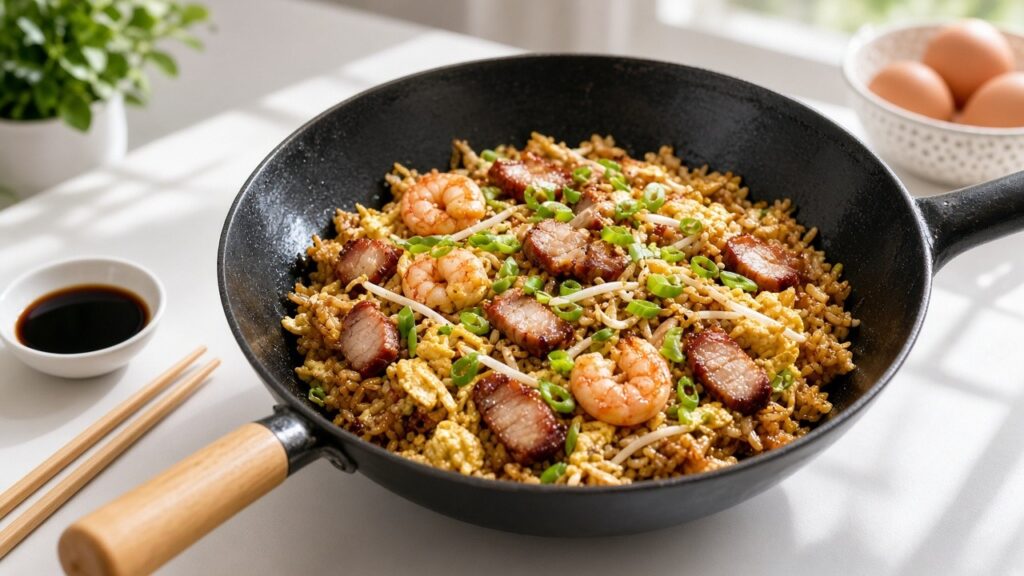
In Panama, fried rice isn’t “takeout.” It’s everyday food. Every neighborhood has a Chinese-Panamanian restaurant or fonda where a heaping plate of arroz frito (or arroz chino) comes out of a roaring wok, studded with red-edged roast pork, shrimp, egg and scallions, often with a side of patacones and a fried wonton. It’s what you order after a long day, for a family lunch or when you want something you know will be good.
Panamanian fried rice (arroz frito, also called arroz chino) is Chinese-style fried rice adapted by Panama’s large Chinese-Panamanian community: day-old long-grain rice stir-fried in a very hot wok with soy sauce (which Panamanians often call “salsa china”), egg, scallions, bean sprouts and a mix of proteins, most famously Chinese roast pork (char siu), shrimp and chicken. “Arroz frito combinado” mixes all three. It’s darker and more soy-seasoned than many Chinese-American fried rices, and it’s often served with patacones, fried wontons or a simple salad.
Below: what Panamanian arroz frito is and why fried rice is everywhere in Panama, how it compares with Chinese-American fried rice, the ingredients, a step-by-step recipe, wok vs skillet, tips for fried rice that isn’t soggy, variations, what to serve with it, storage, a recipe card and answers to common questions. More Panamanian food: the complete guide to Panamanian food.
What is Panamanian arroz frito (arroz chino)?
Arroz frito literally means “fried rice.” In Panama, people also say arroz chino (“Chinese rice”) because it’s associated with the country’s Chinese restaurants. You’ll find it at:
- Chinese-Panamanian restaurants and fondas everywhere, from Panama City to small towns.
- Food courts and takeout counters.
- Home kitchens, where leftover rice and whatever protein is in the fridge become dinner.
The classic plate is generous, dark golden-brown from soy sauce, and loaded with diced roast pork, shrimp, chicken, egg, bean sprouts and scallions.
Why fried rice is everywhere in Panama (Chinese-Panamanian history)
Chinese workers arrived in Panama in large numbers in the 1850s to help build the Panama Railroad, and more came over the following decades, including during the canal era. Many stayed, opened shops, groceries and restaurants, and built families and communities. Today Panama has one of the largest Chinese-descended communities in Latin America, and Chinese-Panamanian food is woven into the national diet.
Panama City has a historic Barrio Chino (Chinatown), and the influence goes far beyond it: family-run corner stores, bakeries and restaurants across the country. Dishes like arroz frito, wonton soup, chow mein, fried wontons and Chinese-style roast pork are part of everyday Panamanian life. Chef Edgar Hernández’s cookbook Paila explores Panamanian-Asian fusion; see the best Panamanian cookbooks.
Panamanian vs Chinese-American fried rice
| Panamanian arroz frito | Chinese-American fried rice | |
|---|---|---|
| Color | Dark golden-brown, generous soy | Light to medium brown |
| Classic protein | Roast pork (char siu), shrimp, chicken, often combined | Choice of one: chicken, pork, shrimp, beef |
| Vegetables | Bean sprouts, scallions, sometimes onion, celery or peas | Peas, carrots, onion, scallions |
| Seasoning | Soy sauce (“salsa china”), sometimes oyster sauce, a little sugar or salt | Soy sauce, sometimes oyster sauce, salt, white pepper |
| Served with | Patacones, fried wontons, salad, hot sauce | Egg rolls, sweet and sour dishes |
| Portion | Very large, often a full meal for one or shared | Side or main |
Both come from Cantonese-style fried rice, but each evolved with local tastes and ingredients.
Ingredients
Day-old rice
Cold, cooked long-grain rice is the foundation. Day-old rice has dried out a little, so the grains stay separate in the wok instead of clumping. Jasmine or regular long-grain white rice both work.
No day-old rice? Cook rice with slightly less water than usual, spread it on a sheet pan and refrigerate uncovered for at least an hour (or freeze it for 20 minutes).
Pork, chicken, shrimp or combo
- Chinese roast pork (char siu): the signature. Its sweet, red-edged edges are what make Panamanian fried rice look and taste the way it does. Buy it from a Chinese barbecue shop or market, or make a quick version (see tips).
- Chicken: diced cooked chicken or chicken thigh stir-fried in the wok.
- Shrimp: peeled, deveined, quickly stir-fried.
- Ham: some home cooks use diced ham as an easy swap for roast pork.
- Combo (combinado): a little of everything.
Soy sauce, salsa china and egg
- Soy sauce: in Panama, soy sauce is commonly called salsa china (“Chinese sauce”). Use a regular (light) soy sauce for salt and flavor, plus a splash of dark soy sauce for that deep color if you have it.
- Oyster sauce (optional): adds savory depth.
- Eggs: scrambled in the wok and folded in.
- Sesame oil (optional): a few drops at the end for aroma.
Vegetables and aromatics
- Scallions (cebollina): lots, sliced.
- Bean sprouts (often called frijolitos chinos in Panama): for crunch.
- Garlic and onion: optional, for a more aromatic base.
- Celery, peas or bell pepper: optional additions.
How to make it step by step
- Prep everything first. Fried rice cooks fast, so dice the pork, cook or cut the chicken, peel the shrimp, beat the eggs, slice the scallions and break up the cold rice with your hands.
- Heat the wok (or large skillet) over high heat until it just starts to smoke. Add 1 tablespoon oil.
- Scramble the eggs: pour in the eggs, scramble until just set, then move them to a plate.
- Cook the proteins: add a little more oil. Stir-fry the shrimp until pink, about 1 to 2 minutes, and remove. Stir-fry the chicken until cooked through if raw. Add the roast pork just to warm.
- Aromatics: add garlic and the white parts of the scallions (and onion, if using) and stir-fry for 30 seconds.
- Add the rice: spread it out in the wok, press it against the hot surface and let it sit for 30 seconds before tossing. Repeat for 3 to 4 minutes until the rice is hot and slightly toasted.
- Season: drizzle soy sauce (and dark soy, oyster sauce) around the edge of the wok so it sizzles, then toss to color the rice evenly. Taste and adjust.
- Return everything: add the eggs, shrimp, chicken and pork, plus the bean sprouts. Toss for 1 minute.
- Finish: add the green parts of the scallions and a few drops of sesame oil. Serve hot.
Wok or skillet?
A wok is ideal: its shape concentrates heat at the bottom and lets you toss the rice up the sides. Carbon steel woks work well on gas stoves.
A large skillet (12-inch cast iron or stainless steel) works fine at home, especially on electric or induction stoves. Cook in batches so the pan stays hot.
Either way, the key is high heat and small batches. Overcrowding the pan steams the rice instead of frying it.
Tips for fried rice that isn’t soggy
- Use cold, day-old rice. Freshly cooked rice is too moist.
- Break up clumps before cooking.
- Get the pan very hot before adding oil.
- Cook in batches for big quantities.
- Don’t drown it in soy sauce. Add a little at a time, around the edges of the pan.
- Cook wet ingredients separately (shrimp, vegetables) so they don’t release water into the rice.
- Toss less than you think. Let the rice sit against the hot pan to toast.
Quick char siu-style pork at home
If you can’t buy Chinese roast pork: marinate 1 pound pork shoulder or tenderloin strips in 2 tablespoons hoisin, 1 tablespoon soy sauce, 1 tablespoon honey, 1 teaspoon five-spice powder, minced garlic and a few drops of red food coloring (optional). Roast at 400°F until cooked through (145°F internal for whole cuts, then rest), brushing with more honey near the end. Cool, then dice.
Variations
Arroz frito combinado
The “everything” version: roast pork, chicken and shrimp together. It’s the most popular order at many Panamanian Chinese restaurants.
Shrimp fried rice (arroz frito con camarones)
Just shrimp, often with a little more garlic.
Vegetarian
Skip the meat and seafood. Use extra eggs (or tofu for vegan), plus mushrooms, peas, carrots, bell peppers, bean sprouts and scallions. Season with soy sauce and a vegetarian “oyster” (mushroom) sauce.
Keto-friendly
Swap the rice for cauliflower rice; see the best keto rice substitutes.
What to serve with it (wonton, patacones)
- Patacones (fried green plantain slices): a very Panamanian side. See maduros vs tostones.
- Fried wontons: crispy, sometimes with a sweet-and-sour dip.
- Wonton soup: a common Chinese-Panamanian pairing.
- Simple salad: lettuce, tomato and cucumber.
- Hot sauce: a few drops of Panamanian ají chombo sauce. See my Panamanian hot sauce recipe.
- Drinks: a cold soda, chicha or a Panamanian beer.
Other rice-based Panamanian classics: Panamanian arroz con coco, Panamanian red beans and rice and Panamanian lentil soup. In Chicago, I look for Chinese roast pork in Chinatown; see Chinatown Chicago dumplings and Panamanian food in Chicago.
Storage
- Refrigerate within 2 hours of cooking in a shallow, airtight container. Eat within 3 to 4 days.
- Reheat in a hot skillet or wok with a teaspoon of oil until steaming hot, or in the microwave covered with a damp paper towel.
- Freeze up to 2 months in a freezer bag, flattened. Reheat from frozen in a skillet.
Cooked rice left at room temperature for too long can grow bacteria, so cool and refrigerate it promptly.
Recipe card
Panamanian Fried Rice (Arroz Frito Combinado)
Serves: 4 | Prep: 20 minutes | Cook: 15 minutes | Total: 35 minutes
Ingredients
- 4 cups cold cooked long-grain white rice (from about 1⅓ cups raw)
- 3 tablespoons neutral oil, divided
- 3 large eggs, beaten with a pinch of salt
- 8 ounces medium shrimp, peeled and deveined
- 1 cup diced cooked chicken
- 1 cup diced Chinese roast pork (char siu)
- 2 garlic cloves, minced
- 6 scallions, sliced, whites and greens separated
- 3 tablespoons soy sauce, plus more to taste
- 1 teaspoon dark soy sauce (optional, for color)
- 1 tablespoon oyster sauce (optional)
- 1½ cups bean sprouts
- ½ teaspoon toasted sesame oil (optional)
Method
- Break up the cold rice with your hands. Prep all ingredients.
- Heat a wok or 12-inch skillet over high heat. Add 1 tablespoon oil, scramble the eggs until just set and remove.
- Add 1 tablespoon oil, stir-fry the shrimp until pink, 1 to 2 minutes, and remove. Add the chicken and pork for 1 minute to warm; remove.
- Add the remaining oil, garlic and scallion whites; stir-fry 30 seconds.
- Add the rice, pressing it against the pan and tossing, 3 to 4 minutes.
- Drizzle soy sauce, dark soy and oyster sauce around the edges; toss to color evenly.
- Return eggs, shrimp, chicken and pork with the bean sprouts; toss 1 minute.
- Add scallion greens and sesame oil. Taste, adjust soy sauce and serve hot.
FAQ
Why is it called arroz chino in Panama?
Because it’s associated with Panama’s Chinese-Panamanian restaurants and community, who brought and popularized it. “Arroz chino” simply means “Chinese rice.”
Can I use fresh rice?
It’s better with day-old rice. If you only have fresh rice, spread it out on a tray and chill it uncovered for at least an hour so it dries a little.
What is salsa china?
In Panama, “salsa china” usually means soy sauce. Some cooks also use a darker, thicker soy sauce for color.
Can I make it vegetarian?
Yes. Skip the meat and shrimp and use extra egg or tofu with mushrooms, peas, carrots and bean sprouts, plus a vegetarian mushroom “oyster” sauce.
How do I keep fried rice from getting soggy?
Use cold, day-old rice, a very hot pan, small batches and not too much soy sauce. Cook wet ingredients separately.
Is arroz frito spicy?
No. It’s savory and salty. Panamanians add heat with hot sauce at the table. See is Panamanian food spicy?