
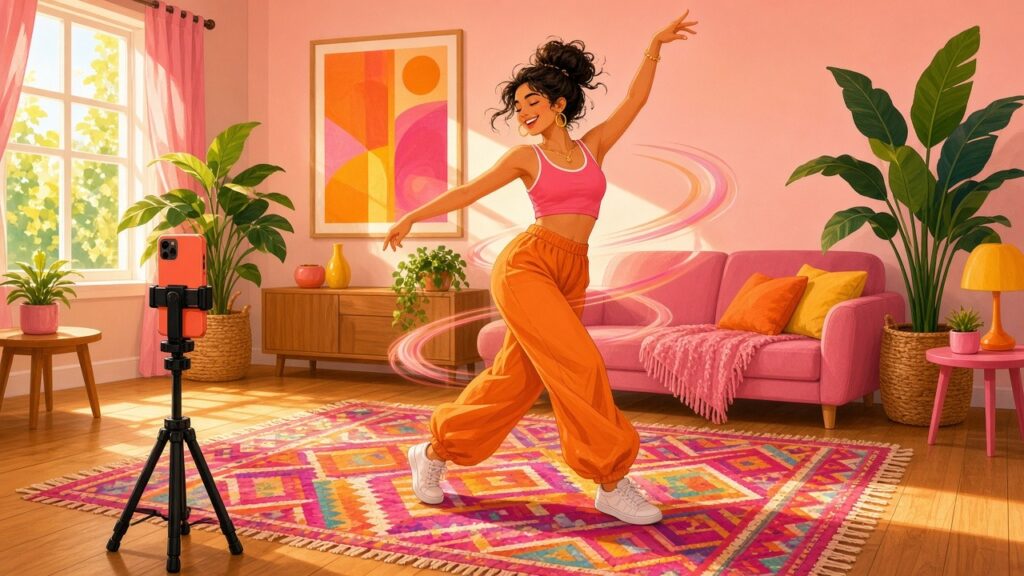
Plenty of people take a few classes, feel stuck and decide they “just aren’t dancers.” Usually the problem isn’t talent. It’s how they practice. Dancing many styles, from salsa and bachata to Zumba, belly dance and tap, taught me that a handful of habits make the biggest difference, whether or not you’re in a class every week.
To get better at dancing on your own: train your ear to find the beat, drill basics until they’re automatic, film yourself and review with a specific checklist, take classes in more than one style, dance socially or perform to test your skills under pressure, and follow a short, consistent practice plan of 15 to 30 minutes most days. Plateaus usually mean you need new input (feedback, a new style or a harder challenge), not more of the same.
This post is the hub for practicing and improving on MarGo Moments. The linked guides go deeper on each topic.
Can you get better at dancing on your own?
Yes, with a caveat. Solo practice builds timing, technique, stamina and confidence. What it can’t easily give you is outside feedback and partner connection. The best plan mixes self-practice with occasional classes, workshops or socials. Online dance classes are a strong middle ground, especially if you film yourself following along.
Musicality: learn to hear the beat
Most “I can’t dance” feelings come from not knowing where the beat is. Fix that first.
- Clap or tap the downbeat of songs you like, out loud: “1, 2, 3, 4.”
- Find the “1.” In most pop and Latin music, it’s where a phrase begins and the music feels like it “lands.”
- Count in eights. Dance instructors count 1–8 because most phrases fit eight beats.
- Listen for instruments. In salsa, the cowbell and conga; in bachata, the güira; in hip-hop, the snare on 2 and 4.
- Practice away from the floor. Count while walking, cooking or driving.
For style-specific listening, see salsa vs bachata music.
Basics and drills that pay off
Advanced dancers look effortless because their basics are automatic. Drill:
| Drill | Why it works | How long |
|---|---|---|
| Basic step of your style, nonstop through a song | Timing and stamina | 1 song daily |
| Weight transfers (side to side, slow) | Balance and clean steps | 2 minutes |
| Spotting and single turns | Control without dizziness | 5 minutes |
| Isolations (head, chest, hips) | Body awareness and styling | 5 minutes |
| Slow-motion choreography | Exposes sloppy transitions | 1 combination |
| Same move, three energies (soft, sharp, groovy) | Expression and dynamics | 3 minutes |
Slow is the secret. If you can’t do it cleanly at half speed, you can’t do it at full speed.
Film yourself (and how to watch it)
Video is the most honest teacher you’ll ever have, and it’s free.
How to film:
– Phone at hip height, landscape, full body in frame.
– Film the same combination each week so you can compare.
– Wear clothes that show your lines (not baggy everything).
How to watch (one thing at a time):
1. Timing: are your steps on the beat? Watch with the sound on, then off.
2. Posture: are your shoulders hunched, head down?
3. Feet: are steps the right size? Are you on balls of feet where needed?
4. Arms: are they intentional or dangling?
5. Face and energy: do you look like you’re enjoying it?
Pick one fix per week. Trying to fix everything makes you stiff. It can feel awful at first; that’s normal. See how to not feel awkward dancing.
Take classes in more than one style
Cross-training is the habit that helped me most. Each style teaches something the others don’t:
- Ballet: posture, balance, turns, clean lines. See can adults start ballet.
- Salsa and bachata: timing, partner connection, spins. Start with salsa for beginners or bachata for beginners.
- Hip-hop: groove, grounding, rhythm variety. See hip-hop for beginners.
- Jazz: performance quality and sharp technique. See jazz dance for beginners.
- Belly dance: isolations and control. See belly dance for beginners.
- Tap: rhythm precision and musicality. See teach yourself tap.
- Zumba: stamina and fearless following. See Zumba for beginners.
Even one month of a new style can unlock a problem in your main one.
Learn choreography faster
Picking up combinations quickly is a skill you can train:
- Chunk it. Learn eight counts at a time and link them only when each chunk is solid.
- Name the moves. “Step-tap, turn, hip roll, point” is easier to remember than a blur of steps.
- Mark it. Walk through the steps small and without energy before dancing full out.
- Learn feet first, arms second. Add styling once the footwork is automatic.
- Review within 24 hours. A quick run-through the next day locks it in.
These tricks work for every style; for a fitness-class version, see how to memorize Zumba choreography.
Conditioning that supports dancing
Dance itself builds fitness, but a little strength and mobility work makes technique easier:
- Calf raises and ankle circles for relevés, turns and jumps.
- Squats and lunges for grounded hip-hop and Latin styles and safe landings.
- Planks and dead bugs for core control in turns.
- Hip and hamstring stretches after practice for range of motion.
Two short sessions a week of 15 minutes are plenty. Gentle strength work also lowers the chance of the sore knees and tight calves many adult beginners notice.
Social dancing and performing
Practice in your living room builds skill; dancing in front of others builds readiness.
- Socials test your timing with unfamiliar music and partners. Learn what to expect in what is a salsa social.
- Student showcases and recitals force you to polish a routine. See how to prepare for a dance performance.
- Jams and open floors in hip-hop or freestyle push improvisation.
A practice plan by week
Time: 15–30 minutes, 4–5 days a week.
| Week | Daily focus | Weekly goal |
|---|---|---|
| 1 | Count songs aloud; basic step through 3 songs | Find the 1 in any song in your style |
| 2 | Add weight-transfer and isolation drills | Film a 30-second basic; note one fix |
| 3 | Learn one short combination slowly | Perform it on beat at full speed |
| 4 | Add turns or styling; repeat combination | Film again and compare with week 2 |
| 5–8 | Rotate: technique day, combo day, freestyle day | Go to one social or class |
Warm up first. Five minutes of marching, joint circles and light stretches reduce the risk of strain.
Why you’re not improving (plateaus)
| Sign | Likely cause | Try this |
|---|---|---|
| Same mistakes on video for weeks | Practicing without feedback | Take a private lesson or ask a teacher for one correction |
| Feels boring | Same routine every day | Learn new choreography or a new style |
| Good at home, freeze in class | Nerves, not skill | Dance in front of a friend or at a social |
| Tired and sore | Not enough rest | Take two rest days a week |
| Can follow, can’t freestyle | Only copying | Spend 5 minutes a day improvising to random songs |
| Steps fine, looks stiff | Over-thinking technique | Practice “performance runs” focusing only on enjoying the music |
How long it takes
Most adults notice clear improvement in timing and confidence within 4 to 8 weeks of steady practice. Looking comfortable at a social or in a choreography class typically takes 3 to 6 months; feeling advanced takes years, and that’s the fun part. See how long it takes to learn salsa for a style-specific timeline.
Skills to work on, by level
| Level | Focus on | Signs you’re ready to move on |
|---|---|---|
| Beginner (first 3–6 months) | Finding the beat, basic steps, weight changes, posture | You can do the basics without looking at your feet |
| Advanced beginner | Turns, simple combinations, picking up choreography | You can follow a class combination at full speed |
| Intermediate | Styling, musicality, clean transitions, partner connection | You add your own interpretation to the music |
| Advanced | Performance quality, improvisation, teaching others | Others ask how you learned that |
Practicing at home: a 20-minute routine
- Warm up (5 minutes): march, shoulder rolls, hip circles and ankle mobility. See dance warm-up for beginners.
- Rhythm (3 minutes): clap or step on every beat of one song, then only on 1 and 5.
- Basics drill (5 minutes): your style’s basic step, slow, then at tempo.
- Combination (5 minutes): one short sequence from class, mirrored and unmirrored.
- Freestyle (2 minutes): dance to one song with no plan.
More setups and space ideas are in how to practice dance at home.
Getting better at specific styles
- Salsa: learn salsa dancing for beginners, how to spin in salsa and salsa ladies styling.
- Bachata: how to dance bachata for beginners.
- Zumba: memorize Zumba choreography.
- Ballet and jazz: can adults start ballet, jazz dance for beginners.
- Hip hop: hip-hop dance for beginners.
Recovery matters
Muscles adapt between sessions, not during them. Sleep, eat enough, drink water and take at least one rest day a week. A few minutes of gentle stretching after class helps you feel looser the next day; see stretching after dance class. Sharp or lingering pain is a reason to rest and check with a medical professional, not to push through.
Online classes or in person?
Online classes are great for drilling and for learning at your own pace; in-person classes give you feedback and, for partner styles, real partners. Most dancers improve fastest with a mix. See are online dance classes worth it and, in Chicago, adult dance classes in Chicago.
Set one goal at a time
Pick a single focus for each month: cleaner turns, hearing the 1, or remembering choreography. Write it down, practice it on purpose, and film yourself at the start and end of the month so you can see the change.
FAQ
Why am I not getting better at dancing?
Usually because you practice without feedback, repeat only what you already know, or don’t practice consistently. Film yourself, fix one thing at a time and add new challenges.
How long does it take to get good at dancing?
Comfortable in 3–6 months of regular practice; good in a year or two; improving forever. It depends on frequency and the style.
Can I get better at dancing at home?
Yes. Home practice is ideal for timing, technique and stamina. Pair it with occasional classes or socials for feedback and partner work.
Is anyone naturally good at dancing?
Some people start with more rhythm or body awareness, often from music or sports. But skill is mostly built. Beginners who practice consistently pass “natural” dancers who don’t.
How do I feel more confident dancing?
Know your basics so well you don’t think about them, practice in front of others in small steps, and focus on enjoying the music instead of judging yourself.
Better dancing comes from listening, repetition, honest feedback and a little bravery. Put the phone on the tripod, press record and dance one song today.