
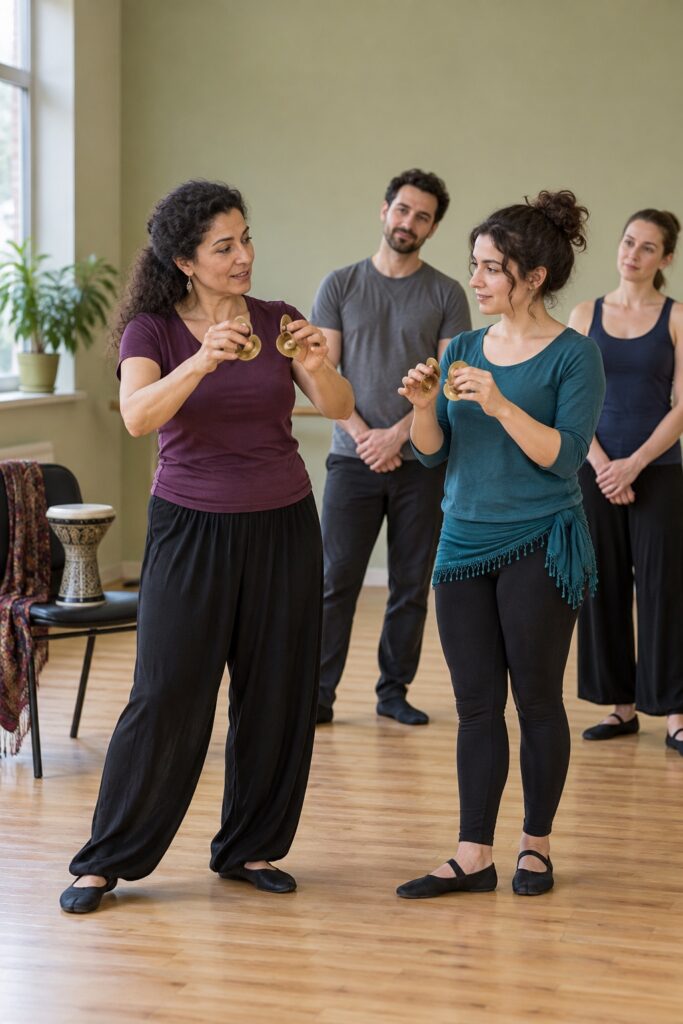
Belly dance taught me something new about my own hips, and I’m a Latina who dances cumbia! It’s a dance of control: small, precise movements that look effortless when they’re done well. It’s also deeply musical and so much fun. If you’ve been curious, here’s everything you need to start, at home or in a class.
To belly dance as a beginner, start with the posture (soft knees, neutral pelvis, lifted chest), then learn the core moves one at a time: hip drops, hip slides, hip circles, figure eights, shimmies, chest lifts and snake arms. Practice slowly to Middle Eastern music for 15–20 minutes a few times a week.
What is belly dance?
Belly dance is the Western name for a family of dances from the Middle East and North Africa. Its traditional form is often called raqs sharqi, Arabic for “dance of the east.” The movements isolate different parts of the body (hips, chest, belly, arms, head) and connect them to the rhythms and melodies of the music. Learn the rhythms in what is belly dance music called?
There are several styles, and a beginner class will usually focus on one (see belly dance styles explained):
| Style | What it’s like |
|---|---|
| Egyptian raqs sharqi | Elegant, subtle and very musical; often considered the classical style |
| Lebanese | Energetic and flirty, with bigger moves |
| Turkish | Playful and lively, often with finger cymbals |
| American cabaret | A mix of influences, the style many people saw in restaurants |
| Group improvisation styles (like FCBD® style) | Dancers follow cues in a group, with strong posture and earthy movement |
| Fusion | Belly dance mixed with hip-hop, flamenco, jazz and more |
Step 1: Learn the belly dance posture
Everything starts here. Good posture makes your moves cleaner and more comfortable.
- Feet about hip-width apart, toes forward.
- Knees soft, slightly bent, never locked.
- Pelvis neutral: not tucked under, not arched back.
- Core gently engaged, like zipping up a pair of jeans.
- Chest lifted, as if a string pulls your breastbone up.
- Shoulders relaxed and down, away from your ears.
- Arms floating out to the sides, elbows soft, wrists lifted.
Check yourself in a mirror from the side. Your ears, shoulders and hips should line up.
Step 2: The first 10 belly dance moves
Learn them in this order, slowly, one at a time.
| Move | Body part | How to do it |
|---|---|---|
| Hip lift / hip drop | Hips | Lift one hip up by straightening that knee, then drop it down to the beat |
| Hip slide | Hips | Slide your hips side to side, keeping your shoulders still |
| Hip twist | Hips | Twist one hip forward and back, like turning a key |
| Hip circle | Hips | Draw a big, smooth circle with your hips: side, front, side, back |
| Horizontal figure 8 | Hips | Your hips trace an “8” on the floor, one hip pushing forward then back |
| Vertical figure 8 (maya / taqsim) | Hips | Your hips trace an “8” on a wall in front of you; slow and smooth |
| Shimmy | Hips | Bend and straighten your knees quickly, one after the other; your hips vibrate |
| Chest lift / drop | Chest | Lift your chest up and lower it, without moving your hips or shoulders |
| Chest slide / circle | Chest | Slide your ribcage side to side, then connect it into a circle |
| Snake arms | Arms | Roll your shoulder, elbow, wrist and fingers in a wave, alternating arms |
Two that take more practice
- Undulation (camel): a wave that rolls from your chest down through your belly to your hips. Start with a chest circle on the side, then try to keep it flowing downward.
- Layering: doing two moves at once, like a shimmy with a hip circle. Wait until each move feels easy on its own.
My biggest tip: isolation is everything. In a hip slide, your shoulders don’t move. In a chest slide, your hips don’t move. Practice in front of a mirror and you’ll see it.
Step 3: Learn to hear the music
Middle Eastern music has rhythms with names, and knowing a few helps you dance to them. These are the ones you’ll hear most often in beginner classes:
| Rhythm | Feeling | Beginner tip |
|---|---|---|
| Maqsum | The most common, bright and steady | Hip drops on the strong beats |
| Baladi | Earthy, with a heavy “doum doum” at the start | Grounded hip moves, walking steps |
| Saidi | Bouncy, from Upper Egypt | Playful hip moves and traveling steps |
| Malfuf | Fast and rolling | Quick travel steps and spins |
| Chiftetelli | Slow and sensual | Figure eights, undulations, snake arms |
The two main drum sounds are doum (deep, from the center of the drum) and tek (sharp, from the edge). Listen for them, and match your bigger moves to the doums and smaller accents to the teks.
What to wear for belly dance
Affiliate disclosure: Some links in this section are affiliate links. If you buy through them, I may earn a commission. As an Amazon Associate I earn from qualifying purchases.
- A hip scarf: it shows your hip movements, so you (and your teacher) can see them. Coin scarves also make a lovely sound with shimmies.
- Fitted clothes or a fitted top: leggings, yoga pants or flowy pants, and a top that lets you see your torso and posture. Some dancers tie a top up a bit to see the belly moves.
- Feet: most dancers go barefoot; some wear dance paws or soft dance shoes on rough floors.
- Hair: tied up, so you can see your shoulders and chest.
As an Amazon Associate I earn from qualifying purchases. If you want one, here’s a search for coin hip scarves. Many studios also lend them, so ask before you buy.
Props for later
When you’re comfortable with the basics, many dancers learn props: zills (finger cymbals), the veil, Isis wings and the cane (from saidi). They’re fun, but start without them.
A 4-week beginner practice plan
| Week | Focus | 15–20 minutes, 3–4 times a week |
|---|---|---|
| 1 | Posture and hips | Posture check, hip lifts and drops, hip slides, hip twists, slowly to music |
| 2 | Circles and eights | Hip circles, horizontal and vertical figure 8s; add snake arms |
| 3 | Chest and shimmy | Chest lifts, slides and circles; a slow shimmy, then faster |
| 4 | Combine | Simple combination: 4 hip drops, 2 hip circles, 4 snake arms, shimmy walk |
Warm up before each session with gentle neck, shoulder and hip rolls, and finish with an easy stretch.
Learning at home vs in a class
You can learn a lot at home with videos and a mirror. A class adds:
- Corrections: a teacher sees immediately if you’re locking your knees or moving your shoulders.
- Cultural context: the music, history and meaning of the dance.
- Musicality: learning to hear and interpret the rhythms.
- Community: belly dance is wonderfully social, with haflas (dance parties), showcases and student performances.
Belly dance classes in Chicago
| Where | Address | Beginner class | Price |
|---|---|---|---|
| Raks Geek – Fusion Bellydance Level 1 | Newport Theater, 956 W Newport Ave (Lakeview) | Wednesdays 6:15–7:45 p.m., 8-week sessions, max 12 students, with Dawn Xiana Moon; no experience needed | $160 for 8 weeks ($20/class) |
| Bellydance by Phaedra – Raqs Sharqi from the Ground Up | Hokulea Academy, Chicago’s Northwest Side | Mondays 7–8 p.m., beginner level, drop-ins welcome | $30 drop-in; $200 for an 8-week session |
| Old Town School of Folk Music | 4544 N Lincoln Ave | Belly dance in 8-week sessions | Varies by session |
| Mayfair Arts Center | 8701 S Bennett Ave (Calumet Heights) | North African belly dance among the classes offered by its resident partners | Contact: 312-922-1272 |
Good to know: the Newport Theater studio is up one flight of stairs with no elevator, and Raks Geek’s fall 2026 session ends with a student showcase. Sessions fill up, so register early. Find more styles and studios in my guide to adult dance classes in Chicago.
Common beginner mistakes
- Locking your knees. Soft knees make hip moves possible and smooth.
- Moving everything at once. Isolate: one body part moves, the rest stays calm.
- Going too fast. Slow, controlled moves first; speed later.
- Holding your breath. Breathe! It keeps the movements fluid.
- Forgetting the arms. Soft, lifted arms frame everything and make simple moves look beautiful.
- Comparing yourself. Every body belly dances. Every body looks beautiful doing it.
What to wear to a first belly dance class: a practical checklist
You do not have to show your belly
A comfortable fitted T-shirt, tank or other secure top is enough for many beginner classes. Showing skin is not a requirement for learning hip movement. Choose coverage that lets you concentrate, and check the studio’s dress code rather than assuming a performance costume is expected.
Leggings or flexible trousers usually work well. The teacher should be able to see enough of your knees, hips and posture to help you, without you feeling exposed. A skirt is a personal or class-specific choice, not compulsory beginner equipment.
Is a hip scarf necessary?
Usually not for the first class. A light scarf can make hip movement easier to see, but a heavy coin belt can be distracting, noisy or uncomfortable. Some studios prefer quiet scarves so the teacher’s counts and music stay audible.
Ask before bringing one with lots of coins, beads or shedding decorations. Loose pieces can land on the dance floor. Tie the scarf so it stays in place without restricting breathing or digging into your waist; it should help you notice movement, not force it.
Bare feet, dance shoes or sneakers?
Follow the teacher’s guidance for the floor and style. Bare feet are common in some classes, while other settings call for dance slippers, appropriate dance sneakers or another indoor shoe. Outdoor shoes may be prohibited to protect the floor.
Avoid guessing that more grip is always better. A sole that sticks during pivots can be uncomfortable for joints, while too little traction can make balance uncertain. If you need supportive footwear or have a foot concern, discuss it with the instructor before class rather than silently working through pain.
What about cover-ups and accessories?
Bring a removable layer for travel, waiting and the start of class. Keep jewelry small and secure; long necklaces and dangling bracelets can catch or distract during arm movements. Tie hair back enough to see and move comfortably.
Pack water and any required indoor shoes. Leave swords, canes, veils and other props for a class that specifically teaches them. A beginner does not need to buy a stage outfit to belong in the room.
FAQ
Can I learn belly dance at home?
Yes, the basics. Use a mirror, start with posture, learn one move at a time with video lessons, and practice to music. Add a class when you can for corrections and context.
Is belly dance hard for beginners?
The moves are simple to understand but take practice to control, especially isolations and shimmies. It’s very beginner-friendly, and you’ll see progress in a few weeks. I go deeper in is belly dancing hard?
Do I need to show my belly to belly dance?
No. In class, wear whatever is comfortable. Some people like to see their torso to check movements, but it’s never required.
Can anyone belly dance?
Yes. Belly dance welcomes every body type and every level. Classes like Raks Geek’s say it directly: all genders and bodies are encouraged.
How long does it take to learn belly dance?
With 2–3 short practices a week, most beginners feel comfortable with the basic moves in a month or two. Smooth layering and improvisation take longer.
Is belly dance similar to Latin dance?
They share hip movement and a love for rhythm, but belly dance focuses more on isolations and follows Middle Eastern music. If you love both, they help each other. I talk about Latin hips in my salsa for beginners guide, and Zumba even includes belly dance-inspired moves. See my Zumba for beginners guide.
What music should I practice belly dance to?
Classic Egyptian songs and modern Arabic pop both work. Look for playlists labeled “belly dance music” or “raqs sharqi,” and start with slower songs.
Tie on a hip scarf, put on some music, and start with one slow hip drop. ¡Que se muevan esas caderas!