
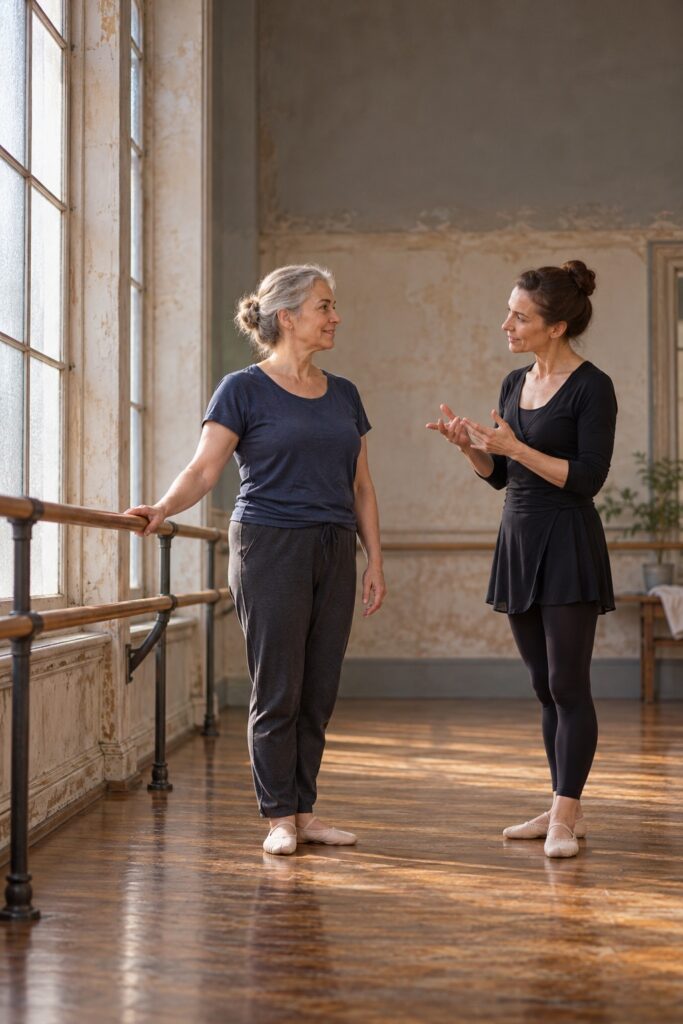
I love all styles of dance, and ballet has a special place in my heart. It’s the one that teaches you posture, control and grace that you then carry into salsa, Zumba, everything. And no, you didn’t need to start as a little girl in a pink tutu. Studios in Chicago have classes made exactly for adults who are walking into a ballet studio for the very first time.
Yes, adults can start ballet with no experience. Many studios offer adult classes called “Basic,” “Ballet Basics” or “Beginner Ballet I” that teach positions and terms from zero. Start with one or two classes a week in fitted clothes and ballet slippers, and focus on technique, not tricks.
Is it too late to start ballet as an adult?
No. Becoming a professional ballerina usually means training from childhood, but that’s a different goal. Dancing ballet for joy, strength, grace and artistry is open to any adult. Adult ballet is its own world, with its own classes, levels, intensives and even performing groups.
Chicago’s big ballet schools say it directly. The Joffrey Ballet’s Grainger Academy has an Adult Division “designed for adult dancers of all abilities,” including people who want to learn dance for the first time, and it describes its Beginner Ballet I as “a great class for those who always wanted to dance ballet but didn’t have the space to be a beginner.” I love that line.
What you can (and can’t) expect as an adult beginner
| Realistic in your first year | Takes longer (and that’s okay) |
|---|---|
| Learning the five positions and the basic barre exercises | Multiple pirouettes |
| Following a full class, barre and center | Big jumps with clean technique |
| Better posture and body awareness | Deep turnout and extensions |
| Understanding the French terms | Pointe work |
| Dancing short combinations to music | Advanced classes |
Adults have advantages too: we understand instructions, we chose to be there, and we usually bring more musicality and expression than we think. Progress comes from showing up regularly, not from talent.
What happens in an adult beginner ballet class?
Almost every ballet class follows the same order, which is wonderful for beginners because you know what’s coming:
- Barre (about half the class). You hold the barre with one hand and do exercises that warm up and train your legs and feet: pliés, tendus, dégagés, ronds de jambe, relevés. Then you turn around and repeat on the other side.
- Center. You step away from the barre and do similar exercises without support, plus port de bras (arm movements) and simple balances.
- Small jumps (petit allegro). Simple jumps like sautés in first position.
- Across the floor. Traveling steps like chassés, walks and simple turns, usually in small groups.
- Révérence. A short, graceful bow to thank the teacher and the pianist. My favorite part.
A typical adult class runs 60 to 90 minutes. At Chicago Ballet Arts, for example, adult classes are 75 to 90 minutes.
The first ballet terms to learn
Ballet’s vocabulary is French. Learn these and you’ll understand most of a beginner class:
| Term | What it means | What you do |
|---|---|---|
| Plié | Bent | Bend your knees, heels down, over your toes |
| Relevé | Raised | Rise onto the balls of your feet |
| Tendu | Stretched | Slide one foot out along the floor to a pointed foot |
| Dégagé | Disengaged | Like a tendu, but the foot lifts a little off the floor |
| Rond de jambe | Circle of the leg | Draw a half-circle on the floor with your pointed foot |
| Passé / retiré | Passed / withdrawn | Bring your toe to the side of your knee |
| Port de bras | Carriage of the arms | Moving the arms through positions |
| Sauté | Jumped | A simple jump |
| Chassé | Chased | A gliding step where one foot “chases” the other |
| Pas de bourrée | Bourrée step | A small three-step linking move |
| Pirouette | Spin | A turn on one leg (it will come!) |
The five positions of the feet
- First: heels together, toes turned out.
- Second: feet apart, about hip-width or a little more, toes turned out.
- Third: the heel of one foot in front of the arch of the other (often skipped in adult classes).
- Fourth: one foot in front of the other with space between.
- Fifth: one foot right in front of the other, heel to toe.
Important: turn out only as far as your hips naturally allow, and keep your knees over your toes. Forcing turnout from the knees or feet is the classic beginner mistake. A good teacher will tell you the same.
What to wear to your first ballet class
Adult classes are much more relaxed than kids’ classes. You don’t need a pink leotard and a bun (unless you want them!).
- Clothes: close-fitting, comfortable clothes so the teacher can see your alignment: leggings or tights, and a fitted top or leotard. The Joffrey Academy asks students wearing a leotard to add tights, shorts or pants, and no costumes or tutus.
- Shoes: ballet slippers. For beginner classes, many studios let you wear socks at first (the Joffrey does).
- Hair: tied back, away from your face and neck.
- Skip: baggy clothes, jewelry that swings, and sneakers.
Choosing ballet slippers
Affiliate disclosure: Some links in this section are affiliate links. If you buy through them, I may earn a commission. As an Amazon Associate I earn from qualifying purchases.
| Type | Pros | Good for |
|---|---|---|
| Full sole | More support; your feet work harder to point | Beginners who want to build foot strength |
| Split sole | Flexible, shows the arch of the foot | Dancers who want a pretty line and easy pointing |
| Leather | Durable, a bit of grip | Most floors |
| Canvas | Light, breathable, washable | Sweaty feet, slippery floors |
Try them on in person if you can. In Chicago, Bloch has a store at 1710 N Wells St in Old Town, and Chicago Dance Supply is at 5301 N Clark St in Andersonville. As an Amazon Associate I earn from qualifying purchases. If you shop online, here are searches for adult leather ballet slippers and canvas ballet slippers.
How often should an adult beginner take ballet?
One class a week will teach you the basics. Two classes a week is where you really start to feel progress, because your body remembers from one class to the next. Some adults add a short practice at home between classes: a few pliés and tendus holding a kitchen counter, or simply learning the terms.
Can adults go on pointe?
Sometimes, but not as a beginner. Pointe requires years of solid technique and strength. The Joffrey’s Adult Division, for example, allows pointe work only for intermediate and advanced adult students at the faculty’s discretion, and never at beginner levels. Its pointe series also requires two ballet technique classes a week. Enjoy the slippers first; they’re beautiful too.
Where to start adult ballet in Chicago
| Studio | Where | Beginner class | Price |
|---|---|---|---|
| The Joffrey Ballet – Grainger Academy, Adult Division | Downtown Chicago (Joffrey’s main address: 10 E Randolph St) | Beginner Ballet I (ages 15+, no training needed) | $22 drop-in; $210 for a 10-class pass |
| Chicago Ballet Arts | 915 Foster St, Evanston | Ballet Basics (ages 18+, no or very little experience) | $18 drop-in |
| Lou Conte Dance Studio | 1147 W Jackson Blvd | Basic-level classes for first-time dancers | Drop-in and class cards |
| Old Town School of Folk Music | 4544 N Lincoln Ave | Adult ballet in 8-week sessions | Varies by session |
| Chicago Park District – Stanton Park | Near North Side | Beginner ballet, Mondays 10:30–11:30 a.m. (fall 2026) | Free |
A few good-to-knows from the studios:
- Joffrey: online registration is required in advance; registration opens 7 days before class. New students should create their account at least one business day ahead. They also run an Adult Winter Intensive, December 21–23, 2026 (registration opens November 3). No photos or videos in class.
- Chicago Ballet Arts: advance registration is strongly suggested because classes are small. There are no classes November 24–29, 2026 for Thanksgiving. They also offer floor barre, an adult ensemble and a summer adult intensive.
- Park District: programs run in seasonal sessions and fill up; check the program search when registration opens.
For more styles and studios, see my guide to adult dance classes in Chicago.
Watch ballet to learn ballet
Watching professionals is part of the training. The Joffrey Ballet performs its season at the Lyric Opera House (20 N Wacker Dr), and seeing a full-length ballet after a few weeks of class is magical: suddenly you recognize the tendus, the chassés, the pas de bourrée.
My tips for your first adult ballet class
- Arrive 10–15 minutes early, introduce yourself to the teacher, and say it’s your first class. (Some studios won’t let you join if you’re more than 10 minutes late, because the warm-up matters.)
- Stand in the middle of the barre, not at the end. You can follow people in front and behind you.
- Don’t compare yourself to the person who danced for 20 years. Compare yourself to you last month.
- Ask questions about terms you don’t understand. Teachers love curious beginners.
- Go back the next week. The second class is when it starts to make sense.
Ballet also makes you better at every other dance. If you love Latin dance like I do, your salsa turns get cleaner and your posture gets prouder. If you’re curious about other styles, I also wrote about learning salsa as a beginner and Zumba for beginners.
Adult ballet clothes: the questions beginners actually ask
Do I need a leotard for adult ballet?
Often no, unless the studio lists one in its dress code. A fitted T-shirt or exercise top with leggings can be a practical first-class outfit. The teacher needs to see your alignment well enough to help you, but you do not need to arrive dressed for a professional audition.
If you prefer a leotard, wear one that stays comfortable when you raise your arms and bend. Tights, leggings or a light skirt may be options depending on the studio. Choose support garments for comfort and security, not because you think an adult beginner must match someone else’s body or costume.
Can I wear socks instead of ballet slippers?
Ask the studio before class. Some teachers allow socks for an introductory session; others require properly fitted slippers because the floor and class exercises make traction important. Bare feet, ordinary socks and ballet slippers do not grip every surface the same way.
Do not practice turns in slippery socks on a polished home floor to test whether you are “ready” for class. And do not buy pointe shoes for a beginner class: pointe work needs a teacher’s assessment, training and appropriate fitting.
Canvas or leather slippers?
Both are used. Fit, studio guidance and how the shoe works on the floor matter more than choosing a material from an internet rule. Your toes should not be painfully curled. A shoe so loose that it twists around the foot is not a good bargain either.
If the studio has a recommended fitter or model, start there. Wear the socks or tights you intend to use when checking fit, and confirm exchange rules before sewing elastic or wearing shoes on a floor.
What should I avoid wearing?
Avoid very loose trousers that hide the feet, long jewelry, watches or accessories that could catch, and clothing you have to pull into place every few counts. Put long hair back securely enough that you can turn your head and see.
A light removable layer is useful before you warm up, but take it off if it blocks movement or your teacher cannot see your alignment. Bring clean indoor shoes and follow the studio’s floor rules. The goal is to spend class thinking about the movement rather than managing your outfit.
FAQ
Can I learn ballet as an adult with no experience?
Yes. Look for classes labeled Basic, Ballet Basics or Beginner Ballet I, which assume no previous experience and start with positions and terms.
Is adult ballet hard?
It’s challenging in a good way. The steps are simple at first, but doing them with good technique takes focus. Beginner classes move slowly and break everything down.
How long does it take to get good at ballet as an adult?
It depends on how often you go. With one or two classes a week, most people feel comfortable with a full beginner class after a few months and move up a level after a year or more.
Do I need to be flexible to start ballet?
No. Flexibility develops with practice. Never force your splits or turnout; work within your natural range.
Can I learn ballet at home?
You can practice at home with videos and a counter as a barre, but a teacher’s corrections are what make the difference, especially for alignment. Use home practice as a complement to classes.
What should I wear to adult ballet?
Close-fitting, comfortable clothes like leggings and a fitted top, and ballet slippers (or socks, if the studio allows them for beginners). Tie your hair back.
Is ballet good cross-training for other dances?
Yes. Ballet builds posture, balance, control and clean turns, which help in salsa, jazz, contemporary and Zumba.
Ready? Put your hair up, find a Basics class, and take your first plié. ¡Tú puedes!