
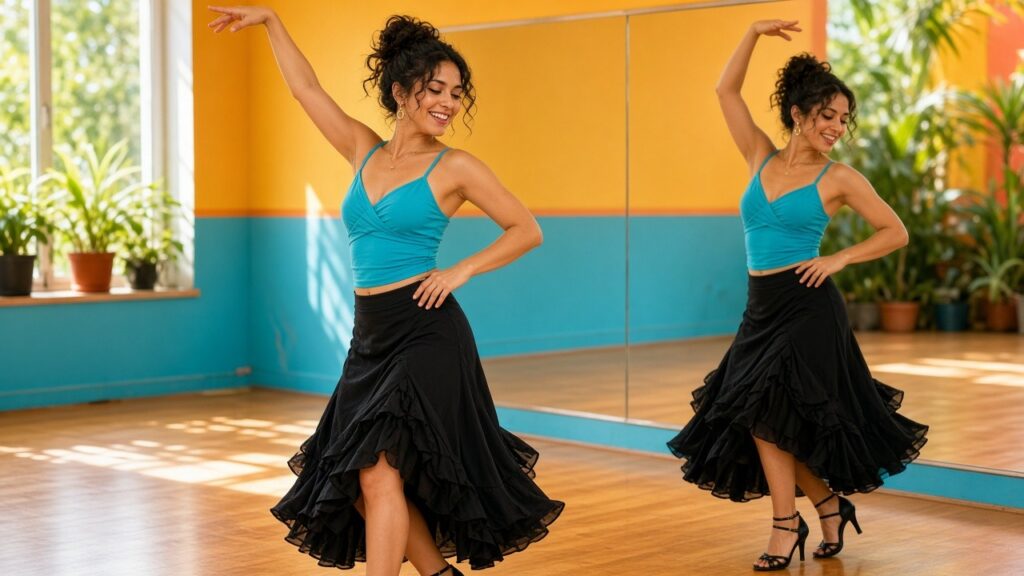
Watch a follower at a salsa social who’s been dancing for a few years. She’s not just turning when she’s led. Her arms frame each spin, her shoulders catch the accents in the music, her hands brush through her hair on a break, and during a shine she adds a little flick of the foot. That’s ladies styling, and it’s what turns following into dancing.
Salsa ladies styling is the personal flair a dancer adds to salsa: arm and hand movements, body movement such as shoulder and hip isolations, footwork variations, shines and styled spins. It’s usually taught in dedicated classes for followers, though anyone can take them. You don’t need to be an advanced dancer, but knowing the salsa basic and simple turns first makes styling easier. With a partner, styling must never interfere with following the lead.
I take ladies-styling classes and practice styling as part of my solo salsa routine. Here’s what styling includes, whether you need to know salsa first, partner vs solo styling, beginner moves, bachata styling, what to wear and how to find a class.
What is salsa ladies styling?
Styling is the expressive layer on top of technique. Leads decide where the couple goes; follows decide how it looks and feels as they get there. Styling lets a follower interpret the music, show personality and make simple patterns look beautiful.
The name “ladies styling” is traditional, because most followers in salsa have historically been women. Today, many studios call it “follower styling” or simply “styling,” and classes are open to anyone who wants to work on body movement and flair.
What styling includes
| Element | What it is | Examples |
|---|---|---|
| Arms | How you carry and move your arms in and out of turns | Framing a spin, sweeping arms on a break, soft wrists |
| Hands | Finishing touches that add elegance | Fingers through the hair, hand to the chest, a flick |
| Body movement | Isolations and posture | Shoulder shimmies, rib cage isolations, body rolls, hip movement |
| Footwork | Variations on the basic | Kicks, flicks, cross-overs, toe taps |
| Shines | Solo footwork sections | Suzie Q, cross-body shines, spins in place |
| Spins | Styled turns | Clean spotting, arm positions, finishes |
| Musicality | Matching the music | Hitting breaks, accenting horns or percussion |
| Presence | Confidence and expression | Posture, eye contact, smile |
Do you need to know salsa first?
You don’t need to be advanced, but it helps to know:
- The basic step in your style (On1 or On2)
- A cross-body lead and a basic right turn
- How to stay on time
If you’re brand new, take a few months of beginner salsa first, then add styling. Some studios offer “styling for beginners” classes that teach basics and styling together, which can work well as a first step. For timing and style choices, see salsa On1 vs On2, and for the beginner path, learn salsa dancing for beginners.
Styling with a partner vs solo
With a partner
The golden rule: follow first, style second. Styling should fit inside the lead without changing your timing or direction. Practical tips:
- Style with your free arm when one hand is connected.
- Use the counts that are yours. The pause counts (4 and 8), the end of a turn and open breaks are natural styling moments.
- Keep a light connection. Don’t drop your partner’s hand to style unless the lead releases you.
- Watch the space. Big arm sweeps on a crowded floor can hit someone.
- Make it small at first. A wrist roll or a shoulder accent is enough.
Solo
Solo styling is where you can practice freely: shines, body movement, arm lines and footwork variations, in front of a mirror or anywhere at home. It builds the vocabulary and confidence you’ll later use with partners. My guide to learning salsa without a partner includes solo routines that pair well with styling.
Basic styling moves to start with
1. Arm framing on a right turn
As you turn, lift your free arm softly in front of your body, elbow slightly bent, then let it float down as you finish facing your partner. It frames the spin and keeps your arm from flailing. For more on balance and spotting, see how to spin in salsa.
2. Hair sweep
On a break where your free hand is available, run your hand from the side of your face back over your hair, then let it extend away. Keep it smooth and on the beat.
3. Shoulder shimmy
During a basic or on a pause, shimmy your shoulders forward and back, keeping your hips and feet steady. Start slowly; speed comes later.
4. Body roll
From the chest down through the hips, a wave-like movement on a slow part of the music. Practice it standing in front of a mirror first.
5. Wrist rolls
Rotate your wrist softly as your arm extends out of a turn. Small, elegant, and easy to fit into almost any pattern.
6. Hip accents
On the forward break, let your hip follow the weight change, adding a little emphasis. Your hips move because your knees and weight move, not because you push them.
7. Footwork flick
On the pause (count 4 or 8), lightly flick or tap your free foot instead of standing still.
8. Suzie Q shine
A classic shine in which you cross one foot over the other while swiveling the heels. It builds coordination and is used in both salsa and Zumba.
Bachata ladies styling (brief)
Bachata styling uses many of the same ideas: arm lines, hair sweeps, body rolls and hip accents, adapted to bachata’s slower tempo and closer connection. Body waves and chest isolations are especially common. Some studios teach dedicated bachata styling classes. If you’re starting bachata, read how to dance bachata for beginners and bachata sensual vs Dominican bachata.
What to wear and heels
| Item | Recommendation |
|---|---|
| Shoes | Dance shoes with suede soles; heel height you can balance and spin in (many beginners start around 2 to 2.5 inches) |
| Practice shoes | Dance sneakers or low-heeled practice shoes for long classes |
| Clothing | Fitted or flowy clothing that lets your arms and torso move; a skirt helps you see your spins |
| Hair | Tie it up for technique classes, wear it down to practice hair styling |
| Jewelry | Small and secure; avoid bracelets and rings that catch a partner |
Styling classes often include heel work, so bring the shoes you’ll actually dance in at socials. For more details, see what to wear salsa dancing.
How to find a class and what to expect
Where to look
- Salsa studios often offer weekly ladies-styling or follower-technique classes.
- Dance festivals and congresses run styling workshops.
- Online classes are useful for solo styling drills.
- In Chicago, many Latin dance studios and community programs include styling in their schedules. See salsa dancing in Chicago and adult dance classes in Chicago.
What to expect
- Warm-up with isolations and body movement
- Technique such as spins, posture and arm lines
- Combinations of styling moves to music, often taught as a short choreography
- Mirror work, since styling is visual
- A supportive atmosphere. Styling classes are often social and encouraging.
If you feel self-conscious about body movement, that’s common. My guide on how to not feel awkward dancing can help.
How to add styling without missing the lead
- Start with one move per song. Choose something small like a wrist roll.
- Style at natural pauses: counts 4 and 8, the end of a turn, open breaks.
- Keep your frame active. If your connected arm goes limp, you’ll miss the next lead.
- Stay on time. Styling never replaces stepping on the beat.
- Watch for the next prep. Leads usually prepare a turn on the count before; stop styling and respond.
- Practice with partners who know you’re learning. Ask friends to dance slow patterns while you try styling.
How styling differs by salsa style
| Style | Styling character | Typical focus |
|---|---|---|
| LA style (On1) | Glamorous, sharp lines, dramatic arms | Spins, arm framing, hair sweeps, dips |
| New York (On2) | Smooth, groovy, elegant | Shines, body movement, musical accents |
| Cuban casino | Earthy, playful, grounded | Hips, shoulders, Afro-Cuban movement, despelote |
| Colombian (Cali) | Fast and sparkly | Quick footwork, kicks, flicks |
None is better; choose the one that matches the salsa you dance socially. For the differences between styles, see Cuban salsa vs LA-style salsa.
How long until styling feels natural?
Most people need a few months of regular styling classes or home practice before moves start appearing on their own during social dances. At first, styling feels planned: you think “now I’ll do a hair sweep.” Over time, the music triggers it. Keep practicing a handful of moves until they’re automatic, then add new ones. Filming yourself every few weeks shows progress you might not feel.
Common styling mistakes
- Styling instead of following. Missing leads because you were busy with your arms.
- Too much, too soon. Every count doesn’t need a move.
- Stiff arms. Keep elbows soft and wrists relaxed.
- Copying without understanding. Learn why a move works, so it fits your body and the music.
- Forgetting posture. Great styling starts with tall, confident posture.
A 10-minute home styling routine
| Minutes | Practice |
|---|---|
| 0 to 2 | Shoulder and rib cage isolations |
| 2 to 4 | Body rolls, slow then on the beat |
| 4 to 6 | Arm framing with slow spins |
| 6 to 8 | Footwork flicks and a Suzie Q shine |
| 8 to 10 | Freestyle one song, combining what you practiced |
Practice in front of a mirror and occasionally film yourself to see what works.
FAQ
Do I need to know salsa to start ladies styling?
It helps to know the basic step and simple turns first. Some studios offer beginner styling classes that teach basics and styling together, but most styling classes assume you can already dance a basic on time.
Is ladies styling only for followers?
No. Traditionally it’s taught to followers, who are often women, but many classes are open to anyone. Leads also benefit from styling and body movement classes, and many studios now call them follower or general styling classes.
What do I do with my arms in salsa?
When connected, keep a gentle, active frame. When free, keep your arm softly in front of your body during turns, then use it for styling at natural pauses: framing, hair sweeps, wrist rolls or extending away. Avoid flailing or letting it hang limp.
Can I take styling classes in Chicago?
Yes. Many Chicago Latin dance studios and programs offer ladies- or follower-styling classes, and workshops appear at local events and festivals. Check studio schedules, since offerings change by season.
How do I add styling without missing the lead?
Style only at natural pauses, start with small moves, keep your connected arm active and stop styling when you feel a turn being prepared. Following always comes first.
Can I learn styling online?
Yes, for solo work. Online classes are great for isolations, arm lines, shines and spin technique you can practice in front of a mirror. Partner styling, adding flair while following a real lead, is best practiced in person at classes and socials.