
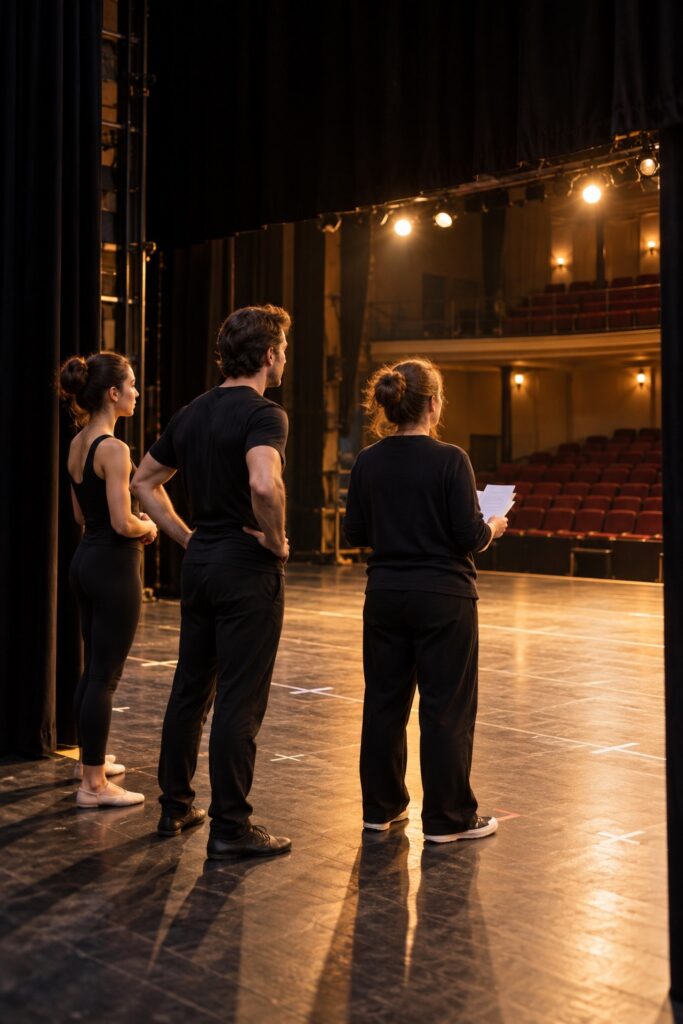
There’s nothing like the moment the lights go down and you hear the first notes of your song. Whether it’s a studio showcase, a recital, a Zumba demo at a festival or a Latin dance team performance, being on stage turns months of classes into something unforgettable. Preparing well is what lets you actually enjoy it. Here’s my timeline, checklist and favorite tricks.
To prepare for a dance performance, rehearse the choreography until it’s automatic (weeks ahead), practice full-out in costume and shoes, attend every spacing and dress rehearsal, pack a backstage bag the night before, sleep well, eat a familiar meal, warm up before you go on, and keep dancing if you make a mistake.
Your performance prep timeline
| When | What to do |
|---|---|
| 6–8 weeks before | Learn the choreography; record every rehearsal; ask about costume, shoes and hair |
| 3–4 weeks before | Know the routine without counting; practice full-out at home; get your costume and try it on |
| 2 weeks before | Run the routine in costume and performance shoes; work on facials and expression |
| 1 week before | Spacing and dress rehearsals; break in anything new; plan hair and makeup |
| The day before | Pack your bag, light run-through, early night |
| Performance day | Arrive at call time, warm up, check your costume, breathe, enjoy |
Weeks before: make the choreography automatic
You want your body to remember the routine so your mind can focus on performing.
- Record every rehearsal (if allowed) and watch it at home.
- Practice in sections, then the full routine. Start each run from a different section, so you can recover from anywhere.
- Know the counts AND the music. Learn which move goes with which lyric or instrument. If the music skips or someone rushes, you’ll still know where you are.
- Practice “full-out” (with full energy and size) at least a few times a week, not just “marking” (small, low-energy).
- Mentally rehearse: close your eyes and dance the routine in your head, beat by beat. It’s surprisingly powerful, and you can do it on the bus.
- Practice your formations: where you stand, who’s next to you, where you travel.
Performance quality: facials and energy
Technique is half of it. The audience feels your energy.
- Look up and out, to the back of the room, not at the floor.
- Match your face to the song: joy for a cumbia, fire for a salsa, softness for a bolero.
- Make movements bigger than in class. Stage lights and distance make everything look smaller.
- Finish every move, including the last pose. Hold it until the lights go out or the music truly ends.
The week before: rehearsals and costume
Spacing and tech rehearsal
In the performance space, you’ll learn where everything is. Pay attention to:
- Stage directions: stage left and right are from the performer’s point of view, facing the audience. Downstage is toward the audience, upstage is away.
- Spike marks: small pieces of tape on the floor that mark your spots.
- The wings: where you enter and exit.
- The floor: slippery? sticky? raked? Test turns in your shoes.
- The lights: bright stage lights can make it hard to see the audience and can feel disorienting at first. Find a spot to focus on (like an exit sign).
Dress rehearsal
Treat it like the real show: costume, shoes, hair and makeup. It’s where you discover the strap that slips, the skirt that catches your heel, or the earring that flies off in a turn. Fix everything that day.
Costume tips
- Dance a full run in the costume before the show.
- Secure everything: safety pins, fashion tape, a stitch where needed.
- Practice quick changes if you have them, and lay out your next costume in order.
- Put your name in everything.
The day before
- Pack your bag (checklist below).
- Do a light run-through, not a hard rehearsal. Save your energy.
- Get a good night’s sleep.
- Plan your timing: how you’ll get there, parking or transit, and your call time.
Backstage bag checklist
| Category | Pack |
|---|---|
| Costume | Costume(s), undergarments, tights, a backup pair of tights |
| Shoes | Performance shoes, plus sneakers or slides for backstage |
| Hair | Brush, hair ties, bobby pins, hairspray, gel, hair accessories (see how to do a dance bun) |
| Makeup | Your makeup, setting spray, makeup remover wipes, lashes and glue if needed |
| Fixes | Safety pins, fashion tape, a small sewing kit, scissors, clear nail polish for runs |
| Comfort | Water bottle, snacks you know you like, a warm layer, a cover-up for your costume |
| Personal | Phone and charger, any personal items you need, a towel, deodorant |
Stage makeup tip
Stage lights wash out your face, so stage makeup is usually stronger than everyday makeup: more defined brows, stronger eyes and lashes, more blush and a bold lip. Choose long-wearing, sweat-resistant products and a setting spray, because you’ll be warm under the lights. Your director may have specific instructions; follow them.
Performance day
- Eat a normal meal that you know works for you, a few hours before. Nothing new today.
- Drink water throughout the day.
- Arrive at your call time (or a little earlier).
- Warm up properly: 15–20 minutes of light cardio, gentle stretches and the moves from your routine. Stay warm while you wait with a jacket or sweats over your costume.
- Do a mental run-through of the routine.
- Check your costume one last time: pins, straps, shoes, hair.
- Listen for “places” and be in your spot in the wings on time.
Calming performance nerves
Nerves are normal, and they mean you care. A little adrenaline makes you dance with more energy.
- Breathe slowly: in for 4 counts, hold for 4, out for 4, hold for 4. Repeat a few times.
- Shake it out: shake your hands, roll your shoulders, bounce lightly.
- Change the story: “I’m nervous” becomes “I’m excited.” The feeling is surprisingly similar.
- Focus on your first move only. Once you start, your body takes over.
- Remember the audience is on your side. Friends and families came to cheer for you, not to judge you.
What if I make a mistake on stage?
Keep going. The audience doesn’t know the choreography. If you smile and continue, almost nobody will notice.
- Forgot a step? Keep a simple move on the beat (a step touch or a basic step) and rejoin at the next 8-count.
- Slipped or stumbled? Get up with confidence and keep dancing. The audience will cheer.
- Costume problem? Keep dancing unless it’s unsafe; adjust when you can.
- Bumped into someone? Smile, adjust your spacing, keep going.
After the show, you’ll realize the “disaster” lasted two seconds.
After the performance
- Cool down and stretch gently.
- Hang up your costume and collect your things.
- Celebrate! With your team, your family, your friends.
- Watch the video later, and notice what you did well first.
Where to perform as an adult in Chicago
You don’t have to be a professional to perform. Many adult programs end with a showcase:
- The Old Town School of Folk Music runs dance classes in 8-week sessions that often end with an optional showcase.
- Raks Geek fusion bellydance classes at the Newport Theater end with a student showcase (Sunday, November 22, 2026, for the fall session).
- Chicago Ballet Arts in Evanston has an Adult Ensemble that rehearses and performs, with no audition required.
- Latin dance studios often have student teams and performances; ask your studio.
Find classes in my guide to adult dance classes in Chicago, and if nerves are what’s holding you back, start with how to not feel awkward dancing. Learning a long routine? My tips on how to memorize Zumba choreography work for any style.
FAQ
How do I remember my choreography on stage?
Rehearse until it’s automatic, link moves to the music, practice starting from different sections, and do mental run-throughs. On stage, focus on the next move, not the whole routine.
What should I eat before a dance performance?
A normal, familiar meal a few hours before, and water throughout the day. Avoid trying anything new on performance day.
How early should I arrive for a performance?
At your call time, or a little earlier. That gives you time to change, do hair and makeup, warm up and calm your nerves without rushing.
How do I stop shaking before going on stage?
Breathe slowly (4 counts in, 4 out), shake out your hands and shoulders, and stay warm. Shaky nerves usually disappear with the first move.
How long should I warm up before performing?
About 15–20 minutes: light cardio, gentle stretches and some moves from your routine. Stay warm while you wait.
What does “full-out” mean?
Dancing with full energy, size and expression, as you would in the performance, as opposed to “marking” (doing the moves small to save energy or to review).
¡Mucha suerte! Enjoy every second on that stage.