
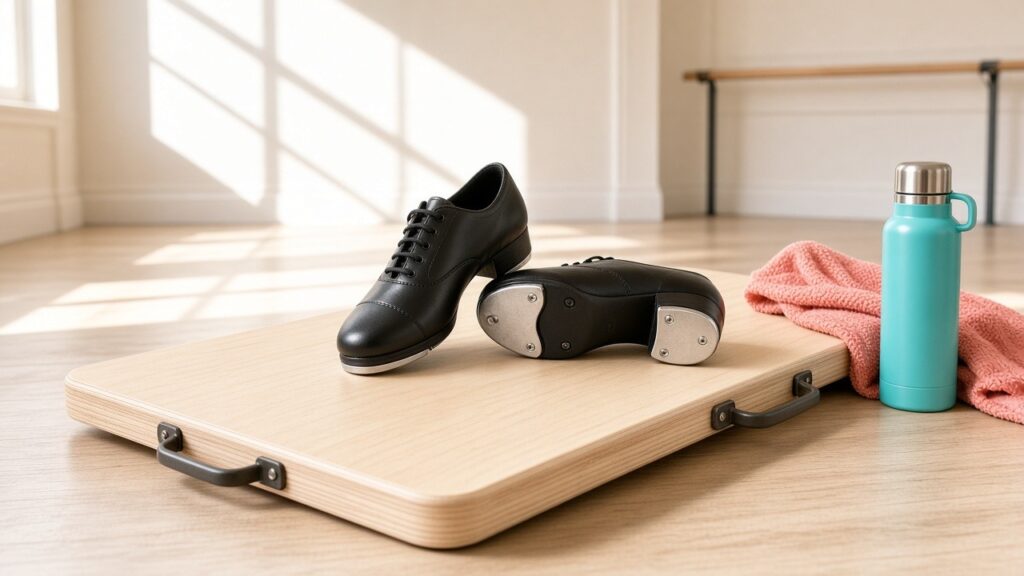
Tap is pure joy: your feet become a drum. I love it because it trains your rhythm like nothing else, and that rhythm comes with me to salsa and Zumba. The good news is that tap is one of the easiest dance styles to start at home. You need shoes, a small board and some patience with your neighbors (here is how to make tap shoes quieter). Here’s how to do it right.
Yes, you can teach yourself the basics of tap dance at home with tap shoes, a tap board and good video lessons. Start with toe taps, heel drops, shuffles, flaps and ball changes, practice 15–20 minutes most days, and record yourself. Add an in-person class to correct technique and learn to dance with others.
Can you really learn tap on your own?
You can learn the first steps, the sounds and many beginner combinations on your own. Tap has a big advantage for self-learners: you can hear your mistakes. A shuffle should make two clear sounds. If you hear one, or a blurry “shh,” you know it’s not there yet.
What’s harder alone:
- Technique details: relaxed ankles, weight placement and using the right part of the foot. A teacher spots these in seconds.
- Bad habits: stomping with stiff legs, or dancing with your weight on your heels, are easy to build and hard to undo.
- Rhythm with others: tap is a conversation with the music and other dancers. Classes and jams teach that.
My advice: start at home, and add a class once you’re hooked. Even a few classes give you corrections that make your home practice much better.
What you need to tap dance at home
| Item | What to look for | Budget tip |
|---|---|---|
| Tap shoes | Leather or synthetic, with metal taps screwed onto the toe and heel; snug fit | Beginner oxford-style tap shoes are the most versatile |
| A tap board or floor | Wood or a portable tap board | A board protects your floors and sounds better |
| Video lessons | Clear close-ups of the feet, structured levels | Free YouTube to start; a paid course for structure |
| Music | Swing and jazz at a slow tempo, then faster | Use an app that slows songs down |
| A phone | To record your feet | Watch it back with sound |
Tap shoes
Affiliate disclosure: Some links in this section are affiliate links. If you buy through them, I may earn a commission. As an Amazon Associate I earn from qualifying purchases.
Tap shoes have metal plates (the “taps”) screwed onto the toe and heel. The Chicago Human Rhythm Project describes them simply: generally leather with aluminum toe and heel taps. For adult beginners:
- Oxford (lace-up) tap shoes are the classic choice and fit securely.
- Low-heel character tap shoes are popular in musical theatre styles.
- Fit: snug, like a second skin, with your toes near the end but not curled. A loose shoe makes muddy sounds.
Try them on at a dance shop if you can. In Chicago, Bloch (1710 N Wells St) and Chicago Dance Supply (5301 N Clark St) both carry dance shoes; call to ask about tap shoes in your size.
As an Amazon Associate I earn from qualifying purchases. If you shop online, start with adult beginner tap shoes.
Where to tap at home
Never tap on tile, stone or concrete: it’s hard on your body, it damages the taps, and it sounds harsh. Carpet absorbs all the sound. And tap shoes can scratch nice wood floors.
The solution is a portable tap board: a piece of plywood or a purpose-made wooden board. Look for:
- At least 2 × 3 feet (bigger is better for traveling steps).
- Plywood or hardwood with some give; some have a rubber backing to reduce noise and keep the board from sliding.
- A smooth, sealed top so your taps don’t catch.
Portable tap boards on Amazon come in different sizes, or a hardware store can cut a sheet of plywood for you.
Neighbor tip: if you live in an apartment (hola, Chicago two-flats!), practice at reasonable hours, put a rug or yoga mat under the board, and tell your downstairs neighbors. A little warning goes a long way.
The first 10 tap steps to learn
Learn them in this order. Each one builds on the one before.
| Step | Sounds | How to do it |
|---|---|---|
| Toe tap | 1 | Lift the front of your foot and tap the toe down, heel stays on the floor |
| Heel drop | 1 | Stand on the ball of your foot and drop the heel |
| Step | 1 | Transfer your full weight onto the ball of the foot |
| Stamp / stomp | 1 | Stamp = put your whole foot down and keep the weight; stomp = hit and lift, no weight change |
| Brush | 1 | Swing the leg and strike the floor with the ball of the foot on the way forward (or back) |
| Shuffle | 2 | A brush forward and a brush back, loose ankle |
| Flap | 2 | A brush forward that lands as a step, weight changes |
| Ball change | 2 | Step on the ball of one foot, then quickly the other |
| Step heel | 2 | Step on the ball, then drop the heel |
| Cramp roll | 4 | Ball, ball, heel, heel in quick order |
Once these feel comfortable, combine them: shuffle ball change, flap ball change, and then the famous time step, a short rhythm pattern that tap dancers use as a warm-up and a building block.
Learn the Shim Sham
When you’re ready for your first full routine, learn the Shim Sham Shimmy. It’s a classic tap routine that’s often called the “national anthem” of tap, and dancers all over the world know it. If you ever go to a tap jam or festival, there’s a good chance someone will start a Shim Sham, and you can join in.
Tips for learning tap at home
- Relax your ankles and knees. Tension is the enemy of clear sounds. Shuffles come from a loose ankle, not a stiff leg.
- Stay over the balls of your feet. Most tap happens with your weight forward.
- Go slow, then faster. Clean sounds at a slow tempo first. Speed comes later.
- Count out loud. “And-one, and-two.” Tap is music; counting keeps you honest.
- Record yourself with sound, and listen with your eyes closed. Even sounds = good technique.
- Practice a little, often. Fifteen to twenty minutes most days beats two hours on Saturday.
- Warm up first: march, roll your ankles and do some easy toe taps before fast work.
A simple 4-week home practice plan
| Week | Focus | Daily practice (15–20 min) |
|---|---|---|
| 1 | Single sounds | Toe taps, heel drops, steps, stamps and stomps to a slow song |
| 2 | Brushes and shuffles | Brushes front and back, shuffles slow, then to music |
| 3 | Two-sound steps | Flaps, ball changes, step heels; shuffle ball change |
| 4 | Combinations | Cramp rolls, flap ball change, a simple time step |
Each week, record the same 30-second combination and compare. You’ll hear the progress.
Online tap lessons
- Free videos on YouTube are great for single steps. Look for teachers who show the feet up close and call out the sounds.
- Structured courses tell you what to learn next. United Taps, for example, is an online tap program created by tap teacher Rod Howell in 2006, built for everyone from absolute beginners to advanced dancers; it’s a one-time purchase rather than a subscription.
Tap classes in Chicago (when you’re ready)
Chicago has a real tap community. A few places to try a class:
| Where | Address | What to know |
|---|---|---|
| Chicago Human Rhythm Project (CHRP) | Classes at the Fine Arts Building (410 S Michigan Ave) and the Mayfair Arts Center (8701 S Bennett Ave, Calumet Heights) | Chicago’s tap organization; Tap 1 classes with Lane Alexander for beginners. Info: 312-922-1272 |
| Chicago Park District – McFetridge Sports Center | 3843 N California Ave | Adult tap, Fridays 6–7 p.m., fall 2026 session ($88) |
| Old Town School of Folk Music | 4544 N Lincoln Ave | Adult tap in 8-week sessions |
| Lou Conte Dance Studio | 1147 W Jackson Blvd | Drop-in tap classes with levels from Basic up |
CHRP also produces Rhythm World, its tap festival, and it’s a wonderful way to see what tap can be. For more studios and styles, see my guide to adult dance classes in Chicago.
Tap step glossary: counts, weight and a drill for each
Tap terminology can vary a little between teachers. Listen to the demonstration and the rhythm, not just the name. The important beginner question is often where your weight ends up, because that determines which foot is free for the next sound.
| Step | Sound pattern | Weight idea | Slow practice drill |
|---|---|---|---|
| Toe tap / toe touch | One front-tap sound | Usually no transfer in this basic drill | Four right, four left, keeping the standing knee soft |
| Heel drop | One heel sound | Heel lowers from a raised position | Rise gently onto both forefeet, lower one heel at a time |
| Step | One ball-of-foot sound | Transfer onto the stepping foot | Walk slowly on the balls of the feet without gripping the toes |
| Stamp | One whole-foot sound | Put weight onto the foot in this usage | Alternate four slow stamps with controlled knees |
| Stomp | One whole-foot sound | Strike and lift without transfer in this usage | Stomp, lift, pause; keep balance on the standing side |
| Brush | One forward or backward sound | Free foot stays free | Brush forward, pause, brush back, pause |
| Shuffle | Brush forward and brush back | Usually no transfer by itself | Two sounds evenly, then leave a full beat of silence |
| Flap | Brush forward, then step | Transfer on the second sound | Say “brush-step” slowly before making it quicker |
| Ball change | Two quick weight transfers | Ball of one foot, then the other | Small back-side ball change with no jumping |
| Step heel | Ball then heel | Stay on the same foot through the heel | Right step-heel, left step-heel, slow and even |
| Cramp roll | Ball, ball, heel, heel | Weight moves through the sequence | Right ball, left ball, right heel, left heel; then reverse |
How should I count a shuffle or flap?
Start with two evenly spaced sounds, such as “1-and,” before trying different rhythmic placements. A shuffle leaves the foot available afterward; a flap finishes with a step onto it. If you cannot tell where your weight went, slow down rather than making the ankle work harder.
Do not lock the supporting knee. Keep the ankle loose enough for a clear brush, but do not force a large swing or kick the floor. Small controlled sounds are more useful than loud, tense ones.
A five-minute accuracy drill
- One minute of single brushes with pauses, alternating feet.
- One minute of shuffles: two sounds, then a quiet beat to reset.
- One minute of flaps, concentrating on the weight transfer.
- One minute of step-heels, aiming for equally clear sounds.
- One minute of a very slow cramp roll, reversing the starting foot halfway through.
Use a slow metronome if helpful, but lower the tempo if you begin rushing. Record a short audio clip: your ears may notice an extra scrape or missing sound before your eyes do. Stop if you feel pain, and ask a qualified teacher to check technique if the same problem persists.
Is a toe tap the same as a toe stand?
No. Names can overlap in casual speech, but striking the front tap in a beginner drill is not permission to put body weight onto the extreme toe of the shoe. Toe stands and advanced work need appropriate instruction. Keep this glossary with the basic sound-and-weight exercises it describes.
FAQ
How long does it take to learn tap dance?
With regular short practice, most beginners can do the basic steps clearly in a few weeks and a simple time step and short routine in a few months. Clean, fast footwork takes longer, and that’s part of the fun.
Is tap dance hard for adults?
The first steps are simple, and adults usually learn them quickly. The challenge is relaxing your ankles and keeping clear rhythm at faster tempos. It’s very beginner-friendly.
Can I tap dance in regular shoes?
You can practice the movements in hard-soled shoes, but without taps you won’t hear the sounds, which is half the learning. Get tap shoes when you’re ready to practice seriously.
Can I tap dance on carpet?
Not well. Carpet absorbs the sound and makes your feet catch. Put a tap board on top of the carpet instead.
What’s the best floor for tap dance?
Wood with a little give, like a sprung studio floor or a wooden tap board. Avoid tile, stone and concrete.
Do I need to read music to tap dance?
No. You need to count and feel rhythm. Tap will actually teach you a lot about music, like how to hear the beat and syncopation.
Is tap good for other dance styles?
Yes! Tap trains rhythm, timing and quick feet. I notice it in my salsa footwork and even in Zumba. If you love rhythm, try salsa as a beginner too, and if you’re also curious about ballet, here’s how adults can start ballet.
Put on some swing music, step onto your board and start with one clear toe tap. ¡Que suene!