
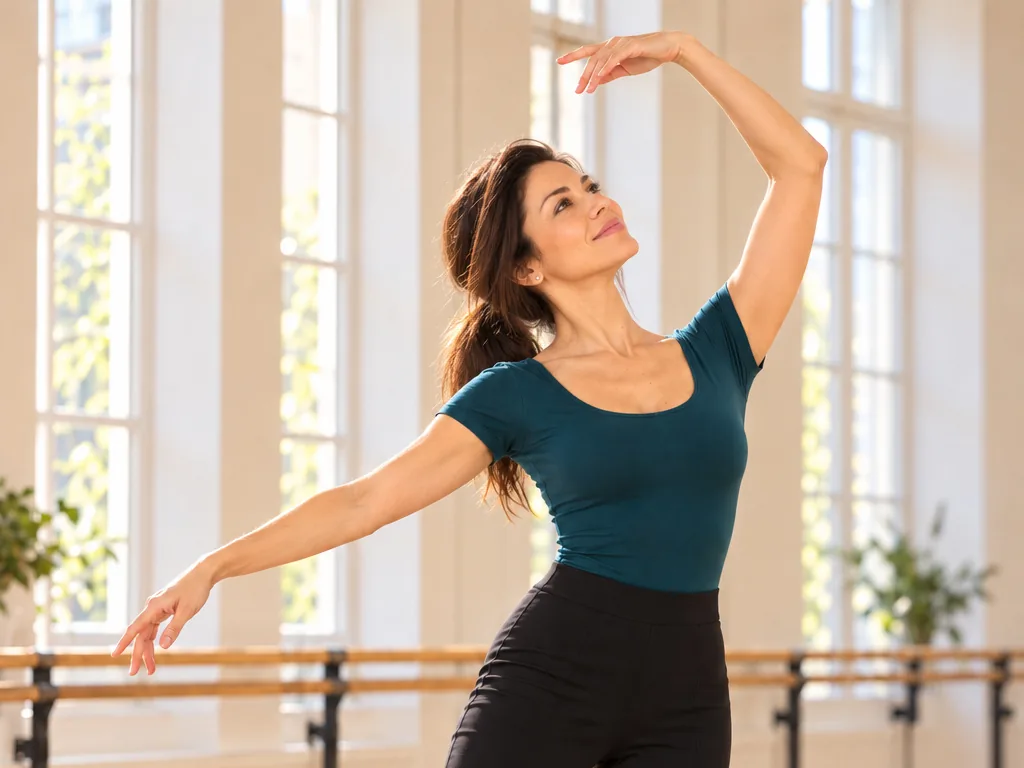
Jazz class is pure showtime. Big energy, sharp moves, a little sass, and those moments when the whole class hits the same pose on the last beat. I love that it mixes everything: the technique of ballet, the rhythm of African and Latin dance, and the personality of Broadway. And Chicago is one of the great jazz dance cities in the world. Here’s how to begin.
To start jazz dancing, learn the basic posture and isolations, then the core steps: jazz walks, chassé, pas de bourrée, jazz square, ball change, kicks and a simple pirouette. Practice to upbeat music with energy and style, and take a beginner jazz class to learn technique and choreography.
What is jazz dance?
Jazz dance grew out of the vernacular dances of African American communities in the early 20th century, the same roots as tap, the Charleston and the Lindy Hop, and later absorbed ballet technique, Latin rhythms and Broadway theatre. Today it’s high-energy, expressive and full of personality.
Jazz dance styles
| Style | What it’s like | You’ll recognize it from |
|---|---|---|
| Broadway / musical theatre jazz | Big, expressive, tells a story | Musicals, show choirs |
| Fosse style | Turned-in knees, hats, isolated hands and hips, cool and precise | Chicago the musical, Cabaret |
| Lyrical jazz | Smooth and emotional, between jazz and ballet | Dance competitions |
| Contemporary jazz | Mixes jazz with modern and contemporary dance | Concert dance companies |
| Street / commercial jazz | Influenced by hip hop and pop | Music videos, concerts |
| Latin jazz | Jazz technique with Latin rhythms and hips | My personal favorite, ¡claro! |
| Classic jazz | Clean lines, sharp style, smooth and cool | Classic movie musicals |
Step 1: Jazz posture and isolations
Jazz has a lower, more grounded center than ballet:
- Knees soft and ready to move; jazz often uses a bent-knee “plié” stance.
- Core engaged, chest open, shoulders down.
- Arms with energy to the fingertips. Even a resting arm is alive.
Isolations are moving one body part while the rest stays still. They’re a staple of jazz warm-ups:
- Head: forward, back, side to side, small circles.
- Shoulders: up and down, forward and back, rolls.
- Ribcage: side to side, forward and back.
- Hips: side to side, forward and back, circles.
Practice them in front of a mirror. When your ribs move while your hips stay still, you’ll feel like a real jazz dancer.
Step 2: The 12 basic jazz steps
| Step | What it is | Beginner tip |
|---|---|---|
| Jazz walk | A low, smooth walk in plié, rolling through the foot | Stay low and confident |
| Chassé | A gliding step where one foot “chases” the other | Keep it smooth, not bouncy |
| Pas de bourrée | Back, side, front: a quick three-step linking move | Say “back-side-front” out loud |
| Ball change | A quick weight change from the ball of one foot to the other | Light and quick on “and-1” |
| Jazz square (jazz box) | Cross, back, side, front, drawing a square | Classic and easy to learn |
| Step touch with style | Step to the side, touch, add arms and attitude | Make it yours |
| Kick ball change | Kick, step on the ball of the foot, change weight | Point the foot on the kick |
| Hitch kick | Lift one knee, then kick the other leg as you hop | Start low |
| Fan kick | The leg sweeps in a fan shape across the body | Control the leg, don’t fling it |
| Jazz turn / pirouette | A turn on one foot, usually from a passé position | Spot your head on a fixed point |
| Chainé turns | Quick traveling half-turns on two feet | Spot, spot, spot! |
| Jazz hands | Fingers spread wide, energy out | Yes, it’s a real step, and it’s fun |
Later you’ll add leaps (like the grand jeté), contractions (curling the torso), layouts and floor work, but every one of them is built on these basics.
What happens in a beginner jazz class?
Most jazz classes follow a structure:
- Warm-up (15–20 minutes): isolations, pliés, stretches, core work, often to fun music.
- Technique and progressions: turns, kicks and balances, sometimes at the barre.
- Across the floor: chassés, jazz walks, leaps and turns, in small groups moving diagonally across the room.
- Combination (choreography): the teacher teaches a routine in 8-counts and you dance it in groups. The best part!
- Cool-down and stretch.
Classes are usually 60 to 90 minutes long.
What to wear to jazz class
Affiliate disclosure: Some links in this section are affiliate links. If you buy through them, I may earn a commission. As an Amazon Associate I earn from qualifying purchases.
- Clothes: fitted, comfortable clothes so the teacher can see your lines: leggings, jazz pants or shorts, and a fitted top or tank.
- Shoes: jazz shoes, soft leather or synthetic shoes with a thin sole that let you turn and point your feet. Split-sole jazz shoes are the most popular. Some classes let you dance in socks or barefoot; ask first. Jazz sneakers are a cushioned option for more street-style classes.
- Hair: tied back.
As an Amazon Associate I earn from qualifying purchases. If you shop online, here’s a search for adult split-sole jazz shoes. To try them on in Chicago, Bloch (1710 N Wells St) and Chicago Dance Supply (5301 N Clark St) carry dance shoes; GUS also mentions its own shop for dance shoes and attire.
A 4-week beginner practice plan
| Week | Focus | 15–20 minutes, 3–4 times a week |
|---|---|---|
| 1 | Posture and isolations | Head, shoulder, ribcage and hip isolations to music; jazz walks |
| 2 | Linking steps | Chassé, pas de bourrée, ball change, jazz square |
| 3 | Kicks and turns | Kick ball change, low fan kicks, quarter and half turns with spotting |
| 4 | Combination | Learn a short 16-count routine from a beginner video, then perform it for your phone camera |
Practice on a smooth floor with room to move, and always warm up first.
Jazz dance in Chicago
Chicago has a special place in jazz dance history. Gus Giordano and his wife Peg founded their dance school in Chicago in 1953, and Giordano’s jazz technique became known around the world. The Giordano Dance Chicago company still performs his style of jazz today. And Lou Conte founded Hubbard Street Dance Chicago here in 1977; his studio still teaches adult classes.
Here are places where adults can take jazz classes:
| Where | Address | Class and price |
|---|---|---|
| GUS® (the original Gus Giordano Dance School) | 5230 N Clark St (Andersonville), 773-275-5230 | Adult drop-in classes including jazz, ballet, contemporary and tap; $15 per hour, pay by the class, classes never expire |
| Chicago Park District – McFetridge Sports Center | 3843 N California Ave | Adult jazz, Fridays 5–6 p.m., fall 2026 session ($88) |
| Lou Conte Dance Studio | 1147 W Jackson Blvd | Drop-in jazz classes with levels from Basic up |
| Old Town School of Folk Music | 4544 N Lincoln Ave | Adult jazz in 8-week sessions |
For more styles and studios, see my guide to adult dance classes in Chicago. Love rhythm in your feet too? Here’s how to teach yourself to tap dance.
Tips for your first jazz class
- Bring energy. Jazz is about performance, even in class. Smile, look up, sell it!
- Learn the counts. Ask the teacher to repeat the counts if you’re lost.
- Mark it first: walk through the steps small before dancing them full out.
- Stand in the second or third row, so you can see someone in front of you and the mirror.
- Don’t worry about kicks and splits. Height and flexibility come with time; technique comes first.
- Have fun with your style. Jazz loves personality.
FAQ
Can I learn jazz dance as an adult beginner?
Absolutely. Look for classes labeled Basic, Beginner or Jazz 1. They start with isolations, basic steps and simple combinations.
Is jazz harder than hip hop?
They’re different. Jazz uses more ballet-based technique (turns, kicks, pointed feet), while hip hop is more grounded and groove-based. Many beginners find hip hop more natural at first and jazz more technical. Here’s my guide to hip hop for beginners.
Do I need ballet to take jazz?
No, but it helps. Jazz uses some ballet terms and positions. Taking a ballet class too makes your jazz turns and lines stronger. See can adults start ballet.
What’s the difference between jazz and contemporary?
Jazz is upbeat, rhythmic and performance-focused, with sharp moves. Contemporary is more fluid and emotional, using floor work, release and breath.
What shoes do I need for jazz?
Jazz shoes with a thin, flexible sole (split-sole is the most popular). Some classes allow socks or bare feet, especially for lyrical and contemporary jazz.
How long does it take to learn jazz dance?
With one or two classes a week, most beginners can follow a full beginner class in a couple of months. Turns, kicks and leaps keep improving for years, and that’s the fun.
Put on something upbeat, find your jazz walk, and give it some sass. ¡Con todo!