
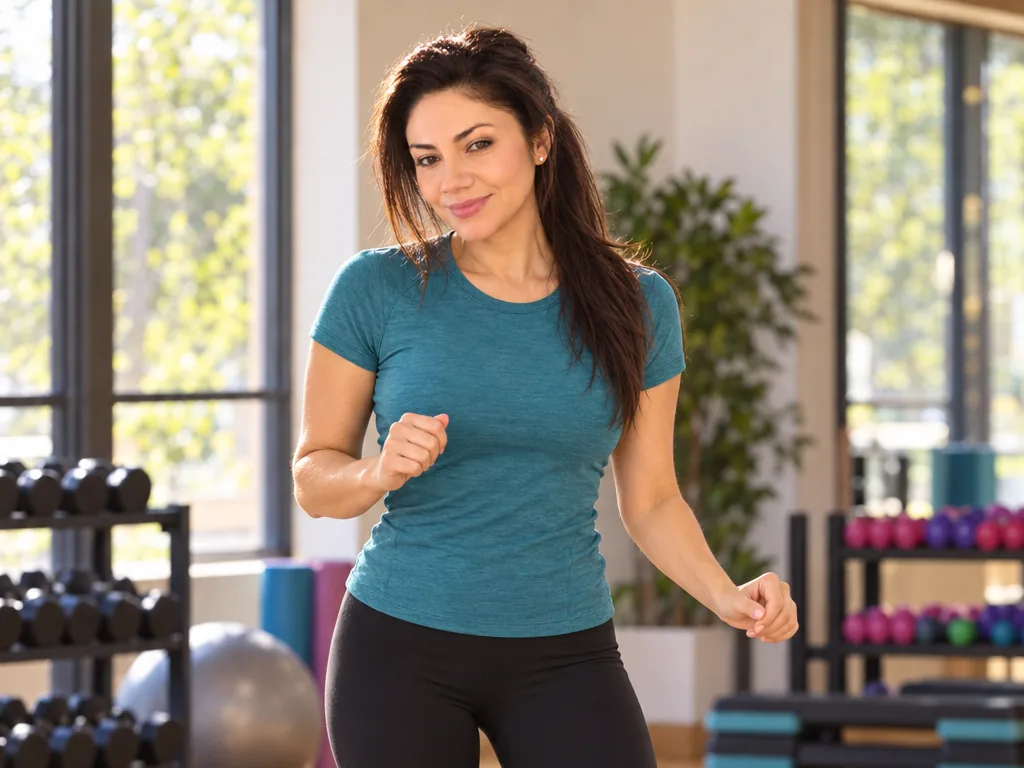
Zumba is my favorite class of the week. I dance ballet, tap, hip hop, belly dance and jazz too, but when the first merengue of a Zumba class starts, I’m home. That’s the Panama in me: I grew up with this music in the kitchen, at parties, on the bus. Now I dance it in Chicago, and I want you to feel that same joy from your very first song.
To do Zumba as a beginner, learn the four basic rhythms (merengue, salsa, cumbia and reggaeton), take a beginner-friendly class and stand where you can see the instructor. Follow the feet first, add the arms later, and keep moving when you get lost. After three or four classes it clicks.
This guide is everything I wish someone had told me before my first class: how a class works, the four rhythms and their basic steps, how to practise at home, and how to choose a class you’ll want to go back to.
What is Zumba?
Zumba is a dance workout set to Latin and world music. You follow an instructor through short routines, one per song, built from simple dance steps. There’s no partner, no technique test and no mirror-perfect moves. The goal is to move to the music and have fun.
It began by accident. In 1986, in Cali, Colombia, a young aerobics teacher named Beto Pérez forgot his usual cassette of pop songs. He only had a mixtape of salsa and merengue in his car, so he improvised a class to it. His students loved it so much that he kept the Latin music. He first called his classes “rumba”, and years later, after he moved to Miami, the program became Zumba. Today it is taught all over the world; the BBC has reported classes in 186 countries.
How does a Zumba class work?
A Zumba class is a playlist, usually 45 to 60 minutes long. Every song has its own short routine, and each routine repeats a few moves many times.
- Warm-up (one or two songs): easy marches and step-touches to get your body moving.
- The main part: fast songs and slower songs, one after another. A slower song usually follows a hard one so you can breathe.
- Cool-down (last song): slow moves and a stretch.
The instructor rarely explains anything. Instead, they cue with their body: pointing the direction, showing with their fingers how many repeats are left, and starting the next move a beat early so you can see it coming. Most instructors face the class and mirror you, so when they go to their left, you go to your right, just like looking in a mirror.
Want the minute-by-minute picture? Here’s how long a Zumba class is and how the hour is split.
What are the 4 basic Zumba rhythms?
Zumba instructors learn four core rhythms first: merengue, salsa, cumbia and reggaeton. Almost every class uses them, so if you know these four basic steps, you can follow most songs.
| Rhythm | Where it’s from | How it feels | The basic step |
|---|---|---|---|
| Merengue | Dominican Republic | Steady, happy, like marching | March in place, hips follow |
| Salsa | Cuba and New York | Quick, bouncy | Forward and back, with a pause |
| Cumbia | Colombia | Relaxed, rolling | One foot steps back, like dragging your heel |
| Reggaeton | Puerto Rico and Panama | Strong, bouncy beat | Bounce, with hips and shoulders |
Yes, Panama! Reggaeton grew from reggae en español, which Panamanian artists were singing in the 1980s and 90s, before it exploded in Puerto Rico. So when the reggaeton song starts, you’ll see me smile a little bigger.
Merengue step: the easiest place to start
- Stand with your feet hip-width apart, knees soft.
- March in place: right, left, right, left, one step on every beat.
- Let your hips move naturally as you shift your weight from foot to foot. Don’t force it.
- Add your arms: elbows bent, like you’re holding a partner, or let them swing.
Once you can march, the instructor will turn it into side steps, turns and travels. It’s all still a march.
Salsa basic step
- Step your right foot forward (1), shift weight back to your left (2), bring your right foot home (3), pause (4).
- Step your left foot back (5), shift weight forward to your right (6), bring your left foot home (7), pause (8).
- Keep your steps small and your knees soft.
In Zumba, salsa often goes side to side instead of forward and back. Same idea: three steps and a pause. If you want to find the 1 in the music, here’s how I hear the beat in salsa.
Cumbia step
- Keep your weight on your left foot.
- Step your right foot back behind you, then bring it home.
- Repeat on the same side, then switch.
- Your arms can swing low and relaxed, like you’re holding a candle or a skirt.
It feels a little like stirring a pot with your heel. Very relaxing once you get it.
Reggaeton bounce
- Feet a bit wider than your hips, knees bent.
- Bounce down on every beat, as if you’re sitting into a chair and coming up.
- Add a hip push to the side, or a shoulder pop, on the strong beats.
Reggaeton is where you can have attitude. Small or big, your choice.
How do I do Zumba at home as a beginner?
You can absolutely start at home, and it’s a great way to feel more confident before a class. Here’s the 20-minute routine I’d give a friend:
- Clear a space about the size of a yoga mat in every direction. Wear sneakers; socks slip.
- Warm up (3 minutes): march in place to any upbeat song, add arm swings and shoulder rolls.
- Merengue (4 minutes): march, then march side to side, then turn in a slow circle.
- Salsa (4 minutes): basic step forward and back, then side to side.
- Cumbia (4 minutes): step back on one side for a song, then switch.
- Reggaeton (3 minutes): bounce, then add hips or shoulders.
- Cool-down (2 minutes): slow marching, then stretch your legs and shoulders.
Do it two or three times a week and your first class will feel so much easier. When you’re ready to follow full routines, a video helps: pick one marked “beginner” and repeat the same video for a week instead of jumping between many. The official Zumba app also has on-demand classes and beginner tutorials if you want structure. Learning the same routine many times is the secret; I explain my method in how to memorize Zumba choreography.
Do I need to know how to dance to do Zumba?
No. Zumba is not a technique class, and nobody grades your hips. Everyone in that room was a beginner once, including the instructor.
My rule: feet first, arms later. If the arms confuse you, put your hands on your hips and only do the feet. When the feet feel automatic, add the arms. A move with the right feet and simple arms is still the right move.
If dancing in front of people makes you nervous, I wrote about that too: how I stopped feeling awkward in dance class.
How hard is Zumba for beginners?
Zumba is as hard as you make it. The same class can be a gentle dance or a big sweat:
- Lighter: keep your feet on the floor instead of jumping, make the moves smaller, march in place when you need a breath.
- Harder: bigger arms, lower knees, more bounce, jump when the instructor jumps.
The hardest part for most beginners isn’t the effort, it’s keeping up with the changes. That gets easier every class because instructors repeat their songs for weeks. Drink water between songs, and if anything hurts, stop and take the lighter version. I go deeper in is Zumba hard?
What should I wear to Zumba?
- Shoes: clean sneakers that let you turn. Running shoes with very grippy, chunky soles can stick to the floor when you pivot. Cross-training or dance sneakers with a smooth spot under the ball of the foot are easier on turns.
- Clothes: anything you can move and sweat in: leggings, joggers or shorts, and a breathable top.
- Extras: a water bottle, a small towel, hair tied back.
The rule is simple: comfortable, breathable, and shoes that turn. Zumba’s own advice is aerobic or cross-training shoes rather than running shoes. My full list, including what to wear for Aqua Zumba, is in what to wear to Zumba, and my guide to choosing Zumba shoes compares the best types and what to look for.
Where should I stand in my first Zumba class?
In the middle, two or three rows back. You’ll see the instructor clearly and you’ll have a few regulars around you to follow when you get lost. The back corner feels safer, but you can’t see anything from there. Arrive ten minutes early, choose your spot, and tell the instructor it’s your first class. Good instructors will keep an eye on you and show simpler versions.
How often should a beginner do Zumba?
Two or three classes a week is a great start. It gives your body time to rest and your brain time to remember the routines. I take Zumba as often as my week allows, and I mix it with walking and the gym.
What types of Zumba classes are there?
When you look at a class schedule you’ll see different names. These are the ones you’re most likely to find:
| Class | What it is | Good for |
|---|---|---|
| Zumba (Zumba Fitness) | The classic class: about an hour of Latin and world rhythms with intervals | Your first class |
| Aqua Zumba | Zumba in the pool; the water makes it low impact | Summer, and anyone who wants softer landings |
| Zumba Gold | Zumba at a lower intensity, with simpler steps | An easier pace and a gentle start |
| Zumba Toning | Zumba with light toning sticks for parts of the class | Adding strength moves |
| Zumba Step | Zumba on a low aerobic step | More leg work |
| Zumba Kids | Classes made for children | Kids who love to dance |
| STRONG Nation / STRONG 30 | A music-led workout from the same company, not a dance class; STRONG 30 is 30 minutes | When you want a different kind of session |
Start with the classic class, and try the others when you know the basic rhythms. Curious about the pool version? Here’s my Aqua Zumba vs. Zumba comparison. For what each format feels like, see my guide to the types of Zumba classes.
How do I find a Zumba class near me?
- The Zumba class finder: on zumba.com and in the official Zumba app, you can search classes by location and see licensed instructors.
- Gyms and community centers: many gyms include Zumba in membership. In Chicago, the Chicago Park District offers fitness and dance programs at park fieldhouses across the city, so check your neighborhood park too.
- Dance studios: some studios add Zumba or Latin fitness to their schedules.
Try two or three instructors before you decide. The right instructor changes everything: their music, their energy and how clearly they cue. In Chicago, start with my guide to Zumba classes in Chicago.
Zumba for beginners in Chicago
If you live here like me, you have wonderful options, and some are free. These were current in late October 2026; always check before you go:
| Where | When | Cost |
|---|---|---|
| Mandrake Park, 3858 S. Cottage Grove Ave. (Chicago Park District) | Thursdays 6:15 to 7:15 p.m., through December 10, 2026 (no class November 26) | Free |
| Chicago Women’s Park & Gardens, 1801 S. Indiana Ave. (Chicago Park District) | Tuesdays 6:15 to 7:15 p.m., through December 8, 2026 | Check the Park District listing |
| Old Town School of Folk Music, 4544 N. Lincoln Ave. | Wednesdays, 45-minute classes in 8-week sessions | $134 ($114 for members) |
| Millennium Park Summer Workouts (City of Chicago) | Saturdays in summer; in 2026, Zumba ran 11 to 11:45 a.m., May 16 to September 5 | Free |
Chicago Park District winter 2027 session: programs are posted November 30, 2026. Online registration opens December 7 for parks west of California Avenue and December 8 for parks east of it, and classes run January 4 to March 14, 2027. Zumba spots in popular parks fill fast, so set a reminder.
For every studio, gym and park option across the city, read my full guide to Zumba classes in Chicago.
Your first Zumba class checklist
- Sneakers that turn (clean, if the class is indoors)
- A full water bottle
- A small towel
- Hair tied back
- Arrive 10 minutes early
- Tell the instructor it’s your first class
- Stand in the middle, two or three rows back
- Feet first, arms later
- Smile when you get lost (everybody does)
Beginner mistakes I see (and how to fix them)
- Hiding in the back corner. You can’t see the instructor’s feet. Move to the middle.
- Trying to copy the arms from song one. Do the feet, put your hands on your hips, and add arms in week two.
- Stopping when you get lost. Keep marching to the beat. You’ll rejoin at the chorus.
- Changing instructors every week. Instructors repeat their routines, so the same class for a few weeks is how you learn them.
- Watching the mirror instead of the instructor. Watch the leader’s feet; you can admire yourself later.
- Wearing grippy running shoes. Pivots get hard and knees don’t love it. Choose shoes with a smoother sole.
- Skipping the cool-down. The last song and the stretch are part of the class. Stay for them!
How long until Zumba feels easy?
For most people, three or four classes with the same instructor. By then you know how the class runs, you recognize a few songs, and you’ve survived getting lost (everybody does). That’s when it gets fun: you stop following and start dancing.
Here are the signs you’re getting there:
- You know the next move before the instructor cues it.
- You stopped looking at your feet.
- You added arms, or hips, to moves that used to be feet only.
- When you get lost, you find your way back at the chorus.
Animated footwork guides for the four beginner rhythms
These simple overhead GIFs illustrate practice patterns, not a complete class, official Zumba choreography or every traditional version of each dance. Left and right refer to your own feet, not a mirrored instructor. A filled footprint shows the supporting side; the animation is deliberately slow.
Keep the steps small, use a clear non-slip space, and work within a comfortable range. If a movement hurts or makes you dizzy, stop. Use your instructor’s in-person demonstration when it differs from a simplified diagram.
Merengue practice: alternate the weight
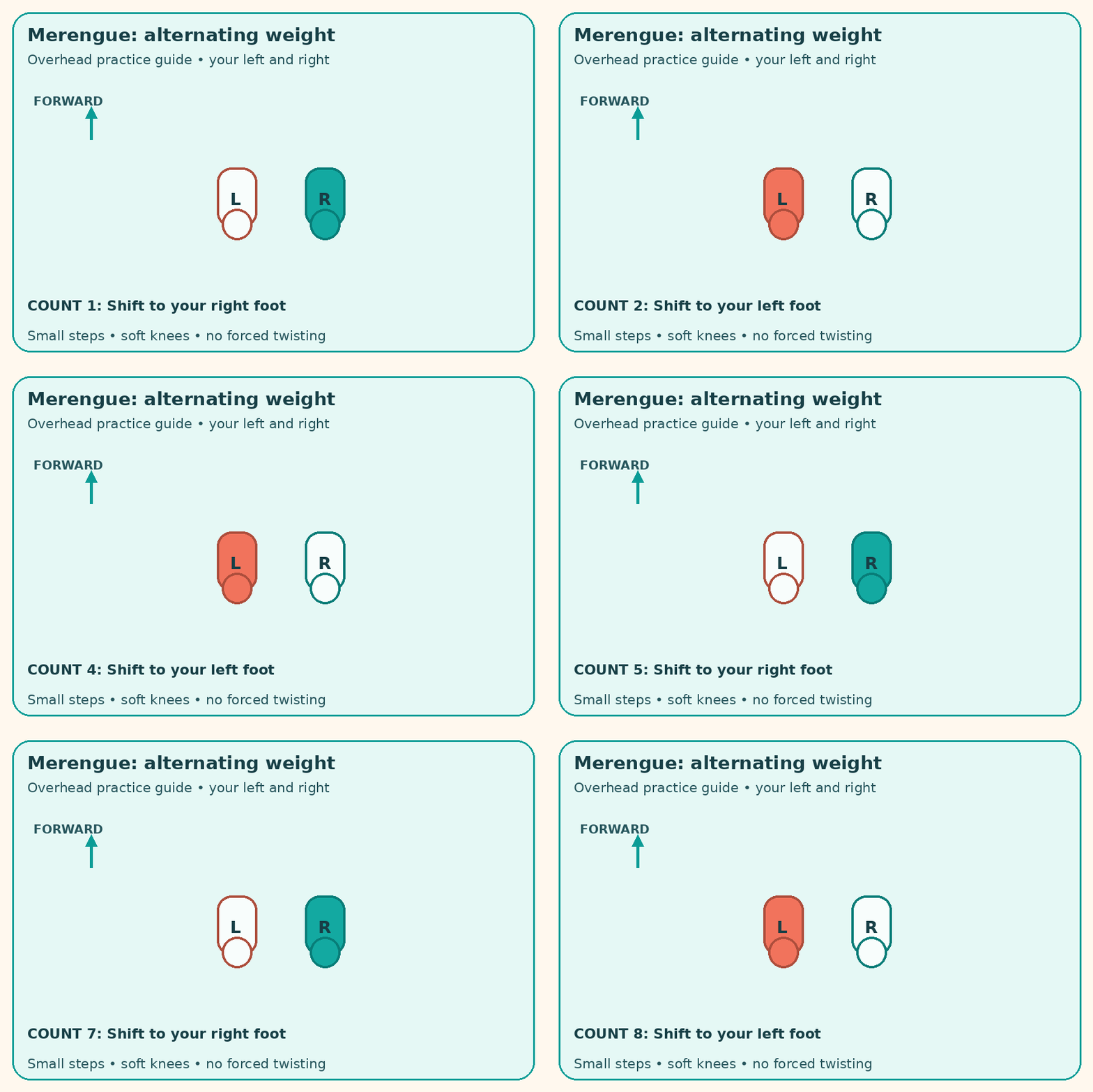
Count 1, 2, 3, 4, 5, 6, 7, 8, changing support from right to left on each beat. Think of a relaxed march with feet near hip width. Let the knees soften; do not force the hips sideways. Begin with the arms quiet so the weight change is easy to feel.
Salsa practice: three steps and a pause
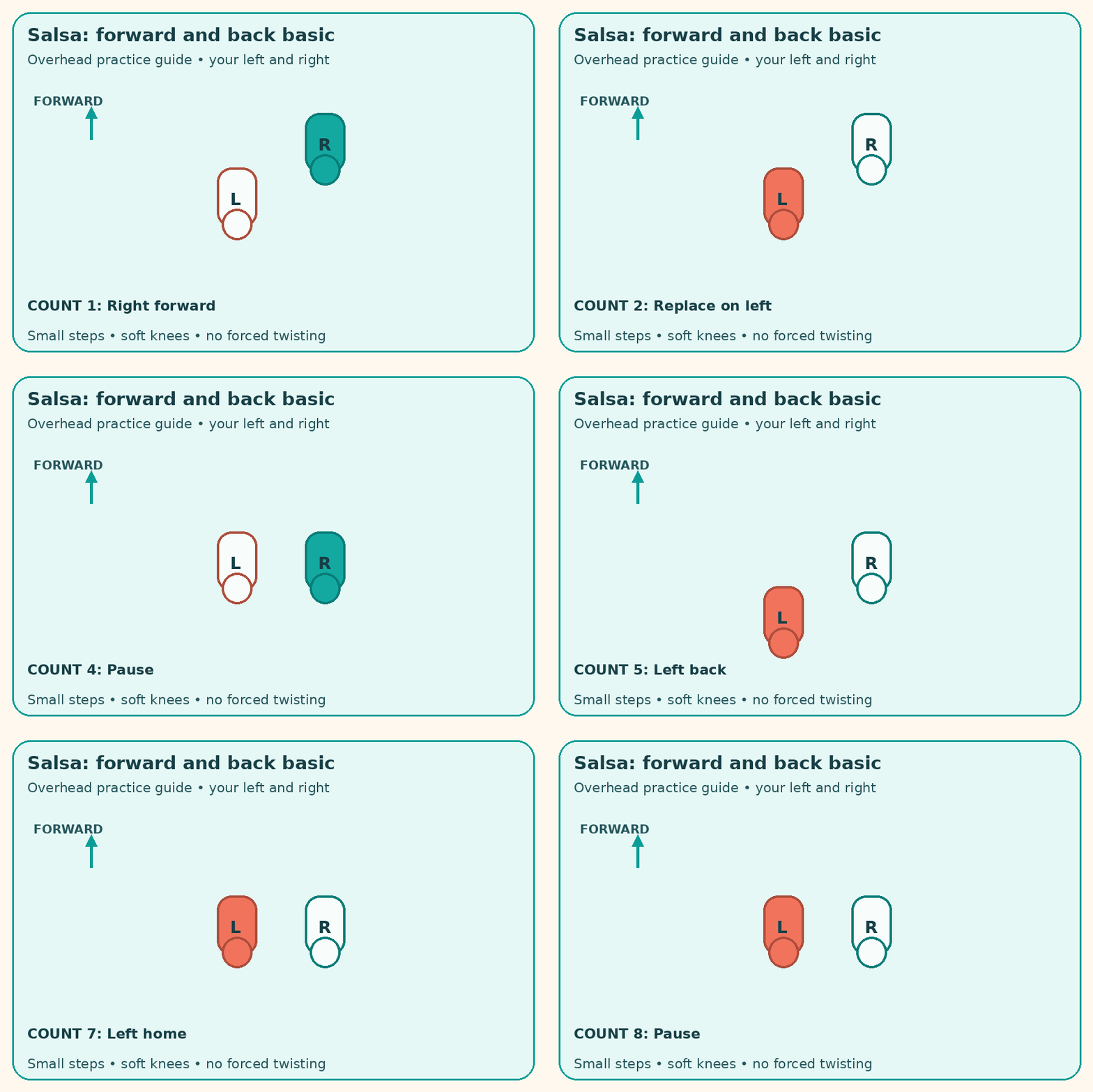
For the right-leading pattern used here: right forward on 1, replace onto the left on 2, right home on 3, pause 4. Left back on 5, replace onto the right on 6, left home on 7, pause 8. The pauses are part of the rhythm, not missing steps. Keep the travel small; classes may also use side basics or start on the other foot.
Cumbia practice: a small back rock
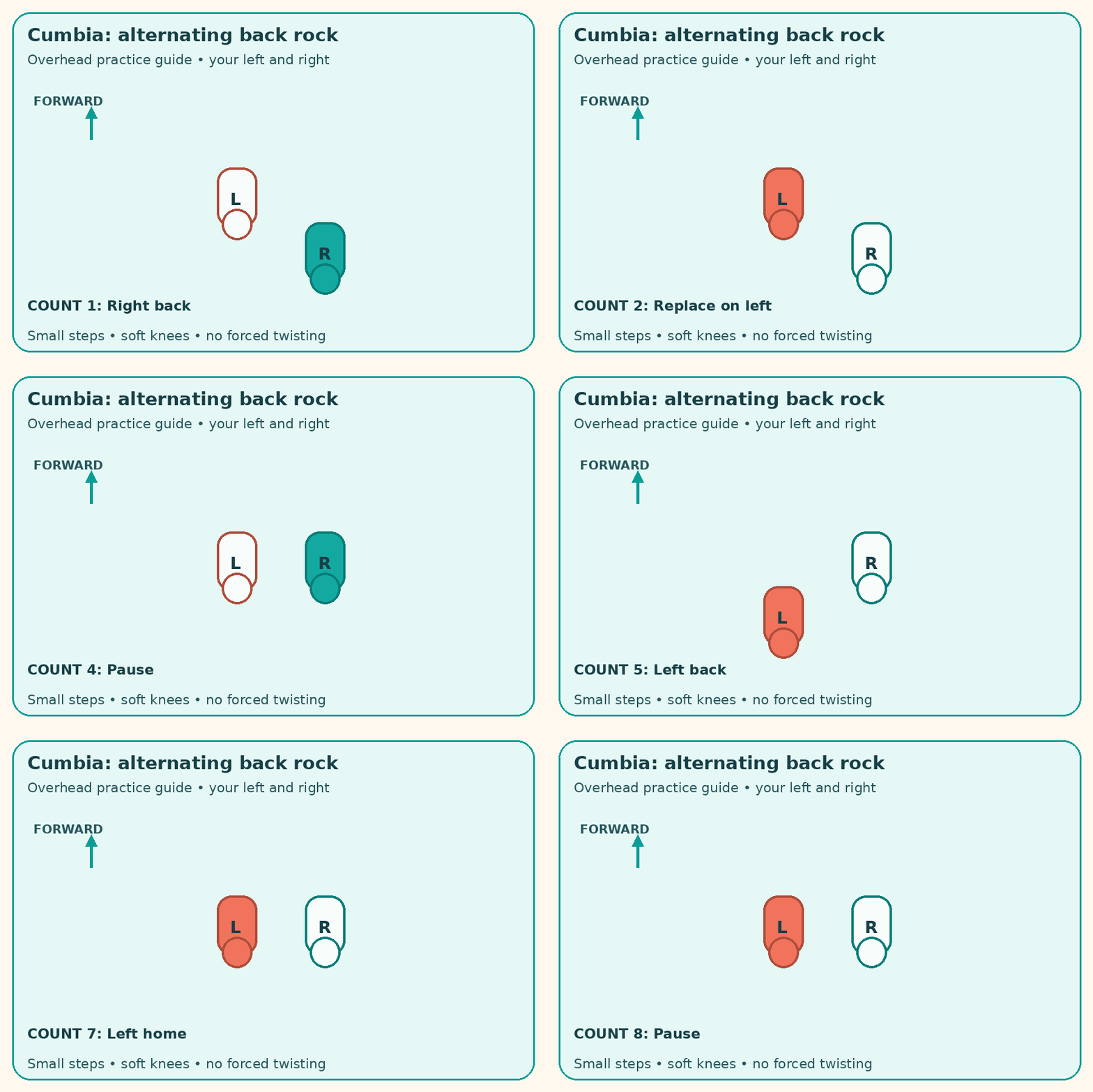
Try right back on 1, replace onto left on 2, right home on 3, pause 4. Then left back on 5, replace onto right on 6, left home on 7, pause 8. This is a simple alternating practice version, not a claim that all cumbia uses one basic. Avoid crossing far behind or twisting a planted knee.
Reggaeton practice: stay in place and soften the knees
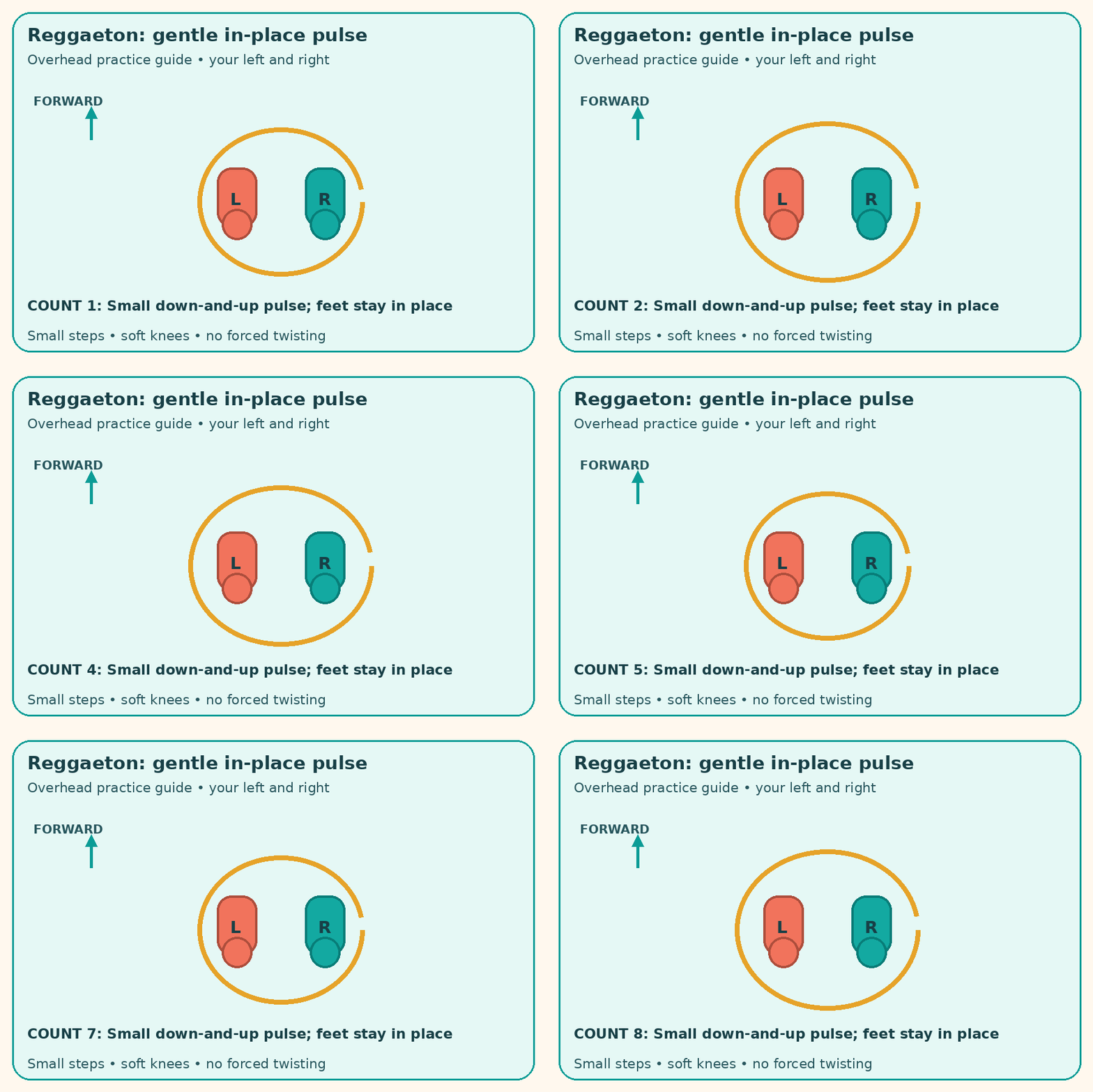
Keep a comfortable stance and make a small, controlled down-and-up pulse over 1–8. The diagram keeps the feet planted because the exercise is about a gentle groove, not stamping or jumping. Let the knees and torso stay comfortable; you do not need a deep squat or a forced back arch. Add arms only when the pulse feels easy.
A beginner 16-count combination
This short combination uses two of the simplest patterns so you can learn a transition without rushing through all four rhythms at once:
| Counts | Action |
|---|---|
| 1–4 | Merengue march: right, left, right, left |
| 5–8 | Continue the same march, making the steps slightly smaller |
| 9–12 | Settle into a comfortable stance and do four gentle reggaeton-style pulses |
| 13–16 | Continue four small pulses, then reset before repeating |
Practice the footwork without music first, then use an easy, steady track. Keep transitions unhurried: you do not have to match a fast class playlist immediately. After that feels comfortable, practice the eight-count salsa and cumbia patterns separately rather than forcing them into four counts.
The goal is recognition and confidence, not perfect choreography. In class, following a simpler version for a song is a useful choice—not a failure to keep up.
Zumba for beginners FAQ
Can I do Zumba if I have two left feet? Yes. Zumba is built for people who don’t dance. Do the feet, skip the arms, and laugh when you turn the wrong way. I still do sometimes.
Is Zumba a dance or a workout? Both. It’s a workout made from real Latin dance steps.
Do I need a partner? No. You dance on your own, in a group.
Can I do Zumba at home? Yes. Start with the 20-minute routine above and repeat one beginner video until you know it well.
What if I can’t keep up? March in place and rejoin at the chorus. The chorus always comes back.
How long is a Zumba class? Usually about an hour, with a warm-up at the start and a cool-down at the end. Some gyms run 45-minute classes, and STRONG 30 is 30 minutes.
Is Zumba real dancing? Yes. The steps come from real dances like merengue, salsa, cumbia and reggaeton. More in is Zumba a dance?
Is there free Zumba in Chicago? Yes. The Chicago Park District lists free classes, like Thursdays at Mandrake Park, and in summer there’s Zumba at Millennium Park.
Is Zumba good if I want to learn salsa later? Very. You’ll hear salsa, merengue and cumbia every week, and your body learns the rhythm before your brain does. When you’re ready for a partner dance, here’s how to learn salsa as a beginner.
My last tip: choose joy over perfect
The first time a song comes back and your feet already know it, you’ll understand why I love this so much. Don’t wait to feel ready. Put on your sneakers, find a class, stand in the middle, and dance badly with a smile. That’s how everyone starts.
Nos vemos en la pista. See you on the dance floor! — MarGo