
Every family has recipes that live only in someone’s hands. The sancocho, the Christmas tamales, the cake that only one aunt makes right. A family cookbook saves them before they’re lost. Having written a cookbook myself, here’s how to make one for your family, from collecting the recipes to holding the printed book.
To make a cookbook of family recipes, collect recipes and stories from relatives, cook each recipe with the person who makes it to capture real measurements, write every recipe in the same format, add photos and memories, design the pages in a template, and print it as a photo book, a binder or a print-on-demand book.
Step 1: Decide what kind of cookbook you’re making
- A keepsake for a holiday gift, wedding, reunion or memorial
- A working cookbook that people will cook from every week
- A heritage book that tells your family’s story through food
This choice decides how much testing, how many photos and what kind of printing you need.
Step 2: Collect the recipes
- Ask everyone. Send a simple form or message asking for 2 or 3 recipes each, with the story behind them.
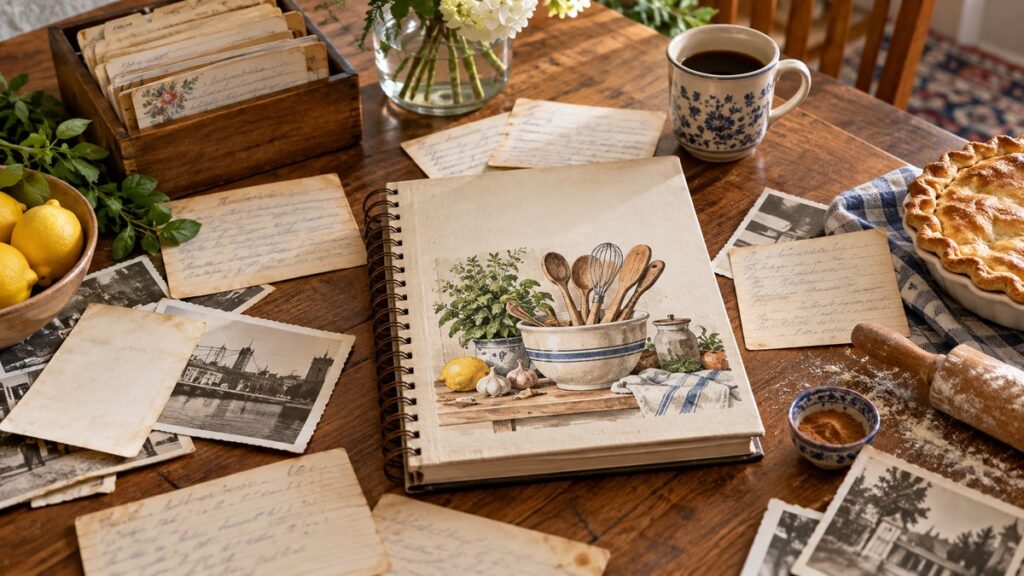
- Gather old cards and notebooks. Scan or photograph handwritten recipe cards; the handwriting itself is a treasure.
- Record the cooks. For recipes that only exist “by eye,” cook alongside the person and measure what they actually use. Put a measuring cup under that “handful” before it goes into the pot. A phone video is a great backup.
- Ask the questions a beginner would ask: What size pot? How do you know when it’s done? What if I can’t find this ingredient?
15 questions to ask the family cook
- Where did you learn this recipe, and from whom?
- When do we make it: Sundays, Christmas, birthdays?
- What pot or pan do you use, and how big is it?
- Which brand or kind of each ingredient? (Which rice, which flour, which sausage?)
- How much is “a little” of salt, in your hand? (Pour it into a spoon to measure.)
- What does it look, smell and sound like when it’s ready?
- How long does each step take on your stove?
- What do you never do with this recipe?
- What do you do if you can’t find an ingredient?
- How many people does one pot feed?
- Can it be made ahead? How long does it keep?
- What do you serve it with?
- Has the recipe changed over the years?
- Who else in the family makes it differently?
- What’s your favorite memory of this dish?
Record the answers on your phone; the voice itself becomes part of the family archive.
Step 3: Test and standardize every recipe
Cook each recipe at least once from the written version. Then write every recipe in the same format:
- Title (and the family name for it, like “Abuela’s sancocho”)
- Short story or memory (2–4 sentences)
- Yield and times
- Ingredients in the order they’re used, with amounts
- Numbered steps with visual cues
- Tips, substitutions and storage
A recipe template you can copy
Recipe name (family name: ______)
From: ______ · Occasion: ______
Memory: 2–4 sentences
Serves: __ · Prep: __ · Cook: __
Ingredients (in order of use, with amounts)
Steps (numbered, with visual cues)
Tips and substitutions
Make ahead and storage
Translating old recipe language
| Old recipe says | Write it as |
|---|---|
| Moderate oven | 350°F (175°C) |
| Slow oven | 300–325°F (150–165°C) |
| Hot oven | 400–425°F (200–220°C) |
| A teacup | About ¾ cup (measure the family’s actual cup) |
| A pinch | About ⅛ teaspoon |
| A handful | Measure it: have the cook drop it into a measuring cup |
| Butter “the size of an egg” | About ¼ cup (4 tablespoons / 55 g) |
| Oleo | Margarine |
| “A can” | Look up the size: many cans have shrunk over the years |
| Cook “until done” | Add a time range and a visual cue |
Step 4: Organize the chapters
Common ways to organize a family cookbook:
- By course: breakfast, soups, main dishes, sides, desserts, drinks
- By person: a chapter for each grandparent, aunt or cousin
- By occasion: Sunday dinner, birthdays, Christmas, summer
- By branch of the family: for example, Mom’s side and Dad’s side
Step 5: Add stories and photos
What turns a recipe collection into a family treasure:
- Old family photos, especially in kitchens or at the table
- Photos of the finished dishes (natural daylight near a window is enough)
- Scans of the original handwritten cards
- Short memories: who made it, when, and what it meant
Always ask permission before including someone’s photo or story.
Step 6: Design the pages
- Easiest: a photo-book service with templates (many offer recipe book layouts).
- Flexible: a design tool or word processor with a consistent template, exported to PDF.
- Keep it readable: large type for ingredients, one recipe per page or spread, plenty of white space.
Can I put other people’s recipes in a family cookbook?
Family recipes shared with permission are fine, and credit the cook on every page. If you include a recipe from a published cookbook, a website or a magazine, write it in your own words and credit the source. In the US, the Copyright Office explains that a mere list of ingredients isn’t protected by copyright, but the written directions, stories and photos can be, so don’t copy someone else’s text or photos. For a private family book, credit generously; for a book you sell, be stricter.
Step 7: Print and share
| Option | Best for | Notes |
|---|---|---|
| Photo book | Gifts and keepsakes | Beautiful, but harder to keep open while cooking |
| Binder with page protectors | Everyday cooking | Easy to add recipes; spill-proof |
| Spiral-bound print | Working cookbook | Lies flat on the counter |
| Print-on-demand book | Many copies or relatives far away | Each person can order their own copy |
| Sharing with everyone | Free and searchable; print as needed |
An 8-week plan for a holiday family cookbook
| Week | Do this |
|---|---|
| 1 | Decide the type of book; send the recipe request to relatives |
| 2 | Collect recipes, cards and photos; follow up with everyone |
| 3–4 | Cook the “by eye” recipes with the family cooks and measure |
| 5 | Type every recipe in the template; scan cards and photos |
| 6 | Design the pages; ask two relatives to proofread |
| 7 | Order one proof copy or print a test page |
| 8 | Fix errors and order the final copies (allow shipping time) |
Print-on-demand and photo-book services get busy before the holidays, so order early.
Tips from my own cookbook
When I wrote my Panamanian cookbook, the hardest part wasn’t cooking. It was turning “you know, until it looks right” into steps someone else can follow. Measure everything, write down the visual cues, and explain the special ingredients. It took longer than I expected; see how long it takes to write a cookbook.
A Panamanian family cookbook starter list
If your family is Panamanian like mine, these are the recipes I’d make sure to save:
FAQ
How many recipes should a family cookbook have?
Anywhere from 20 to 100. A small book that gets finished beats a big one that doesn’t.
How long does it take to make a family cookbook?
A simple one can be done in a few weeks; a tested, photographed book can take several months.
What’s the best program for making a family cookbook?
The one you’ll finish in. A word processor or Google Docs template works; design tools like Canva have recipe-book templates; photo-book services lay out pages for you.
Should the cookbook be bilingual?
If your family speaks two languages, yes: put the original title and key words in the family language and the steps in the language the next generation cooks in.
How do I include a recipe from someone who has passed away?
Write it from their card or from the memory of the people who cooked with them, and say so in the headnote. Include their handwriting if you have it.
What if a relative won’t share the recipe?
Ask to cook it with them. Many cooks don’t keep secrets on purpose; they just never wrote it down.
¡Buen provecho!