
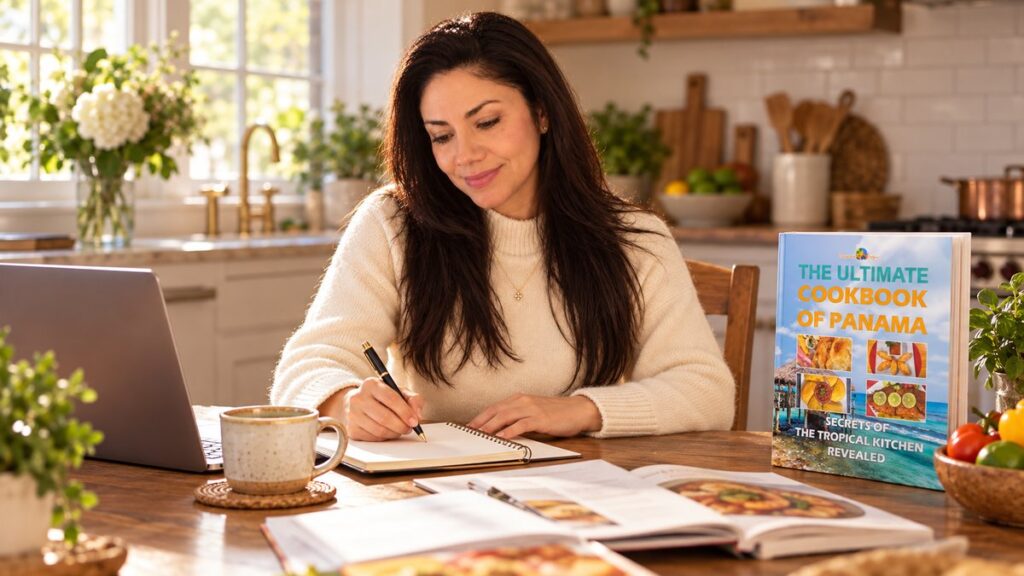
Writing a cookbook takes longer than anyone expects, me included. You think you’re writing down recipes you already know. Then you discover your grandmother’s “un poquito de esto” has to become a measured teaspoon, tested three times, in an American kitchen with American ingredients. Here’s a realistic timeline, stage by stage, and what I learned writing my Panamanian cookbook.
With a traditional publisher, a cookbook usually takes about 18 to 24 months from contract to publication: roughly 9 to 12 months to develop, test and write the recipes, then about a year of editing, photography, design and printing. Self-published cookbooks often take 9 to 18 months.
The cookbook timeline, stage by stage
| Stage | Typical time | What happens |
|---|---|---|
| Idea and proposal | 1–3 months | Concept, chapter list, sample recipes (needed for traditional publishers) |
| Recipe development | 2–6 months | Deciding what’s in, writing first drafts |
| Recipe testing | 6–8 months | Testing each recipe, often several rounds, sometimes with outside testers |
| Writing the manuscript | Overlaps with testing | Headnotes, introductions, tips, substitutions |
| Photography | Weeks to months | Styling and shooting the dishes |
| Editing and copyediting | 2–4 months | Checking every measurement, step and cross-reference |
| Design and layout | 2–3 months | Pages, typography, photo placement |
| Printing and distribution | 3–6 months | Proofs, printing, getting to stores |
Publishing professionals interviewed on cookbook industry podcasts and in food writers’ newsletters describe the same rhythm: most of the first year goes into the recipes and manuscript, and most of the second year into turning it into a book.
Why recipe testing takes so long
Recipe testing is the heart of a cookbook, and it’s the part that surprises first-time authors. Each recipe has to:
- Work in someone else’s kitchen, not just yours
- Use measurements instead of “until it looks right”
- Give times and visual cues (“until golden,” “until the rice holes appear”)
- Offer substitutions for hard-to-find ingredients
- Be tested again after every change
A cookbook with 80 to 100 recipes can mean hundreds of test batches.
Traditional publishing vs self-publishing
Traditional publisher: you usually need a proposal and often an agent. The publisher handles editing, design, printing and distribution. Slower, but with a team.
Self-publishing: you control the timeline, and print-on-demand platforms make it possible to publish without inventory. But you’re responsible for (or hire) editing, design, photos and marketing. A focused self-published book can take under a year; a big one can take as long as a traditional book.
A realistic self-publishing timeline
| Stage | Time for a focused 40–60 recipe book |
|---|---|
| Recipe list and outline | 2–4 weeks |
| Testing and writing | 3–6 months |
| Photos | 1–3 months (overlapping with testing) |
| Editing and proofreading | 1–2 months |
| Layout and cover | 1–2 months |
| Proof copy and corrections | 2–4 weeks |
| Upload and review | A few days |
About the last steps on Amazon KDP, according to KDP’s own help pages: a paperback usually goes live within 72 hours of submission (new accounts can take longer); you can order up to five proof copies, which carry a “Not for Resale” watermark; KDP offers a free ISBN that’s tied to KDP and shows “Independently published” (buy your own ISBN if you want other distribution); and a cookbook with photos needs color printing, which costs more per copy. Order a proof before launch: colors, margins and photo quality look different on paper.
How long does it take to test a recipe?
Plan on two to three test rounds for most recipes, and more for baking and frying, where small changes in measurements show. One round means shopping, cooking, tasting, writing notes and fixing the recipe. Many authors test a handful of recipes a week, around a day job. That’s why 80 recipes can take most of a year.
What slows a cookbook down
- Scope creep: adding chapters halfway through.
- Untested headnotes and stories that need rewriting at the end.
- Photos done last, after the dishes are no longer in season.
- No style sheet: “tbsp” on one page and “tablespoon” on the next means a slow, painful edit.
- Waiting for perfect: a first edition can be revised later, especially in self-publishing.
What I learned writing a Panamanian cookbook
These lessons came from writing my Panamanian cookbook:
- Family recipes need translating twice. Once into English, and once from “a handful” into cups and grams.
- Ingredients are a chapter of their own. Culantro, ñame and guandú aren’t in every supermarket, so readers need to know what they are, where to find them and what to use instead.
- Test in a normal kitchen. A recipe that works in a big caldero on a strong burner has to work in a regular saucepan too.
- Cut what you can’t explain well. It’s better to have fewer recipes that work every time.
- The book takes longer than the recipes. The writing, checking and layout after the cooking is a big part of the work.
Now I’m planning a Greek cookbook, and the same rules apply.
How to write a cookbook faster
- Define your scope in one sentence before you start.
- Write the recipe list first, then cut it by 20%.
- Batch your testing by technique (all the rice dishes, all the fried snacks).
- Use a template for every recipe: yield, times, ingredients, steps, tips, storage.
- Photograph as you test if you’re doing your own photos.
- Get outside testers for your trickiest recipes.
If your goal is a family keepsake rather than a book for sale, the timeline can be much shorter. See how to make a cookbook of family recipes.
FAQ
Can you write a cookbook in 6 months?
A short, focused, self-published cookbook, yes. A traditionally published book, rarely.
How many recipes should a cookbook have?
Many cookbooks have between 50 and 100+. Quality matters more than number.
How long does it take to self-publish a cookbook?
For a focused book, about 6 to 12 months from recipe list to launch, most of it testing and writing. The upload itself takes days.
Do I need an ISBN?
For Amazon KDP, you can use KDP’s free ISBN. Buy your own if you want to sell widely through other channels under your own imprint.
Do I need professional photos?
For a book you sell, good photos make a big difference. For a family cookbook, your own photos are perfect.
¡Buen provecho, and happy writing!