
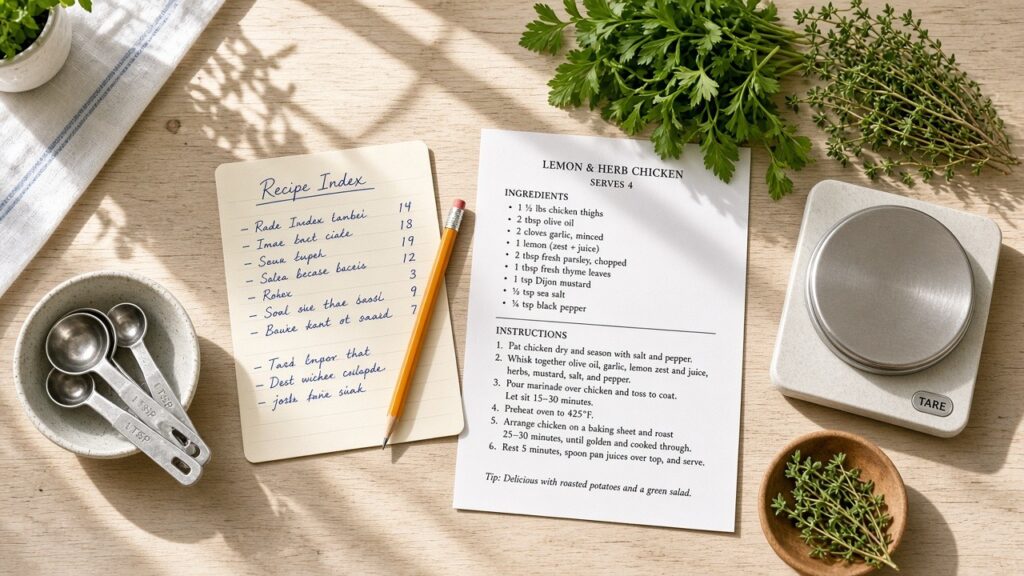
A good recipe is a set of instructions a stranger can follow in their own kitchen and get the same dish you made. That sounds simple until you try to write down something you’ve cooked by feel for years. Writing my Panamanian cookbook taught me that most recipe problems aren’t cooking problems: they’re writing problems. An ingredient that appears in the steps but not the list. “Cook until done.” A “pinch” that means something different to everyone.
To write a recipe, include a clear title, a short headnote, the yield and times, an ingredient list in the order the ingredients are used (with exact amounts, units and prep notes such as “1 onion, finely chopped”), and numbered steps that each describe one stage of cooking with a time, a temperature and a visual cue (“until golden, 5 to 7 minutes”). Use consistent units and abbreviations, name the pan size, and finish with storage, substitutions and serving notes. Then test it by following your own words exactly, or better, have someone else cook from it.
Below: the parts of a recipe, how to write each part, style rules, how to turn family recipes into measured ones, a template you can copy, whether you can copyright a recipe and answers to common questions. If you’re compiling recipes for your family, see how to make a cookbook of family recipes.
The parts of a recipe
A complete recipe usually has these parts, in roughly this order:
- Title
- Headnote (a short introduction)
- Yield (servings or quantity)
- Times (prep, cook, total, and any resting or marinating)
- Equipment (if anything special is needed)
- Ingredient list
- Method (numbered steps)
- Notes (storage, make-ahead, substitutions, variations, serving suggestions)
- Optional: nutrition information, photos, tips.
Title and headnote
The title
A good title tells the reader exactly what they’re making. Aim for:
- Clear and specific: “Panamanian Chicken Tamales in Plantain Leaves,” not “Christmas Joy.”
- Searchable if it’s online: include the dish name people actually search for.
- Original names plus translation when helpful: “Sancocho (Panamanian Chicken Soup).”
The headnote
The headnote is the short paragraph between the title and the ingredients. It’s where your voice lives. Use it to:
- Explain what the dish is and where it comes from.
- Share a short story or memory (keep it brief).
- Tell the reader what to expect: texture, flavor, difficulty, time.
- Flag anything important: “Start the night before,” “You’ll need a 9 x 13 pan.”
Two to five sentences is plenty in a cookbook. Online, a little longer is fine, but readers appreciate getting to the recipe quickly.
Ingredient list (order, units, prep words)
Order
List ingredients in the order they’re used in the method. If two ingredients go in at the same time, list the larger amount or the main ingredient first.
Group ingredients with subheads when a recipe has parts:
- For the filling
- For the dough
- For the sauce
Amounts and units
- Give exact amounts: “2 tablespoons,” not “some.”
- Be consistent: don’t switch between “tbsp” and “tablespoon” in the same book.
- Give weights for baking if you can, and consider grams alongside cups for an international audience.
- Describe items by size when needed: “1 large onion (about 10 ounces).”
- Packaged items: “1 (15-ounce) can black beans, drained and rinsed.”
Prep words: before or after the ingredient?
Where you put the prep word changes the amount:
- “1 cup chopped cilantro” means chop first, then measure.
- “1 cup cilantro, chopped” means measure first, then chop.
The same goes for “1 cup sifted flour” vs “1 cup flour, sifted.” Choose deliberately.
Ingredient formatting
A common format is: amount + unit + ingredient + (comma) + prep.
- 2 tablespoons olive oil
- 1 medium onion, finely chopped
- 3 garlic cloves, minced
- 1 pound boneless, skinless chicken thighs, cut into 1-inch pieces
- Salt and freshly ground black pepper, to taste
List “salt and pepper to taste” and garnishes last. Mark optional ingredients clearly: “(optional).”
Method (steps, times, cues)
One stage per step
Each numbered step should cover one stage of cooking: make the sofrito, brown the chicken, add the rice. Avoid huge steps that cover five actions, and avoid tiny steps for every stir.
Lead with the action
Start each step with a verb: “Heat,” “Add,” “Stir,” “Bake.”
Give times AND visual cues
Ovens, stoves and pans vary, so times alone aren’t enough. Pair them:
- “Cook, stirring often, until the onion is soft and translucent, 5 to 7 minutes.”
- “Bake until the top is golden and a toothpick comes out clean, 35 to 40 minutes.”
- “Simmer until the rice has absorbed the liquid and small holes appear on the surface, about 15 minutes.”
Include heat levels and pan sizes
“Heat the oil in a large skillet over medium-high heat.” “Pour into a greased 9 x 13-inch baking dish.”
Mention every ingredient
Every ingredient in the list should appear in the steps, and every ingredient in the steps should be in the list. This is the most common recipe error editors catch.
End with serving
The final step should tell the reader what to do with the finished dish: “Let rest 10 minutes, then slice and serve with lime wedges.”
Yield, times, equipment
- Yield: “Serves 4 to 6” or “Makes 24 cookies” or “Makes about 6 cups.”
- Times: prep time, cook time and total time. Include passive time (marinating, chilling, rising) so readers aren’t surprised.
- Equipment: list anything not every kitchen has: a stand mixer, a 10-inch cast-iron skillet, a spiralizer, a candy thermometer.
Style rules (abbreviations, temps)
Pick a style and use it everywhere. Common conventions in U.S. cookbooks:
| Item | Common style |
|---|---|
| Teaspoon / tablespoon | Spelled out (“tablespoon”) in many cookbooks, or “tsp” / “Tbsp” if abbreviated consistently |
| Temperatures | “350°F” (add °C for international readers: “350°F / 175°C”) |
| Fractions | ½, ⅓, ¼ or 1/2, 1/3, 1/4, consistently |
| Ranges | “5 to 7 minutes” (or “5–7 minutes”) |
| Numbers | Numerals for measurements (“2 cups”); spell out small counts in prose if your style prefers |
| Pan sizes | “9 x 13-inch baking dish” |
| Eggs, butter, sugar | Specify defaults once: “Eggs are large, butter is unsalted unless noted” |
Write in the present tense, second person and imperative mood: “Add the garlic,” not “You will add” or “I added.”
Writing family recipes (translate a pinch)
Family recipes are often written as memories: “flour until it feels right,” “a pinch of salt,” “a cup” that’s actually a specific chipped mug. Turning them into usable recipes takes patience.
- Cook alongside the family cook if you can, and measure everything they add before it goes in the pot. Put a bowl under their hand.
- Weigh “handfuls” and “pinches.” Do it several times and average.
- Note the vessel: “a cup” might be a coffee cup. Measure it.
- Write the visual cues they use: “when the dough stops sticking to the bowl,” “when the oil shimmers.”
- Cook it yourself from the written version and adjust.
- Keep the stories in the headnote. They’re part of the recipe.
This is how my own family recipes went from “un poquito de esto” to measured teaspoons. More on the whole process in how long it takes to write a cookbook.
Recipe template to copy
[Recipe title]
[Headnote: 2–5 sentences about the dish, where it comes from and what to expect.]
Serves: [X] | Prep: [X] minutes | Cook: [X] minutes | Total: [X] minutes
Equipment: [anything special]
Ingredients
For the [part 1]
- [amount] [unit] [ingredient], [prep]
- [amount] [unit] [ingredient], [prep]
For the [part 2]
- [amount] [unit] [ingredient], [prep]
Method
- [Action verb + what to do + heat/pan + time + visual cue.]
- [Next stage.]
- [Finish and serve.]
Notes
- Make ahead / storage: [how long, how to store, how to reheat]
- Substitutions: [swap options]
- Variations: [ideas]
Common recipe-writing mistakes
| Mistake | Fix |
|---|---|
| An ingredient appears in the steps but not the list | Check every ingredient both ways before publishing |
| “Cook until done” | Give a time range and a visible or measurable cue (color, texture, internal temperature) |
| No pan size | Name the size and type: “10-inch skillet,” “3-quart saucepan” |
| Vague amounts (“a can,” “a bunch”) | Give can sizes and approximate weights or cup measures |
| Steps out of order | Read the method aloud while miming the cooking |
| Missing resting or marinating time | Add it to total time and mention it in the headnote |
| Inconsistent abbreviations | Make a one-page style sheet and stick to it |
How to write a recipe card
For a printed recipe card (4 x 6 or 3 x 5 inches), keep it short:
- Title, yield and total time at the top.
- Ingredients in a compact list or two columns.
- Short numbered steps.
- Use the back for notes or the story.
Testing your recipe
- Cook from your written recipe exactly, not from memory.
- Have someone else cook it without your help, and watch where they hesitate.
- Check the list against the steps.
- Check times and temperatures on a different stove or oven if possible.
- Edit, then test again.
Can you copyright a recipe?
In the U.S., according to the U.S. Copyright Office, a mere list of ingredients isn’t protected by copyright. What can be protected is substantial literary expression: a headnote, a detailed explanation, stories, photos and illustrations. A collection of recipes (a cookbook) can be protected as a compilation.
In practice:
- You can cook and share a dish from someone else’s recipe.
- You shouldn’t copy someone else’s headnotes, instructions word for word or photos.
- When you adapt a recipe, rewrite the instructions in your own words and credit your inspiration (“Adapted from…”).
This is general information, not legal advice. For specific questions, talk to an intellectual property attorney.
FAQ
What order should ingredients go in?
The order they’re used in the method. If two go in at once, list the main or larger one first. Group ingredients under subheads for multi-part recipes.
How do I write recipe steps clearly?
Number them, start each with an action verb, cover one stage per step and include heat level, pan size, time and a visual cue.
Should I give weights or cups?
For U.S. home cooks, cups and spoons are expected. For baking and international readers, add weights (grams) too; weights are more accurate.
How do I write a recipe card?
Title, yield and time on top, a compact ingredient list, short numbered steps and notes on the back.
Can I copyright a recipe?
A plain list of ingredients isn’t protected in the U.S., but your written explanations, stories and photos can be, and so can a cookbook as a compilation. This is general information, not legal advice.
How long should a headnote be?
Two to five sentences in a cookbook. Say what the dish is, why it matters and anything the cook should know before starting.
Do I need to include nutrition information?
Not required for most home and self-published cookbooks. If you include it, explain how it was calculated and that it’s an estimate.