
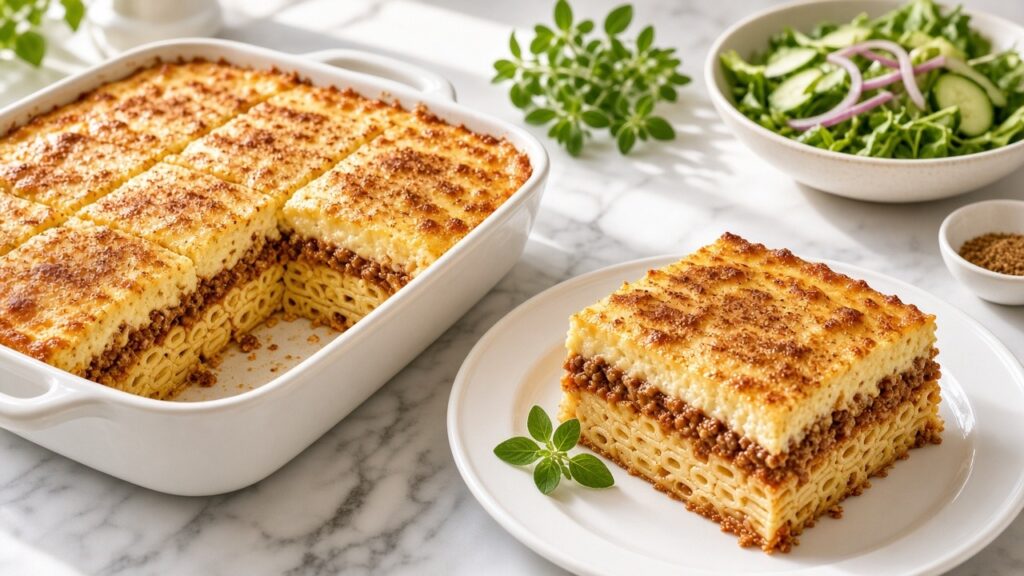
Pastitsio is the Greek dish that convinces people baked pasta can be elegant. Three distinct layers: tubes of pasta bound with egg and cheese on the bottom, a cinnamon-scented meat sauce in the middle and a thick, custardy béchamel on top that bakes to a deep golden brown. Cut into it after it rests and you get a clean, tall square with every layer visible. It’s a Sunday and holiday dish in Greece, and it’s one of the recipes I’m developing for my planned Greek cookbook.
To make pastitsio, boil thick tube pasta (Greek pastitsio No. 2, or bucatini or ziti) until just under al dente, toss it with butter, egg whites and grated kefalotyri or Parmesan, and press it into a deep 9 x 13-inch dish. Top with a thick meat sauce of ground beef or lamb simmered with onion, garlic, tomato, red wine, cinnamon, allspice and a little clove. Cover with a thick béchamel enriched with egg yolks and cheese, then bake at 350°F for about 50 to 60 minutes until deep golden. Let it rest at least 30 to 45 minutes before cutting so the layers set.
Below: what pastitsio is (and how it compares with lasagna and moussaka), the ingredients and swaps, the three components step by step, why béchamel splits, assembly and baking, resting, make ahead and freezing, what to serve with it, troubleshooting, a recipe card and a vegetarian and half-batch version. For more Greek cooking: 22 Greek dishes to make at home.
What is pastitsio?
Pastitsio (Greek: παστίτσιο) is a baked pasta casserole of pasta, spiced meat sauce and béchamel. The name comes from the Italian pasticcio (“pie” or “mess”), and versions exist across the eastern Mediterranean; Cyprus has makaronia tou fournou, and Egypt has macarona béchamel. The modern Greek form, with its tall béchamel cap, was popularized in the early 20th century, the same era that gave moussaka its béchamel topping.
Pastitsio vs lasagna vs moussaka
| Pastitsio | Lasagna | Moussaka | |
|---|---|---|---|
| Base | Tube pasta bound with egg and cheese | Flat pasta sheets in multiple layers | Fried or roasted eggplant (often potato) |
| Meat sauce | Beef/lamb with cinnamon, allspice, clove, wine | Beef/pork ragù, often Italian herbs | Similar to pastitsio’s |
| Cheese | Kefalotyri, kasseri or Parmesan | Ricotta, mozzarella, Parmesan | Kefalotyri or Parmesan |
| Topping | Very thick béchamel with egg yolks | Béchamel (in Bolognese style) or cheese | Thick béchamel |
| Layers | Three distinct layers | Many alternating layers | Three or more layers |
| Spice | Warm: cinnamon, allspice, clove | Savory herbs | Warm spices like pastitsio |
Full comparison: pastitsio vs moussaka.
Ingredients
Which pasta (pastitsio No. 2, bucatini, ziti)
- Pastitsio No. 2 (Greek “makaronia No. 2”): long, thick, hollow tubes made for this dish, sold at Greek and Mediterranean markets and online. The classic choice.
- Bucatini or perciatelli: long, thinner hollow strands; break them in half and lay them parallel.
- Ziti or penne: easiest to find; short tubes give a slightly different look but excellent results.
- Mezzi rigatoni: a good, sturdy short tube.
Cook the pasta 2 to 3 minutes less than the package says; it finishes cooking in the oven.
Meat: beef, lamb or both
- Ground beef (80 to 85 percent lean) is the most common in Greek homes.
- Ground lamb adds richness and a more traditional flavor.
- Half and half is my favorite: beef for body, lamb for flavor.
- Ground veal or pork also works mixed with beef.
Spices: cinnamon, clove, allspice
Warm spices make pastitsio taste Greek, not Italian:
- Cinnamon: a stick in the sauce or about 1 teaspoon ground.
- Allspice: ½ teaspoon.
- Clove: a pinch of ground or 2 whole cloves (remove them).
- Nutmeg: in the béchamel.
- Bay leaf, oregano and a splash of red wine.
The spices should be noticeable but not dessert-like. Taste and adjust.
Cheese: kefalotyri and substitutes
- Kefalotyri: a hard, salty Greek sheep’s or goat’s milk cheese, the classic.
- Kefalograviera: similar, slightly milder.
- Kasseri: milder, semi-hard.
- Parmigiano-Reggiano or Pecorino Romano: the best easy substitutes. Pecorino is saltier and closer to kefalotyri.
Full shopping list
See the recipe card below for quantities.
Step 1: Pasta layer with egg and cheese
- Boil the pasta in well-salted water until 2 to 3 minutes short of al dente. Drain well.
- Toss the hot pasta with butter until coated.
- Cool slightly, then mix in 2 lightly beaten egg whites (save the yolks for the béchamel) and about ½ cup grated cheese. The egg binds the pasta so the bottom layer holds together when sliced.
- Spread it evenly in a buttered deep 9 x 13-inch baking dish (at least 3 inches deep). If using long pasta, lay it in parallel rows; it looks beautiful when cut.
Step 2: Meat sauce
- Brown the meat in a little olive oil over medium-high heat, breaking it up, until no pink remains and some bits are brown. Drain excess fat if needed.
- Add onion and garlic and cook until soft, 5 to 7 minutes.
- Add tomato paste and cook 2 minutes, stirring.
- Deglaze with red wine and simmer until mostly evaporated.
- Add crushed tomatoes (or grated fresh tomatoes), cinnamon, allspice, clove, bay leaf, oregano, salt and pepper, plus a splash of water if needed.
- Simmer uncovered, stirring occasionally, until thick and jammy with little liquid, 30 to 45 minutes. A wet sauce makes soggy pastitsio.
- Remove bay leaf, cinnamon stick and whole cloves. Taste and season. Let it cool a little.
Step 3: Thick Greek béchamel (and why it splits)
Greek béchamel for pastitsio is thicker than a French one: it should hold its shape and bake into a tall, sliceable custard layer.
- Warm the milk in a saucepan or microwave.
- Make a roux: melt butter over medium heat, whisk in flour and cook, whisking, 2 to 3 minutes without browning. This cooks out the raw flour taste.
- Add warm milk gradually, whisking constantly, until smooth. Cook, whisking, until very thick, like soft pudding, 8 to 10 minutes.
- Season with salt, white pepper and nutmeg. Remove from heat.
- Stir in cheese.
- Temper the yolks: let the béchamel cool for 5 minutes. Whisk the yolks in a bowl, whisk in a ladle of béchamel, then whisk the mixture back into the pot.
Why béchamel splits (or turns lumpy or grainy)
| Problem | Why | Fix |
|---|---|---|
| Lumpy | Cold milk added too fast, or not enough whisking | Whisk hard; push through a sieve or use an immersion blender |
| Grainy or curdled | Eggs added to very hot sauce scrambled | Cool the béchamel slightly and temper the yolks |
| Greasy, split | Overheated after adding cheese; too much butter | Keep heat low after adding cheese; whisk in a splash of warm milk |
| Too thin | Not cooked long enough or too much milk | Cook longer until it coats the spoon heavily |
| Too thick to spread | Overcooked or cooled too long | Whisk in warm milk a little at a time |
Assembly and baking
- Heat the oven to 350°F (175°C), rack in the middle.
- Pasta layer in the dish, pressed lightly.
- Meat sauce evenly over the pasta.
- Béchamel over the top, spreading to the edges to seal in the meat. It should be at least 1 inch thick.
- Sprinkle with a little more grated cheese and a pinch of nutmeg or cinnamon.
- Place on a sheet pan to catch drips.
- Bake for 50 to 60 minutes, until the top is deep golden brown in spots and the center is hot (about 165°F). If the top browns too fast, tent with foil.
How long to rest before cutting
At least 30 to 45 minutes, ideally an hour. This is the step people skip and regret. Resting lets the béchamel and egg-bound pasta set, so you get clean squares instead of a sliding mess. Pastitsio stays hot for a long time and is excellent warm, not piping hot. Greek families often serve it closer to room temperature.
Make ahead, freezing and reheating
Pastitsio is a great make-ahead dish, and the timings are much like moussaka’s; see can moussaka be made ahead of time?
- Make components ahead: meat sauce up to 3 days ahead, refrigerated.
- Assemble ahead: up to 24 hours, covered and refrigerated. Bake from cold, adding 15 to 20 minutes to the bake time.
- Bake ahead: bake, cool, refrigerate up to 4 days. Reheat covered at 325°F for 30 to 40 minutes (or individual slices for 15 to 20 minutes).
- Freeze: freeze baked and cooled pastitsio, whole or in portions, wrapped tightly, up to 3 months. Thaw overnight in the fridge, then reheat as above. You can also freeze unbaked; thaw in the fridge before baking.
What to serve with pastitsio
- Greek salad (horiatiki): tomatoes, cucumber, onion, olives and feta.
- Green salad with lemon-oregano dressing.
- Roasted vegetables or green beans (fasolakia).
- Crusty bread.
- Tzatziki on the side.
- Dessert: baklava (see why is my baklava soggy?) or fresh fruit.
For a Greek feast, add souvlaki or gyro. Pastitsio is also an Easter and holiday favorite; see Greek Easter food traditions.
Troubleshooting
| Problem | Fix |
|---|---|
| Soggy, watery layers | Reduce the meat sauce until thick; drain pasta well |
| Pasta layer falls apart | Use egg whites and cheese to bind; rest longer before cutting |
| Béchamel sank into the meat | Béchamel too thin or meat sauce too wet; cook both thicker |
| Top too dark | Tent with foil; bake on the middle rack |
| Bland | Season every layer; use enough cinnamon, allspice and salty cheese |
| Dry | Pasta overcooked or sauce too reduced; keep a little moisture in the sauce |
Recipe card
Pastitsio (Greek Baked Pasta with Béchamel)
Serves: 10 to 12 | Prep: 45 minutes | Cook: 1 hour 45 minutes (including sauce) | Rest: 45 minutes | Total: about 3 hours 15 minutes
Pasta layer
- 1 pound (450 g) pastitsio No. 2 pasta, bucatini or ziti
- 3 tablespoons butter
- 2 egg whites, lightly beaten
- ½ cup grated kefalotyri, Pecorino or Parmesan
Meat sauce
- 2 tablespoons olive oil
- 2 pounds (900 g) ground beef, lamb or a mix
- 1 large onion, finely chopped
- 3 garlic cloves, minced
- 2 tablespoons tomato paste
- ½ cup dry red wine
- 1 (28-ounce) can crushed tomatoes
- 1 cinnamon stick or 1 teaspoon ground cinnamon
- ½ teaspoon ground allspice
- ⅛ teaspoon ground clove
- 1 bay leaf
- 1 teaspoon dried oregano
- Salt and black pepper
Béchamel
- 6 cups whole milk, warmed
- 8 tablespoons (1 stick) butter
- ⅔ cup all-purpose flour
- ½ teaspoon grated nutmeg
- Salt and white pepper
- ¾ cup grated kefalotyri, Pecorino or Parmesan, plus more for the top
- 4 egg yolks (2 from the pasta eggs plus 2 more)
Method
- Make the meat sauce: brown meat, add onion and garlic, tomato paste, wine, tomatoes and spices; simmer until thick, 30 to 45 minutes. Remove whole spices.
- Cook pasta 2 to 3 minutes short of al dente; drain, toss with butter, then egg whites and cheese. Spread in a buttered deep 9 x 13-inch dish.
- Make béchamel: roux of butter and flour, whisk in warm milk, cook until very thick, season, add cheese, cool 5 minutes and temper in yolks.
- Layer meat sauce over pasta, then béchamel. Sprinkle with cheese.
- Bake at 350°F for 50 to 60 minutes until deep golden.
- Rest 45 minutes to 1 hour before cutting.
FAQ
Can I make vegetarian pastitsio?
Yes. Replace the meat with 2 pounds of chopped mushrooms (cooked until their liquid evaporates), lentils or a mix, plus a finely diced eggplant. Keep the same spices, tomato and wine, and reduce the sauce until thick.
How do I make a half batch?
Halve every ingredient and use an 8 x 8-inch or 9 x 9-inch deep dish. Bake about 40 to 50 minutes, still resting at least 30 minutes.
Can I use regular macaroni?
Yes. Elbow macaroni works in a pinch; the bottom layer will look different but taste the same.
Why does my pastitsio fall apart when I cut it?
It needs a longer rest, a thicker béchamel and a drier meat sauce. Egg whites in the pasta help too.
What’s the difference between pastitsio and moussaka?
Pastitsio has a pasta base; moussaka uses eggplant (and often potato). The meat sauce and béchamel are similar. See pastitsio vs moussaka.