
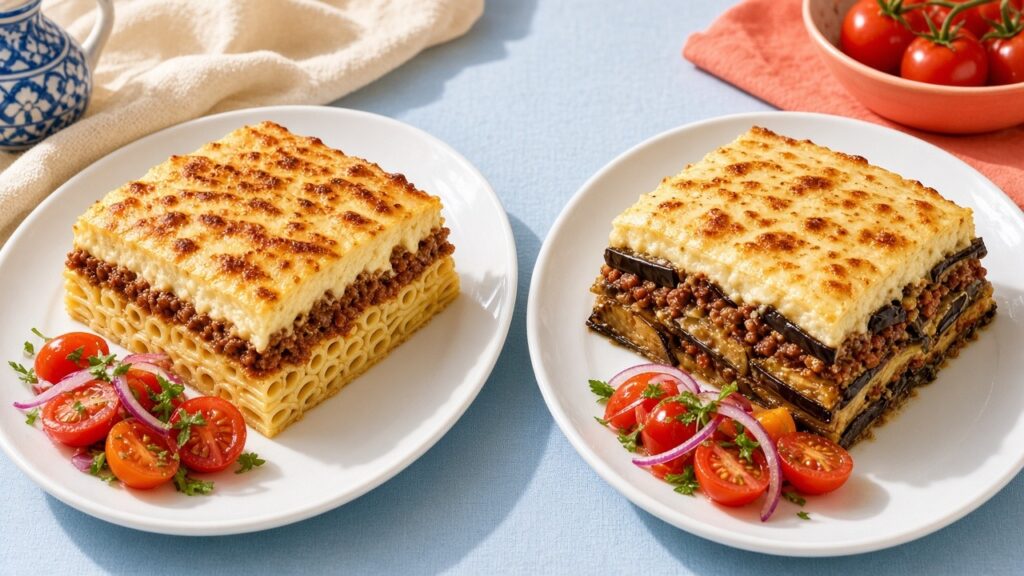
A golden béchamel top can make two different Greek casseroles look almost identical from across the table. Cut a slice, though, and the difference is easy to see: pasta tubes in one, vegetable layers in the other.
Pastitsio is a Greek baked pasta dish, usually layered with a minced-meat tomato sauce and béchamel. Moussaka is usually layered with eggplant and minced-meat sauce under béchamel, sometimes with potatoes too. In the familiar Greek versions, pasta is the main structural difference: pastitsio has it, while moussaka normally does not.
Both are satisfying make-ahead dishes. Choosing between them is less about finding the “better” casserole and more about whether you want baked pasta or tender vegetable layers.
Pastitsio vs moussaka at a glance
| Feature | Pastitsio | Greek-style moussaka |
|---|---|---|
| Main lower layer | Tubular pasta | Eggplant, often with potato |
| Typical middle | Minced meat in a reduced tomato sauce | Minced meat in a reduced tomato sauce |
| Typical topping | Béchamel, often enriched or finished with cheese | Béchamel, often enriched or finished with cheese |
| Texture | Pasta with a creamy top and savory meat layer | Tender vegetables with a creamy top and savory meat layer |
| Common concern | Overcooked pasta or a loose slice | Watery eggplant or oily, loose layers |
| Naturally vegetarian? | No, not the usual meat version | No, not the usual meat version |
| Automatically gluten-free? | No | No; béchamel often contains wheat flour |
Recipes vary by household and region. Moussaka also has versions outside Greece that do not follow this exact layered béchamel-topped format. Here, I am comparing the familiar Greek casserole versions rather than claiming one definition covers every country.
What is pastitsio?
Pastitsio is a baked pasta casserole built around tubular pasta, meat sauce and a creamy topping. Long, thick hollow pasta gives the cut face its recognizable rows of holes. Other sturdy tubes can work in a home adaptation, but the shape changes the look and texture.
The meat sauce is generally more reduced than a sauce you would casually toss through spaghetti. If it is watery at assembly, that extra moisture has nowhere helpful to go. The result should be moist, not a pan of pasta floating in sauce.
Is pastitsio just Greek lasagna?
“Greek lasagna” is a useful first comparison because both are layered baked pasta dishes, but they are not identical. Pastitsio usually uses tubular pasta rather than flat sheets. The seasoning and layer arrangement differ, and a béchamel top is central to the familiar presentation.
Cinnamon or other warm spices may appear in the meat sauce, but they should support the savory flavor rather than turn it into something sweet. There is no rule that every family uses the same amount or combination of spices.
Does pastitsio always use beef?
No. Beef is common, and recipes can use lamb or a mixture. Vegetarian versions exist too, but they are adaptations of the usual meat preparation. If a menu simply says pastitsio, do not assume a particular meat—or that it is meat-free—without asking.
What is Greek-style moussaka?
The familiar Greek version layers eggplant with a savory minced-meat sauce and a béchamel topping. Potatoes are common in some versions and absent in others. The eggplant can be fried, roasted or otherwise prepared before assembly.
The official Visit Greece overview of traditional dishes describes moussaka with eggplant, potato, seasoned meat and béchamel. That is a useful picture of a recognizable version, not a command that every household must use identical layers.
Is moussaka always made with eggplant?
Eggplant is the main reference point for the Greek dish in this comparison. Across the wider family of dishes called moussaka, you can find potato-focused and other versions with different structures. When choosing a recipe, check its specific ingredients rather than relying on the name alone.
Does moussaka contain pasta?
Not in the usual Greek eggplant version. If you see tubular pasta under a béchamel top, you are probably looking at pastitsio or a deliberate hybrid rather than the standard eggplant casserole.
How do they taste different?
Pastitsio gives you the familiar bite of baked pasta, a concentrated meat sauce and a creamy top. The pasta absorbs some surrounding flavor and makes the slice feel structured and substantial.
Moussaka has a softer vegetable character. Well-cooked eggplant becomes silky and carries both sauce and olive-oil flavor. Potato, when included, adds a firmer, starchy layer. The same broad seasoning in the meat sauce can therefore feel quite different in the finished dish.
If you like eggplant, moussaka gives it a starring role. If you are uncertain about eggplant or want a pasta-centered dish, pastitsio is the more obvious first choice. Neither should taste dominated by raw flour, excess cinnamon or a greasy puddle.
Moussaka vs lasagna
Greek-style moussaka and lasagna can share meat sauce and a creamy layer, but the eggplant replaces the pasta sheets that structure lasagna. Some lasagnas use béchamel; others use ricotta or different cheese combinations. It is more accurate to describe moussaka as a layered eggplant casserole than as lasagna with a different name.
Which is harder to make?
Both involve several components rather than difficult last-second technique. You cook the main layer, make a meat sauce, prepare béchamel, assemble and bake. Organization matters more than speed.
Moussaka often requires more vegetable preparation, particularly if you cook eggplant in batches. Pastitsio requires attention to pasta doneness and handling so the bottom does not turn mushy. Both reward reading the whole recipe before starting.
A useful work order
- Start the meat sauce so it has time to reduce.
- Prepare the vegetables or pasta while the sauce simmers.
- Make béchamel once the other components are close to ready.
- Assemble according to the chosen recipe, without adding unnecessary liquid.
- Bake until cooked through and the top is browned as directed.
- Rest before cutting so the layers can settle.
Do not copy a cooking time from one dish into a different pan depth or recipe and assume it will work. A deep, cold casserole takes longer to heat through than a shallow one assembled warm.
Why does the slice fall apart?
The shared culprits are too much moisture and too little resting time. A just-baked casserole is hot, fluid and full of steam. Letting it settle helps it hold a cleaner slice; it does not mean the dish was ruined because the first spoonful was soft.
For pastitsio, watch for pasta cooked too far before baking, watery meat sauce, or an overly thin béchamel. For moussaka, underprepared or wet eggplant, excess oil and a loose sauce can all contribute.
How to keep moussaka from becoming watery
Cook the eggplant before assembly as the recipe directs, giving it room to roast or fry properly rather than steaming in a crowded pile. Drain excess oil if frying. Reduce the meat sauce until it is spoonable and concentrated rather than soupy.
Salting eggplant can be useful in some recipes, but it is not a magic substitute for proper cooking and moisture control. If your recipe includes salting and rinsing, dry the slices thoroughly before oil or heat.
How long should either dish rest?
Many recipes suggest roughly 20–30 minutes, sometimes longer for a deep pan. Follow the recipe and the serving conditions; the goal is a slice that holds while the food is still pleasantly hot. Do not leave a casserole out for hours in pursuit of a perfect photograph.
Which is healthier, lighter or lower in carbs?
Neither name gives you a complete nutrition answer. Pastitsio includes pasta. Moussaka may include potatoes, flour in the béchamel, and a substantial amount of oil or sauce. Eggplant does not automatically make the finished dish light or low-carbohydrate.
Portion size, the meat, how vegetables are cooked and the amount of topping all matter. If you want a vegetable-forward plate, add a crisp salad and choose a serving that suits you. If you need a specific nutrition target, calculate the actual recipe rather than borrowing numbers from a different version.
Is moussaka gluten-free?
Usually not automatically. Even without pasta, a classic béchamel commonly uses wheat flour. Check the sauce and any other ingredients, and consider cross-contact if cooking for someone with celiac disease.
Can either be vegetarian?
Yes, with a recipe designed for it. Lentils, mushrooms or other fillings can replace the meat layer, but they must be seasoned and reduced appropriately. Simply removing the meat from an existing recipe can leave the pan with too little filling or too much liquid.
Dairy-free is a separate adaptation because the topping and cheese may need replacing. Vegetarian does not mean vegan.
What to serve with them
A fresh tomato-and-cucumber salad, greens with lemon, or another crisp, acidic side works well against the richness. You do not need a second heavy starch beside a generous serving of baked pasta or a potato-containing moussaka.
For more of the meal, see Greek dishes to make at home. If you are comparing grilled Greek favorites as well, souvlaki vs gyro explains the difference between skewered pieces and shaved meat.
Making ahead, freezing and reheating
Follow the chosen recipe’s directions for whether to refrigerate assembled or baked. If assembling in advance, cool cooked components promptly, refrigerate safely, and allow for the extra heating time of a cold pan. Check that the baking dish can safely go from cold storage to the oven; thermal shock can break some dishes.
For cooked leftovers, divide into manageable portions and refrigerate within two hours, or one hour above 90°F. Keep at 40°F or below and use within 3–4 days. Freeze portions for longer storage; about 2–3 months is a practical quality target. Eggplant and creamy sauce textures may change a little after freezing.
Thaw in the refrigerator and reheat to 165°F throughout. Covering during most of reheating helps prevent the top drying out; uncover briefly if needed at the end. Follow USDA leftovers guidance, not just a browned top, to judge reheating safety.
Pastitsio and moussaka FAQ
Can I use all beef in either dish?
Yes, choose a recipe written for beef or substitute thoughtfully for a similar minced-meat filling. Beef and lamb have different fat levels and flavors, so drain or reduce the sauce as needed rather than adding it to the pan greasy or watery. The finished texture matters as much as the species.
Do they use the same béchamel?
They can use closely related sauces, but recipes differ in thickness, cheese and egg enrichment. Use the sauce written for your dish and pan rather than assuming any quantity of thin white sauce will hold the layers.
Can I substitute macaroni for pastitsio pasta?
A sturdy tubular pasta can work as an adaptation. Smaller macaroni changes the structure and the cut face. Cook it as directed for the recipe so it does not become mushy during baking.
Can I make moussaka without potatoes?
Yes, many versions rely on eggplant without a potato layer. Use a recipe balanced for that choice rather than removing a substantial layer and expecting the same height and yield.
Which is better for a dinner party?
Choose according to your guests: pastitsio for pasta lovers, moussaka for people who enjoy eggplant. Both are convenient because the main work happens before serving. Check dietary needs first; neither is automatically vegetarian or gluten-free.
Can you combine pasta and eggplant in one bake?
Of course, but that is a variation rather than the simplest way to understand the two classics. For a first attempt, choose one well-structured recipe so you can learn the moisture balance and layer textures.
When in doubt, look beneath the golden top. Pasta points you toward pastitsio; eggplant points you toward Greek-style moussaka. That is the distinction worth remembering at the table.