
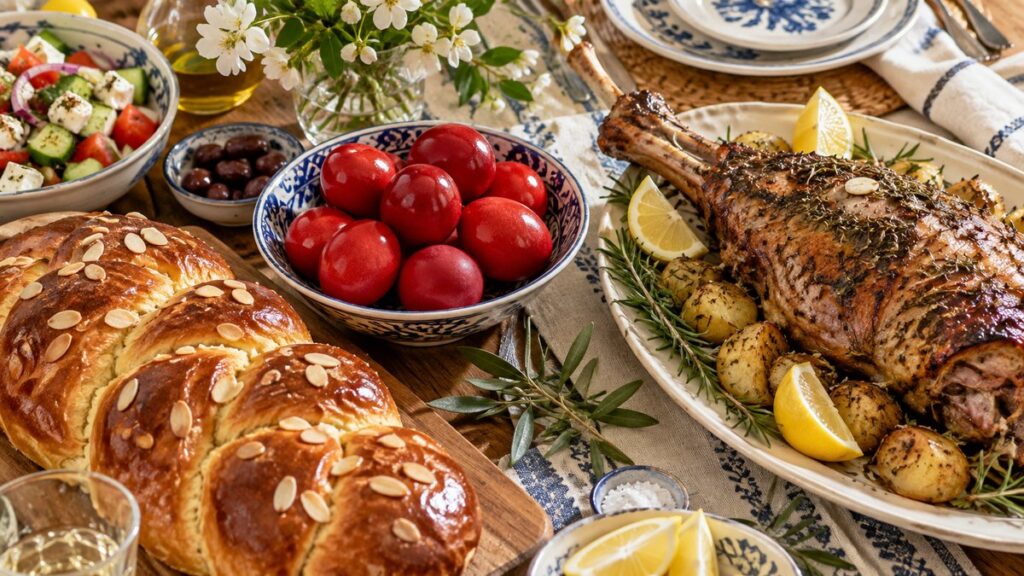
Greek Easter (Pascha) is the biggest feast of the Greek year, bigger than Christmas, and food tells the whole story: weeks of simple fasting food, red eggs, sweet braided bread, a soup eaten after midnight, and a whole lamb turning over the fire on Sunday. While planning my Greek cookbook, this is the celebration I find most beautiful. Here it is, day by day.
Greek Easter food traditions include Lenten fasting dishes without meat or dairy, dyeing eggs red and baking tsoureki (sweet braided bread) on Holy Thursday, eating magiritsa soup after the midnight Resurrection service, cracking red eggs (tsougrisma), and roasting lamb on a spit on Easter Sunday.
When is Greek Easter?
Greek Easter follows the Orthodox calendar, so it often falls on a different Sunday from Western Easter. | Year | Greek Orthodox Easter | Western Easter |
|—|—|—|
| 2027 | Sunday, May 2 | Sunday, March 28 |
| 2028 | Sunday, April 16 | Sunday, April 16 (same day) |
| 2029 | Sunday, April 8 | Sunday, April 1 |
The Orthodox date is calculated with the older Julian calendar, which is why it usually comes later. Great Lent starts on Clean Monday (Kathara Deftera), seven weeks before Easter.
Great Lent: the fasting foods
For the weeks before Easter, many Greek Orthodox Christians follow a fast with no meat, dairy or eggs (and, on many days, no olive oil or wine). Lenten cooking (nistisima) is delicious on its own:
- Fasolada (bean soup) and fakes (lentil soup)
- Gigantes, giant beans baked in tomato
- Briam, roasted vegetables
- Taramosalata, the fish-roe spread
- Lagana, the flatbread baked for Clean Monday, the first day of Lent
- Seafood like octopus, shrimp and squid, which are allowed on many fast days
The Greek Easter week at a glance
| Day | Food tradition |
|---|---|
| Clean Monday | Lagana bread, taramosalata, olives, seafood, kite flying |
| Lent weeks | Nistisima: beans, lentils, vegetables, seafood on allowed days |
| Lazarus Saturday | Lazarakia, small spiced breads shaped like Lazarus |
| Holy Thursday | Dye red eggs; bake tsoureki and koulourakia |
| Good Friday | Strictest fast: simple food, often lentils with vinegar |
| Holy Saturday night | Magiritsa after the midnight service; tsougrisma |
| Easter Sunday | Spit-roasted lamb, kokoretsi, salads, sweets |
Holy Thursday: red eggs and tsoureki
Red eggs: On Holy Thursday, families dye hard-boiled eggs a deep red, the color of the blood of Christ and of new life.
Tsoureki: A sweet, braided Easter bread, rich with eggs and butter, scented with mahlepi (ground cherry pits) and mastiha (mastic resin). Sometimes a red egg is baked right into the braid.
Koulourakia: Twisted butter cookies, glazed with egg and often sprinkled with sesame, perfect with coffee.
How to dye eggs red
Simmer 12 white eggs gently in water with 3 tablespoons of white vinegar and red egg dye (sold in Greek markets around Easter) for 12 to 15 minutes. For a natural dye, simmer the skins of 10 to 12 red or yellow onions in 6 cups of water for 30 minutes, strain, add vinegar and cook the eggs in it; you’ll get deep red-brown. Cool, then rub each egg with a few drops of olive oil for shine.
Tsoureki tips
- Mahlepi and mastiha are sold in Greek groceries; grind mastiha with a little sugar so it doesn’t stick.
- The dough is rich and sticky, so give it long rises (2 to 3 hours for the first) in a warm spot.
- Braid it in three strands, brush with egg, sprinkle with sliced almonds, and tuck a red egg into the braid if you like.
- Tsoureki keeps 3 to 4 days wrapped; stale slices make wonderful French toast.
Good Friday: the strictest day
Good Friday is a day of mourning and the strictest fast. Many families eat very simply; some eat lentil soup with a splash of vinegar.
Holy Saturday at midnight: magiritsa
At the late-night service on Holy Saturday, the church goes dark, then the priest brings out the Holy Light, and candles are lit one from another as people say “Christos Anesti” (Christ is risen) and answer “Alithos Anesti” (Truly He is risen).
Families then go home to break the fast with magiritsa, a soup traditionally made with lamb offal, green onions, dill and lettuce, finished with avgolemono (egg and lemon). It uses the parts of the lamb that will be roasted the next day.
This is also when the tsougrisma begins: each person holds a red egg and taps it against another’s. The person whose egg stays unbroken is said to have good luck for the year.
Magiritsa without offal
Many modern cooks make magiritsa with lamb shoulder or chicken instead of offal: simmer the meat with onions, then add plenty of chopped green onions, dill and romaine, a little rice, and finish with avgolemono. The tempering technique is the same as in my avgolemono recipe in Greek dishes to make at home.
Easter Sunday: the lamb
Easter Sunday is the feast. In many parts of Greece, the whole lamb (arni) or goat is roasted on a spit (souvla) over charcoal for hours, with family and friends gathered around, music and wine. Where there’s no spit, it’s roasted in the oven with lemon potatoes.
Also on the table:
- Kokoretsi: lamb offal wrapped in intestines and grilled on a spit
- Tzatziki, horiatiki salad and spanakopita or tiropita
- Red eggs, tsoureki and koulourakia
How to celebrate Greek Easter at home (no spit required)
- Roast a leg of lamb with garlic, lemon, oregano and potatoes: for a 5–6 lb (2.3–2.7 kg) bone-in leg, roast at 325°F (165°C) for about 2½ to 3 hours, until 145°F (63°C) for medium or higher for the falling-apart Greek style; add potatoes for the last 1½ hours.
- Dye eggs red on Thursday and play tsougrisma on Sunday.
- Bake or buy tsoureki. In Chicago, Greek bakeries and markets sell it around Easter; see my Greektown guide.
- Make the sides ahead: tzatziki, salad and moussaka, which is better made ahead.
Greek Easter and Panamanian Semana Santa
In Panama, we also keep Holy Week with special food: fish instead of meat on Good Friday and sweets like cabanga, made from grated green papaya and coconut cooked in sugarcane honey until thick, then cut into squares or balls. Different dishes, but the same rhythm: fasting, then feasting with family.
FAQ
Why do Greeks dye eggs red for Easter?
Red symbolizes the blood of Christ and new life; the egg represents the Resurrection.
What do Greeks eat after the midnight Easter service?
Magiritsa soup, and red eggs for tsougrisma.
What is the main dish of Greek Easter?
Roast lamb, traditionally on a spit.
When is Greek Easter in 2027?
Sunday, May 2, 2027, five weeks after Western Easter (March 28).
What do Greeks eat during Lent?
Nistisima: bean and lentil soups, gigantes, briam, taramosalata, lagana bread, olives, and seafood like octopus and shrimp on allowed days.
What is the Greek Easter greeting?
“Christos Anesti” (Christ is risen), answered “Alithos Anesti” (Truly he is risen).
What is tsoureki flavored with?
Mahlepi and mastiha, sometimes orange zest.
More Greek cooking
See my 22 Greek dishes to make at home and how to make moussaka ahead.
Kalo Pascha! Happy Easter!