
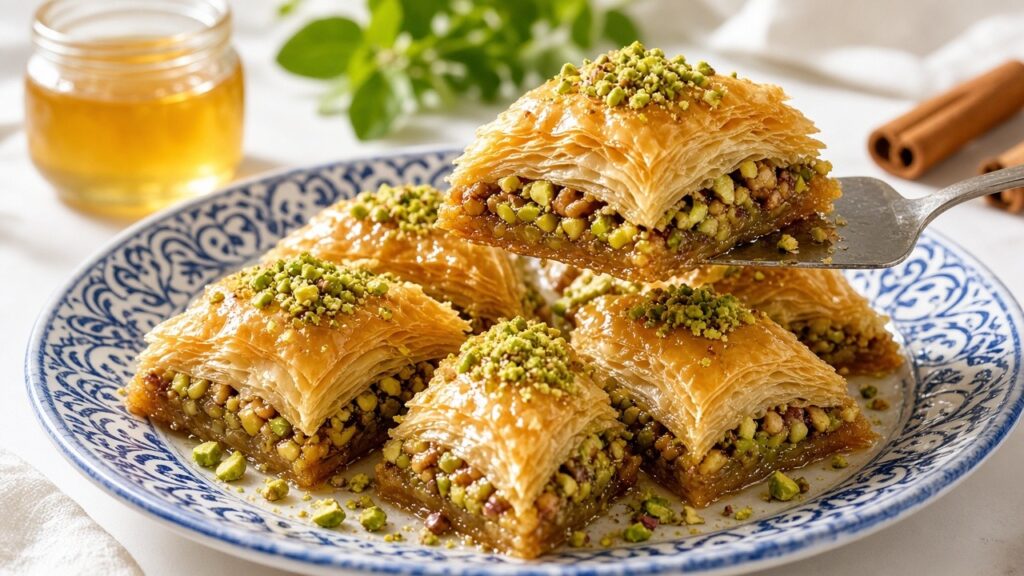
Good baklava shatters when you bite it: crisp, flaky top layers, a nutty middle, and just enough syrup to make it sweet and moist without turning the phyllo into wet paper. When baklava comes out soggy, it’s disappointing, especially after all that layering. The good news is that soggy baklava almost always comes down to a handful of fixable causes.
Baklava gets soggy when the syrup and pastry are the same temperature (hot syrup on hot baklava or cold on cold), when there’s too much syrup or the syrup is too thin, when the phyllo is under-baked, when the phyllo got wet or wasn’t buttered enough, or when the finished baklava was covered while still warm. The fix: pour cool syrup over hot baklava straight from the oven, use a thick syrup simmered for about 10 minutes, bake low and long until the top is deep golden and the bottom is crisp, brush every sheet with clarified butter, and let it rest uncovered overnight. Soggy baklava can often be rescued by re-baking it at 300°F for 10 to 15 minutes.
Below: every cause and its fix, how to rescue a soggy batch, how to store baklava so it stays crisp, whether baklava is supposed to be soft, and answers to common questions. For more Greek recipes, see Greek dishes to make at home.
Why is my baklava soggy? The short answer
| Cause | What happens | Fix |
|---|---|---|
| Syrup and baklava at the same temperature | Phyllo steams and absorbs too fast, or syrup sits on top | Cool syrup on hot baklava (or hot syrup on cooled baklava) |
| Too much syrup | Pools at the bottom and soaks every layer | Use about 2 to 2½ cups for a 9×13 pan |
| Syrup too thin | Watery syrup soaks in and softens the layers | Simmer 10 minutes until slightly thick |
| Under-baked | Inner and bottom layers stay doughy | Bake low and long until deep golden |
| Not enough butter | Dry layers absorb syrup instead of resisting it | Brush every sheet |
| Wet phyllo | Gummy, stuck-together layers | Thaw properly; cover with a dry towel |
| Not cut before baking | Syrup can’t reach the bottom evenly; top crushes | Cut all the way through before baking |
| Covered while warm | Trapped steam softens the top | Rest uncovered 6 hours or overnight |
| Humidity or refrigeration | Moisture softens phyllo over time | Store at room temperature, loosely covered |
The syrup rule: cool syrup on hot baklava (or the reverse)
This is the most important rule in baklava. One of the two should be hot and the other cool.
- Hot baklava, cool syrup (the most common method): make the syrup first so it’s at room temperature by the time the baklava comes out of the oven. Pour it over the baklava straight from the oven. You’ll hear a sizzle. The hot, dry phyllo absorbs the syrup slowly and stays crisp on top.
- Cool baklava, hot syrup: let the baklava cool completely, then pour hot syrup over it. Some Greek and Turkish cooks prefer this.
Why it matters:
- Hot on hot: the syrup stays thin and absorbs quickly into steaming pastry, which makes it soggy.
- Cold on cold: the syrup sits on top and doesn’t soak in, leaving a sticky top and dry inside.
To test yourself, make two small pans, one with each method, and compare them the next day. You’ll see the difference.
Too much syrup or too thin syrup
Too much syrup
More syrup doesn’t mean better baklava. A standard 9×13-inch pan needs about 2 to 2½ cups of syrup. If syrup pools at the bottom of the pan the next day, use less next time.
Pour slowly and evenly, focusing on the cut lines so syrup reaches the bottom. Stop when the baklava stops absorbing easily.
Syrup too thin
Syrup should be simmered long enough to thicken slightly, about 10 minutes after it boils. It should coat a spoon but still be pourable.
A basic Greek-style syrup:
| Ingredient | Amount |
|---|---|
| Sugar | 1½ cups |
| Water | 1 cup |
| Honey | ½ cup |
| Lemon juice | 1 tablespoon |
| Cinnamon stick | 1 |
| Strip of orange or lemon peel | 1 |
Bring the sugar and water to a boil, add the cinnamon and peel, and simmer for 10 minutes. Remove from the heat and stir in the honey and lemon juice. Let it cool completely if you’re pouring it over hot baklava.
The lemon helps prevent the sugar from crystallizing. The honey adds flavor and thickness.
Under-baked layers and oven temperature
Baklava needs time for heat to reach all the way to the bottom layers. If the oven is too hot, the top browns before the inside cooks, and the inner layers stay pale and doughy, which then soaks up syrup and turns soggy.
- Bake at 325°F to 350°F. A lower temperature for longer cooks evenly.
- Bake 50 minutes to 1½ hours, depending on the pan size, the number of layers and your oven.
- Look for deep golden brown on top, not pale yellow.
- Check the bottom with a knife or by lifting a corner. It should be golden and crisp.
- Use a metal pan. Glass and ceramic heat more slowly, so the bottom can stay pale. If you use glass, bake longer.
- Bake on the middle or lower rack so the bottom cooks through.
An oven thermometer helps, since many home ovens run hot or cold.
Not enough butter, or wet phyllo
Butter
Each sheet of phyllo should be brushed with butter. The fat separates the layers and helps them bake crisp. Dry, unbuttered sheets bake into a papery mass that absorbs syrup and softens.
Use clarified butter. Regular butter is about 15% water. That water turns to steam between the layers. Clarified butter (or ghee) is pure fat and makes crisper baklava.
How to clarify butter: melt it slowly, let the milk solids sink, skim off the foam, and pour the clear butter off the solids.
Wet phyllo
- Thaw frozen phyllo in the refrigerator overnight, then let it sit at room temperature for an hour or two before opening the package. Thawing on the counter or in the microwave can make sheets sticky and gummy.
- Cover the phyllo with a dry towel or plastic wrap while you work. If you use a damp towel, place plastic wrap or parchment between the towel and the phyllo, so moisture doesn’t touch the sheets.
- Don’t panic about tears. Torn sheets can be patched in the middle layers.
Nuts and filling
- Use dry, chopped nuts, not ground to a paste. A coarse chop lets air and syrup move between layers.
- Toast the nuts lightly if you like, and let them cool.
- Don’t add wet ingredients like extra honey to the filling.
- Don’t overload: too many nuts between layers can make the middle dense.
Cutting before baking
Baklava should be cut into diamonds or squares before baking, all the way to the bottom of the pan. This:
- Lets heat and butter reach the inner layers.
- Lets syrup flow evenly down to the bottom.
- Prevents the crisp top from shattering when you cut it later.
Use a very sharp knife and cut slowly, holding the top layers in place with your other hand. After baking, run the knife along the cuts again before pouring the syrup.
Humidity and covering it
After the syrup goes on, leave the baklava uncovered at room temperature for at least 6 hours, ideally overnight. This gives the syrup time to absorb and the top time to dry and stay crisp. Covering it while it’s warm traps steam and softens the top.
Humidity also matters. On very humid days, baklava softens faster. Store it in a cool, dry place.
Can you fix soggy baklava? (re-bake method)
Often, yes, especially if the problem is a soft top.
- Preheat the oven to 300°F.
- Place pieces on a rack set over a baking sheet so excess syrup can drip away.
- Bake for 10 to 15 minutes, until the top is crisp and fragrant. Watch carefully so it doesn’t burn.
- Cool uncovered on the rack.
If the bottom is swimming in syrup, drain the extra syrup first, then re-bake. If the inner layers were never cooked, re-baking may only partly help.
How to store baklava so it stays crisp
| Where | How long | How |
|---|---|---|
| Room temperature | Up to 1 to 2 weeks | Loosely covered with foil or a clean towel, or in a container with the lid slightly open |
| Refrigerator | Not recommended | Cold and moisture soften phyllo and harden the syrup |
| Freezer | Up to 3 months | Wrap tightly; thaw at room temperature, unwrapped, and re-crisp in the oven if needed |
Don’t seal baklava in an airtight container right away. Let it rest uncovered overnight first.
Is baklava supposed to be soggy?
No, but it shouldn’t be dry either. Good baklava has:
- A crisp, flaky top that shatters.
- A moist, syrupy middle and bottom.
- Layers you can still see.
Some regional styles are syrupier than others, and baklava naturally softens slightly over a few days. But a wet, limp top and gummy layers mean something went wrong. For more Greek desserts and holiday sweets, see Greek Easter food traditions, and for bakeries that make it well, my Greektown Chicago food guide.
A crisp baklava checklist
- Thaw phyllo in the refrigerator overnight.
- Clarify the butter.
- Make the syrup first and let it cool.
- Brush every sheet with butter.
- Use coarsely chopped, dry nuts.
- Cut all the way through before baking.
- Bake at 325°F to 350°F until deep golden, top and bottom.
- Pour cool syrup over hot baklava slowly, along the cuts.
- Rest uncovered overnight.
- Store at room temperature, loosely covered.
FAQ
Why is only the bottom of my baklava soggy?
Usually because the bottom layers were under-baked, or because there was too much syrup and it pooled. Bake longer or on a lower rack, use a metal pan, and use less syrup. You can also brush the bottom sheets with extra butter.
Honey vs sugar syrup: which is better?
Both work. Pure honey syrup is thick and very sweet, and it can make baklava stickier. Sugar syrup is lighter and crisper. Many Greek cooks use a mix: mostly sugar syrup with honey added at the end for flavor.
Should I pour hot or cold syrup on baklava?
Pour cool syrup over hot baklava, or hot syrup over cooled baklava. Never hot on hot or cold on cold.
How long should baklava sit before serving?
At least 6 hours, ideally overnight, uncovered, so the syrup absorbs and the top stays crisp.
Why is my baklava dry?
Not enough syrup, syrup that was too thick, or cold syrup on cold baklava. Next time, use a little more syrup and follow the temperature rule.
Can I make baklava ahead?
Yes. Baklava is a great make-ahead dessert. It’s often best the day after baking and keeps well at room temperature for a week or more.