
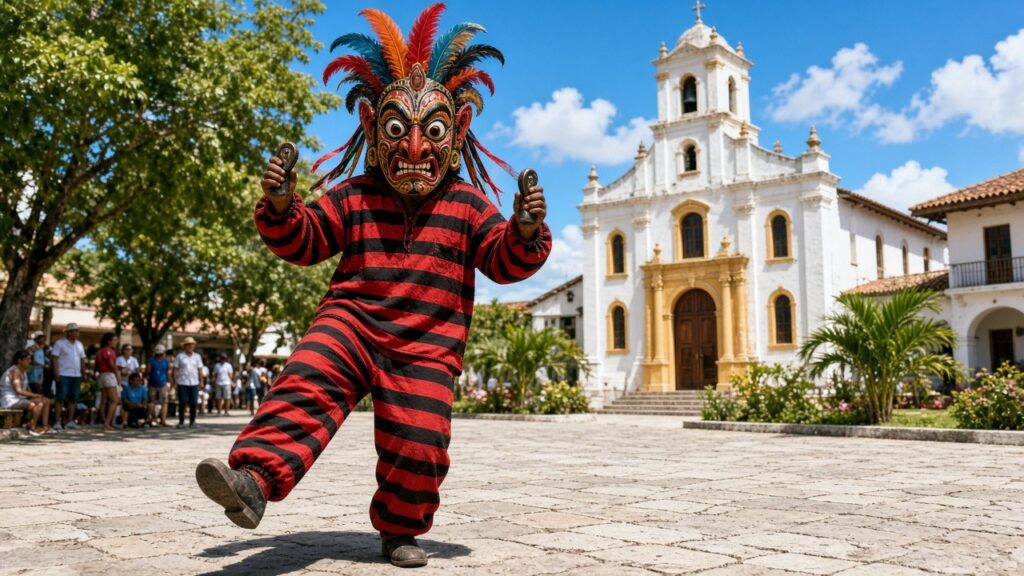
If you’ve seen a photo of a Panamanian dancer in a baggy red-and-black striped suit, a fierce painted mask with horns and a crown of feathers, clicking castanets in a crowded street, you’ve met a diablico sucio. They’re one of the most recognizable images of Panamanian folklore, printed on posters, painted on buses and sold as masks in craft markets, but many visitors (and plenty of Panamanians who grew up in the city) don’t know the story behind them.
The diablicos sucios (“little dirty devils”) are folkloric devil dancers from Panama’s Azuero Peninsula, best known for the Corpus Christi festival in La Villa de Los Santos, Los Santos province. They wear red-and-black striped costumes, large painted papier-mâché masks with horns and plumes, and play castanets while dancing to pipe and drum. The dance is a religious drama of good against evil: the devils dance through the streets until they’re defeated by the Archangel Michael, a story brought by Spanish Catholic missionaries and transformed by local traditions over centuries.
Below: who the diablicos sucios are, where and when they dance, the costume and mask, the dance and its music, how they differ from the diablicos limpios, origins and meaning, related Panamanian folk dances, where to see them and answers to common questions. For more Panamanian folklore, see what is tamborito? and the Panamanian pollera dress.
Who are the diablicos sucios?
The diablicos sucios are a troupe of masked dancers who represent devils in a religious folk drama. They’re part of a larger group of “danzas” (folkloric dances with characters and stories) performed during Corpus Christi celebrations in the Azuero region, the heartland of Panamanian folklore.
A few key characters:
- The diablicos sucios: the troupe of devils in red-and-black stripes, dancing in two rows.
- The Gran Diablo or Diablo Mayor: the leader of the devils, sometimes with a more elaborate costume.
- The Archangel Michael (San Miguel Arcángel): the figure of good who confronts and defeats the devils.
- Musicians: the players of the pito (a small pipe or flute) and caja (drum) who keep the dance going.
The name “sucio” (“dirty”) is usually explained by the costume’s original dyes. Early costumes were said to be colored with natural materials such as charcoal or soot and achiote (annatto), which left the fabric looking “dirty” compared with the brighter costumes of other troupes. You’ll also hear people simply call them “los diablicos.”
Where and when they dance (Corpus Christi, La Villa de Los Santos)
Corpus Christi
Corpus Christi is a Catholic feast celebrating the Eucharist. It falls on the Thursday 60 days after Easter Sunday (some places celebrate on the following Sunday), so it moves each year, usually landing in late May or June.
La Villa de Los Santos
La Villa de Los Santos, a colonial town in Los Santos province on the Azuero Peninsula, is the best-known home of the Corpus Christi danzas. The town is also famous in Panamanian history for the “Primer Grito de Independencia” (First Cry of Independence) from Spain on November 10, 1821, so it’s a place where history and folklore meet.
During the Corpus Christi celebrations, the town fills with masked troupes, processions, music and visitors. The diablicos dance in the streets, in front of the church and in the plaza over several days.
Other places and occasions
You may also see diablicos sucios at:
- Other Azuero towns’ religious festivals and folk festivals.
- National folklore festivals and parades, including events in Panama City.
- Patriotic celebrations in November (Panama’s “fiestas patrias”).
- Cultural shows for visitors, schools and folkloric groups.
The costume and mask
The costume
- Stripes: a loose, one-piece or two-piece suit with horizontal red and black stripes from neck to ankle. The baggy cut lets dancers jump and kick freely.
- Colors: red is usually explained as fire or blood; black as darkness, evil or mourning. Interpretations vary by family and town.
- Accessories: a cape or scarf, sometimes cascabeles (small bells) or ribbons, and comfortable shoes (often alpargatas or sandals in older photos, sneakers today).
- Castanets: carried in the hands and clicked in rhythm with the music.
The mask
The mask is the star. Diablico masks are traditionally made by artisans from papier-mâché (papel maché) shaped over a clay or plaster mold, dried, then painted in bright colors.
Common features:
- Bulging eyes, large teeth or fangs and exaggerated features.
- Horns, sometimes curling, sometimes several.
- A tall crest of feathers or plumes (or paper and fabric decorations) on top.
- Bright reds, blacks, greens, yellows and whites.
Each mask is different, and families of mask makers have passed the craft down for generations in Los Santos and nearby Herrera province. The masks are now also sold as folk art, so you’ll find small decorative versions in craft markets.
The dance and music
The dance
The diablicos dance in two rows (filas), facing each other or moving in formation through the streets. The steps are energetic: jumps, stamps, turns, kicks and crossing patterns, with the castanets marking the rhythm. Movement is grounded and percussive, with a playful, menacing energy as the devils taunt the crowd.
The dance tells a story. The devils celebrate and cause chaos until the Archangel Michael confronts them. In the climax, the devils are defeated and, in many tellings, symbolically converted or redeemed, marking the triumph of good.
The music
The traditional accompaniment is pito y caja:
- Pito: a small transverse flute or pipe that plays the melody.
- Caja: a drum (often a snare-like drum) that keeps a driving rhythm.
Each danza has its own tunes (sones), and dancers change steps when the music changes. The castanets add a third layer of rhythm.
Diablicos sucios vs diablicos limpios
Corpus Christi in Azuero features more than one devil troupe. The two you’ll hear compared most:
| Diablicos sucios | Diablicos limpios | |
|---|---|---|
| Name | “Dirty little devils” | “Clean little devils” |
| Costume | Red-and-black horizontal stripes | Brighter, cleaner-looking costumes, often lighter colors decorated with ribbons, bells or sequins |
| Mask | Papier-mâché devil mask with horns and plumes | Masks as well, often with a different style and decoration |
| Instruments | Castanets in hand; pito y caja | Similar music; may use bells and different tunes |
| Character | Rough, playful, menacing | Neater, more elegant presentation |
| Best known in | La Villa de Los Santos and Azuero | Azuero towns during Corpus Christi |
Details vary by town and troupe, so treat this as a general guide. Other Corpus Christi danzas include the Danza del Torito (the little bull) and the Danza de los Montezumas, each with its own costume and story.
Origins and meaning
Spanish religious theater
The roots of the diablicos go back to the colonial period. Spanish Catholic missionaries used religious theater, processions and dance-dramas to teach Christian ideas. Devil characters and the battle between good and evil were common in Corpus Christi celebrations in Spain, and similar devil dances appeared across Latin America (in Bolivia, Peru, Venezuela and elsewhere).
Local transformation
In Panama, those Spanish traditions mixed with Indigenous and African influences in music, rhythm, costume and mask-making. Over centuries, the diablicos became a distinctly Panamanian tradition, carried on by local families, brotherhoods and folkloric groups.
What it means today
Today, the diablico sucio is:
- A religious tradition tied to Corpus Christi and the triumph of good over evil.
- A symbol of Panamanian identity and Azuero pride, alongside the pollera and the montuno.
- A living craft, keeping mask-making and costume-sewing skills alive.
- A popular image in art, tourism and souvenirs.
Other Panamanian folk dances
The diablicos are just one part of Panama’s rich folk dance tradition. Others to know:
- Tamborito: often called Panama’s national dance, a courtship dance with drums, call-and-response singing and hand-clapping. Full guide: what is tamborito?
- Punto: an elegant couple dance showing off the pollera.
- Mejorana and cumbia panameña: guitar-based and drum-based folk music and dance.
- Congo: Afro-Panamanian dance and theater traditions from the Caribbean coast, especially Colón province, performed at Carnival.
- Bullerengue: an Afro-descendant drum and song tradition from the Darién and coastal areas.
The women’s costume you’ll see at many of these events is the pollera: see the Panamanian pollera dress. For festival food, see Panamanian street food and Panamanian chicha recipes.
Where to see them
- Corpus Christi in La Villa de Los Santos: the classic experience. Dates change each year, so check the Catholic calendar and local announcements. Expect crowds, heat and lots of walking; book lodging early (Chitré, a short drive away, is the nearby city with more options).
- Folklore festivals in Azuero: several towns in Los Santos and Herrera provinces hold festivals with danzas throughout the year.
- Panama City events: folkloric groups perform at parades, cultural centers and national celebrations, especially around November.
- Museums and craft markets: masks and costumes are displayed in museums and sold by artisans. The Museo de la Nacionalidad in La Villa de Los Santos focuses on the town’s independence history.
Before you go, check current schedules with official tourism sources and local parishes, as programs change each year.
Tips for visitors
- Be respectful. The dances are religious and community traditions, not just a show. Follow processions quietly and don’t block dancers.
- Ask before close-up photos of individuals, especially children.
- Expect playful interaction. Diablicos may tease the crowd; it’s part of the fun.
- Dress for heat. Light clothing, sunscreen, water and a hat.
- Buy masks from artisans if you want a souvenir; prices reflect the hours of handwork.
FAQ
Where do the Diablicos Sucios dance?
Best known in La Villa de Los Santos on Panama’s Azuero Peninsula during Corpus Christi. They also appear in other Azuero towns, folk festivals and national celebrations, including in Panama City.
When do they dance (Corpus Christi)?
During Corpus Christi celebrations, which fall about 60 days after Easter, usually in late May or June. The exact dates change every year.
What do the masks and red-and-black costumes mean?
They represent devils in a religious drama of good versus evil. Red is commonly linked to fire or blood and black to darkness or evil. The horned papier-mâché masks with plumes make the devils look fierce and larger than life.
What music goes with the dance?
Traditionally pito y caja, a small pipe or flute with a drum, plus the castanets the dancers play. Each danza has its own tunes.
Can visitors see the Diablicos in Panama?
Yes. Corpus Christi in La Villa de Los Santos is open to visitors, and folkloric groups perform at festivals and events throughout the year. Check current dates with official tourism and local sources.
Why are they called “sucios”?
“Sucio” means “dirty.” The name is usually linked to the original dyes, such as charcoal and achiote, that gave the costumes a darker, “dirty” look compared with other troupes.
Are diablicos sucios scary for kids?
They can look scary, and they playfully tease the crowd, but it’s a festive, family tradition. Many Panamanian children grow up seeing them at parades.