
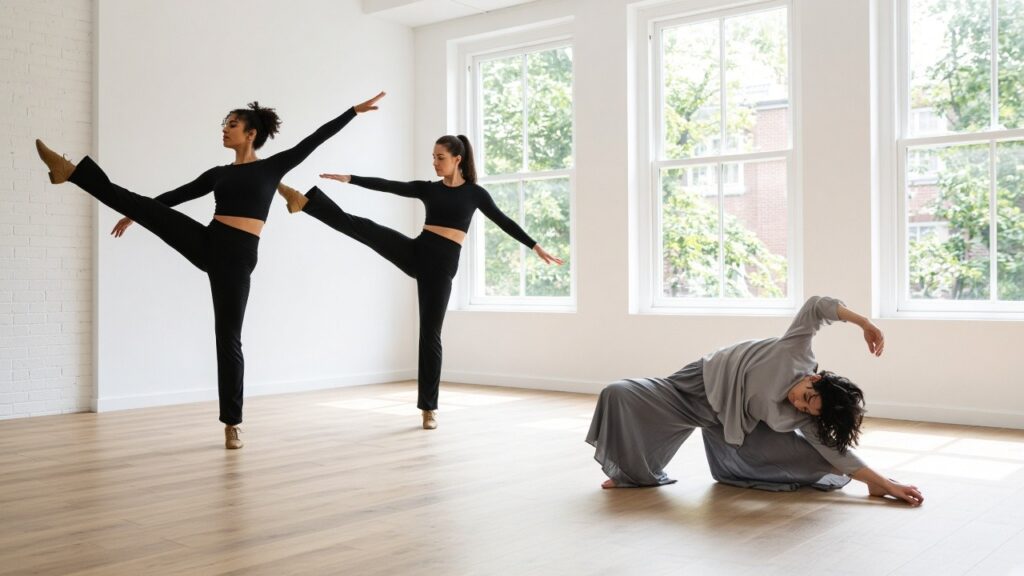
Jazz and contemporary often sit next to each other on a studio schedule, share the same teachers and even use some of the same steps, so it’s easy to assume they’re the same thing. They aren’t. Pick the wrong one and you might find yourself rolling on the floor barefoot when you expected sharp kicks to a pop song, or the other way around.
Jazz dance is energetic, rhythmic and performance-focused: sharp isolations, kicks, leaps, turns and clean lines, usually danced in jazz shoes to music with a strong beat (pop, musical theater, funk, classic jazz). Contemporary dance is fluid and expressive: it blends ballet and modern dance technique, uses the floor, breath, weight and release, and is usually danced barefoot to a wide range of music, often slower and more emotional. Jazz is about rhythm and attack; contemporary is about flow, weight and storytelling.
Below: the short answer in more detail, what jazz and contemporary actually are, a side-by-side table of technique, music, shoes and feel, where lyrical and modern fit, which to take first and answers to common questions. If you’re brand new, start with jazz dance for beginners.
Jazz vs contemporary: the short answer
Think of it this way:
- Jazz pushes energy outward. Movements hit the music, accents are sharp and the dancer “sells” the choreography to the audience. Faces are expressive and performance-ready.
- Contemporary pulls energy through the body. Movements spiral, fall and recover, accents are softer or unexpected and the dancer is often inside the movement rather than presenting it.
Both demand strength, flexibility and musicality. Both borrow from ballet. The difference is mostly in quality of movement, music, use of the floor and footwear.
What jazz dance is (styles)
Jazz dance grew out of African American vernacular dance in the late 19th and early 20th centuries, alongside jazz music. It moved through social dances, vaudeville and Broadway, then into film and television. Over time it split into many styles:
- Traditional or authentic jazz: rooted in the swing era and social dances like the Charleston and Lindy Hop; rhythmic, grounded and playful.
- Broadway or musical theater jazz: big, theatrical and character-driven, influenced by choreographers like Bob Fosse and Jerome Robbins. Think turned-in knees, jazz hands, hats and story.
- Classic (or “modern”) jazz technique: the studio jazz most adults take, built on codified techniques like those of Jack Cole, Luigi, Gus Giordano and Matt Mattox. It emphasizes isolations, clean lines, turns, kicks and leaps.
- Lyrical jazz: jazz technique danced to slower, emotional music, with more flow (more on lyrical below).
- Jazz funk and commercial jazz: a mix of jazz technique and hip hop grooves, the style you see in music videos and on tour.
- Latin jazz and Afro-jazz: jazz combined with Latin or African dance rhythms and movement.
Typical jazz class elements: a warm-up with isolations (head, shoulders, ribs, hips), stretching, progressions across the floor (chassés, jazz walks, pas de bourrées, turns, kicks and leaps) and a combination at the end.
What contemporary dance is
Contemporary dance developed in the mid-20th century as choreographers pushed against the strict forms of classical ballet. It draws on modern dance pioneers such as Martha Graham (contraction and release), Merce Cunningham, José Limón (fall and recovery) and Doris Humphrey, plus ballet, jazz, yoga, martial arts and improvisation.
Key ideas you’ll meet in a contemporary class:
- Floor work: rolling, sliding, spiraling down to the floor and back up.
- Weight and gravity: falling, suspending and recovering instead of always lifting up.
- Breath: movement initiated and timed by breath.
- Release: letting tension go to allow a swing or drop.
- Spirals and off-center movement: the body doesn’t always stay vertical and balanced.
- Improvisation: some classes ask you to explore a movement idea freely.
Contemporary is also a broad term. In the studio and on TV competitions, “contemporary” often means a blend of ballet, jazz and modern technique danced barefoot to emotional music. In the concert-dance world, it covers experimental choreography that can look very different.
Technique, music, shoes and feel compared
| Jazz | Contemporary | |
|---|---|---|
| Roots | African American vernacular dance, Broadway, film | Modern dance, ballet, postmodern dance |
| Movement quality | Sharp, rhythmic, percussive, “hit” the accents | Fluid, grounded, flowing, organic |
| Energy | Outward, presentational | Inward and outward; often internal |
| Signature moves | Isolations, jazz walks, kicks, leaps, pirouettes, jazz hands | Contractions, spirals, floor rolls, falls and recoveries, swings |
| Use of floor | Mostly upright; some floor slides | Lots of floor work |
| Body lines | Clean, often turned-in or parallel, stylized | Parallel and turned-out; curved and off-center shapes |
| Music | Pop, musical theater, funk, R&B, jazz standards, upbeat tracks | Ambient, classical, indie, acoustic, electronic, sometimes silence |
| Shoes | Jazz shoes (or dance sneakers for jazz funk) | Barefoot, socks or turning shoes |
| Clothing | Fitted tops, jazz pants or leggings | Fitted or loose, comfortable layers; knees often covered for floor work |
| Expression | Big facial expression, performance “sell” | Emotion through the body; faces more natural |
| Feel for a beginner | High energy, workout-like, fun to perform | Calm to intense, introspective, can feel freeing |
For jazz footwear, see ballet shoes vs jazz shoes.
Lyrical and modern: where they fit
Lyrical
Lyrical sits between jazz and contemporary. It uses jazz and ballet technique (turns, leaps, extensions) but interprets the lyrics and emotion of a song, usually a slower ballad. Lyrical is often danced in jazz shoes, turning shoes or barefoot. If jazz feels too sharp and contemporary feels too abstract, lyrical is a good middle ground.
Modern
Modern dance is the early-20th-century rebellion against ballet: Graham, Humphrey, Limón, Horton, Cunningham and others developed their own codified techniques. Contemporary dance grew out of modern dance and keeps many of its principles (floor work, breath, weight). Some studios use “modern” and “contemporary” interchangeably; others teach a specific modern technique like Horton or Limón.
Modern jazz
“Modern jazz” usually means studio jazz technique (the classic style above), not modern dance. It’s a common source of confusion: modern jazz is still jazz, with jazz shoes and sharp accents.
Which to take first
There’s no rule, but here’s how to choose as an adult:
- Take jazz first if you love upbeat music, want an energetic workout-style class, enjoy performing and like clear counts and steps. Jazz progressions also build turns, kicks and leaps that help in every style.
- Take contemporary first if you like slower music, want to move more freely, enjoy floor work or yoga-like flow and are comfortable improvising a little.
- Take both if you can. They complement each other: jazz builds precision and attack; contemporary builds flow, weight and expression.
Look for classes labeled “beginner,” “adult beginner,” “level 1” or “open level with modifications.” Ask the studio what to wear and whether shoes are required. If you’re nervous, how to not feel awkward dancing and dance class etiquette help. Always warm up first: see dance warm-up for beginners.
What to expect in your first class
Jazz: warm-up with isolations and stretching, across-the-floor progressions (jazz walks, chassés, turns, kicks), then a short combination. Bring jazz shoes or ask whether sneakers or socks are OK for day one.
Contemporary: a slower warm-up with breathing, rolling down the spine, swings and floor work, then across-the-floor or center phrases, ending with a combination. Wear clothes that cover your knees and dance barefoot unless told otherwise.
Finding classes in Chicago
Many Chicago studios run adult jazz, lyrical and contemporary classes, and the Chicago Park District offers dance programs in some parks. See adult dance classes in Chicago for how to choose a studio. If you can’t make in-person classes, online dance classes are an option, and how to practice dance at home helps between sessions.
How jazz and contemporary look on stage
If you’re trying to tell them apart while watching:
- Count the beats. If the dancers hit every accent of a strong beat, it’s probably jazz. If the movement flows across the beat or follows the melody, it’s probably contemporary or lyrical.
- Look at the feet. Jazz shoes or sneakers usually mean jazz or commercial; bare feet usually mean contemporary.
- Watch the floor. Lots of rolls, slides and falls suggest contemporary.
- Watch faces. Big smiles and attitude point to jazz; quiet, internal expressions point to contemporary.
- Listen to the music. Musical theater, pop and funk suggest jazz; piano, strings, ambient or indie suggest contemporary.
Skills each style builds
| Skill | Jazz | Contemporary |
|---|---|---|
| Turns | Strong focus: pirouettes, chaîné turns, pencil turns | Turns with spirals, off-balance and inverted turns |
| Jumps | Leaps, jetés, toe touches, switch leaps | Lower, grounded jumps and suspensions |
| Musicality | Hitting accents and counts precisely | Phrasing with melody, breath and silence |
| Strength | Explosive power for kicks and leaps | Core control for floor work and slow balances |
| Flexibility | Kicks, extensions, splits | Spine mobility, hips and back |
| Performance | Facial expression, projection, character | Emotional honesty, connection to the movement |
How to practice each at home
For jazz, practice isolations to an upbeat song, then drill jazz walks, chassés and a single pirouette prep on a smooth floor. For contemporary, practice rolling down and up through the spine, slow pliés with breath and a simple swing-and-drop sequence on a mat or rug. Keep sessions short, warm up first and stop if anything hurts.
Common myths
- “Contemporary is just slow jazz.” No. Contemporary uses different principles (weight, breath, release, floor work) that come from modern dance.
- “You have to be flexible to start.” You don’t. Flexibility improves with regular stretching; beginner classes modify.
- “Contemporary is easier because it’s slow.” Slow movement takes a lot of control and strength. It’s different, not easier.
- “Jazz is just for kids’ competitions.” Adult jazz classes are common, and Broadway and commercial jazz are adult professions.
FAQ
Do I need ballet before jazz or contemporary?
No. Ballet helps with technique (turnout, lines, turns), and many teachers recommend it alongside, but adult beginner jazz and contemporary classes don’t require it. If you want to try ballet too, see can adults start ballet?
What is the difference between jazz and modern jazz?
“Jazz” covers all jazz styles; “modern jazz” usually refers to the studio jazz technique developed mid-century (isolations, kicks, turns, leaps). It’s still jazz, not modern dance.
Where does lyrical fit in?
Lyrical sits between jazz and contemporary: jazz and ballet technique danced to a slow, emotional song, interpreting the lyrics.
Which is better for an adult beginner?
Whichever you’ll enjoy and keep going to. Jazz suits people who like upbeat music and clear counts; contemporary suits people who like slower music, floor work and expressive movement.
What shoes do I wear for contemporary?
Usually none: contemporary is mostly danced barefoot, sometimes in socks or turning shoes (half soles). Ask your studio.
Is contemporary dance the same as modern dance?
Not exactly. Contemporary grew out of modern dance and borrows its principles, but it also blends ballet, jazz and newer ideas. Some studios use the terms interchangeably.
Can I take jazz and contemporary in the same week?
Yes, and many dancers do. They build different skills, and practicing both makes you more versatile.