
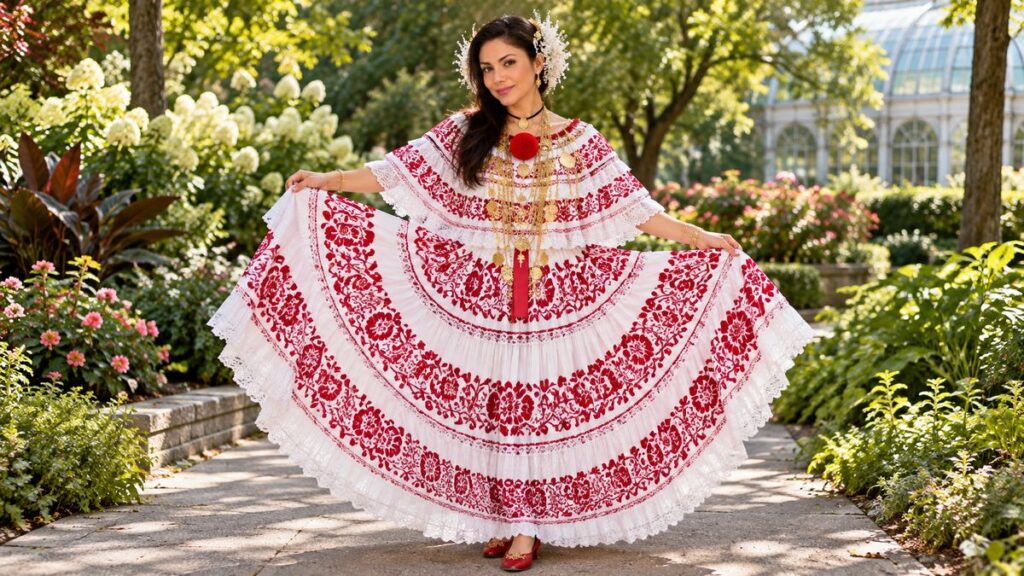
When a Panamanian woman puts on a pollera, the whole room changes. The skirt swings, the tembleques shimmer in her hair, the gold chains catch the light, and everyone who grew up with that dress feels it in the chest. The pollera is Panama’s national dress, and it’s one of the most detailed handmade folk costumes in the Americas. Here is what it is, its parts and types, and when it’s worn.
The Panamanian pollera is Panama’s national dress for women: a two-piece outfit of a wide, gathered skirt and a blouse with full ruffles, decorated with hand embroidery, appliqué or lace, worn with tembleques (shimmering hair ornaments), combs and gold jewelry. Fine gala polleras take up to two years of handwork.
Pollera, the word
In Spanish, pollera simply means a full skirt, and in Peru, Bolivia and Argentina the word refers to the layered skirts of Andean women. In Panama, “la pollera” means the complete national dress. If you’re searching in English, add “Panamanian” to get the right one.
The parts of a Panamanian pollera
The dress
- Camisa (blouse): worn off the shoulders, with one or two wide ruffles (arandelas) that fall over the arms and chest.
- Pollerón (skirt): a very full skirt in two or three gathered tiers, wide enough to hold in both hands and swing in the dance.
- Decoration: the work is done by hand. The most admired techniques include talco en sombra and talco al sol (fabric appliqué), punto de cruz (cross-stitch), zurcido (darned work), embroidery, and lace insertions.
- Lana (pompoms): colored wool pompoms at the neckline, front and back, with matching ribbons.
The head
- Tembleques: hair ornaments made of beads, pearls or fish scales on fine wire that tremble (tiemblan) when the dancer moves. They are worn in pairs in the hair.
- Peinetas: decorative combs, traditionally gold.
- Hair: pulled back with a center part.
The jewelry
A gala pollera is worn with a set of gold jewelry: several necklaces (cadenas) of different lengths, often a rosary-style chain, a cross or medallion, and earrings. Some families keep these pieces for generations.
The shoes
Satin slippers (chapines) that match the color of the wool and ribbons.
Types of pollera
- Pollera de gala: the formal white pollera, richly decorated, worn for festivals, parades and special occasions. This is the one most people picture.
- Pollera montuna: the everyday, rural pollera. Simpler, often with a printed skirt and a blouse with one or two ruffles, and colorful tembleques. The montuna is linked to country life and is often worn for dancing.
- Pollera congo: worn in the Afro-Panamanian Congo tradition of the Caribbean coast, especially in Colón. Bright, patched and full of movement, it’s very different from the gala pollera.
The matching men’s outfit is the montuno: white shirt and pants with embroidery and a straw hat.
Where the pollera comes from
The pollera developed during the colonial period from Spanish dress and changed over centuries in Panama, combining European, Indigenous and African influences. The Azuero region (Los Santos and Herrera provinces) is especially famous for its pollera makers.
When is the pollera worn?
- Panama’s November patriotic holidays (fiestas patrias), parades and school events.
- Carnival, especially in Las Tablas and the Azuero towns.
- Folk dance performances, including the tamborito.
- Desfile de las Mil Polleras: the great parade of polleras in Las Tablas (Los Santos), held on the second Saturday of January under Executive Decree No. 116. When that Saturday collides with January 9, Martyrs’ Day, it can move to the following weekend: the 2026 parade was on Saturday, January 17, 2026. Thousands of women parade (La Estrella de Panamá counted more than 8,000 in 2025). Check Panama’s Tourism Authority (ATP) for the next date.
- Día Nacional de la Pollera is July 22, set by Law 293 of 2022, and Las Tablas marks it with the Festival Nacional de la Pollera.
- Panamanian communities abroad, including in Chicago, wear polleras at cultural festivals and patriotic celebrations.
How long does a pollera take to make, and what does it cost?
Panamanian artisans and reporters give a good picture:
| Typical figure | Source | |
|---|---|---|
| Time to make a gala pollera | About 2 years today; early-1900s polleras made by one woman could take 3 years or more | TVN, 2024 |
| Artisans involved | Up to 7 specialists dividing the work | TVN, 2024 |
| Cost of a full pollera set | About $7,000 to $10,000 | Artisan Elia Córdoba, La Estrella de Panamá, 2025 |
| Gala pollera zurcida | $1,000 to $15,000, depending on the order | Artisan Blanca Villarreal, TVN, 2024 |
| Full gold jewelry set (joyero) | $35,000 to $40,000 in gold; $5,000 to $8,000 in gold-plated silver | Taller Artesanal Joyero, Las Tablas, TVN, 2024 |
| One cadena chata | About $2,500 in gold, about $190 gold-plated | Same |
Simpler montunas and costume-style polleras cost much less. Many families pass polleras down from grandmother to granddaughter, and some buy one gold chain a year for a daughter so the set is complete by her quinceañera.
The pollera jewelry (joyero)
The jewelry is so tied to the dress that Las Tablas jewelers call it a “marriage.” Experts recommend no more than 13 or 14 pieces, so the dress doesn’t look overloaded. The traditional core chains include:
- Cadena chata: the flat-link chain everyone buys first, about 42 inches long with a medallion and cross. “With a chata, it looks complete.”
- Guachapalí, bruja, cola de pato, salomónica, rosario, cabestrillo and media naranja: the classic chains and pieces of the set.
- Zarcillos (earrings), peinetas (combs), rings and bracelets.
Pieces are made in gold or in gold-plated silver, in a dense Panamanian filigree.
More than 100 styles
Panamanian researcher Eduardo Cano documented more than 100 styles of pollera. Besides the gala and montuna there are simple regional styles like the darienita and the chorrerana, and the pollera congo, made of patched fabric, a style rooted in the Black communities of the colonial era who made dresses from scraps of old clothes.
Where to see polleras
- Museo de la Pollera “Dora Pérez de Zárate” at Mi Pueblito (Plaza Interiorana), Panama City. Panama City’s mayor’s office reopened it in November 2025; it displays many versions of the dress, including the pollera worn at Miss Universe 1986.
- Las Tablas in January (Mil Polleras) and July (Festival Nacional de la Pollera).
- Carnival in the Azuero towns.
How to wear a pollera respectfully
If you’re not Panamanian and you’re invited to wear one at an event, wear it fully and with care: hair done properly, no mixing with unrelated costume pieces, and with curiosity about where it comes from. Panamanians are usually delighted when people ask questions about the dress.
FAQ
What is the national dress of Panama?
The pollera for women and the montuno for men.
What are tembleques?
Shimmering hair ornaments that tremble when the wearer moves.
How much does a Panamanian pollera cost?
A complete hand-made set runs roughly $7,000 to $10,000 according to artisans, and gold jewelry can cost far more. Montunas and simpler styles cost much less.
How long does it take to make a pollera?
Up to about two years for a gala pollera, with several artisans dividing the work.
When is the Mil Polleras parade?
The second Saturday of January in Las Tablas; in 2026 it was January 17 because of Martyrs’ Day on January 9.
What colors is a pollera?
A gala pollera is white with colored work and wool pompoms; the colors of the pompoms, ribbons and slippers match.
Is the pollera the same as the Mexican folk dress?
No. They’re different traditions, with different shapes, techniques and jewelry.
More Panama culture
Learn about the tamborito, Panama’s national folk dance, or taste the culture through my guide to Panamanian food.