
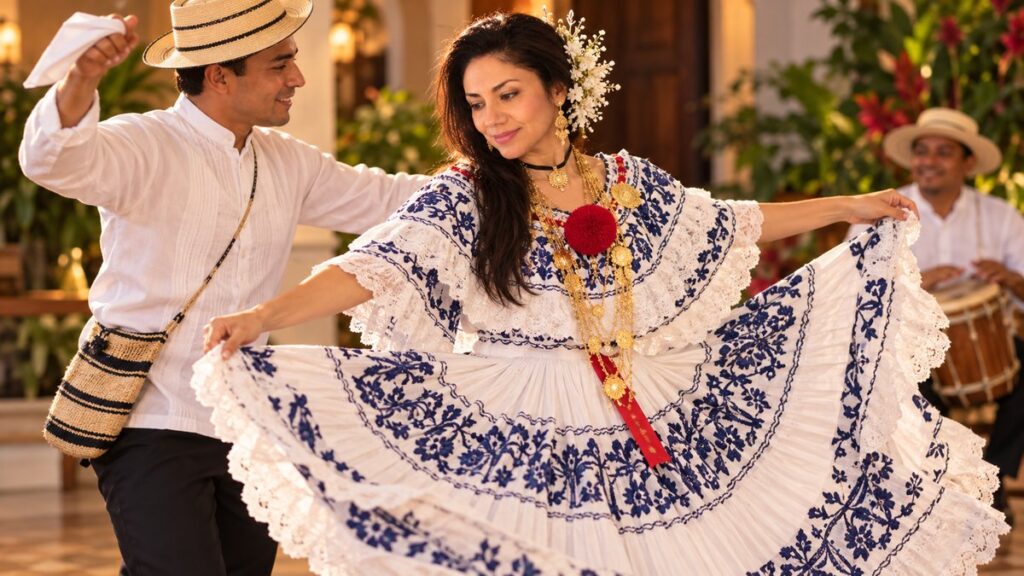
If you have ever been to a Panamanian celebration, you know the moment: the drums start, the women begin to clap and sing, a circle forms, and a couple steps into the middle. That’s the tamborito. It’s music, song and dance all at once, and for Panamanians it feels like the heartbeat of the country.
The tamborito is Panama’s national folk dance and music. A lead singer (the cantalante) calls out verses, a chorus of women answers while clapping, and three drums (the caja, pujador and repicador) play the rhythm, while couples take turns dancing a flirtatious courtship inside a circle (the rueda).
Where the tamborito comes from
The tamborito grew out of the meeting of African, Spanish and Indigenous cultures on the Isthmus of Panama during the colonial period. Africans brought to Panama from the early 1500s brought drums, call-and-response singing and dance; Spanish verse (coplas) shaped the lyrics. Written references to the tamborito in Panama City and Veraguas go back centuries. It’s also danced on Colombia’s northern Pacific coast, which was long connected to Panama.
Today it’s considered Panama’s national dance and is taught in schools across the country.
The music: singer, chorus, claps and three drums
- Cantalante: the lead female singer. She starts the song and leads the call-and-response.
- Coro: the chorus, usually women, who answer the cantalante and clap (palmas) to keep the beat.
- Caja: a double-headed drum played with two sticks. It keeps the time.
- Pujador: a deep wedge-tuned drum (tambor de cuña) that holds a steady low pulse.
- Repicador: a higher-pitched drum that improvises and “talks” to the dancers, calling out their turns and stamps.
The drums are traditionally covered with deerskin and tightened with cords and wedges. The two main rhythms are tambor norte, slower (in 2/4), and tambor corrido, faster (in 6/8).
The dance: a courtship in a circle
The singers, drummers and audience form a circle (la rueda). One couple at a time dances in the center:
- The woman in her pollera holds her skirt and moves with small, gliding steps, turning and swaying with elegance. She shows her skirt, her posture and her grace.
- The man, in a montuno and straw hat, follows and circles her, stamping (zapateando) and showing off, sometimes waving his hat. He courts her, but they don’t touch.
- The drummer on the repicador answers their steps.
- Another man can step in to take his turn, and the woman keeps dancing as if nothing happened. Then a new couple enters.
The feeling is playful and proud: flirtation without contact.
Regional styles
The tamborito changes from region to region. A few examples:
- Santeño (Los Santos): the best known, often the version you see in shows.
- Chorrerano (La Chorrera): slower and narrative, with a larger drum set than the central provinces.
- Ocueño (Ocú and Las Minas): slow and romantic.
- Portobelo and Colón: part of the coastal drum traditions, heard during carnival.
There are also two ways of dancing it: tambor de orden (a formal circle, one couple at a time) and la tuna (dancing and singing through the streets).
Panama’s drums, region by region
Panamanian folklorist Nodier Casanova, writing in La Prensa, describes a basic set of three wedge-tuned drums plus a caja or tambora, varying by region:
| Region | Drum set | What’s special |
|---|---|---|
| Los Santos, Herrera, Veraguas, Chiriquí | 3 drums with a caja | The most finely made and the most Spanish-influenced; the Santeño drum influenced the rest of the country |
| Colón (Congo tradition) | 4 drums | Rustic, sometimes painted black and white; a very large tambora for cumbia and zambapalo |
| La Chorrera | 5 drums | The most kinds of drum in Panama, including a big cumbiero, close to Colombia’s alegre |
| Darién | 5 percussion instruments | Wedge drums on a wooden base, and a cajón (box) for the bunde |
| Antón | 4 drums | A unique caja played between the legs, like a European bass drum |
Why a box instead of a drum? Casanova links Darién’s cajón to the colonial Church’s ban on drums, which it called pagan: enslaved Africans played on whatever they had, likely including merchandise boxes. Nineteenth-century accounts from Panama City even describe coconut shells struck with sticks in place of drums.
When is the tamborito danced?
At carnival, at patriotic festivals in November, at school events and folk festivals, and anywhere Panamanians gather, including Panamanian community events abroad. It’s often the dance that closes the night.
How to enjoy your first tamborito
- Clap along with the women’s chorus. The beat is easy to feel.
- Watch the drummer and the dancers talk to each other.
- If someone invites you into the circle, step in. Short steps, posture tall, and smile.
What is the traditional dance of Panama?
Tamborito is one of Panama’s best-known traditional dances and is often described as a national dance. It combines sung call-and-response, handclapping, drumming and a couple’s dance within a social circle. Panama has other important dance traditions, so the phrase “the traditional dance” should not erase Congo traditions, regional forms or festival-specific dances.
The official Panama folklore overview is a useful starting point for that wider context. Tamborito makes more sense as living music and social participation than as a fixed sequence to copy without listening.
What should you listen for in the music?
Listen first for the relationship between the lead singer, often called the cantalante, and the responding group. The handclaps support the shared pulse while the drums have distinct supporting and improvising roles.
Names and arrangements vary by region. In a familiar ensemble, you may hear references to the pujador, repicador and caja. Rather than expecting three identical drum parts, listen for the supporting low pattern, the more active answering or embellishing sound, and the timekeeping role. A live group’s details are worth learning from the people playing them.
You do not need to force tamborito into the count of a salsa basic. Watch how the dancers respond to the singing and drums. Staying with the pulse and understanding the invitation to enter matters more than doing an impressive turn.
Tamborito clothing and the pollera
The pollera is strongly associated with Panamanian traditional dress and appears in many formal folkloric presentations. Its blouse, full skirt, adornments and accompanying jewelry can be elaborate, but styles and occasions differ. A performance costume is not the only way the dance exists in community life.
A male dancer may wear traditional clothing appropriate to the region and presentation, often including a hat. Avoid treating one staged outfit as a uniform for every Panamanian dancer. If attending a festival, ask before touching clothing, jewelry, hats or instruments; they can be handmade, valuable and personally meaningful.
The skirt’s movement can be part of the visual conversation, but it is not a cue to pull another dancer’s clothing. Watch, learn from the local group, and join only when invited.
Is tamborito the same as the Diablicos Sucios dance?
No. Diablicos Sucios belongs to a different folkloric tradition associated with distinctive devil figures, masks and specific community and festival contexts. Sharing Panamanian roots does not make the music, meaning or choreography interchangeable. Likewise, Panama’s Congo traditions deserve their own context rather than being folded into one generic “Latin dance” label.
A respectful way to experience it for the first time
Stand where you are not blocking the circle or musicians. Listen for a full phrase before trying to follow the rhythm. Ask whether photographs or video are welcome, and do not interrupt a performance to request a pose. If someone invites you in, follow their lead with small, unforced steps and enjoy the shared occasion.
The best souvenir is not a claim that you mastered tamborito in five minutes. It is understanding a little more of the voices, rhythm and people who keep it alive.
FAQ
What is the national dance of Panama?
The tamborito.
How old is the tamborito?
It has been practiced since at least the 17th century, growing out of African, Spanish and Indigenous traditions on the Isthmus.
What are the drums in the tamborito called?
The caja, the pujador and the repicador, though names and numbers change by region.
What’s the difference between tambor norte and tambor corrido?
Tambor norte is slower; tambor corrido is faster and livelier.
What does “tamborito” mean?
It comes from tambor (drum), “little drum.”
What do dancers wear for the tamborito?
Women wear the pollera; men wear the montuno and a straw hat.
Is the tamborito the same as the cumbia?
No. Panama also has cumbia and other folk dances, but the tamborito has its own instruments, songs and steps.
More Latin dance and Panama culture
Learn about the pollera, Panama’s national dress. If the drums got you moving, read my guide to salsa vs bachata vs merengue. And for Panama at the table, start with my guide to Panamanian food.