
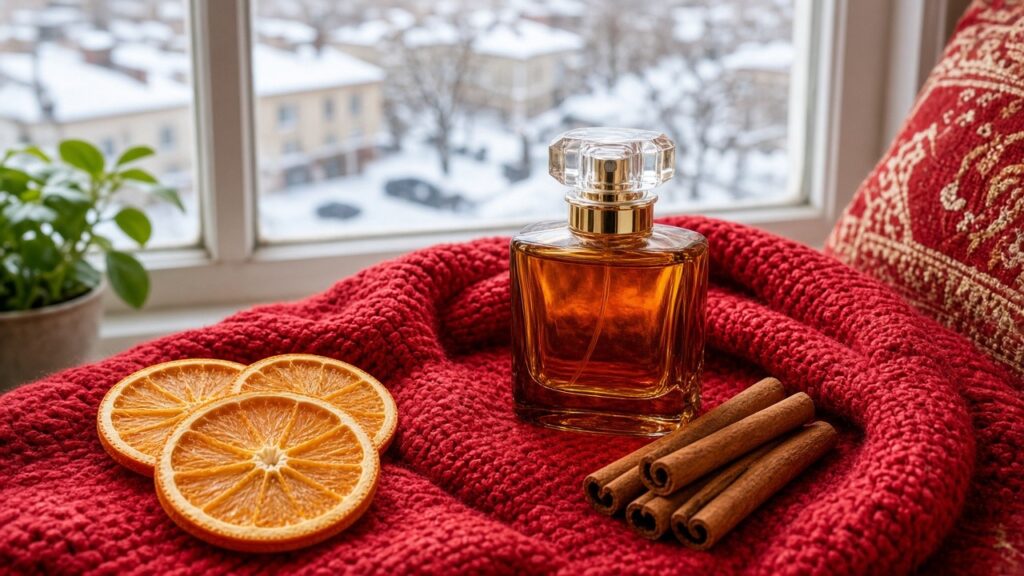
Cold air changes how perfume behaves. The bright citrus that sparkles in July can disappear in a January wind, while a warm amber that felt heavy in summer suddenly seems cozy and just right under a wool coat.
The best perfumes for winter are usually warm, dense scent families such as amber, vanilla and gourmand, woods, resins, spices and rich florals, often in eau de parfum or extrait strength. Cold air slows evaporation, so heavier base notes project more gently and last longer than they would in heat. Apply to skin under your layers, not only on your coat, and choose by setting: soft woods for the office, spicy amber or gourmand for evenings and holidays.
This is the Chicago-winter companion to the guide on perfume for hot, humid weather. Same idea, opposite season: work with the weather instead of fighting it.
What makes a perfume good for winter
Cold air mutes fragrance
Scent reaches your nose as molecules evaporating from skin or fabric. Warmth speeds that up; cold slows it down. In freezing weather, the lightest top notes (citrus, airy greens, sheer aquatic effects) can feel faint or vanish quickly once you step outside. Heavier molecules found in base notes like vanilla, musk, woods, resins and amber materials cling longer and are still noticeable when the air is cold.
That is why many people describe winter perfume as “warm” or “enveloping.” The fragrance stays closer to the body, and the denser materials have more presence in still, indoor heat.
Dry indoor heat matters too
Chicago winters swing between frigid sidewalks and dry, overheated rooms. Dry skin tends to hold fragrance less well than moisturized skin, so a perfume that lasts all day in August may fade early in February. A plain, unscented moisturizer applied before perfume gives the fragrance something to sit on.
Concentration: why eau de parfum often wins
| Concentration | Typical character | Winter use |
|---|---|---|
| Eau de cologne | Very light, short-lived | Refresh after the gym; rarely enough alone |
| Eau de toilette (EDT) | Lighter, brighter opening | Good for the office or if you dislike strong scent |
| Eau de parfum (EDP) | Fuller, longer base | A reliable winter default |
| Extrait / parfum | Dense, close to skin | Evenings, long cold days, a little goes far |
| Perfume oil | Very close-wearing | Skin under layers; see perfume layering |
Concentration labels are not a strict law of strength; brands use them differently. Still, an EDP of a warm fragrance is usually a safe starting point when you want a scent to survive a commute.
The best winter perfume families
Amber (formerly called “oriental”)
Amber fragrances are built around warm, resinous, slightly sweet materials: labdanum, benzoin, vanilla, tonka, sometimes spices. They feel like a blanket. If you only own one winter scent, this is the family most people reach for.
Good if you like: cozy, glowing, a little sensual.
Skip if: you find sweetness cloying in heated rooms.
Gourmand
Gourmands use edible-seeming notes: vanilla, caramel, praline, coffee, chocolate, honey. Winter is their natural season because sweetness that feels sticky in humidity reads as comforting in the cold. For a full explainer, see what is a gourmand perfume.
Tip: if pure sugar feels childish, look for gourmands balanced with woods, smoke, iris or coffee bitterness.
Woody
Cedar, sandalwood, vetiver, oud-style accords and guaiac wood give a dry, polished warmth. Woods are the most office-friendly winter family because they are noticeable without being sweet.
Spicy
Cardamom, cinnamon, clove, pink pepper, saffron and nutmeg add heat and sparkle. Spice often appears on top of amber or woods. It smells festive without needing to be loud.
Rich florals
Winter does not mean giving up flowers. Tuberose, jasmine, rose with oud or patchouli, and powdery iris are dense enough to hold up in the cold. Think velvet rather than fresh-cut stems.
Musks and “skin scents”
Soft musks wear close and blend with knitwear. They are underrated in winter because they make scarves smell wonderful for days.
My Chicago winter picks, by mood
Rather than a list of bottles that changes every season, here are the profiles worth hunting for, with the type of notes to look for on a description. Test before buying; a profile tells you direction, not how a scent will smell on your skin.
| Mood | Notes to look for | Where it shines |
|---|---|---|
| Cozy weekend | Vanilla, tonka, cashmere woods, soft musk | Brunch, errands, movie nights |
| Polished office | Cedar, iris, light amber, tea | Meetings, close desks |
| Festive evening | Cinnamon, clove, rum, amber, orange | Holiday parties, dinners out |
| Dark and dramatic | Oud accord, incense, leather, rose | Concerts, dates, gala nights |
| Snowy clean | Musk, white woods, aldehydes, iris | When you want fresh but not icy |
| Sweet treat | Praline, coffee, caramel, almond | Cold walks, cafés, home |
By price range
- Under $40: body mists and hair mists in vanilla or musk; drugstore and fast-fashion EDPs often follow popular amber-vanilla profiles. They fade faster, so carry a small atomizer.
- $40–$100: many mid-market EDPs and celebrity fragrances do warm vanilla, amber and woods well. This is where discovery sets pay off.
- Over $100: designer and niche houses offer more complex resin, incense and oud accords. Sample first, always.
Before spending on a full bottle, try a sample or decant for at least a few days of real winter wear, including a commute outside. A scent that smells lovely in a warm store can behave very differently on a 15°F morning.
How to apply perfume under winter layers
Skin first
Spray pulse points that stay covered but warm: the base of the neck, chest, inner elbows and behind the knees if you wear skirts with tights. Body heat under layers gently lifts the scent each time you move or open your coat.
Then (carefully) fabric
A light mist on a scarf holds fragrance for a long time, often longer than skin. Two cautions:
- Perfume can stain silk, light-colored wool and delicate fabric. Test an inside seam first or spray the air and walk through it.
- Scent on a scarf builds up day after day. If you switch perfumes, wash or air the scarf so two fragrances do not clash.
Avoid the coat collar overload
Spraying the outside of a coat means you smell yourself constantly in an enclosed car or train, and the coat keeps it long after you would prefer it gone. Keep fabric sprays light and use them only on items you plan to pair with that scent.
Moisturize first
An unscented lotion or a matching body cream before perfume helps it last in dry heat. Petroleum jelly dabbed on pulse points is an old, inexpensive trick for the same reason.
Day vs night winter scents
Daytime: lighter woods, iris, soft vanilla, tea, clean musks. One or two sprays. You want to be noticed when someone leans in for a hug, not across the hallway.
Night: amber, incense, tuberose, boozy accords (rum, cognac), leather and deeper gourmands. Night scents can be a touch stronger, especially in big rooms, but indoor holiday gatherings are often warm and crowded, so do not overdo it.
A good rule: if you can clearly smell yourself after 30 minutes without bringing your wrist to your nose, you probably applied enough for the room.
Holiday party scents
Holiday events stack scents: candles, pine, cooking, mulled wine and everyone else’s perfume. Fragrances that work well:
- Spiced orange and amber, which harmonize with the room rather than competing.
- Boozy rum or cognac accords, festive but not sugary.
- Rose with spice or oud, elegant for formal dinners.
Avoid strong, sweet scents if you will be sitting close to people at a dinner table. Food and perfume compete, and your host may have worked hard on that meal.
Winter perfume for the office
Closed windows and recycled air make offices small scent bubbles. Choose:
- Skin-close musks and woods
- Iris and powdery notes
- Tea, light cedar, soft vanilla
Apply one or two sprays at home, not at your desk. If coworkers have sensitivities or there is a scent-free policy, follow it; a fragrance-free day costs you nothing. Save the dramatic incense for after hours.
Common winter perfume mistakes
- Overspraying because you can’t smell it. You may simply be used to it. Read why you can’t smell your own perfume before adding more.
- Storing bottles by a radiator. Heat and light damage perfume. See the perfume storage guide.
- Testing only in a heated store. Wear it outside before you commit.
- Spraying on dry, cracked skin. It disappears quickly and can sting.
Winter notes at a glance
| Note | What it smells like | Why it works in winter |
|---|---|---|
| Vanilla | Sweet, creamy, comforting | Rich base note that lingers in cold air |
| Amber | Warm, resinous, slightly powdery | Projects gently through layers |
| Tonka bean | Almond, hay, vanilla-like | Cozy and long-lasting |
| Sandalwood | Creamy, soft wood | Smooth and wearable for work |
| Cedar | Dry, pencil-shaving wood | Adds structure without sweetness |
| Cinnamon and clove | Spicy, festive | Feels like the holidays |
| Cardamom | Fresh-spicy, slightly citrusy | Brightens heavy blends |
| Tuberose and jasmine | Lush white florals | Bloom on warm skin under layers |
| Oud | Dark, smoky, leathery | Intense; a little goes a long way |
| Musk | Soft, clean, skin-like | Close, intimate trail |
For the difference between single notes and blended accords, see perfume notes vs accords.
How to make perfume last longer in winter
- Moisturize first. Dry winter skin holds fragrance poorly; an unscented lotion or a matching body cream gives perfume something to cling to.
- Spray after a warm shower while skin is still slightly damp.
- Use pulse points that stay covered but warm: inner elbows, behind the knees, the base of the throat under a scarf.
- Layer within the same family: a vanilla body cream under an amber perfume. See perfume layering.
- Carry a travel spray or decant for a midday refresh. See how to decant perfume.
- Try a perfume oil under your spray for extra staying power. See perfume oil vs spray.
Storing perfume in a cold climate
Cold itself doesn’t harm perfume, but big temperature swings do. Don’t leave bottles in a freezing car or next to a radiator. Keep them in a closed drawer or cabinet away from light, and avoid the steamy bathroom. More in storing perfume and knowing when it has changed.
Testing a winter perfume before you buy
Wear a sample on a real cold day, outside and inside, for several hours. A scent that smells perfect in a warm store can feel faint outdoors or cloying in an overheated office. See how to get perfume samples and, if you’re settling on one bottle for the season, how to find your signature scent.
FAQ
Should winter perfume be stronger than summer perfume?
It can be a little stronger, because cold air mutes projection, but stronger does not mean more sprays. Choosing denser notes or an eau de parfum usually works better than doubling the amount of a light summer scent.
Is eau de parfum better than eau de toilette in winter?
Often, yes, because the higher concentration and heavier base last longer in cold, dry air. An EDT still works if you prefer a lighter presence or wear it under a scarf where body heat keeps it alive.
Can I wear my summer perfume in winter?
Yes. Fresh citrus or aquatic scents can feel crisp and clean in snow. Expect them to fade sooner, layer them over an unscented lotion, or pair them with a soft musk or vanilla underneath.
Where should I spray perfume when I wear a coat and scarf?
On the base of the neck, chest and inner elbows under your layers, with an optional light mist on the scarf. Avoid soaking the coat itself.
Does perfume last longer in winter?
On fabric, often yes. On skin, cold can make it seem quieter, and dry skin may shorten wear. Moisturizing helps more than extra sprays.
What notes smell like winter?
Vanilla, amber, cinnamon, clove, cardamom, pine, cedar, incense, leather, tonka and smoky woods are the notes most people associate with cold weather and the holidays.
Winter perfume is about comfort: a scent that wraps around you when you unbutton your coat inside. Choose warmth for the room you will be in, apply under your layers and let the cold do the rest.