
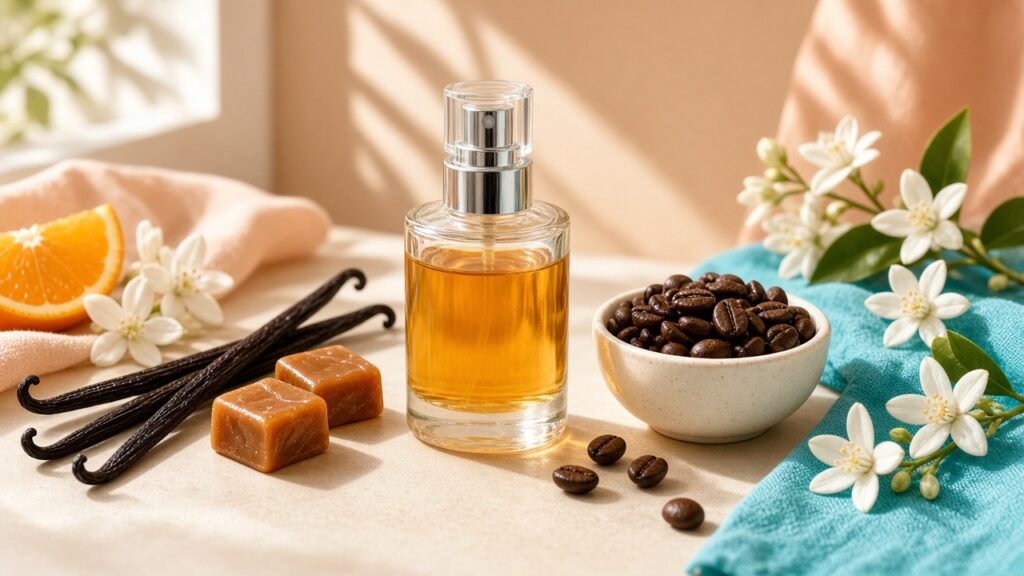
Vanilla, toasted sugar, a little coffee: some perfumes seem to arrive with their own dessert menu. That does not mean they all smell like frosting, and it definitely does not mean you need to love very sweet perfume to enjoy them.
A gourmand perfume is a fragrance built around an edible-smelling impression, such as vanilla, caramel, chocolate, coffee, almond or milky rice. The effect can be sugary, creamy, roasted or even savory. “Gourmand” describes how a perfume smells—not whether it contains food, is natural, lasts all day or belongs to a particular gender.
My simplest explanation: if a floral perfume makes you think of a bouquet, a gourmand can make you think of something delicious. The interesting part is what the perfumer puts around that delicious center.
What does gourmand mean in perfume?
Gourmand comes from French and is associated with enjoying food. In fragrance, it describes a food-like smell or a family of fragrances where that impression is central. The Perfume Society’s gourmand overview lists caramel, chocolate, milk, coffee, almond and vanilla among the familiar examples.
Not every note list containing vanilla makes a perfume a gourmand. Vanilla can soften a woody scent without making it smell like pudding. Likewise, lemon can suggest fresh peel, cleaning products, a garden or lemon cake, depending on the composition around it.
Look at the overall effect, not one ingredient name. A perfume with vanilla, cedar and dry incense may feel woody. Add a strong caramel-and-cream effect and the same broad ingredients could read as a dessert-like gourmand.
Common gourmand notes and what they actually smell like
| Note or accord | Possible impression | What can change it |
|---|---|---|
| Vanilla | Soft sweetness, warm vanilla pod, custard | Smoke and woods make it drier; cream and sugar make it more dessert-like |
| Caramel or burnt sugar | Toffee, cooked sugar, sticky sweetness | Salt, coffee or bitter notes can sharpen it |
| Coffee | Roasted beans, espresso, sweet latte | Milk and vanilla soften it; woods can make it darker |
| Chocolate or cacao | Cocoa powder, dark chocolate, chocolate sweets | Cacao can be dry or bitter rather than candy-like |
| Almond or pistachio | Marzipan, nut cream, pastry | Floral notes can make it powdery; sugar can make it confectionery-like |
| Lactonic or milky | Cream, warm milk, soft coconut-like smoothness | Musk can make it feel clean; spices can suggest a warm dessert |
| Marshmallow or candy floss | Airy sugar, fluffy sweetness | Florals can make it more abstract than literal candy |
| Honey | Syrupy, floral, waxy or slightly animalic sweetness | Tobacco, flowers and woods can shift it far from a dessert |
These are descriptive possibilities, not a guarantee that every perfume listing a note will smell the same. “Pistachio” in one fragrance might be nutty and lightly salty; in another it might mostly suggest sweet ice cream.
Does a caramel note mean there is actual caramel inside?
Usually the note describes an illusion. Perfumers use blends of aroma materials to suggest food. The Perfume Society explains caramel as a fantasy ingredient associated with materials such as ethyl maltol, rather than caramel sauce distilled out of a saucepan.
A note list is not the ingredient declaration. It cannot tell you whether a perfume is suitable for a particular allergy, whether it contains an animal-derived material, or whether it meets a personal vegan standard. For those questions, check the actual packaging and ask the manufacturer about the specific product.
Never add baking extracts, sugar syrup or food oils to a perfume bottle. They are not substitutes for a professionally formulated fragrance.
Gourmand vs sweet, fruity, amber and vanilla perfume
Is all sweet perfume gourmand?
No. A very sweet floral may smell like blossoms rather than food. A fruity perfume may suggest a freshly cut pear rather than pear tart. Gourmand becomes useful when the food-like association is a defining part of the scent.
The reverse also matters: not every gourmand is intensely sweet. Bitter coffee, unsweetened cacao and toasted grain can give an edible impression without much syrupy sweetness.
Is vanilla perfume always gourmand?
No. Vanilla is useful in many perfume styles. A dry woody vanilla, a smoky vanilla and a vanilla cupcake scent can all list vanilla prominently but feel very different. If you dislike sugary perfume, ask for a dry, woody or smoky vanilla rather than rejecting the note altogether.
Gourmand vs amber perfume
Amber in perfumery often describes a warm, resinous impression rather than the smell of a gemstone. It can overlap with vanilla and sweetness, which is why the two categories sometimes feel related. But a resinous amber need not smell edible, and a coffee gourmand need not feel especially resinous.
Fragrance classifications are guides, not mutually exclusive scientific boxes. A perfume can comfortably be called a floral gourmand or a woody gourmand.
How gourmand became a modern perfume category
Mugler’s Angel, launched in 1992, is widely treated as the breakthrough modern gourmand. It did not simply smell like plain vanilla: its sweet, praline-like effects sat alongside a strong patchouli character. Its success helped make obviously food-like impressions a major commercial perfume direction. Earlier perfumes had used sweet materials, so “breakthrough” is more careful than claiming nobody had ever made an edible-smelling perfume before.
Three familiar examples that show the range
These are examples of the style, not a ranked shopping list or a claim that I have personally wear-tested every current formula:
- Mugler Angel Eau de Parfum: a historical reference for praline-like sweetness against patchouli. It shows why gourmand can be earthy and assertive, not just soft cake.
- Prada Candy Eau de Parfum: the maker describes caramel, benzoin and musks. It illustrates a warm caramel direction rather than a coffee-centered one.
- YSL Black Opium Eau de Parfum: a coffee, white-flower and vanilla direction. It demonstrates how florals can share the composition with an edible impression.
Sample the exact concentration and version named; a flanker or parfum can differ from an eau de parfum with similar packaging. Brand descriptions explain the intended direction, not a guarantee of your perception or wear time.
Tonka, praline and fruit notes
Tonka-like effects can feel warm, almond-like, hay-like or vanilla-adjacent depending on the blend. Praline suggests sweet toasted nuts and caramelized sugar rather than one mandatory natural ingredient. Fruit can push a gourmand toward jam, pie or a creamy dessert, but a fresh fruit note alone does not automatically make a perfume gourmand.
You may also see the older family label “oriental” on fragrance pages. Many contemporary resources use amber or ambrée instead. It is not another word for gourmand: it usually points toward warmth, resins, spices or related effects, which may or may not smell edible.
The main gourmand styles
Dessert gourmands
These make the most literal connection: cake, caramel, chocolate, marshmallow or a sweet drink. If you enjoy the idea of smelling like a bakery, this is the part of the family to explore. If you find dessert scents overwhelming, start elsewhere rather than assuming the whole category is wrong for you.
Floral gourmands
Flowers share the stage with an edible note: orange blossom with marshmallow, rose with vanilla, or jasmine with a creamy sweet base. The result can feel more like “perfume with a delicious side” than a literal food smell.
Woody, smoky and spicy gourmands
Cedar, sandalwood-like accords, smoke, pepper or warm spices can balance a sweet center. A vanilla-and-wood combination can feel soft without becoming sugary. A coffee-and-wood scent can feel roasted rather than milky.
Fresh or lightly sweet gourmands
Citrus, tea-like notes and airy musks can create more space around a food-like impression. These are worth investigating if you want a gentle gourmand for warm weather or do not enjoy dense sweetness. Do not assume that a pale bottle or a “fresh” marketing description proves how it will behave; wear a sample.
How to find a gourmand you will actually enjoy
I would begin with the food aromas you like, then add the question perfume marketing often skips: what do you not want to smell all day? Loving a slice of cake is not the same as wanting a cake scent on your scarf for eight hours.
- Choose one direction. Start with vanilla, coffee, cacao, nutty, milky or fruity dessert. Comparing six unrelated scents at once makes it harder to identify what you enjoy.
- Set a sweetness limit. Tell the person helping you whether you want barely sweet, moderately sweet or unapologetically dessert-like.
- Try on paper first. Eliminate anything you immediately dislike before putting it on your skin.
- Wear one or two on skin, if tolerated. Use separate spots and do not keep adding more scents on top.
- Check after the opening. Smell again after 30–60 minutes and several hours. The bright beginning may disappear while the sweet base remains.
- Test in your real setting. Warm rooms, a heavy sweater and close office seating can change how comfortable a dense scent feels.
- Repeat before buying a large bottle. A small sample is more useful than deciding from the first five minutes at a counter.
My broader guide to choosing perfume helps you compare fragrance families without turning the process into homework.
A simple sample-testing note
Write down four things: sweetness from 1–5, the main food impression, how far away you notice it, and whether you still enjoy it several hours later. Add “too powdery,” “too smoky” or “beautiful but too strong” if needed. Those words will make the next sample much easier to choose.
You do not need professional vocabulary. “Smells like sweet coffee at first, then mostly vanilla” is a perfectly useful observation.
Can you wear gourmand perfume in summer or at work?
Yes, provided the scent and amount suit the setting. Season is a comfort consideration, not a rule that makes a fragrance forbidden after May. Heat can make an already strong scent feel more noticeable, and a close shared room gives other people less choice about breathing it.
For work, begin with a small amount, keep it close to the skin, and follow any fragrance-free policy. Do not add more just because your own nose has stopped noticing it. If someone near you is sensitive, choosing no fragrance is kinder than debating whether the perfume is “light.”
In warm weather, a less dense composition or smaller application may feel better. Do not spray on irritated or freshly shaved skin, and follow the product’s directions. If fragrance causes irritation, stop using it; strong scent is not something to push through.
Do gourmand perfumes last longer?
Some do, but the family name does not give you a reliable wear-time promise. Longevity depends on the formula, application, skin, environment and what you can still perceive. Projection—how far it radiates—is also different from how many hours you can detect it close to your skin.
A quiet scent may last without filling a room. A loud opening may fade quickly. Compare actual wear tests instead of assuming a gourmand eau de parfum must outlast every fresh eau de toilette.
Keep the bottle away from heat and direct light. My perfume storage guide explains what to watch for when a fragrance changes.
Layering without turning everything into sugar
Start with one perfume rather than two strong perfumes competing. If you want to layer, an unscented moisturizer lets you keep the original fragrance clear. Check the moisturizer’s label and avoid anything that irritates your skin.
For scented combinations, test small amounts on paper first. A dry woody fragrance might balance a sweet vanilla, while another sugary body product may make it much sweeter. There is no dependable “two sprays of this plus three of that” formula across different brands and atomizers.
Do not mix liquids inside the original bottles. You could alter the formulation, contaminate the product or lose a bottle you liked on its own.
Gourmand perfume FAQ
How do you pronounce gourmand?
An English approximation is goor-MAHND. You will hear variations, especially between English and French speakers. Knowing what style you enjoy matters more than saying it perfectly at a counter.
Are gourmand perfumes only for women?
No. Vanilla, coffee, chocolate and woods are not restricted by gender. Choose the sweetness, texture and strength you enjoy rather than treating a marketing label as a rule.
Why does a gourmand smell burnt or bitter on me?
It may include roasted coffee, cacao, smoke or a burnt-sugar effect. Those facets can be intentional. Skin and the surrounding blend can also change which parts you notice. Test another gourmand style before concluding that every food-like fragrance will do the same thing.
Are gourmand perfumes made with real sugar?
A “sugar” note usually describes a sweet-smelling effect, not table sugar poured into the formula. The note pyramid is not a recipe or an ingredient label. Consult the actual product information for ingredients.
Is gourmand the same as edible perfume?
No. Food-like fragrance is still perfume and must not be eaten or drunk. Keep it away from children and pets and use it only as directed.
What if I love vanilla but hate candy scents?
Look for dry vanilla, woody vanilla, vanilla with tea or a restrained spicy vanilla. Tell the person helping you that you do not want caramel, marshmallow or a frosting-like effect. That gives them a much clearer direction than simply asking for something “not too sweet.”
The right gourmand is not necessarily the sweetest one. It is the one whose delicious part you still want around you after the first enthusiastic sniff.