
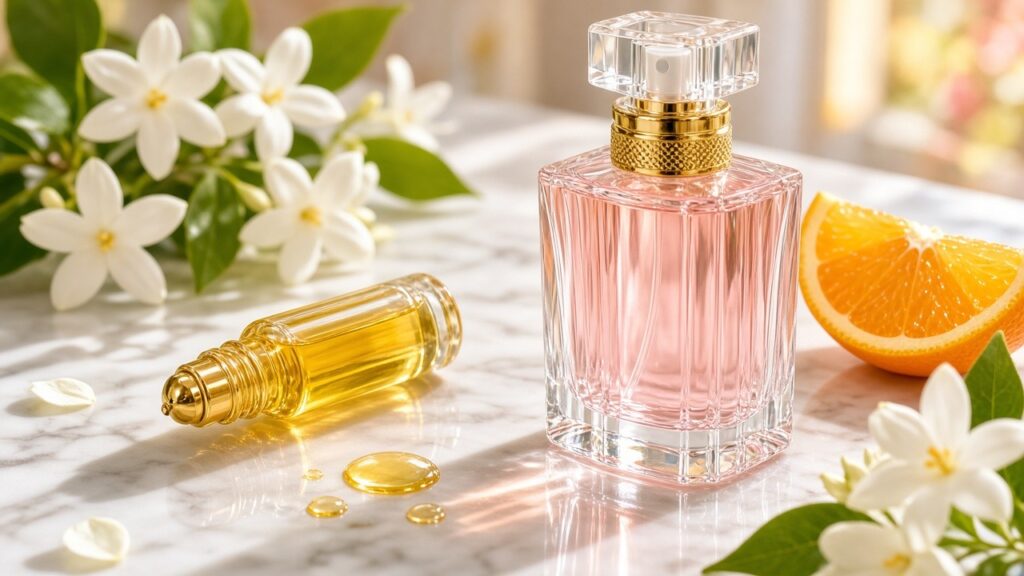
Perfume oils and sprays can contain the same scent and still feel like two different perfumes. One sits close to your skin like a secret; the other fills a room as you walk in. Neither is better in every situation. The right choice depends on how far you want your scent to travel and how long you want it to last.
Perfume oil usually lasts as long as or longer than a spray on skin and stays closer to the body, because oil evaporates slowly and contains no alcohol to push scent outward. A spray (eau de parfum or eau de toilette) projects more and creates a noticeable trail, but its alcohol evaporates fast. Choose oil for an intimate, long-wearing scent and the office or gym; choose spray for presence, events and a scent others will notice.
I wear both, and grew up around perfume oils as much as sprays. Here’s what perfume oil is, how each wears, how to test longevity on your own skin, price per use, when to wear each, and why perfume oil isn’t the same as fragrance oil.
Perfume oil vs spray: the short answer
| Perfume oil (roll-on, attar) | Perfume spray (EDP, EDT) | |
|---|---|---|
| Base | Oil (carrier oil or concentrated perfume oil) | Alcohol and water |
| Projection | Low; stays near the skin | Moderate to strong |
| Sillage (trail) | Soft | Noticeable |
| Longevity on skin | Often long, especially with high concentrations | Varies; EDP typically longer than EDT |
| Application | Roll or dab on pulse points | Spray from a short distance |
| Feel | Slightly oily; absorbs over minutes | Dries quickly |
| Travel | Small, often leak-resistant roll-ons | Atomizers can leak; carry-on limits apply |
| Best for | Office, gym, close settings, layering | Events, evenings, a signature trail |
What is perfume oil?
Perfume oil is fragrance dissolved in an oil rather than alcohol. It comes in a few forms:
- Roll-ons: a small bottle with a rollerball. Common in modern brands and indie perfumers.
- Attars (ittar): traditional oil perfumes from South Asia and the Middle East, often made by distilling botanicals like rose or sandalwood into a base oil. Many are very concentrated and applied with a glass rod.
- Concentrated perfume oils (CPOs): alcohol-free oils sold in small vials, sometimes inspired by well-known scents.
- Solid perfumes: fragrance in wax and oil, a close cousin that wears similarly.
Oil perfumes are popular across the Middle East, South Asia and North Africa, and in many Latin American homes, scented oils and colonias sit side by side on the dresser. They’re quiet, personal and easy to touch up.
How they wear: projection and sillage
Projection is how far a scent radiates from your skin. Sillage is the trail it leaves as you move.
Alcohol in a spray evaporates within seconds and lifts the fragrance molecules into the air, which is why sprays have that big opening burst and fill a room. Oils don’t evaporate quickly, so the fragrance stays on and very near the skin. People notice an oil when they hug you, sit next to you or lean in, rather than from across the room.
That makes oils excellent for close quarters and sprays better for “presence.” A spray usually also shows the top notes more clearly; with oil, the opening is softer and the heart and base notes arrive sooner.
Which lasts longer?
On skin, perfume oil often lasts as long as or longer than an alcohol spray of similar concentration, because oil holds fragrance and evaporates slowly. But “lasting” has two meanings:
- How long it stays on your skin: oil usually wins, often noticeably.
- How long others can smell it: a spray usually wins, because its projection is higher, at least for the first hours.
Concentration matters as much as format. A light 10 percent body oil may fade faster than an intense eau de parfum. Dry skin also holds scent less well than moisturized skin, which is one reason oils feel longer-lasting to many people.
How to test longevity on your own skin
Every skin is different, so test for yourself rather than trusting a general rule:
- Choose the same fragrance in oil and spray, or two scents of similar style.
- Apply the oil to one inner wrist and the spray to the other, on clean, unscented, lightly moisturized skin.
- Smell each wrist at 30 minutes, 2 hours, 4 hours and 8 hours.
- Note two things each time: whether you can smell it with your nose on your skin, and whether you can smell it with your wrist held a few inches away.
- Repeat on a second day, ideally in different weather.
You’ll usually find the oil is still present on the skin later in the day, while the spray was more noticeable early on. Your results are the ones that matter.
Price per use
Oils often look cheaper, and they can be, for a few reasons: they’re sold in small bottles, contain no alcohol (which is inexpensive but bulky), and you use only a drop or two per wear.
| Format | Example size and price | Approx. use per wear | Approx. wears | Example cost per wear |
|---|---|---|---|---|
| Perfume oil roll-on | 10 ml for $30 | 0.05 ml (2 to 3 swipes) | About 200 | About $0.15 |
| Eau de parfum spray | 50 ml for $100 | 0.3 to 0.4 ml (3 to 4 sprays) | About 125 to 165 | About $0.60 to $0.80 |
| Eau de toilette spray | 100 ml for $90 | 0.4 to 0.5 ml (4 to 5 sprays) | About 200 to 250 | About $0.35 to $0.45 |
These are illustrative prices and amounts to show how to calculate cost per wear. Your bottle, sprayer and habits change the numbers.
Why are perfume oils often cheaper?
Smaller bottles, less packaging, no alcohol to ship and simpler production are all part of it. Some inexpensive oils are also inspired by popular perfumes rather than made by the original house. Very high-quality attars, on the other hand, can be expensive because the raw materials are costly.
When to wear each
Choose oil for:
- The office, where a strong trail can bother coworkers
- The gym or dance class, where you want a soft, close scent; see perfume for gym and dance class
- Travel and purses, since roll-ons are small and rarely leak
- Hot weather, applied lightly, if sprays feel too loud; my perfume for hot, humid weather covers more
- Sensitive settings like hospitals or long flights
Choose spray for:
- Parties, dates and evenings when you want to be noticed
- A signature scent with a recognizable trail
- Fresh, citrus or airy fragrances that need lift
- Scenting clothing or a scarf (test fabric first)
Where to apply perfume oil
Apply oil to warm pulse points: inner wrists, the base of the throat, behind the ears, inner elbows and behind the knees. Roll or dab; don’t rub your wrists together, which can blur the top notes. Start with one swipe on each point and add more later if you want it stronger. Keep oils off light-colored silk and fabrics that can stain.
Layering oil under spray
Layering is where both formats shine together. A thin layer of oil gives the spray something to cling to, which can make it last longer and feel richer.
- Same scent: apply the oil version first, then spray the same fragrance for projection.
- Complementary scents: a vanilla, musk or amber oil under a floral or citrus spray adds warmth and depth.
- Order: oil first, wait a minute or two, then spray.
For pairing ideas, see perfume layering.
Perfume oil vs fragrance oil (not the same)
“Fragrance oil” often means synthetic scented oil made for candles, soap, diffusers and crafts, not for skin. Some are skin-safe; many aren’t tested or labeled for that use. Perfume oil (or body oil) is formulated to wear on skin.
Don’t apply candle or diffuser fragrance oils to your body, and don’t confuse either with essential oils, which are concentrated plant extracts that can irritate skin when undiluted. Patch-test any new oil on a small area first, and stop using it if you get redness or itching.
How to choose your first perfume oil
- Buy a small size first. Roll-ons in 3 to 10 milliliters are ideal for testing.
- Choose a style you already love. Vanilla, amber, sandalwood, rose and musk are classic oil profiles that wear beautifully close to the skin.
- Check the ingredients. Look for a skin-safe carrier oil and clear labeling.
- Check for alcohol-free claims if that’s important to you.
- Read reviews about leaking and rollerball quality, a small detail that matters every day.
Do perfume oils go bad?
Both oils and sprays change over time, but in different ways. Alcohol-based sprays are fairly stable when sealed and stored well; their main enemies are heat, light and air. Oils can also oxidize, and some carrier oils can turn rancid, giving a stale or sharp smell. Most well-made perfume oils stay pleasant for a long time when stored cool and closed; signs one has turned include a darker color, a cloudy look or a sour, crayon-like smell. Keep oils capped, away from sunlight and out of hot bathrooms and cars.
Troubleshooting
- “I can’t smell my oil after an hour.” It may still be there, just close to your skin. Ask someone near you, or smell your wrist directly. You may also be used to it; see why you can’t smell your own perfume.
- The oil feels greasy. Use less, and apply to skin rather than over lotion. A single swipe per point is often enough.
- It stained my clothing. Oils can mark silk and light fabrics. Apply, wait a few minutes to absorb, then dress.
- The rollerball is dry or stuck. Tip the bottle upside down for a few seconds before applying, and wipe the ball clean.
- My spray disappears fast. Moisturize first with an unscented lotion, or layer a matching oil underneath; sprays cling better to hydrated skin.
FAQ
Does perfume oil last longer than spray?
On skin, often yes, because oil evaporates slowly. But a spray usually projects more, so others may smell a spray more in the first hours. Concentration and your skin type matter as much as the format, so test both on your own skin.
Why are perfume oils often cheaper?
They come in small bottles, contain no alcohol, need less packaging, and you use only a drop or two per wear, so cost per use can be low. Some inexpensive oils are inspired by popular perfumes; fine attars can be expensive.
Where do I apply perfume oil?
On warm pulse points: wrists, throat, behind the ears, inner elbows and behind the knees. Roll or dab; don’t rub. Start lightly and keep oil off delicate fabrics.
Which is better for the office?
Usually oil, because it stays close to your skin and doesn’t fill shared spaces. If you prefer a spray, use one or two sprays of a lighter scent and apply it at home, not at your desk.
Can I layer an oil under a spray?
Yes. Apply the oil first, wait a minute or two, then spray. The oil helps the spray cling and can add warmth. Use the same fragrance in both formats or pair a soft vanilla, amber or musk oil with a brighter spray.