
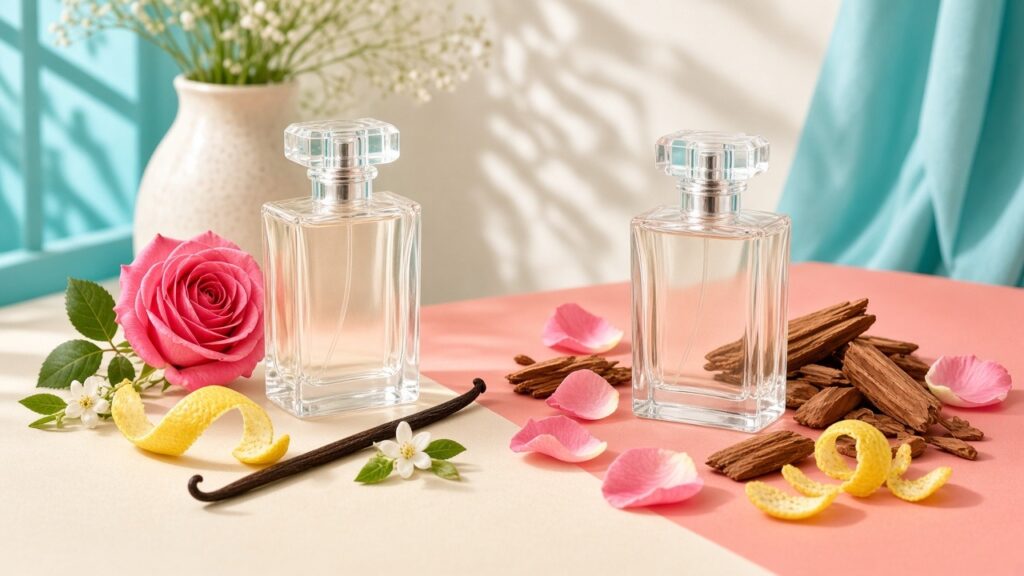
For me, perfume is the last thing I put on before I leave the house, and the first thing people remember. A good fragrance feels like a signature: you walk into a room, and it says “MarGo is here!” But choosing one can be overwhelming: hundreds of bottles, strange words, and everything smells the same after the third spray. Here’s how I choose, step by step.
To choose a perfume that suits you, start with the scents you already love (flowers, fruit, wood, vanilla, fresh soap) and find their fragrance family. Test two or three at a time on your skin, wait at least 30 minutes to smell the dry-down, and choose the one you still love hours later.
Step 1: Start with the smells you already love
Before you look at a single bottle, think about the scents that make you happy in real life:
- Flowers in a garden? Roses, jasmine, gardenias.
- Fresh fruit? Oranges, lemons, mango, berries.
- The beach and clean laundry? Sea air, soap, fresh cotton.
- A warm kitchen? Vanilla, cinnamon, coffee, caramel.
- A forest or an old library? Cedar, sandalwood, moss, leather.
For me, it’s flowers and warm vanilla, maybe because in Panama, the air smells of tropical flowers and sweet things everywhere. Your favorite smells are the best map to your perfume.
Step 2: Learn the four fragrance families
Perfumers group fragrances into families. The best-known system, the Fragrance Wheel created by fragrance expert Michael Edwards, uses four main families:
| Family | What it smells like | Typical notes | You might love it if… |
|---|---|---|---|
| Floral | Flowers, from fresh to rich | Rose, jasmine, peony, tuberose, orange blossom | You love bouquets and gardens |
| Amber (once called “oriental”) | Warm, rich, sweet, spicy | Vanilla, amber, cinnamon, resins, tonka | You love cozy, sensual scents |
| Woody | Dry, earthy, elegant | Sandalwood, cedar, vetiver, patchouli | You love forests and quiet elegance |
| Fresh | Clean, bright, airy | Citrus, green leaves, sea notes, herbs | You love clean laundry and summer mornings |
Many perfumes mix families: a “floral amber” or a “woody fresh”. Look at the perfumes you already like (or that people compliment on you) and find their family on the brand’s website or a fragrance database. That family is your starting point.
The 14 subfamilies, if you want to go deeper
Each of the four families has smaller “subfamilies” on the wheel. This is the map I use when a store assistant says “this one is a soft amber”:
| Family | Subfamily | Think of… |
|---|---|---|
| Floral | Floral | Freshly cut flowers |
| Floral | Soft Floral | Powdery, soft, with aldehydes (that sparkling, soapy feel) |
| Floral | Floral Amber | Orange blossom and sweet spices |
| Amber | Soft Amber | Incense and soft amber |
| Amber | Amber | Resins, vanilla, warm spices |
| Amber | Woody Amber | Sandalwood and patchouli |
| Woody | Woods | Cedar, vetiver, aromatic woods |
| Woody | Mossy Woods | Oakmoss and amber |
| Woody | Dry Woods | Dry woods, leather, smoke |
| Fresh | Aromatic | Lavender and herbs (the family once called “fougère”) |
| Fresh | Citrus | Bergamot, lemon, orange |
| Fresh | Water | Sea air, marine notes |
| Fresh | Green | Cut grass, green leaves, galbanum |
| Fresh | Fruity | Berries and other non-citrus fruits |
The magic of the wheel: families next to each other usually feel related. If you love a Floral Amber, try a Soft Amber or a Floral next. If you dislike everything Woody, skip that side of the wheel and save time at the counter.
Step 3: Understand the notes (top, heart and base)
A perfume changes on your skin over time, in three stages:
- Top notes: what you smell first. Light and bright, like citrus or herbs. They fade fastest.
- Heart (middle) notes: the main character, after the top notes fade. Often flowers or spices.
- Base notes: the deep, lasting part: woods, vanilla, musk, amber. This is the “dry-down”, what stays on your skin for hours.
This is why you should never buy a perfume from the first spray. The first spray is only the top notes. The perfume you’ll live with is the heart and the base.
Step 4: Read the label: parfum, EDP, EDT or cologne?
The label tells you how concentrated the perfume oils are. The percentages vary by brand, but roughly:
| Label | Concentration (approx.) | What to expect |
|---|---|---|
| Parfum / Extrait | Highest, often 20% or more | Rich, close to the skin, long-lasting, most expensive |
| Eau de Parfum (EDP) | About 15–20% | Strong and long-lasting; a popular everyday choice |
| Eau de Toilette (EDT) | About 5–15% | Lighter and fresher; great for daytime and warm weather |
| Eau de Cologne (EDC) | About 2–4% | Very light and refreshing; fades quickly |
But be careful: the same perfume as an EDT and an EDP can smell different, not just stronger, because brands often change the formula. And “strong” can mean two things: how far it spreads around you (projection or “sillage”) and how long it lasts (longevity). Test the exact version you want to buy.
Perfume words, explained
| Word | What it means |
|---|---|
| Notes | The individual smells in a perfume (rose, vanilla, bergamot) |
| Accord | A few notes blended to create one new smell, like a chord in music |
| Dry-down | How the perfume smells after it settles on your skin, the part that lasts |
| Projection | How far the scent reaches from your body |
| Sillage | The trail you leave behind when you walk through a room |
| Longevity | How many hours it lasts on your skin |
| Flanker | A new version of a famous perfume (“Intense”, “Eau Fraîche”, “Night”) |
| Blind buy | Buying a perfume without smelling it first |
| Decant | Perfume poured from a full bottle into a small vial |
| Batch code | A code printed on the box or bottle that identifies when it was made |
Step 5: Test perfume the right way
- Smell on paper first, decide on skin. Use the paper strips (blotters) to narrow down, then put your top one or two on your skin.
- Two or three at a time, maximum. After that, your nose gets tired and everything smells the same. Between scents, many people smell their own skin or sleeve to “reset”.
- One on each wrist, or one on a wrist and one inside the elbow.
- Don’t rub your wrists together. Just let it dry.
- Wait. At least 30 minutes for the heart notes; ideally, live with it for a few hours or a whole day.
- Smell it at the end of the day. If you still love it at night, that’s your perfume.
- Go with clean, unscented skin, without strong lotion or another perfume.
Why does perfume smell different on me than on my friend?
Everyone’s skin is different, and perfume mixes with your skin, so the same fragrance can smell a little sweeter, sharper or softer on different people. This is why a perfume that smells amazing on your friend might not be “you”. Always test on your own skin.
Step 6: Buy small before you buy big
Affiliate disclosure: Some links in this section are affiliate links. If you buy through them, I may earn a commission. As an Amazon Associate I earn from qualifying purchases.
A full bottle is a commitment. Before you buy:
- Ask for a sample at the counter. Many stores will make you a small sample to take home.
- Buy a discovery set: many brands sell sets of small vials of their perfumes.
- Try a travel size or a rollerball.
- Decants (perfume poured from a big bottle into a small one by a reseller) are another option; buy from sellers who clearly say what’s inside and where it came from.
- Wear the sample for several days, in different weather and moods, before buying the big bottle.
As an Amazon Associate I earn from qualifying purchases. If you want to start exploring at home, here are searches for perfume discovery sets and refillable travel perfume atomizers (for carrying a little of your big bottle).
Step 7: Match the perfume to your life
- For the office: lighter scents (fresh, soft floral, light woody), and fewer sprays.
- For a night out or a date: warmer, richer scents (amber, vanilla, rich florals).
- For summer heat: fresh, citrus, light florals. Heavy scents get louder in the heat.
- For winter: warm ambers, woods, vanilla. They feel like a cashmere scarf.
- For dancing: something light that won’t overwhelm your partner. At a salsa social, you’re dancing very close to people; less is more. (More in my guide to what to wear salsa dancing.)
Perfume by season and occasion, at a glance
| Moment | Families that work well | Sprays |
|---|---|---|
| Office and daytime | Fresh, citrus, soft floral, light woods | 1 to 2 |
| Summer heat | Citrus, water, green, light floral | 1 to 2 |
| Date night | Floral amber, amber, woody amber | 2 to 3 |
| Winter | Amber, woods, vanilla, soft amber | 2 to 3 |
| Dancing and the gym | Very light fresh scents, or nothing | 1, or none |
| Weddings and big events | A floral or floral amber you already know | 2 |
Many people end up with a small “wardrobe”: one fresh scent for day and summer, one warm scent for evening and winter.
Can I choose a perfume without smelling it?
Yes, with a method. Read the notes and the family, compare them with perfumes you already love, read reviews that describe the dry-down, and buy a sample or a travel size first. I explain the whole method, with the words to look for, in how to pick a perfume without smelling it.
How do I choose a perfume as a gift?
- Look at what they already wear. Peek at their bottle (or ask a friend), find its family, and choose something in the same family or a neighbor on the wheel.
- Think about their life. Fresh and light for someone who works in close spaces; warmer for someone who loves evenings out.
- Choose a discovery set if you’re not sure. It’s a fun gift: they get to explore and choose their full bottle.
- Keep the receipt, and check the store’s return policy for opened fragrance.
How do I avoid fake perfume?
Fakes are common, especially at prices that seem too good. Buy from the brand itself, department stores and authorized retailers. Check that the box is well made, with clear printing and a batch code that matches the bottle. And trust your nose: a fake often smells right for a few minutes and then fades or turns harsh. On marketplaces, check who the seller is, not only the brand name in the title.
Common mistakes when choosing a perfume
- Buying from the first spray. The first minutes are only the top notes.
- Testing too many at once. After three, your nose is tired.
- Choosing for the bottle. A beautiful bottle is a bonus, not a reason.
- Following someone else’s signature. It smelled amazing on your friend, but test it on your skin.
- Buying a full bottle for a new season. Buy a travel size first. Your summer love may not feel right in a Chicago January.
- Too many sprays. If you can smell yourself strongly all day, it’s too much for the people around you.
How do I wear perfume considerately?
A beautiful perfume should be noticed, not suffered. My rules:
- One to three sprays is usually enough, on pulse points like the wrists, neck or behind the ears, or one spray in the air to walk through.
- Apply at home, not in the office, the car with others, or the gym.
- Respect fragrance-free spaces: some workplaces, clinics and events ask for no fragrance. Follow it.
- If someone asks you to wear less, don’t take it personally. Some people are very sensitive to scents.
- Close spaces need less: elevators, small offices, dance classes, planes.
Natural or synthetic: does it matter?
You’ll see words like “natural”, “clean” and “sustainable” on many bottles. Some things to know:
- Most modern perfumes use both natural and synthetic ingredients. Synthetics let perfumers create notes that can’t be extracted from nature (like lily of the valley) and make scents more consistent.
- “Natural” doesn’t automatically mean gentler on skin, and “synthetic” doesn’t mean bad. If you have sensitive skin, test on a small area first.
- Sustainability claims vary a lot. Look for specifics (which ingredients, which certification, refillable bottles) rather than vague words.
- Refills are great when you buy them from the brand’s own refill system, made for your bottle.
How do I make my perfume last longer?
- Apply after a shower on moisturized skin (an unscented lotion helps).
- Spray on pulse points and on clothes (test fabric first; some perfumes stain).
- Choose an EDP or parfum, and base notes like woods, amber and vanilla.
- Store it well: away from heat, light and the humid bathroom. Here’s my guide to storing perfume and knowing when it has changed.
Use perfume descriptions without letting them choose for you
EDP vs EDT: do not buy only from the concentration label
Eau de parfum and eau de toilette commonly describe different concentrations or versions, but they are not a universal stopwatch. An EDP does not automatically last longer, project farther or smell better than every EDT. Two versions with the same perfume name can also have noticeably different compositions.
Test the exact version on your shortlist. Write the name, concentration and bottle version on the sample so you do not later buy a different one by mistake. If an EDT’s lighter effect suits your daily life better, that is not an inferior choice simply because another bottle says parfum.
Notes, accords and families answer different questions
A family points to a broad style, such as floral, woody or gourmand. A note describes a recognizable smell. An accord is a blended construction that creates a coherent impression. None of these is the complete ingredient declaration.
For the distinction and how to interpret descriptive bars on fragrance sites, see perfume notes vs accords. If you are drawn to vanilla, caramel or coffee, the gourmand perfume guide explains why a food-like scent does not have to be overwhelmingly sweet.
A signature scent can be a decision, not a destiny
You do not have to find one perfume that represents your whole personality forever. One favorite bottle, a small seasonal rotation and occasional samples are all reasonable approaches. The useful question is how you want fragrance to fit your actual life.
If your workplace is fragrance-free, your daily choice may be no perfume there. If your tastes change, you can change the bottle without treating the earlier choice as a mistake. Start small enough that you can learn from wearing it.
For any bottle you keep, good perfume storage matters more than displaying it in the sunniest part of the room. Choose with your nose, then make the practical side easy.
How to choose a perfume FAQ
What is the most popular fragrance family?
Florals are the classic favorite for many people, but the best family is the one you love. Start there.
Should I choose a perfume by my zodiac sign or personality test?
It can be a fun game, but your nose is the real test. Use quizzes to get ideas, then smell.
Can I wear two perfumes together?
Yes. It’s called layering. Start with simple scents (a vanilla and a citrus, for example), one light spray of each, and test before a big day.
How much should I spend on my first perfume?
Whatever you are comfortable with. Start with a sample, a discovery set or a travel size; it costs less and teaches you more.
How do I know which perfume suits my personality?
Start with the smells you love in life and the mood you want: fresh and energetic, romantic, cozy, elegant. Then find the family that matches.
How many perfumes should I test at once?
Two or three. More than that and your nose gets tired.
How long should I wait before deciding?
At least 30 minutes, and ideally a few hours, to smell the dry-down.
Is EDP better than EDT?
Not better, just different: EDP is usually stronger and lasts longer; EDT is lighter and fresher.
Why can’t I smell my perfume after a while?
Your nose gets used to scents you smell constantly, so it stops noticing them, even when others still can.
Find your signature
Your perfume should feel like you on your best day. Take your time, test slowly, and trust your nose. More beauty ideas in my Beauty section.
Con cariño y perfume,
— MarGo