
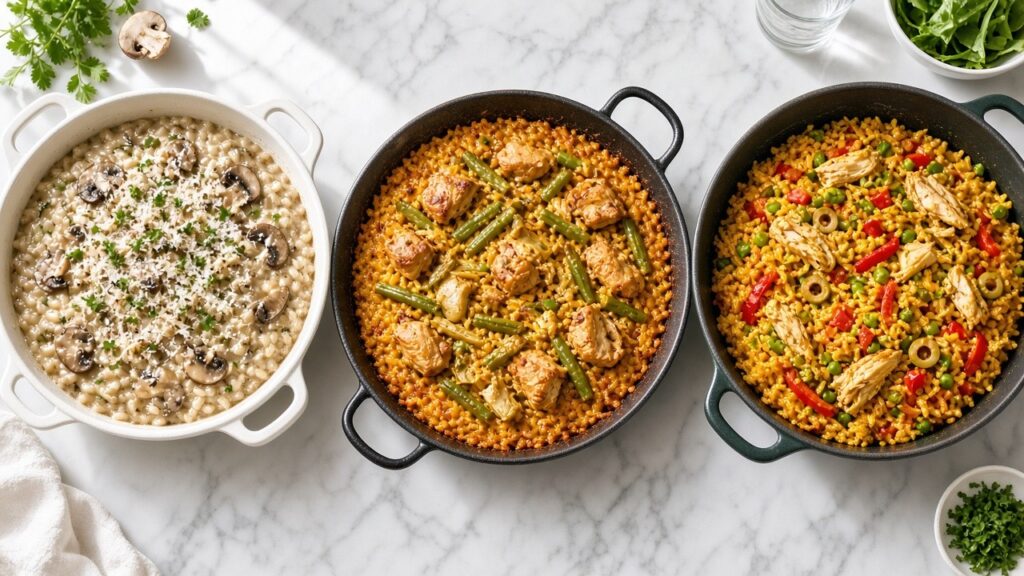
Risotto, paella and arroz con pollo are three of the world’s great one-pot rice dishes, and they come from three different kitchens: northern Italy, Valencia and Latin America. They all start with rice, fat, aromatics and broth. Then they go in completely different directions. One is stirred until creamy, one is left alone until a crust forms, and one is simmered under a lid until tender and fluffy.
Risotto vs paella: risotto is an Italian dish of short-grain, high-starch rice (arborio, carnaroli or vialone nano) cooked by adding hot broth a ladle at a time while stirring, which releases starch and makes it creamy and loose (“all’onda,” like a wave). Paella is a Spanish dish of short-grain, absorbent rice (bomba or similar) cooked in one thin layer in a wide, shallow pan, with all the broth added at once and no stirring, so it finishes dry with a crisp bottom (socarrat). Arroz con pollo sits in between: medium- or long-grain rice simmered covered with chicken, sofrito and broth until fluffy and moist. Swap the techniques and you’ll get the wrong texture.
Below: the short answer, arborio vs bomba rice (and whether you can swap them), stirring vs not stirring, texture, pans, classic flavors, where arroz con pollo fits, which is easiest and answers to common questions. My Panamanian version: Panamanian arroz con pollo.
Risotto vs paella: the short answer
| Risotto | Paella | Arroz con pollo (Panamanian) | |
|---|---|---|---|
| Origin | Northern Italy (Lombardy, Piedmont, Veneto) | Valencia, Spain | Spain originally; Latin America and the Caribbean |
| Rice | Arborio, carnaroli, vialone nano | Bomba, senia, bahía, Calasparra | Medium or long grain |
| Liquid | Hot broth added gradually | All broth added at once | All broth added at once |
| Stirring | Constant or frequent | None after rice goes in | Once or twice, then covered |
| Lid | No | No | Yes |
| Pan | Heavy saucepan or sauté pan | Wide, shallow paella pan | Caldero or heavy pot |
| Texture | Creamy, loose, al dente | Dry, separate grains, crisp bottom | Moist, fluffy, tender |
| Finish | Butter and parmesan (mantecatura) | Rest under a towel | Rest covered, add peas, olives, culantro |
| Time | About 18–20 minutes of active cooking | About 20 minutes plus prep | About 25–35 minutes |
Rice: arborio vs bomba (can you swap them?)
Risotto rice
- Arborio: the most widely available risotto rice; plump, short to medium grain, with lots of surface starch (amylopectin) that makes risotto creamy.
- Carnaroli: often called the “king” of risotto rice; holds its shape better and is harder to overcook.
- Vialone nano: a smaller grain from the Veneto, favored for looser, wavy risottos, especially with seafood.
Paella rice
- Bomba: a short, round Spanish grain that absorbs about two to three times its volume in liquid while staying firm and separate. It’s forgiving and widely sold in the U.S.
- Senia and bahía: traditional Valencian varieties, more absorbent and a little creamier than bomba; used by many Valencian cooks.
- Calasparra: a protected designation for rice (often bomba) grown in Murcia.
Arroz con pollo rice
Most Latin American home cooks use regular long-grain or medium-grain white rice. In Puerto Rico and Cuba, medium grain is popular for a softer texture; in Panama, long grain is common.
Can you swap them?
| Swap | Result |
|---|---|
| Bomba for risotto | Works in a pinch; less creamy, more separate grains. Stir a bit more and finish with plenty of butter and cheese. |
| Arborio for paella | Works, but stays creamier and can get sticky. Use less liquid and don’t stir. |
| Long grain for risotto | Not recommended: not enough starch, won’t get creamy. |
| Long grain for paella | Not recommended: doesn’t absorb flavor the same way; dries out. |
| Arborio or bomba for arroz con pollo | Works, with a softer, stickier (arborio) or firmer (bomba) result; adjust liquid. |
Technique: stirring vs not stirring
Risotto: stir to release starch
- Soffritto: cook onion (sometimes shallot) gently in butter or olive oil.
- Tostatura: add the rice and toast it for a minute or two until the grains turn slightly translucent at the edges.
- Deglaze: add a splash of white wine and let it evaporate.
- Add hot broth gradually: a ladle at a time, stirring often, adding more when the rice absorbs it.
- Cook 16 to 18 minutes until the rice is tender but still has a little bite.
- Mantecatura: off the heat, beat in cold butter and grated parmesan until glossy and creamy. Rest 1 to 2 minutes.
Stirring rubs the grains against each other, releasing starch into the broth and creating the creamy texture.
Paella: don’t stir
- Sofrito: brown the meat or seafood in olive oil, then add vegetables, grated tomato and paprika.
- Add the liquid: hot broth with saffron, all at once, seasoned so it tastes slightly salty.
- Add the rice: scatter it evenly, shake the pan or give one gentle stir to distribute, then leave it alone.
- Cook: high heat for about 10 minutes, then lower for another 8 to 10 minutes until the liquid is absorbed.
- Socarrat: a minute or two on high heat until you hear crackling.
- Rest: 5 minutes under a clean towel.
Not stirring keeps the grains separate and lets the bottom toast.
Arroz con pollo: simmer covered
- Brown seasoned chicken in oil (achiote oil in Panama) in a caldero.
- Cook sofrito: onion, garlic, peppers, ají dulce, culantro, tomato paste.
- Add rice and stir to coat.
- Add broth (often the chicken’s own cooking liquid), bring to a boil and stir once.
- Cover and simmer on low until the liquid is absorbed and the rice is tender, about 20 minutes.
- Fold in peas, olives, capers and fresh culantro; rest covered for a few minutes.
Texture: creamy vs dry with socarrat
- Risotto: creamy and flowing. A good risotto spreads slowly on a plate (“all’onda”); each grain is tender with a slight bite in the center.
- Paella: dry and separate, each grain plump with flavor, with the crunchy socarrat on the bottom.
- Arroz con pollo: fluffy to moist, grains tender and separate but softer than paella, no crust (though in Latin kitchens the crispy bottom of the pot, called pegao in Puerto Rico or concolón in Panama, is a prized bonus with plain rice).
Pan and cooking vessel
| Best vessel | Why | |
|---|---|---|
| Risotto | Heavy-bottomed saucepan or straight-sided sauté pan | Even heat, room to stir |
| Paella | Paella pan (carbon steel or enameled steel) | Wide and shallow for a thin layer and fast evaporation |
| Arroz con pollo | Caldero (cast aluminum pot) or Dutch oven | Even heat, tight lid, holds steam |
If you don’t own a paella pan, use your widest skillet and make a smaller batch. A caldero is the classic Latin American rice pot, but a Dutch oven works.
Flavors and classic versions
Risotto classics
- Risotto alla milanese: saffron, butter and parmesan, often served with osso buco.
- Mushroom risotto (risotto con funghi): often made with porcini.
- Risotto al nero di seppia: with cuttlefish ink, from Venice.
- Risotto primavera: spring vegetables.
- Risotto al parmigiano: simple butter and cheese.
Paella classics
- Paella valenciana: chicken, rabbit, green beans, garrofó beans, saffron, rosemary.
- Paella de marisco: shrimp, mussels, clams, squid.
- Paella mixta: meat and seafood.
- Arroz negro: black rice with squid ink (a cousin, often served with alioli).
Arroz con pollo classics
- Panamanian: achiote-colored, with sofrito, culantro, olives, capers and peas.
- Puerto Rican: sazón and sofrito, olives and capers, with pegao.
- Cuban: sometimes with beer and saffron or bijol, served moist.
- Colombian and Peruvian: Peru’s is green with cilantro.
Where arroz con pollo fits
Arroz con pollo shares DNA with paella: Spanish rice cooked with chicken, sofrito and color (saffron in Spain, achiote or bijol in Latin America). But Latin American cooks adapted it to their rice, their pots and their seasonings, cooking it covered so it steams. It’s moister than paella and fluffier than risotto. If you love seafood rice, see arroz con mariscos vs paella.
Which is easiest
- Arroz con pollo is the easiest for most home cooks: brown, simmer, cover, wait. It’s forgiving and feeds a crowd.
- Risotto is simple but needs attention: about 20 minutes of stirring and tasting. The main risk is overcooking.
- Paella has the fewest steps but the least margin for error: the liquid ratio, heat and no-stir rule matter, and getting socarrat takes practice.
If you’re new to all three, start with arroz con pollo, then risotto, then paella.
Make ahead and leftovers
- Risotto is best right away; it thickens as it sits. Restaurants par-cook it (about two-thirds of the way), spread it on a tray to cool, then finish to order with hot broth. Leftover risotto makes excellent arancini (fried stuffed rice balls) or crispy risotto cakes.
- Paella is best fresh from the pan. Leftovers can be reheated in a skillet with a splash of broth; the socarrat won’t be the same.
- Arroz con pollo reheats very well, which is why it’s a party and potluck favorite. Add a splash of broth, cover and warm gently until steaming.
Refrigerate any cooked rice within 2 hours and eat within 3 to 4 days (1 to 2 days if it contains seafood). Reheat until steaming hot all the way through.
Troubleshooting
| Problem | Dish | Fix |
|---|---|---|
| Gluey or mushy | Risotto | Stop cooking earlier; use carnaroli; add broth gradually |
| Chalky center | Risotto | Cook a few minutes longer with more broth |
| Soupy | Paella | Too much liquid or heat too low; next time measure the ratio and keep the heat up |
| Burnt bottom | Paella | Socarrat went too far; lower the heat sooner and listen for crackling, not smoke |
| Mushy | Arroz con pollo | Too much liquid or stirring; measure and leave it covered |
| Hard grains on top | Arroz con pollo | Cover tightly; add a splash of hot broth and steam a few more minutes |
For other starch staples and how to cook them right, see cooking pasta and noodles for different dishes.
FAQ
Can I use paella rice for risotto?
Yes, in a pinch. Bomba won’t get as creamy as arborio or carnaroli, so finish with plenty of butter and cheese.
Is risotto rice the same as paella rice?
No. Both are short-grain, but risotto rice (arborio, carnaroli) releases more starch for creaminess, while paella rice (bomba) absorbs liquid and stays separate.
Which rice do I use for arroz con pollo?
Regular long-grain or medium-grain white rice is typical. Medium grain gives a softer result.
Do you stir paella like risotto?
No. Stir paella only to distribute the rice when it goes in, then leave it alone. Risotto is stirred often.
Which one is easiest for a beginner?
Arroz con pollo. It’s a one-pot, covered dish that’s hard to ruin. Risotto is next; paella takes the most practice.
Can I make risotto in a paella pan?
Technically, yes, but the wide pan evaporates broth too fast. A heavy saucepan or sauté pan is better.
Why is my risotto not creamy?
Not enough stirring, rice with too little starch, or no butter and cheese at the end. Use arborio or carnaroli and finish off the heat with cold butter and parmesan.