
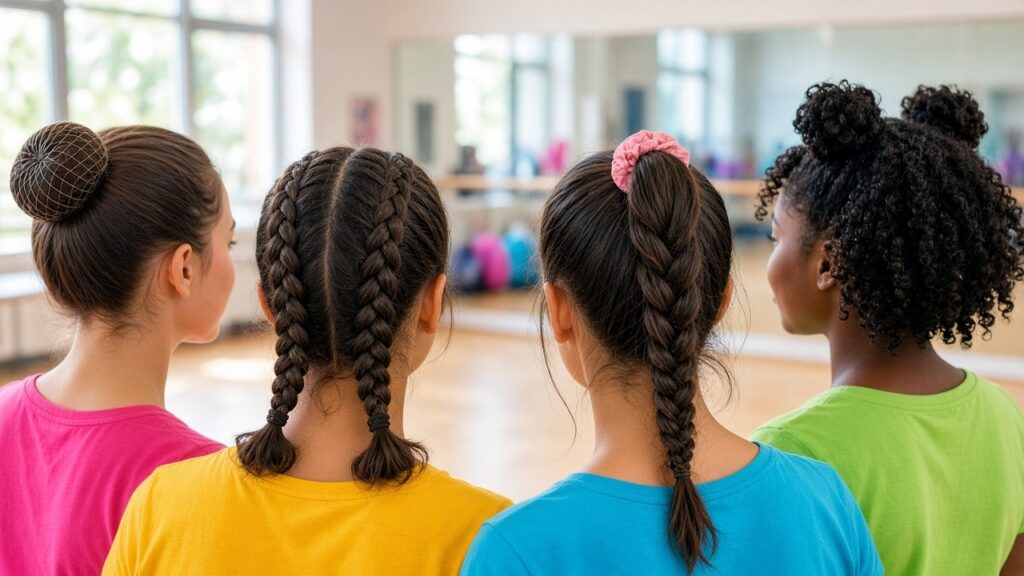
Nothing breaks your focus in dance class like hair whipping into your eyes on a turn or a ponytail sliding loose halfway through a song. The right hairstyle keeps hair off your face and neck, stays put through jumps, spins and floor work, and meets your teacher’s dress code.
The best hairstyles for dance class are a ballet bun for ballet and any class that requires a neat look; French or Dutch braids for hip-hop, Zumba, contemporary and salsa because they hold through sweat and spins; a high ponytail or braided ponytail for jazz and fitness classes; and space buns or a low bun for floor work and curly hair. Secure styles with snag-free elastics, U-pins and bobby pins, smooth flyaways with gel, and skip loose clips or sharp accessories that can fall out or hurt someone.
Below: the best styles at a glance, how to do each one, which styles suit each dance, options for curly and thick hair, what to keep in your bag and answers to common questions. For the full bun tutorial, see how to do a dance bun.
Best hairstyles for dance class at a glance
| Hairstyle | Best for | Hold | Time to do |
|---|---|---|---|
| Ballet bun | Ballet, performances, exams | Very secure | 5 to 10 minutes |
| French or Dutch braids | Hip-hop, Zumba, contemporary, salsa, jazz | Very secure | 10 to 15 minutes |
| High ponytail | Jazz, Zumba, cardio dance, tap | Moderate | 2 minutes |
| Braided ponytail | Zumba, jazz, salsa | Secure | 5 minutes |
| Space buns | Hip-hop, Zumba, curly hair | Secure | 5 minutes |
| Low bun | Contemporary, lyrical, floor work | Secure | 5 minutes |
| Half-up | Salsa, bachata socials, belly dance | Low | 3 minutes |
Ballet bun
The ballet bun is the standard for ballet classes and performances because it keeps all the hair off the neck and face and shows the line of the head and neck.
Quick steps:
- Brush hair into a tight, high ponytail at the crown.
- Twist the ponytail and wrap it around the base.
- Pin it with U-pins, inserting each pin at the edge of the bun, turning it and pushing toward the center.
- Cover with a hair net in your hair color.
- Smooth flyaways with gel and hairspray.
The full step-by-step, with tips for long, thick and curly hair, is in how to do a dance bun. New to ballet? See can adults start ballet?.
French or Dutch braids
Braids are a dancer’s best friend for styles with lots of movement and sweat. Two braids, one on each side, hold hair close to the head and don’t swing.
- French braid: strands cross over the middle, so the braid lies flat.
- Dutch braid: strands cross under the middle, so the braid stands out (an “inside-out” braid). Dutch braids often feel more secure.
How to do two Dutch braids
- Part your hair down the middle from forehead to nape. Clip one side out of the way.
- Take a small section at the front and split it into three strands.
- Cross the right strand under the middle, then the left strand under the middle.
- Add hair from the sides to each outer strand before crossing it under.
- Keep going down the head, adding hair until you reach the nape.
- Finish with a regular three-strand braid and secure with an elastic.
- Repeat on the other side.
For sweat-heavy classes, braid damp hair with a little leave-in or gel, and the braids will hold for hours.
High ponytail and braided ponytail
High ponytail
A ponytail is the fastest option, but a loose ponytail swings and hits your face during turns.
- Brush hair back and gather it at the crown.
- Secure with a thick, snag-free elastic wrapped tightly.
- Add a second elastic for heavy hair.
- Smooth the sides with a little gel.
Braided ponytail
Braid the ponytail and secure the end. A braided ponytail swings less and won’t tangle.
Bubble ponytail
Add elastics every few inches down the ponytail and gently pull the sections wider. It’s playful and stays together.
Space buns
Space buns (two buns on top of the head) are fun, secure and great for curly hair.
- Part your hair down the middle.
- Make two high ponytails, one on each side.
- Twist each ponytail and wrap it around its base.
- Secure with an elastic and a few bobby pins.
Make them tight for class. Space buns are popular for hip-hop, Zumba and dance fitness.
Low bun
A low bun at the nape keeps the back of your head free for floor work, rolls and lying on your back in contemporary or lyrical class. Make a ponytail at the nape, twist, wrap and pin it like a ballet bun. Braid the ponytail first for extra hold.
Styles by dance
| Dance | Recommended styles | Why |
|---|---|---|
| Ballet | Ballet bun | Required by most schools; neat line; nothing moves |
| Jazz | High bun, braided ponytail, braids | Turns and kicks; secure but stylish |
| Contemporary / lyrical | Low bun, braids | Floor work; no high bun to roll on |
| Hip-hop | Braids, space buns, ponytail, natural styles | Movement and personality; whatever stays out of the face |
| Zumba / dance fitness | Braids, high ponytail, space buns, headband | Sweat and high energy |
| Tap | Ponytail or bun | Hair out of the face is enough |
| Salsa / bachata | Low or high bun, braids, half-up for socials | Turns; partners’ hands are near your head |
| Belly dance | Hair down, half-up or low ponytail | Hair can be part of the look; secure it if spinning |
For salsa specifically, long loose hair can whip your partner’s face in turns, so tie it back for class. More in what to wear salsa dancing. For fitness dance, see what to wear to Zumba.
Curly and thick hair options
Curly and coily hair doesn’t need to be straightened for dance class. Choose styles that work with your texture:
- Puff or pineapple: gather curls at the top of the head with a large scrunchie or a satin band.
- Space buns or puffs: two secure puffs on top of the head.
- Two-strand twists or box braids: protective styles that last for days and hold through any class.
- Cornrows: close to the head and very secure.
- Ballet bun for curly hair: smooth with gel or cream, split thick hair into two sections, twist each and wrap, then use large U-pins and a larger net.
- Wide headband or wrap: keeps edges and curls back during high-sweat classes.
Use satin-lined scrunchies or snag-free elastics to reduce breakage. If you’re doing a ballet exam or performance, ask your teacher what’s accepted.
Short hair and bangs
- Bangs: pin them back with bobby pins crossed in an X, or braid them into the hairline.
- Bob-length hair: half-up with a small ponytail and pins, or a mini low bun with a donut.
- Very short hair: a headband or sweatband is enough for most classes.
- For ballet: a small bun or clip-on bun with pins, and gel for shorter layers.
Hairstyles for performances and recitals
Class hair and stage hair are different. For performances:
- Follow the director’s instructions exactly. Group numbers usually require identical styles, part lines and accessories.
- Make it sleeker than class hair. Stage lights show every flyaway; use more gel and hairspray.
- Secure accessories well. Pin flowers, clips and hairpieces with several crossing bobby pins, and test them with turns at the dress rehearsal.
- Plan quick changes. If you change hairstyles between numbers, practice the change and keep pins and tools in a labeled bag.
- Do hair before makeup so you don’t smudge your face while pinning. See stage makeup vs regular makeup and how to prepare for a dance performance.
Hair care for frequent dancers
Tight styles several times a week can stress your hair and scalp. To keep hair healthy:
- Change the position of buns and ponytails from day to day so the same spot isn’t always under tension.
- Avoid styles that are painfully tight. Tension headaches or sore spots mean it’s too tight.
- Take pins and elastics out gently and never sleep in a tight bun.
- Rinse or wash out sweat, gel and hairspray regularly, and use conditioner.
- Protect your edges with satin scarves and gentle elastics, especially with curly or coily hair.
- Give your hair rest days with loose styles when you’re not dancing.
Keeping it in place
- Work with slightly damp or product-prepped hair; it holds a style better than freshly washed, silky hair.
- Use gel or wax sticks to smooth the hairline.
- Finish with hairspray for buns and sleek styles.
- Use a sweatband for high-sweat classes.
- Shake your head and do a turn before class to test.
For keeping your face fresh too, see sweat-proof makeup for dance.
What to bring (pins, gel, scrunchies)
| Item | Why |
|---|---|
| Snag-free elastics (several) | They break or get lost |
| Bobby pins and U-pins | Quick fixes |
| Hair net | For ballet buns |
| Gel or wax stick | Flyaways |
| Travel hairspray | Hold |
| Brush or comb | Redo a style |
| Scrunchie or satin band | Gentle on curls |
| Headband or sweatband | Sweat and baby hairs |
Accessories teachers may not allow
- Large clips and claw clips: they can fall off or hurt when you roll on the floor.
- Hard or sharp accessories: barrettes and metal clips can scratch you or your partner.
- Loose hair: many teachers ask for hair to be tied back for safety.
- Big bows or flowers in class (fine for some performances).
- Long dangling hair accessories that can catch or swing.
Check your studio’s dress code; many specify hair rules for each class.
FAQ
How should I wear my hair for a first dance class?
Tie it back securely and away from your face. A ponytail, braid or bun works for most classes. For ballet, a bun is usually expected. If you’re unsure, ask the studio.
Which hairstyles work for curly hair?
Puffs, space buns, braids, twists, cornrows and a smoothed bun all work. Use snag-free or satin elastics and products that work with your texture.
What hairstyles stay put in Zumba?
Two braids, a braided ponytail or space buns hold best. Add a sweatband to keep baby hairs and sweat out of your face.
Do I need a bun for ballet class?
Most ballet classes and schools require a bun, especially for children and exams. Adult open classes are sometimes more relaxed, but a bun is still the most practical style.
Which hair accessories do teachers not allow?
Usually large claw clips, sharp barrettes and anything that can fall off or hurt during floor work or partnering. Check your studio’s dress code.
Can I dance with my hair down?
In some styles, like belly dance or certain performances, yes. In most classes, it’s safer and easier to tie hair back so it doesn’t block your vision or hit your partner.
What’s the fastest secure hairstyle for dance class?
A tight high ponytail braided to the end takes about five minutes and holds through most classes. Add two bobby pins at the base if your hair is heavy, and a headband for shorter front layers.