
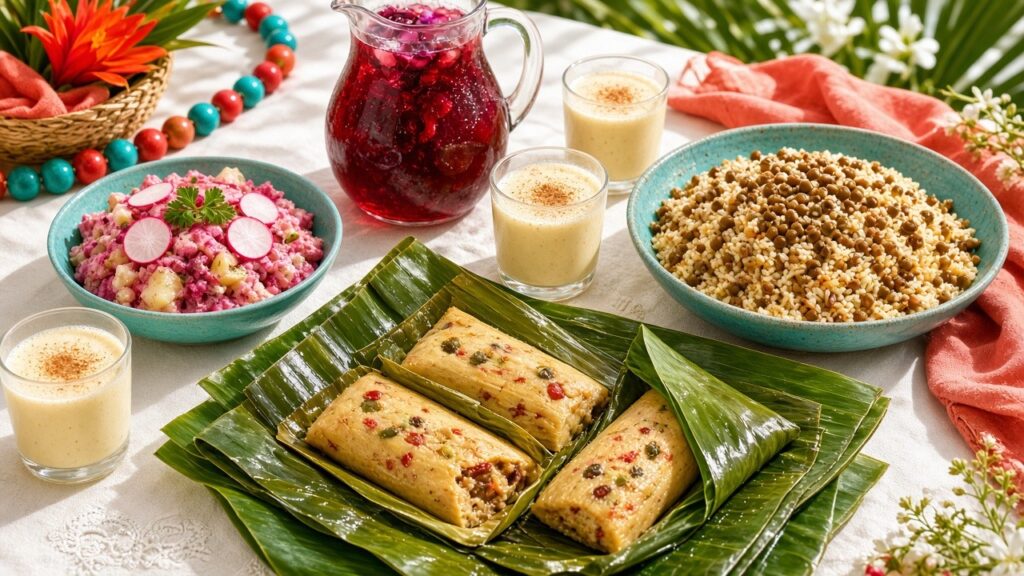
Christmas in Panama is loud, warm and delicious. Families gather on December 24th, the music is on, and the big meal often lands on the table close to midnight. I live in Chicago now, where Christmas means snow outside the window, but on Nochebuena my table still looks Panamanian. Here’s what goes on it, and how to plan the menu yourself.
Traditional Panamanian Christmas food includes tamales wrapped in leaves, arroz con guandú or arroz con pollo, a roast pernil, ham or turkey, pink potato salad with beets, saril (a red sorrel and ginger drink), ron ponche and a dark rum fruit cake. The feast is served on Christmas Eve, Nochebuena.
When do Panamanians eat Christmas dinner?
The big Christmas meal in Panama is on Christmas Eve, December 24th, called Nochebuena. Many families eat late, around midnight, after church or after hours of visiting, music and snacks. Christmas Day is for leftovers, resting and visiting family. Then the whole menu comes back on New Year’s Eve, often with even more people.
The Panamanian Christmas menu, dish by dish
Panamanian tamales
Tamales are the star. Panamanian tamales are made with corn dough (masa) seasoned with a stewed filling, usually chicken or pork, with olives, capers, raisins, onion and sweet pepper, and wrapped in plantain or bijao leaves, not corn husks. Families make them together in big batches in the days before Christmas, and every family has its own way. Here is my recipe: Panamanian tamales.
Arroz con guandú
Rice with pigeon peas, very often cooked with coconut milk. It’s the holiday rice in many Panamanian homes. My recipe: Panamanian arroz con guandú.
Arroz con pollo
The other holiday rice: yellow rice with chicken, vegetables and olives. Some families make both. My version: Panamanian arroz con pollo.
Pernil, ham or turkey
The roast in the center of the table. Pernil (roast pork shoulder marinated with garlic, oregano and citrus) is very common, and so is a glazed ham or a turkey, especially in families with ties to the US. Many cooks roast the ham or turkey with pineapple rings on top.
My pernil method: For an 8–10 lb (3.6–4.5 kg) bone-in shoulder, mash 1 head of garlic, 1 tablespoon dried oregano, 2 tablespoons salt, 1 teaspoon black pepper, ¼ cup (60 ml) oil and ½ cup (120 ml) sour orange juice (or half orange, half lime). Cut deep slits all over the meat, rub the paste in, cover and refrigerate 1 to 2 days. Roast skin side up at 325°F (165°C) for 5 to 6 hours, until the meat pulls apart and reads about 190°F (88°C), then raise the oven to 450°F (230°C) for the last 15 to 20 minutes to crisp the skin. Rest 30 minutes before carving.
Ensalada de papa (pink potato salad)
Panamanian potato salad is pink. It’s made with potatoes, boiled beets, egg, onion, celery and mayonnaise, and the beets turn the whole bowl rosy. Some families add carrots or apple. It’s the side dish that tells you it’s Christmas.
Arroz con pasas
Rice with raisins: white rice cooked with raisins and a little sugar, sometimes with a clove or a cinnamon stick in the pot. It’s sweet-savory and goes beautifully next to ham. Some families serve it instead of arroz con guandú, some serve both.
Plátano en tentación
Very ripe plantains simmered in butter, brown sugar (or raspadura) and cinnamon until they turn glossy and dark. It’s a side dish, served next to the roast, not a dessert, even though it tastes like one.
Tamal de olla
If nobody has the patience to wrap tamales, there’s the “pot tamale”: the same seasoned corn masa and stewed meat cooked together and baked or steamed in a dish, then served by the spoonful. Many families make it in addition to wrapped tamales.
Rosca de huevo
A braided, egg-enriched sweet bread baked in a ring, sometimes topped with sliced almonds or sugar. It’s Panama’s Christmas bread, eaten with coffee in the days around Nochebuena.
Saril
A ruby-red drink (often called chicha de saril) made by steeping dried sorrel (roselle) flowers with ginger, cinnamon and cloves, then sweetening it. In the US you’ll find the flowers sold as flor de Jamaica or hibiscus. Serve it cold. Many adults add a splash of rum.
Ron ponche
Panama’s holiday eggnog: milk, eggs, sugar, vanilla, nutmeg and rum, served very cold. If you don’t drink alcohol, make it without the rum.
Panamanian fruit cake
A dark, dense cake full of dried fruits that have been soaked in rum, sometimes for weeks. It’s often made well ahead and fed with more rum as Christmas gets closer. My recipe: Panamanian fruit cake.
Other sweets and snacks
Depending on the family and the region, you’ll also see sopa borracha (a cake soaked in spiced rum syrup), dulce de papaya, cocadas, grapes and apples (a holiday treat in the tropics because they’re imported) and fruit punch. I gather my favorites in Panamanian desserts.
Three Christmas recipes: saril, ron ponche and pink potato salad
Saril (sorrel and ginger drink)
Makes: about 10 cups (2.4 L) · Active: 15 minutes · Steep: 4 hours or overnight
- 2 cups (about 2 oz / 60 g) dried sorrel, roselle or flor de Jamaica
- A 3-inch (7 cm) piece of fresh ginger, sliced
- 2 cinnamon sticks and 6 whole cloves
- 10 cups (2.4 L) water
- ¾ to 1 cup (150–200 g) sugar, to taste
- Optional for adults: rum to taste
- Bring the water to a boil. Add the flowers, ginger, cinnamon and cloves.
- Simmer 10 minutes, turn off the heat and let it steep at least 4 hours, or overnight in the fridge.
- Strain, pressing on the flowers. Stir in sugar while it’s still warm so it dissolves.
- Chill and serve over ice. It keeps 5 days in the fridge.
Don’t use aluminum pots; the acid in the flowers reacts with them. Saril stains, so wipe spills fast.
Ron ponche (Panamanian Christmas eggnog)
Makes: about 6 cups (1.4 L) · Active: 20 minutes · Chill: 4 hours
- 1 can (12 oz / 354 ml) evaporated milk
- 1 can (14 oz / 397 g) sweetened condensed milk
- 2 cups (480 ml) whole milk
- 1 cinnamon stick
- 4 egg yolks
- 1 tsp vanilla extract and ½ tsp freshly grated nutmeg, plus more for serving
- ¾ to 1 cup (180–240 ml) rum, or leave it out
- Warm the three milks with the cinnamon until steaming, not boiling.
- Whisk the yolks in a bowl. Slowly whisk in 1 cup of the hot milk, then pour it all back into the pot.
- Cook over low heat, stirring constantly, until it thickens enough to coat a spoon and reaches 160°F (71°C), about 5 to 8 minutes. Don’t let it boil.
- Strain, cool, then stir in vanilla, nutmeg and rum. Chill at least 4 hours.
- Serve very cold with a little nutmeg on top. Keep refrigerated and use within 3–4 days, whether or not rum is added.
Cook the egg mixture to 160°F and refrigerate promptly. Label versions containing alcohol clearly; individual dietary and medical needs still matter.
Ensalada de papa (pink Panamanian potato salad)
Serves: 10–12 as a side · Active: 30 minutes · Chill: 2 hours
- 3 lb (1.4 kg) yellow or white potatoes, peeled and cut in ¾-inch (2 cm) cubes
- 2 medium beets, boiled and peeled (or one 15-oz / 425 g can, drained)
- 4 hard-boiled eggs, chopped
- ½ small onion, very finely chopped
- 2 celery ribs, finely chopped
- 1 cup (240 g) mayonnaise
- 1 tbsp white vinegar or lime juice, 1 tsp mustard (optional)
- Salt and pepper
- Optional: 1 cooked diced carrot, 1 diced apple, or 2 cups shredded cooked chicken
- Boil the potatoes in salted water until just tender, 10 to 12 minutes. Drain and cool.
- Dice the beets small. Mix the mayonnaise, vinegar, mustard, salt and pepper.
- Fold the potatoes, eggs, onion and celery into the dressing, then fold in the beets last. The more you stir, the pinker it gets.
- Chill at least 2 hours, ideally overnight. Keep it cold; mayonnaise salads shouldn’t sit out more than 2 hours.
Some families add shredded chicken and serve it as its own dish; Panamanian chefs talk about that version as the taste of their grandmothers’ Christmas.
Your Panamanian Christmas countdown
| When | What to do |
|---|---|
| Late November | Make the fruit cake and start feeding it rum weekly |
| First week of December | Make and freeze tamales; buy plantain leaves and frozen guandú |
| December 20–21 | Make saril; shop for the roast |
| December 22 | Marinate the pernil (2 days is ideal) |
| December 23 | Make ron ponche; cook beets and potatoes for the salad |
| December 24, morning | Assemble the potato salad; take tamales out of the freezer |
| December 24, afternoon | Roast the pernil (about 35–40 minutes per pound at 325°F / 165°C for bone-in shoulder, until very tender, about 190°F / 88°C inside) |
| December 24, evening | Cook the rice and plátano en tentación; reheat tamales |
| December 31 | Do it all again with the leftovers and more guests |
How much food for a Panamanian Christmas?
For 12 adults, this is what I plan:
- Tamales: 24 (two each; they’re big)
- Pernil: an 8–10 lb (3.6–4.5 kg) bone-in pork shoulder, with leftovers
- Ham: a 6–8 lb (2.7–3.6 kg) ham if you’re serving it alongside
- Rice: 5 cups (1 kg) of raw rice for arroz con guandú
- Potato salad: the 3-lb recipe above
- Saril: a double batch
- Ron ponche: one batch, served in small glasses
- Fruit cake: one 9-inch cake gives 16 or more thin slices
Vegetarian at a Panamanian Christmas
Cook the rice with oil instead of pork, make a batch of tamales with a vegetable and olive filling or cheese, and the potato salad, plátano en tentación, saril and fruit cake are already meat-free.
A Nochebuena menu you can cook in the US
This is how I’d plan a Panamanian Christmas for 10 to 12 people in Chicago:
| Course | Dish | When to make it |
|---|---|---|
| Drinks | Saril and ron ponche | 2–3 days ahead; keep cold |
| Main | Pernil (8–10 lb pork shoulder) | Marinate 1–2 days ahead; roast the day of |
| Rice | Arroz con guandú (double batch) | Day of |
| Tamales | 2 per person | 1–2 weeks ahead; freeze, then reheat by steaming or boiling |
| Salad | Pink potato salad | The day before; it tastes better |
| Dessert | Fruit cake | 2–4 weeks ahead |
The trick is the same one Panamanian families use: tamales and fruit cake are made early, so Christmas Eve is about the roast and the rice.
New Year’s Eve in Panama
December 31 brings the same menu back: tamales, arroz con guandú, pernil, potato salad, ron ponche. What changes is what happens at midnight. Along the Interamerican Highway in places like Bejuco de Chame and San Carlos, families build life-size muñecos de año viejo (“old year” dolls, also called judas) out of old clothes, paper and dry leaves, often dressed as politicians, athletes and celebrities from the year’s news. At midnight they’re burned to say goodbye to the bad things of the old year. Then the fireworks start, and the plates come out again.
Panamanian Christmas vs other Latin Christmases
| Panama | Mexico | Puerto Rico | Colombia | |
|---|---|---|---|---|
| Big night | Nochebuena (Dec 24) | Nochebuena (Dec 24) | Nochebuena (Dec 24) | Nochebuena (Dec 24) |
| Tamal | Corn masa in plantain or bijao leaves, chicken or pork with olives, capers, raisins | Corn husks or banana leaves, many fillings | Pasteles (green banana and root masa) | Tamal tolimense in plantain leaves |
| Rice | Arroz con guandú, arroz con pasas | Rice is a side, not the star | Arroz con gandules | Arroz con pollo |
| Roast | Pernil, ham, turkey | Turkey, bacalao, romeritos | Pernil (lechón) | Pernil, lechona |
| Drink | Saril, ron ponche | Ponche (fruit punch), atole | Coquito | Sabajón, aguardiente |
| Sweet | Fruit cake, rosca, plátano en tentación | Buñuelos | Tembleque, arroz con dulce | Natilla, buñuelos |
Making it in Chicago (or anywhere cold)
- Plantain leaves are in the freezer of most Latin and Asian markets. Thaw overnight, wipe and pass them over a flame to soften.
- Sour orange (naranja agria) for the pernil is sold fresh in Latin markets or bottled; half orange juice and half lime juice works.
- Flor de Jamaica for saril is in the spice aisle of Latin groceries, often in big bags.
- Rum: Panamanian rums such as Ron Abuelo are sold at larger liquor stores; any golden rum works.
- Plan oven time. A pernil occupies the oven for hours, so steam or boil the tamales on the stovetop and make the rice on a burner.
Where to shop for a Panamanian Christmas in Chicago
Most ingredients are easy: pork shoulder, potatoes, beets, rice and coconut milk are in any supermarket. For the Panamanian touches, head to Latin and Caribbean markets for plantain leaves (usually frozen), frozen guandú, culantro and dried flor de Jamaica for the saril. I share more in where to buy culantro and Panamanian ingredients in Chicago.
Panamanian Christmas traditions beyond the food
- Christmas falls in the dry season. December in Panama is sunny and breezy, so parties spill onto patios and the street.
- The Christmas ham. Many Panamanian employers give workers a ham, a turkey or a holiday food bag in December; for many families, that’s where the Christmas ham comes from.
- Lights and the parade. Panama City lights up for the season and holds a big Christmas parade; in 2025 it was the “City of Stars” parade on Calle 50 on December 14.
- Family first. Christmas Eve is for family, with relatives and friends dropping by all night.
- Music. Típico music with accordion, salsa and Christmas songs, often all at once.
- Fireworks at midnight, in many neighborhoods.
- Gifts are opened at midnight in many homes, or on Christmas morning.
- New Year’s Eve is a second feast, often with even more people.
Saril and ron ponche: make-ahead questions answered
Saril recipe-card timing and serving notes
The saril recipe above makes approximately 10 cups, or ten 1-cup servings before ice. Allow about 15 minutes active preparation and simmering, at least 4 hours steeping, and enough additional time to chill thoroughly. The overnight option is convenient, but put the steeping drink in the refrigerator rather than leaving it on the counter overnight.
For predictable sweetness, dissolve the first ¾ cup sugar while the strained liquid is warm, then taste after chilling before adding the rest. Ice dilutes the drink, so a chilled sample over a little ice is a better final test than a spoonful of hot concentrate. Use food-grade dried hibiscus sold for drinks, not ornamental flowers or a florist’s bouquet.
Make saril one or two days before the meal, strain it, cover it and refrigerate. If it develops unexpected fizz, mold or an off smell, discard it rather than assuming it has become a desirable fermented drink. The plain recipe is nonalcoholic; keep rum separate and label any adult version clearly.
Ron ponche recipe-card timing and serving notes
The recipe above makes about 6 cups, or twelve small ½-cup servings. Plan on 20 minutes active cooking and at least 4 hours chilling; a shallow covered container chills more efficiently than a large warm bottle. Final yield varies a little with evaporation and how much rum you include.
Temper the yolks slowly and stir across the bottom and into the corners of the pan. Use a thermometer: a spoon-coating texture is helpful but is not a substitute for checking that the egg mixture reaches 160°F. If the mixture turns grainy, remove it from the heat promptly and strain it; a hard boil makes curdling more likely.
Cool promptly and refrigerate at 40°F or below. Use within 3–4 days whether or not you add rum. The recipe’s rum is a flavoring, not a validated preservation treatment. Keep only a small serving jug out and refill from the refrigerator. Discard perishable drink left out longer than two hours, or one hour above 90°F.
Can I make ron ponche without alcohol?
Yes. Leave out the rum and keep the vanilla and nutmeg. It will taste milkier and sweeter because the rum is no longer balancing the dairy. If needed, loosen individual servings with a little cold milk rather than changing the whole batch blindly. Do not tell guests that an alcoholic version is alcohol-free because it contains cooked eggs: cooking the custard and removing alcohol are separate questions.
Can I freeze either Christmas drink?
Saril can be frozen in suitable containers with headroom, or as ice cubes that will not dilute the next glass. Ron ponche can separate or become grainy after freezing, so making a smaller refrigerated batch is usually the nicer option. Never freeze a completely full glass bottle.
Can pregnant guests or children drink ron ponche?
Offer a clearly alcohol-free version made with safely handled ingredients and fully cooked eggs, or a suitable commercially pasteurized alternative. Individual medical and dietary needs still matter. Avoid the blanket promise that any homemade recipe is “safe for everyone.”
Traditional Panamanian Christmas food FAQ
What is the most traditional Panamanian Christmas food?
Tamales. Almost every Panamanian Christmas table has them, along with arroz con guandú or arroz con pollo.
What is saril made from?
Dried sorrel (roselle) flowers, the same flower sold as hibiscus or flor de Jamaica, steeped with ginger and spices and sweetened.
What do Panamanians drink at Christmas?
Saril, ron ponche, fruit punch, and for the adults, beer, rum and Seco Herrerano, Panama’s sugarcane spirit.
Is Panamanian Christmas food spicy?
No. It’s savory and rich, with heat added at the table from ají chombo sauce if you want it.
What is Panamanian Christmas bread?
Rosca de huevo, a braided egg bread baked in a ring. Fruit cake (dulce de frutas or pan de frutas) is the other holiday baking project.
Is Christmas Eve or Christmas Day the big meal in Panama?
Christmas Eve, Nochebuena. Christmas Day is for leftovers and visiting.
What is plátano en tentación?
Ripe plantains simmered in butter, sugar and cinnamon, served as a sweet side dish next to the roast.
Why is Panamanian potato salad pink?
Beets. They’re boiled and mixed into the salad, and their color turns everything pink.
Bring Panama to your table this Christmas
Affiliate disclosure: Some links in this section are affiliate links. If you buy through them, I may earn a commission. As an Amazon Associate I earn from qualifying purchases.
Start with the tamales and the fruit cake, because they need time, and build from there. Everything on this menu is part of my guide to Panamanian food, and my Panamanian home cooking is also collected in my cookbook, Ultimate Cookbook of Panama: Secrets of the Tropical Kitchen by MarGo.
As an Amazon Associate I earn from qualifying purchases.
¡Feliz Navidad y buen provecho!