
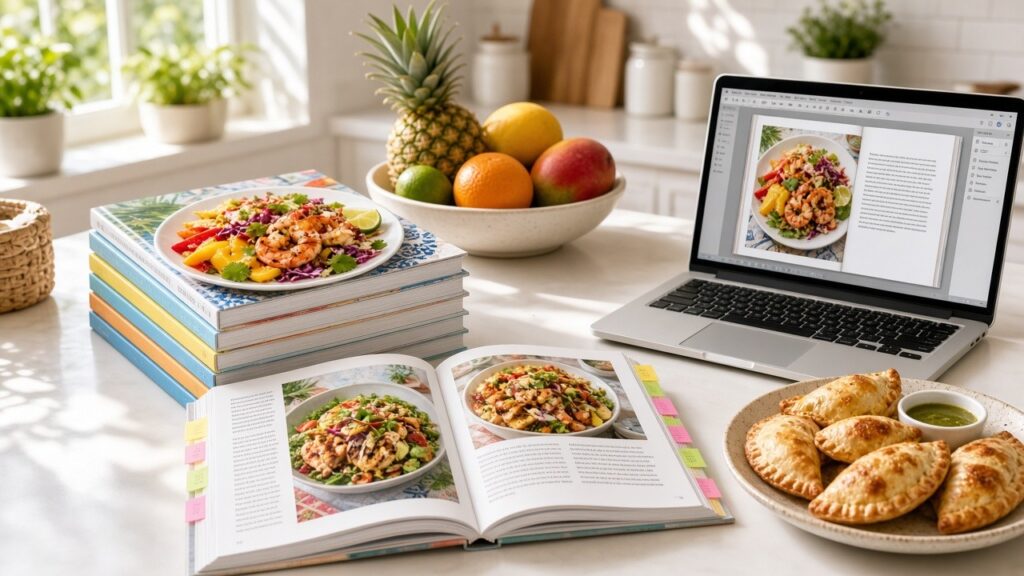
When I decided to write a Panamanian cookbook for home cooks, I didn’t wait for a publisher. My Ultimate Cookbook of Panama is independently published, with an English and a Spanish edition. Self-publishing meant I made every decision, from which recipes made the cut to how the pages looked, and it also meant I was responsible for every step. If you’re thinking of doing the same, here’s the whole process, step by step.
Yes, you can self-publish a cookbook. The steps are: define your concept and audience, develop and test every recipe, write and edit the manuscript, photograph the food, design the interior and cover, get ISBNs and choose a platform (Amazon KDP, IngramSpark, Lulu or an offset printer), decide on print options like color and binding, price the book, then launch and market it. Print-on-demand lets you publish without buying inventory. Most of the work, and most of the time, goes into testing recipes, photography and layout.
Below: each step in detail, lessons worth knowing before you start and answers to common questions. For budgets, see how much it costs to self-publish a cookbook; for timelines, how long it takes to write a cookbook.
Can you self-publish a cookbook?
Absolutely. Self-publishing is common for cookbooks, especially:
- Regional and cultural cookbooks that big publishers overlook (like Panamanian food).
- Family and community cookbooks. If that’s your goal, start with how to make a cookbook of family recipes.
- Niche diets and specialties.
- Bloggers, chefs and teachers with an existing audience.
Self-publishing vs traditional publishing:
| Self-publishing | Traditional publishing | |
|---|---|---|
| Control | Total: content, design, price, timing | Shared with the publisher |
| Upfront cost | You pay (or do it yourself) | Publisher pays; you may get an advance |
| Royalties | Higher percentage per book | Lower percentage |
| Distribution | Online easily; bookstores harder | Bookstores and libraries more easily |
| Speed | As fast as you can work | Often 18–24 months from contract |
| Getting in | No gatekeeper | Usually need an agent and proposal |
Step 1: Concept and audience
Before you test a single recipe, answer:
- Who is it for? Beginners? Experienced cooks? People from the culture, or curious outsiders?
- What’s the promise? “Panamanian food you can make in an American kitchen” is clearer than “Latin recipes.”
- What’s different about your book compared with others? See how I compared mine in the best Panamanian cookbooks.
- How many recipes? Focused cookbooks often have 40 to 80; big references have 100 or more.
- What format? Paperback, hardcover, e-book; color or black and white; one language or two.
Write a one-paragraph description of the book and a draft table of contents. You’ll refer to it constantly.
Step 2: Test recipes
Testing is the heart of the book.
- Write each recipe down in full before you test it.
- Cook it exactly as written, measuring everything.
- Fix and retest until it works every time.
- Test in American kitchens with U.S. ingredients if your audience is in the U.S. Note where to find specialty items and give substitutions.
- Recruit testers (friends, family, readers) to cook from your draft without help and report back.
- Keep a testing log: date, changes, results, notes.
How many recipes and how to organize chapters
Common chapter structures:
- By course: breakfast, soups, mains, sides, desserts, drinks.
- By ingredient: chicken, seafood, rice, roots and plantains.
- By occasion: everyday, weekend, holidays.
- By region (for cultural cookbooks).
Choose the one your reader will use most naturally. For a cultural cookbook, “by course” with an intro to the pantry works well.
Step 3: Write and edit
Write
Each recipe needs a title, headnote, yield, times, ingredient list, method and notes. My guide on how to write a recipe covers the format in detail. Beyond recipes, a cookbook usually includes:
- An introduction: your story and why this book exists.
- A pantry guide: ingredients, where to buy them and substitutions.
- Equipment notes.
- Glossary (for cultural cookbooks).
- An index.
Edit
- Self-edit for consistency: units, abbreviations, temperatures, ingredient names.
- Hire a copyeditor if you can, ideally one with cookbook experience.
- Proofread the final laid-out pages, not just the manuscript; errors creep in during layout.
- For bilingual editions, have a fluent editor check each language separately.
Step 4: Food photography
Options
- Do it yourself: natural window light, a tripod, simple backgrounds (wood, linen, white boards) and a few props.
- Hire a food photographer (and possibly a stylist) for some or all shots.
- Mix: a pro for the cover and chapter openers, your own photos for the rest.
Tips
- Shoot in natural, indirect light near a window; avoid overhead kitchen lights.
- Shoot the food when it looks best, right after cooking.
- Keep a consistent style across the book.
- Shoot at high resolution for print (300 dpi at final size).
- Plan photos per page before shooting so you know the orientation and space needed.
Step 5: Design and layout
Interior
Cookbook layout is detail-heavy: ingredient lists, numbered steps, photos, headnotes and page breaks that don’t split a recipe awkwardly.
- Tools: professional layout software like Adobe InDesign or Affinity Publisher, or simpler tools if your design is simple. Check that your tool exports print-ready PDFs to your printer’s specs.
- Templates: many designers sell cookbook templates.
- Hire a book designer if layout isn’t your strength.
Layout basics:
- Readable fonts at a comfortable size; ingredient lists and steps clearly separated.
- Consistent recipe structure on every page.
- Margins and bleed set to your printer’s specifications.
- Recipes on one page or a spread when possible.
Cover
Your cover sells the book, especially online at thumbnail size. Use a strong food photo, a clear title and your name. Look at bestselling cookbooks in your category for inspiration. A professional cover designer is often worth the money.
Step 6: ISBN, platforms (KDP, IngramSpark, Lulu)
ISBNs
- Each format and each language needs its own ISBN (paperback, hardcover, e-book; English and Spanish).
- Free platform ISBNs: KDP and others offer them, but they list the platform as publisher and can only be used on that platform.
- Your own ISBNs: in the U.S., purchased from Bowker. Buying a block of 10 is cheaper per ISBN than buying one at a time.
Platforms
| Platform | Strengths | Considerations |
|---|---|---|
| Amazon KDP | Free, easy, reaches Amazon customers worldwide; paperback, hardcover and e-book | Mostly Amazon-focused distribution |
| IngramSpark | Distribution to bookstores and libraries through Ingram; many trim sizes and hardcovers | Interface is more technical |
| Lulu | Many formats, including spiral and coil binding options; direct sales | Smaller retail reach |
| Offset printer | Lowest cost per copy at volume; premium quality | Upfront cost, storage and shipping are on you |
Many self-publishers use KDP for Amazon and IngramSpark for wider distribution, with their own ISBNs so the same edition can be on both.
Step 7: Print options (full color cost)
- Color vs black and white: full color looks like a cookbook but costs significantly more per copy on print-on-demand. Use the platform’s printing-cost calculator with your page count.
- Standard vs premium color: some platforms offer two color tiers; compare proofs.
- Trim size: common cookbook sizes include 8 x 10, 8.5 x 8.5 and 8.5 x 11 inches.
- Binding: paperback is cheapest; hardcover is more durable; spiral lies flat but has limited retail availability.
- Paper: heavier, coated paper makes photos look better but costs more.
Always order a printed proof before publishing. Colors and layouts look different on paper than on screen.
Should you publish a cookbook e-book?
An e-book costs nothing to print and reaches readers who cook from tablets, but cookbooks are harder to format than novels:
- Reflowable e-books (the standard Kindle format) rearrange text to fit the screen, so photo placement and two-column ingredient lists may not survive.
- Fixed-layout e-books keep your print design but can be harder to read on phones.
- Test on several devices using the platform’s previewer before publishing.
- Use a separate ISBN if you’re buying your own (KDP doesn’t require one for Kindle e-books).
Many cookbook authors publish print first and add an e-book once the print edition is final.
Step 8: Pricing
- Check the print cost for your book on each platform.
- Look at comparable cookbooks (same size, color, page count, category).
- Calculate royalties at a few price points. Platforms show your royalty as list price times the royalty rate, minus printing cost.
- Set a price that’s competitive and still earns something per copy.
- E-book pricing is usually lower than print.
Full-color print-on-demand cookbooks often need a higher list price than novels just to cover printing.
Step 9: Launch
- Build an audience early: a blog, social media and an email list. Share recipe testing and behind-the-scenes photos.
- Ask for early reviews: send advance copies to readers, bloggers and community members.
- Launch week: announce everywhere, share recipes from the book, and ask readers to leave reviews.
- Local and community events: cooking demos, markets, cultural festivals, libraries and community centers.
- Ongoing: keep sharing recipes and stories; cookbooks sell steadily over years, especially around holidays.
Lessons worth knowing before you start
These are the lessons self-published cookbook authors mention most:
- Testing takes longer than you think. Plan for it.
- Photography and layout eat time. Start planning photos while testing.
- Fewer, better recipes beat more, rushed ones.
- Order proofs at every major stage.
- Buy ISBNs in a block if you’ll publish more than one format or language.
- Start building an audience before launch, not after.
- A second language doubles some work (editing, layout, ISBNs) but can reach a whole new audience.
FAQ
How much does it cost to self-publish a cookbook?
From a few hundred dollars if you do most of the work and print on demand, to $10,000 or more with professional photography, editing and design. See how much does it cost to self-publish a cookbook?
How do I test the recipes?
Cook each one exactly as written, measuring everything, fix what doesn’t work and retest. Then have other people cook from your written version without help.
How many recipes should a cookbook have?
There’s no rule. Focused cookbooks often have 40 to 80 recipes; comprehensive ones have 100 or more. Choose what serves your reader.
How do I organize the chapters?
By course is the most common and easiest for readers. Ingredient, occasion or region also work for specific concepts.
Should I print with KDP or another printer?
KDP is the easiest way to reach Amazon customers. IngramSpark reaches bookstores and libraries. Many authors use both. Offset printing makes sense only if you’ll sell many copies directly.
Can I publish my cookbook in two languages?
Yes. Publish separate editions, each with its own ISBN, or a bilingual edition with both languages side by side. Have each language edited separately.
Do I need permission to include family recipes?
A plain list of ingredients generally isn’t protected by copyright, but stories, headnotes and photos can be. Credit family members who shared recipes, write the instructions in your own words and ask permission before using anyone’s photos or personal stories. This is general information, not legal advice.