
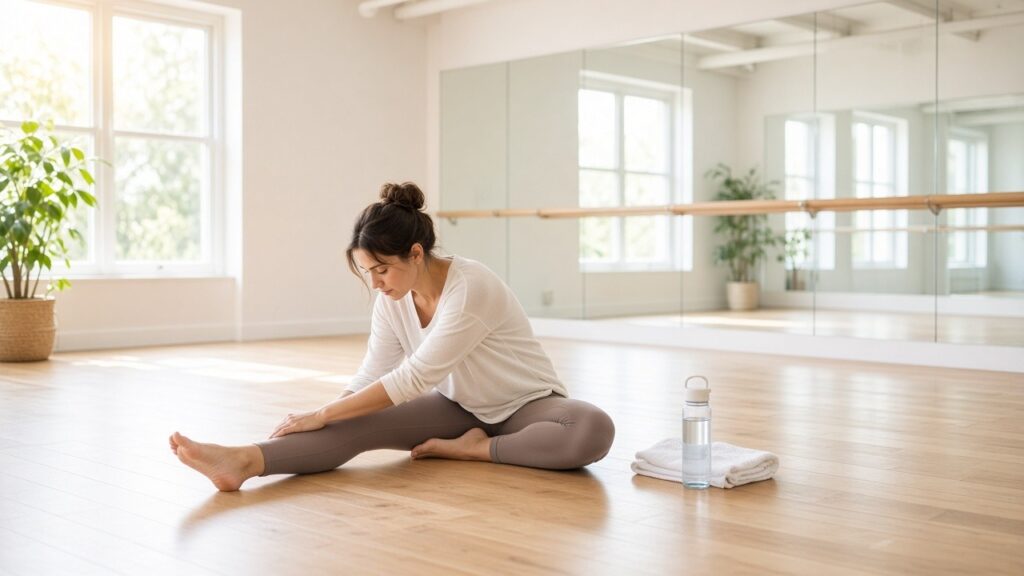
When the last song ends, it’s tempting to grab your bag and run for the door. But the few minutes right after a dance class are a great time to slow your breathing, let your heart rate come down and stretch muscles that are already warm. A short cool-down also gives you a moment to remember the choreography before it fades.
A good cool-down after dance class takes about 10 minutes: a minute or two of easy movement and breathing to bring your heart rate down, then gentle static stretches for the muscles dance works hardest: calves, hamstrings, quads, hip flexors, glutes, inner thighs, lower back, chest and shoulders. Hold each stretch for about 20 to 30 seconds without bouncing, breathe slowly and stretch only to mild tension, never pain. Many fitness organizations recommend static stretching after activity, when muscles are warm, rather than before. This is general information; if you have an injury or health condition, ask a qualified professional what’s right for you.
Below: whether you should stretch after dance class, a 10-minute cool-down with 8 stretches step by step, tweaks for Zumba, ballet, hip hop and tap, stretching before vs after, how long to hold each stretch, how to make it a habit and answers to common questions. Before class, see dance warm-up for beginners.
Should you stretch after dance class?
Short answer: it’s a good habit for most people. A cool-down:
- Gives your body a gradual transition from high energy to rest instead of stopping abruptly.
- Lets you work on flexibility while your muscles are warm, which many dancers find more comfortable.
- Feels good and helps you relax after an intense class.
- Builds body awareness and can be a calm moment to review what you learned.
What stretching can and can’t do is still debated by researchers, especially when it comes to soreness. Think of it as part of a healthy routine, not a cure-all. If something hurts, stop.
A 10-minute cool-down, step by step (8 stretches)
You’ll need a little floor space and a mat, towel or clean studio floor. Wear whatever you danced in.
Minute 0–2: Walk it out and breathe
Walk around the room or march gently in place. Roll your shoulders back a few times. Take slow breaths in through your nose and out through your mouth, letting your heart rate come down. Shake out your arms and legs.
1. Standing calf stretch (30 seconds per side)
Face a wall or barre. Step one foot back, keeping the back leg straight and heel down, and bend the front knee until you feel a stretch in the back calf. Then bend the back knee slightly to target the lower calf (soleus). Calves work hard in every style, especially Zumba, tap and ballet relevés.
2. Standing quad stretch (30 seconds per side)
Stand tall, holding a wall or barre for balance. Bend one knee and hold your foot or ankle behind you, knees close together and hips pressed slightly forward. If you can’t reach, loop a towel around your foot.
3. Low lunge hip flexor stretch (30 seconds per side)
Step one foot forward into a lunge and lower your back knee to the floor (pad it with a towel). Tuck your pelvis slightly and shift forward until you feel a stretch at the front of the back hip. Reach the same-side arm up for more stretch.
4. Seated hamstring stretch (30 seconds per side)
Sit with one leg straight and the other bent, sole against the inner thigh. Hinge forward from your hips, reaching toward your shin or foot with a long spine. Don’t round your back to reach further; a bent knee is fine.
5. Butterfly (inner thigh) stretch (30 seconds)
Sit tall with the soles of your feet together and knees falling out to the sides. Hold your ankles and gently lean forward from the hips. Let your knees relax down; don’t press them.
6. Figure-four glute stretch (30 seconds per side)
Lie on your back, knees bent. Cross one ankle over the opposite knee. Thread your hands behind the bottom thigh and gently pull it toward your chest until you feel a stretch in the glute and outer hip of the crossed leg.
7. Child’s pose and cat-cow (60 seconds)
Come to hands and knees. Do 5 slow cat-cows: round your back up as you exhale, then let your belly drop and chest lift as you inhale. Then sit back onto your heels, arms extended forward and forehead down, in child’s pose for a few breaths. Great for the lower back after hip-heavy styles like salsa, belly dance and Zumba.
8. Chest opener and shoulder stretch (30 seconds each)
Stand or kneel. Clasp your hands behind your back (or hold a towel) and gently lift your chest. Then bring one arm across your chest and hold it with the other arm for a shoulder stretch, switching sides.
Final minute: Breathe
Stand or lie down, close your eyes and take 5 slow breaths. Drink some water.
The routine at a glance
| Stretch | Targets | Time |
|---|---|---|
| Walk and breathe | Heart rate, whole body | 2 min |
| Standing calf | Calves, Achilles area | 30 s each side |
| Standing quad | Front thigh | 30 s each side |
| Low lunge | Hip flexors | 30 s each side |
| Seated hamstring | Back of thigh | 30 s each side |
| Butterfly | Inner thighs | 30 s |
| Figure-four | Glutes, outer hip | 30 s each side |
| Cat-cow and child’s pose | Spine, lower back | 60 s |
| Chest and shoulder | Chest, shoulders, upper back | 30 s each |
| Breathe | Recovery | 1 min |
Style tweaks (Zumba, ballet, hip hop, tap)
Zumba and dance fitness
Zumba is high-energy cardio with lots of hip, calf and lateral work. Spend extra time on calves, hip flexors and inner thighs, and add a side stretch (reach one arm overhead and lean to the side) for all those hip and torso moves. Many instructors lead a short cool-down song at the end; stay for it. See how long is a Zumba class and Zumba for beginners.
Ballet
Ballet works calves, feet, inner thighs, glutes and turnout muscles. Add gentle ankle circles and foot flexes, a supine twist for the spine and a pigeon or figure-four for the deep hip rotators. Avoid forcing turnout or oversplits when tired. See can adults start ballet?
Hip hop
Hip hop is low, grooving and bouncy, with lots of knee bend. Add a deep squat hold (heels down, holding something for balance if needed), neck stretches (ear toward shoulder, gently) after head and chest isolations and a wrist stretch if you did floor work. See hip hop dance for beginners.
Tap
Tap is all about ankles, calves and shins. Add a kneeling shin stretch (sit back on your heels with toes pointed, if comfortable), ankle circles and a toe stretch (kneel with toes tucked under, briefly). See teach yourself tap dance.
Salsa, bachata and partner dance
Partner dance is lots of turning, hip motion and time in heels or dance shoes. Spend time on calves, feet and lower back. Roll your feet on a small ball if they’re tired.
Stretching before vs after (link to warm-up)
| Before class | After class | |
|---|---|---|
| Goal | Raise body temperature, prepare joints and muscles | Bring heart rate down, relax, work on flexibility |
| Type | Dynamic: leg swings, arm circles, pliés, marching, light cardio | Static: hold stretches 20–30 seconds |
| Long static holds? | Generally not recommended right before explosive dance | Yes, muscles are warm |
| Time | 5–10 minutes | 5–10 minutes |
A full pre-class routine is in dance warm-up for beginners.
How long to hold each stretch (general guidance)
- 20 to 30 seconds per stretch is a common recommendation for general flexibility, repeated 2 to 4 times if you have time.
- Breathe slowly and relax deeper on each exhale.
- Mild tension, not pain. You should feel a stretch, not sharp or burning pain.
- No bouncing (ballistic stretching) in a cool-down.
- Both sides equally.
Guidance from organizations such as the American College of Sports Medicine suggests flexibility work at least two to three days a week for adults; daily is fine if it feels good.
Making it a habit
- Do it in the studio right after class, while you’re still warm and before you check your phone.
- Stay for the instructor’s cool-down song; many classes include one.
- Use the same order every time so it becomes automatic.
- Pair it with water and a moment to note the choreography.
- Short on time? Do the 3-minute version: calf, quad, hamstring and child’s pose.
- At home: do the routine after practicing dance at home.
The 3-minute version
- Calf stretch, 20 seconds each side
- Quad stretch, 20 seconds each side
- Standing forward fold with soft knees, 30 seconds
- Chest opener, 20 seconds
- Three slow breaths
Tools that make cool-downs easier
- A stretching strap or towel: for hamstring and quad stretches when you can’t reach.
- A yoga mat: cushions knees in lunges and child’s pose.
- A foam roller: many dancers like rolling calves, quads and upper back after class. Roll slowly and skip anything painful.
- A small massage ball or tennis ball: for tired feet after heels, tap shoes or ballet slippers.
Common cool-down mistakes
| Mistake | Better |
|---|---|
| Bouncing to “get deeper” | Hold still and breathe |
| Holding your breath | Slow nose inhale, longer exhale |
| Forcing splits or turnout when tired | Stay at mild tension |
| Skipping one side | Time both sides equally |
| Stretching cold muscles hours later only | Stretch right after class while warm |
Safety notes
- Stop if you feel sharp pain, numbness or tingling.
- Don’t force flexibility when you’re tired; that’s when people overstretch.
- Ease into stretches you’re not used to.
- Ask a qualified professional if you have an injury, joint condition, are pregnant or have other health concerns.
FAQ
Should I stretch before or after dance class?
Both, differently. Before: a dynamic warm-up (movement, not long holds). After: static stretches held 20 to 30 seconds while you’re warm.
How long should I hold each stretch?
About 20 to 30 seconds is a common general guideline. Breathe slowly and stretch to mild tension only.
Do I stretch differently after ballet or hip hop?
The basics are the same, but focus on what you used most: calves, feet, inner thighs and hips after ballet; squats, neck and wrists after hip hop.
What if I have no time after class?
Do the 3-minute version at the studio, then the full routine later at home. Some stretching beats none.
What should I wear to stretch?
Whatever you danced in, as long as it lets you move freely. Add a layer so you don’t get chilled.
Does stretching prevent soreness?
Research on stretching and next-day soreness is mixed. Stretching may feel good and help flexibility, but don’t count on it to prevent soreness entirely.
Can I stretch at home instead of at the studio?
Yes. If the studio is busy or you need to leave, walk it out on the way home, then do the routine within an hour or so, after a warm shower if you like, while your muscles are still loose.