
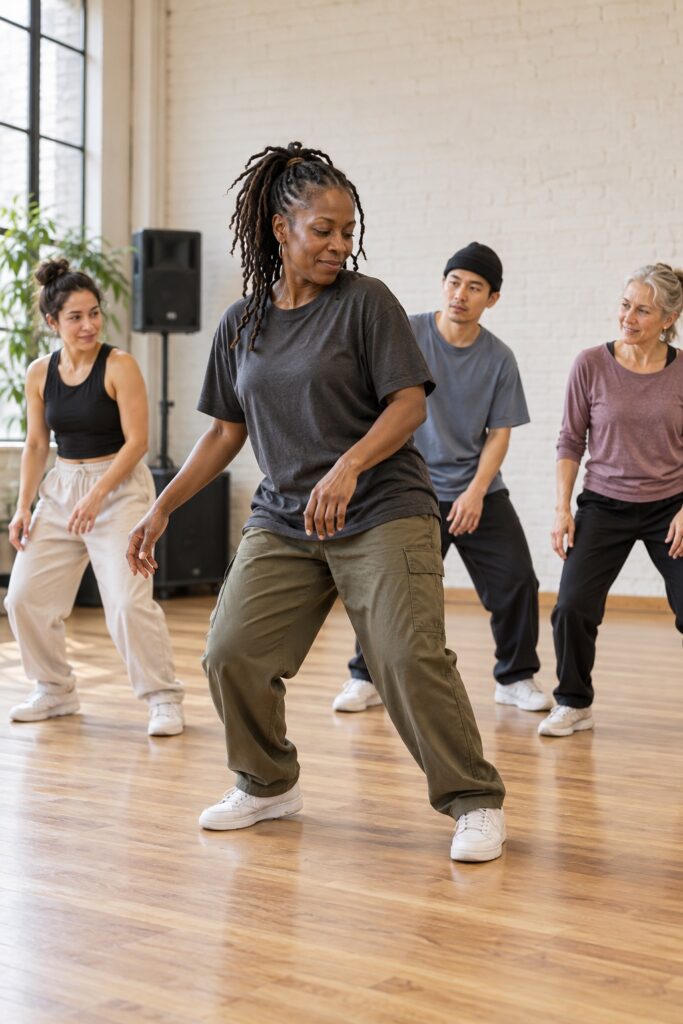
Hip hop class is where I let go of being “pretty” and just get into the groove. It’s attitude, rhythm and personality, and it’s the most welcoming style for anyone who’s ever danced in their kitchen. The secret most beginners don’t know: hip hop isn’t about memorizing tricks. It starts with how you move to the beat. Let me show you.
To start hip hop dancing, learn to groove first: bounce and rock to the beat with soft knees and a relaxed upper body. Then add classic moves one by one (two-step, running man, body roll, kick ball change), practice to music you love, and take a beginner class to learn choreography.
Step 1: Find the beat
Hip hop music usually has a strong, steady beat at a medium tempo. Before you move your feet, listen:
- Count the beat in eights: “1, 2, 3, 4, 5, 6, 7, 8.” Dance classes count everything in eights.
- Find the “and”: the space between beats (“1 and 2 and”). Many moves happen on the “and.”
- Nod your head to the beat. Then let it go into your shoulders, then your knees.
If you can nod on the beat, you can dance hip hop.
Step 2: Learn the two basic grooves
Grooves are the heartbeat of hip hop. Everything else sits on top of them.
The bounce (down groove)
- Stand with feet a little wider than hip-width, knees soft.
- On each beat, bend your knees slightly so your body “drops” down, and come back up on the “and.”
- Keep your chest and shoulders relaxed; let the bounce move through your whole body.
The rock
- Shift your weight to one foot, then the other, on the beat.
- Let your chest lean slightly with the weight shift, like a gentle sway.
- Add a head nod, and you’ve got it.
Practice tip: put on three songs and only groove. No steps. It feels silly at first, but it’s what makes everything else look natural.
Step 3: 10 classic beginner hip hop moves
| Move | How to do it | Practice tip |
|---|---|---|
| Two-step | Step to the side, bring the other foot in, repeat to the other side, with a bounce | Add arm swings and a little attitude |
| Step touch with groove | Step side, touch the other foot in, bounce on each count | Turn it into a traveling step |
| Kick ball change | Kick one foot forward, step on the ball of that foot, change weight to the other | Clean on “1 and 2” |
| Body roll | Roll your body in a wave from the chest down to the hips | Start against a wall to feel it |
| Shoulder isolation | Pop one shoulder up, then the other, to the beat | Keep your hips still |
| Running man | Slide one foot back while lifting the other knee, then switch, like running in place | Slow it down first |
| Cabbage Patch | Make circles with your fists in front of your chest while bouncing | Classic and fun |
| The Wop | Shoulder and hip movement side to side with a bounce | Great for freestyle |
| Heel-toe | Tap heel, then toe, traveling sideways | Builds footwork |
| Freeze | Stop completely on a beat, then start again | Shows musicality |
Learn one move a week. Then link two moves together, then three. That’s how choreography is built.
Hip hop styles explained
“Hip hop dance” is a big umbrella. Here are the styles you’ll hear about:
| Style | What it is |
|---|---|
| Choreography / “studio hip hop” | Routines to current music; what most beginner classes teach |
| Breaking | Floor moves, spins and freezes; the original hip hop dance |
| Popping | Quick muscle contractions (“hits”) that make the body look like it’s popping |
| Locking | Fun, big movements with sudden “locks” in position |
| Krump | Expressive, energetic and powerful |
| House | Fast footwork and flowing moves to house music, which was born in Chicago |
| Footwork | Very fast, intricate foot patterns to footwork music; a Chicago creation |
Chicago is a dance city
As a Chicagoan, I have to brag: house music was born in Chicago, and footwork (the fast, mind-blowing footwork style danced to juke and footwork music) came from Chicago’s South and West Sides. If you want to see real footwork, look for battles and community events. You’ll leave inspired.
What to wear to hip hop class
Affiliate disclosure: Some links in this section are affiliate links. If you buy through them, I may earn a commission. As an Amazon Associate I earn from qualifying purchases.
- Clothes: comfortable and easy to move in: joggers, sweatpants, shorts, a T-shirt or tank. Many people like loose clothes for style.
- Shoes: clean sneakers with a fairly smooth sole so you can turn and slide. Avoid running shoes with deep treads that stick to the floor (same reason as in Zumba; I explain it in how to choose Zumba shoes).
- Bring: water and a small towel.
As an Amazon Associate I earn from qualifying purchases. If you’re shopping, here’s a search for dance sneakers for hip hop.
A 4-week practice plan at home
| Week | Focus | 15–20 minutes, 3–4 times a week |
|---|---|---|
| 1 | Rhythm and grooves | Head nod, bounce and rock to 3–4 songs at different tempos |
| 2 | Footwork basics | Two-step, step touch, kick ball change, heel-toe |
| 3 | Upper body | Body rolls, shoulder isolations, Cabbage Patch, the Wop |
| 4 | Combine and freestyle | Learn a short 8-count from a beginner video; then freestyle for one song |
Record yourself. It’s the fastest way to see if you’re on the beat and if your moves look how you feel them.
How to learn hip hop choreography faster
- Learn in 8-counts: break the routine into chunks of eight and master one before the next.
- Learn the footwork first, then the arms.
- Say the moves out loud while you dance (“step, step, roll, kick”).
- Slow the video down, then speed it up.
- Mirror vs. non-mirror: if a video is mirrored, move to your right when the dancer moves to their left.
- Add your style. Same move, your personality.
Hip hop classes in Chicago
| Where | Address | Class |
|---|---|---|
| Chicago Park District – Armour Square Park | 3309 S Shields Ave | Adult hip hop, Thursdays 7–7:45 p.m., fall 2026 ($30) |
| Lou Conte Dance Studio | 1147 W Jackson Blvd | Drop-in hip hop with levels from Basic up |
| Old Town School of Folk Music | 4544 N Lincoln Ave | Adult hip hop in 8-week sessions |
| Mayfair Arts Center | 8701 S Bennett Ave (Calumet Heights) | Hip hop among the classes offered by its resident partners; info at 312-922-1272 |
More studios and styles are in my guide to adult dance classes in Chicago.
Common beginner mistakes
- Stiff knees. Bend them! Hip hop lives in the knees.
- Dancing “on top” of the music. Get into the groove first; the beat should move you.
- Trying tricks too soon. Spins and floor work come after the basics.
- Copying without style. Teachers want to see you, not a copy.
- Being afraid to look silly. Everyone in a beginner class feels awkward at first. Here’s how to not feel awkward dancing.
Hip hop class clothing and shoes: choose movement first
Sneakers should suit the floor, not just the outfit
Wear clean indoor sneakers with enough support for your class and a sole the studio accepts. A very sticky running-shoe tread can resist pivots, while a worn smooth sole can slip. There is no single best sneaker for every floor, class or foot.
Ask your teacher what works in that room. Break in shoes gently and avoid trying a completely unfamiliar pair during a long session. If the class includes floorwork, a clean pair matters for your hands and clothing as well as the studio surface.
Baggy or fitted clothes?
Either can work if you can move fully and the teacher can still help you see your alignment. Loose trousers and an oversized top are common stylistic choices, not admission requirements. Leggings or a more fitted top can also be perfectly appropriate.
Try a squat, a reach overhead and a gentle torso turn before leaving home. If the waistband slides, a hem catches under the heel or the top needs constant adjustment, change it. Secure long drawstrings and remove jewelry that swings or catches.
Choose layers that let you warm up without overheating. Bring a dry top if you want one for the trip home, and avoid heavy fragrance in a shared studio.
Hip hop, popping, locking and breaking are not interchangeable labels
A studio’s “hip hop” class can mean social grooves, foundations, choreography influenced by several street styles, or a mix. Read the class description and ask what is actually taught.
- Hip hop foundations and social grooves: often emphasize bounce, rock, rhythm and social-dance vocabulary alongside personal expression.
- Popping: commonly associated with controlled muscle contractions and releases, with many related techniques and styles. It has its own history rather than being merely a difficult hip hop move.
- Locking: associated with distinct stops, points and an expressive groove, rooted in funk dance traditions. It is not the same technique as popping.
- Breaking: includes its own vocabulary of top rock, footwork, freezes and other elements. A beginner choreography class is not automatically a safe place to teach yourself power moves.
- Commercial or open-style choreography: may combine influences for a staged routine. It can be enjoyable without representing every foundation of the traditions it draws on.
You do not need to master every style before taking class. Choose one beginner setting, learn its groove and context, and give the foundations time before chasing a dramatic trick from a short video.
FAQ
Can I learn hip hop at home?
Yes. Start with grooves and basic moves using beginner videos, a mirror or your phone camera, and music you like. A class adds corrections, choreography and community.
Is hip hop hard for beginners?
It’s one of the most beginner-friendly styles. The basic grooves are natural movements, and beginner classes break everything down in 8-counts.
Do I need to be flexible or in great shape to start?
No. Hip hop meets you where you are. Your rhythm and confidence improve with every class.
How long does it take to learn hip hop?
Most beginners can groove comfortably and learn a short routine within a few weeks. Fluid, stylish dancing comes with months of regular classes.
What’s the difference between hip hop and Zumba?
Zumba is a fitness class with Latin and world rhythms (and some hip hop and reggaeton songs). Hip hop class teaches dance technique and choreography. I love both. See Zumba for beginners.
What shoes should I wear for hip hop?
Clean sneakers with a fairly smooth sole that let you turn and slide. Avoid deep-tread running shoes.
Put on your favorite song, bend your knees and find the bounce. ¡Dale!