
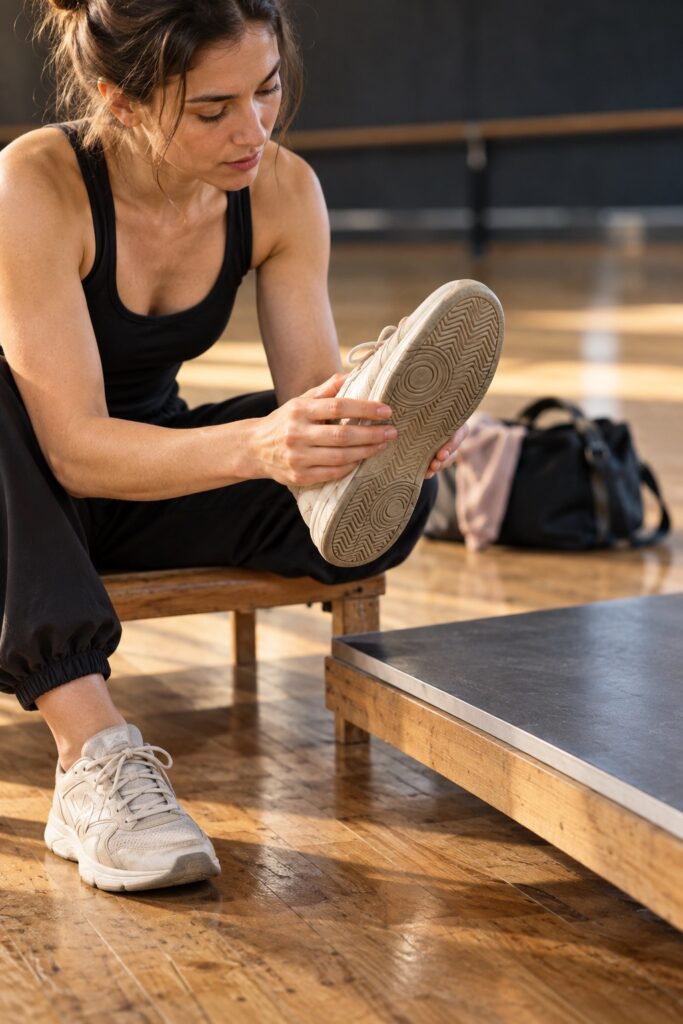
I’ve danced Zumba in all kinds of shoes: the wrong ones, the almost-right ones, and finally the ones that make me feel like I’m floating. The difference is huge. With the right shoes, the turns in a merengue song feel smooth, the side steps feel secure, and you finish the hour wanting more. Here’s exactly what to look for, and how to test a pair before you commit.
Choose Zumba shoes with a smooth pivot spot under the ball of the foot, a sole that grips without sticking, firm side-to-side support, light cushioning and a snug heel. Dance sneakers and cross-trainers work best. Running shoes with deep treads catch on turns.
Why your Zumba shoes matter so much
Zumba is not a forward-moving workout like walking or running. In one song you step side to side, pivot, turn, shimmy, march and jump. Your shoes have two jobs that seem to contradict each other: hold you steady when you step and stop, and let your foot rotate when you turn.
That’s why the “best” sneaker for running is often not the best for Zumba. A shoe that grips the floor in every direction feels great on a trail, but on a studio floor it holds your foot while the rest of your body is trying to turn. A good Zumba shoe finds the balance: controlled grip, not maximum grip.
The 6 things to check in a Zumba shoe
| Feature | What to look for | Why it matters in Zumba |
|---|---|---|
| Pivot spot | A smooth, round area under the ball of the foot | Lets you turn without your shoe catching on the floor |
| Sole and grip | Shallow tread, non-marking rubber | Holds you on side steps but releases on turns |
| Lateral support | Firm sides, a structured midfoot | Keeps your foot centered on the sole during side-to-side moves |
| Cushioning | Supportive, not mushy | Comfort on jumps and bounces while you still feel the floor |
| Fit | Snug heel, room for toes to spread | Your foot shouldn’t slide inside the shoe on quick moves |
| Weight | Light | Quick feet, less effort over an hour of dancing |
1. A pivot spot for turns
This is the feature that separates a dance-fitness shoe from a regular sneaker. Look at the sole: under the ball of the foot, many dance sneakers have a smooth, round “spin spot” or pivot point. When you turn on the ball of your foot, that spot lets the shoe rotate with you instead of grabbing the floor. Capezio, for example, has a whole line of dance sneakers with a spin spot, and Bloch builds spin spots into its split-sole dance sneakers.
2. Grip that matches your floor
The right grip depends on where you dance:
- Wood or sprung studio floors: you want a shoe that turns easily. Sticky soles grab here.
- Gym floors (rubber or vinyl): these can be grippy, so a pivot spot really helps.
- Carpet or concrete at home: a bit more grip is fine, and turning is harder anyway.
Many studios and gyms also ask for non-marking soles to protect the floor. Dance sneakers and most indoor training shoes have them; check the box or product description.
3. Lateral (side-to-side) support
Zumba is full of side steps, grapevines and quick changes of direction. A shoe with soft, floppy sides lets your foot slide toward the edge of the sole. Look for a structured midfoot, reinforced sides or a firm “cage” around the foot. Press the side of the shoe with your thumb: it should feel supportive, not like a sock.
4. Cushioning, but not too soft
Some cushioning makes the jumps and bounces more comfortable, especially in a long or high-energy class. But very soft, thick foam can feel unstable on side steps and makes turning less crisp because you lose the feel of the floor. Aim for “supportive and springy,” not “marshmallow.”
5. Fit
A dance shoe should feel snug without squeezing. Your heel shouldn’t lift when you rise onto the ball of your foot, and your toes should have room to spread. If the sides press on your feet, the shoe is too narrow; if there’s extra space at the toes, it’s probably too big. Bloch’s dance sneaker guide uses the same simple checks.
My tips for trying them on:
- Wear the socks you’ll dance in.
- Try them on later in the day, when your feet are at their biggest.
- Do a few side steps, a small jump and a turn on the ball of your foot right there in the store.
- Lace them snug through the top eyelets so your heel stays put.
6. Weight
Light shoes make quick footwork feel easy and turn more freely. Heavier shoes feel more planted. Neither is wrong; it depends on whether your class has more turns (go light) or more jumps (a little more structure and cushion).
Types of shoes for Zumba, compared
| Type | How it’s built | Best for | Trade-off |
|---|---|---|---|
| Split-sole dance sneaker | Rubber only under the ball and heel, flexible arch, usually a spin spot | Turn-heavy classes, studio floors | Less support under the arch; indoor-only |
| Full-sole dance sneaker | One continuous sole, often with a pivot point | Zumba classes and gym floors | Less flexible than split-sole |
| Midsole (hybrid) dance sneaker | Continuous rubber base with arch shaping | Studio and street | Grips more than a split sole |
| Cross-training shoe | Wide base, side support, moderate cushion | Gyms, jumps, toning moves | Can stick on turns |
| Running shoe | Built for forward motion, deep tread, thick heel | Your first class only | Catches on pivots, less side support |
Bloch describes the three dance-sneaker types this way: split soles for flexibility and turns, full soles for support and wearing to and from class, and midsoles as the hybrid that works in the studio and outside. For most people starting Zumba, a full-sole dance sneaker with a pivot spot or a cross-trainer with a fairly smooth sole is the easiest choice.
Can I wear running shoes to Zumba?
For your first class, yes, if that’s what you have. But running shoes are made for moving forward: deep treads and a thick, flared heel. When you pivot, that tread grabs the floor. If you keep dancing, get a pair of dance sneakers or cross-trainers. In my Zumba for beginners guide, shoes are the one purchase I tell everyone to make once they decide they like it.
How to test a Zumba shoe (in the store or at home)
Before you take the tags off or wear them outside, do this quick test on a smooth floor:
- The turn test: stand on the ball of one foot and do a quarter turn, then a half turn. The shoe should rotate without catching.
- The side-step test: step quickly side to side four times. Your foot should stay centered on the sole.
- The heel test: rise onto the balls of your feet. Your heel shouldn’t slip out.
- The bounce test: do a few small jumps. Comfortable landings, no slapping.
- The toe test: wiggle your toes. They should move freely.
If you buy online, test inside on a clean floor and keep the box until you’re sure. Most stores won’t take back shoes that have been worn outdoors.
Can I make my sneakers turn better?
Yes, a few ways:
- Keep your Zumba shoes for indoors only. Outdoor dirt (and in Chicago, road salt in winter) makes soles sticky and dirty.
- Use spin spot stickers or pivot pads. Bloch makes BLOCHspot stickers that you apply to the sole of a sneaker to create a spin spot, and other brands sell removable pivot pads. Ask your studio if they’re allowed on their floor.
- Turn on the ball of your foot with your weight a little forward, not flat-footed.
- Wipe the soles before class if they’ve picked up dust.
Where to try on dance sneakers in Chicago
You can absolutely buy online, but nothing beats trying a turn in the store. A few Chicago shops that sell dance shoes:
| Store | Address | Phone | Good to know |
|---|---|---|---|
| Bloch Chicago | 1710 N Wells St, Chicago, IL 60614 (Old Town) | (773) 888-6155 | Bloch’s own store; closed Mondays |
| Bloch Oak Park | 159 N Marion St, Oak Park, IL 60301 | (773) 745-5600 | Closed Mondays |
| Chicago Dance Supply | 5301 N Clark St, Chicago, IL 60640 (Andersonville) | (773) 728-5344 | Dancewear and dance shoes from several brands |
Hours change, so call before you go and ask which dance sneakers they have in your size.
Shopping for Zumba shoes online
Affiliate disclosure: Some links in this section are affiliate links. If you buy through them, I may earn a commission. As an Amazon Associate I earn from qualifying purchases.
As an Amazon Associate I earn from qualifying purchases. If you’re shopping online, these searches are a good start: dance sneakers with a spin spot, split-sole dance sneakers, Zumba and dance fitness shoes and pivot pads for sneakers.
A more expensive shoe isn’t automatically better. Good fit and a sole that turns matter more than the brand name.
How to care for your Zumba shoes
- Wear them only for dancing, and carry them to class in a shoe bag.
- Let them air out after class instead of leaving them zipped in your gym bag.
- Wipe the soles with a damp cloth when they collect dust.
- Don’t put them in the dryer.
When should I replace my Zumba shoes?
There’s no exact date. Look at the shoe:
- The pivot spot or the tread is worn smooth and you’re slipping where you didn’t before.
- The cushioning feels flat and the landings feel harder than they used to.
- The sides have stretched out and your foot slides inside the shoe.
- The sole is starting to separate.
If you dance several times a week, you’ll notice this sooner than if you go once a week.
What about Aqua Zumba?
In the pool, you don’t need dance sneakers. Many people wear water shoes for grip on the pool floor and the deck. I explain the differences in Aqua Zumba vs Zumba.
FAQ
What kind of shoes are best for Zumba?
Dance sneakers or cross-training shoes with side support, light cushioning and a smoother sole or pivot spot under the ball of the foot. They let you step side to side securely and still turn easily.
Are split-sole dance sneakers good for Zumba?
Yes, especially for classes with lots of turns. They’re light and flexible and usually have a spin spot. They give less support under the arch than a full sole, and most are for indoor use only.
Can I do Zumba barefoot or in socks?
Not in a regular class. Socks are slippery on wood and gym floors, and bare feet stick and have no support. Wear sneakers.
Do I need special Zumba-brand shoes?
No. Any dance sneaker or cross-trainer with the features above works. Choose by fit, sole and support, not by the logo.
Should Zumba shoes be tight or loose?
Snug, especially at the heel, with room for your toes to move. Your foot shouldn’t slide inside the shoe when you change direction.
Can I wear my Zumba shoes outside?
Better not. Outdoor dirt and wear make the sole sticky and less smooth for turns, and many studios ask for clean, non-marking shoes.
Are tennis or volleyball shoes okay for Zumba?
They have good side support, but many have grippy soles made to stop fast, which can catch on turns. They’re fine to start; a dance sneaker turns better.
Once your shoes are ready, the rest is easy. See what to wear to Zumba for the outfit and what to bring, then find a class near you in my guide to Zumba classes in Chicago. ¡A bailar!