
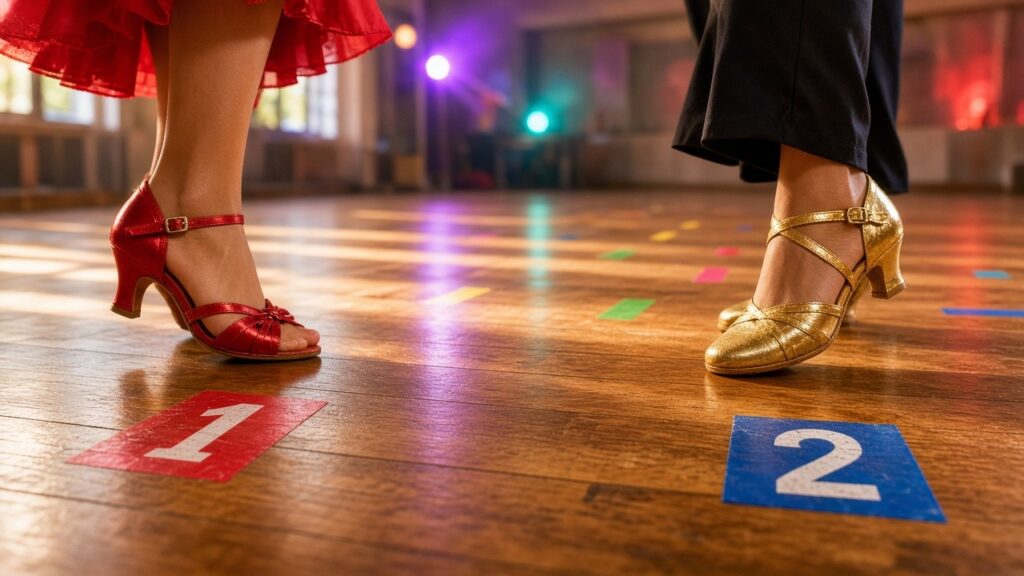
If you’ve ever heard dancers argue about “On1” and “On2” at a salsa social, you’ve seen how seriously some people take the timing. Both are linear salsa styles danced in a slot, both use the same eight-count music, and both can be beautiful. The difference is which beat you break on, and that changes how the dance feels.
In salsa On1 (LA style), you take your “break step,” the step that changes direction, on beat 1 of the music, so the dance feels like it starts on the downbeat. In salsa On2 (New York style, also called mambo), you break on beat 2, which lines your step up with the conga’s rhythm and gives a smoother, more laid-back feel. On1 is usually easier for beginners and is the most common style at many US socials, including in Chicago. On1 and On2 dancers can dance together if one adapts.
I dance On1 socially in Chicago, and here’s everything you need: what each timing means, how to hear the difference in the music, which is easier, whether you can mix them, what you’ll find at Chicago socials, how to switch, and where Cuban and Colombian salsa fit.
On1 vs On2: the short answer
| Salsa On1 (LA style) | Salsa On2 (New York style / mambo) | |
|---|---|---|
| Break step | Beat 1 (and 5) | Beat 2 (and 6) |
| Feel | Punchy, on the downbeat, dramatic | Smooth, groovy, laid-back |
| Musical connection | Melody and downbeat | Conga and the rhythm section |
| Movement | Linear, in a slot | Linear, in a slot |
| Spins | Flashy, fast, many multiples | Smooth spins, lots of shines |
| Shines (solo footwork) | Common | Very common, a hallmark |
| Beginner friendliness | Usually easier | Takes more practice to hear |
| Where it’s common | West Coast, many US cities, worldwide | New York, East Coast, many congresses |
What “On1” means (LA style)
Salsa music is counted in eights: 1, 2, 3, (4), 5, 6, 7, (8). You step on six of the eight counts and pause on 4 and 8. In On1, the “break,” the forward step that changes direction, happens on count 1 for the lead (and on 5 for the follow, or vice versa depending on the pattern). The basic goes:
- 1: break forward (lead) / back (follow)
- 2: rock back
- 3: step together
- 4: pause
- 5: break back (lead) / forward (follow)
- 6: rock forward
- 7: step together
- 8: pause
LA style, which made On1 famous, is known for dramatic dips, fast spins, tricks and performance energy. Socially, On1 dancers in most cities don’t do the acrobatics; they enjoy the clear, energetic timing and turns.
What “On2” means (New York mambo)
In On2, the break happens on count 2. The New York style most dancers learn today was popularized by teachers who codified it in the 1980s and 1990s, building on the mambo dancers of New York’s Palladium era. A common On2 basic goes:
- 1: step back (lead) or in place
- 2: break back
- 3: step together
- 4: pause
- 5: step forward
- 6: break forward
- 7: step together
- 8: pause
Because the break falls on 2, On2 feels like it sits “inside” the rhythm, following the conga and the groove rather than the downbeat. Many dancers describe it as smoother and more relaxed. Shines, playful solo footwork sections, are a big part of On2 culture.
How to hear the difference in the music
You don’t need to be a musician, but knowing a few instruments helps.
The downbeat (for On1)
Count 1 is usually the strongest beat: where a phrase begins, where the melody often lands and where the bass or piano tends to start a pattern. Many beginners find it naturally by listening to the vocals and horns.
The conga (for On2)
The conga player’s basic pattern, the tumbao, includes open tones on beats 4 and 8 and slaps or softer tones in between. On2 dancers often feel the break on 2 and 6 as part of that conga groove, so the conga becomes their guide.
The clave
The clave is the rhythmic key of salsa: a five-stroke pattern played over two bars, either “3-2” or “2-3.” You don’t need to dance to the clave directly, but noticing it helps you understand where a song’s phrases start. Many dancers hear “the 2” in the two side of the clave.
A quick listening exercise
- Play a salsa song and count 1 through 8 out loud, finding where the phrase begins.
- Clap on 1 and 5 (On1 breaks).
- Now clap on 2 and 6 (On2 breaks).
- Listen for the conga’s open tones on 4 and 8.
For more on how salsa music differs from bachata, see salsa vs bachata music.
Which is easier for beginners?
On1 is usually easier because most people hear the downbeat naturally, and the basic step aligns with it. It’s also what many beginner classes teach first.
On2 takes more practice because breaking on 2 feels “late” at first. Many people who grew up with Latin music find it intuitive, though, and some teachers start students on On2 from day one.
If your local scene dances mostly one style, learn that one first. You’ll get more dances. For a beginner path, see learn salsa dancing for beginners and how long it takes to learn salsa.
Can On1 and On2 dancers dance together?
Yes, with adjustment.
- If the lead dances On2 and the follow dances On1 (or the other way around), the follow usually adapts by listening to the lead’s timing through connection. Experienced follows can switch within a dance.
- Turn patterns are largely the same. The difference is when the steps happen. A follow can often keep up by following the lead’s body rather than counting.
- Shines are harder to share. Solo footwork sections are timed, so mixed couples may keep shines simple.
- Ask. “Do you dance On1 or On2?” is a normal question at a social.
The real problem is when one partner is off time entirely. Being clearly on one timing is more important than which one you choose.
What Chicago socials dance
In Chicago, many social dancers dance On1, and beginner classes commonly start there. On2 also has a dedicated community, with classes, practice nights and dancers who prefer it, and you’ll see both on the same floor at many events. Cuban casino has its own following, and bachata takes a big share of many Latin nights.
If you’re new, check the event description or ask the organizers what the beginner lesson covers. My guide to salsa dancing in Chicago explains what to expect, and if you’ve never been to a social, read what is a salsa social first.
Switching from On1 to On2
Many dancers learn On1 first and add On2 later. Some tips:
- Take a dedicated On2 class rather than trying to convert in a social.
- Practice the basic alone to music until breaking on 2 feels natural.
- Listen to the conga and let it guide you.
- Count out loud at first, then let the counting go.
- Use shines practice. On2 shines are great timing drills.
- Expect a few weeks of confusion. It’s normal to slip back into On1 when you’re tired or excited.
- Dance with experienced On2 dancers. Their timing will teach your body.
Going the other way, from On2 to On1, follows the same process.
Where Cuban salsa fits
Cuban salsa (casino) isn’t linear. Couples move in circles around each other, there’s often a “rueda” (a group dance in a circle with called moves), and timing is typically danced “a tiempo” (on the downbeat) or “contratiempo” (on the offbeat). It’s a different culture and technique rather than a third timing of LA or New York style. For the full comparison, see Cuban salsa vs LA-style salsa.
Colombian (Cali) salsa
Colombian salsa, especially Cali style, is known for very fast footwork, small quick steps, kicks and flicks, often danced to fast salsa songs. It’s usually danced on or near the downbeat, often without a strict slot, and with less emphasis on long turn patterns. It’s spectacular to watch and its own world to learn.
How to tell if you’re off time
- You and your partner keep bumping into each other on the break: one of you may be breaking on 1 and the other on 2.
- Your pause feels rushed or missing. Both timings pause on 4 and 8; if you never pause, you’re stepping on every beat.
- Turns feel early. On2 dancers who drift into On1 often start turns a beat too soon.
- You only find the beat in loud songs. Practice with quieter, rhythm-heavy tracks and listen for the conga and cowbell.
A simple fix is to stop dancing, listen for a full eight counts, and restart on the correct count. Experienced dancers do this all the time.
Salsa timing glossary
| Term | Meaning |
|---|---|
| Break step | The step that changes direction; On1 on 1, On2 on 2 |
| Slot | The imaginary line linear dancers move along |
| Shines | Solo footwork sections where partners separate |
| Tumbao | The conga’s repeating pattern; open tones on 4 and 8 |
| Clave | The five-stroke rhythmic key, in 3-2 or 2-3 |
| Downbeat | The strong first beat of a phrase |
| Mambo | Older New York dance and music; today often means On2 |
| Casino | Cuban salsa, circular rather than linear |
On1 vs On2 practice plan
| Week | On1 focus | On2 focus |
|---|---|---|
| 1 | Basic on 1 and 5, side basic | Basic on 2 and 6, counting aloud |
| 2 | Right turn, cross-body lead | Cross-body lead on 2, simple turn |
| 3 | Combining patterns to faster music | Listening for conga; basic shines |
| 4 | Social practice | Shines plus partner work, social practice |
Whichever you choose, practice the basic and simple shines solo at home; my guide to learning salsa without a partner has a routine.
FAQ
Is Colombian salsa On1?
Colombian salsa is often danced on or near the downbeat, so it’s closer to On1 in timing, but it’s a distinct style with fast, intricate footwork and usually no strict slot. Many Colombian dancers don’t use On1/On2 terms at all.
Is On2 the same as mambo?
On2 is often called mambo, especially New York style On2 salsa, because it descends from the mambo dancers of 1950s New York. Strictly speaking, mambo also refers to the earlier music and dance; today, “mambo” and “New York On2” are used almost interchangeably on the social scene.
Should I learn On1 or On2 first?
Learn the timing most common in your local scene, so you can practice at socials. For many US cities, including Chicago, that’s On1. You can always add On2 later.
Can I dance On1 to any salsa song?
Yes. Both On1 and On2 can be danced to any salsa song; it’s about where you break, not which songs you choose. Some dancers feel slower, groovier songs suit On2 and faster, punchier songs suit On1.
Why do people say On2 is more musical?
Because On2’s break lines up with the conga’s groove, many dancers feel it connects them to the rhythm section. That’s a preference, not a rule. On1 dancers can be just as musical by hearing breaks, accents and phrasing. Musicality comes from listening, not from which beat you break on.