
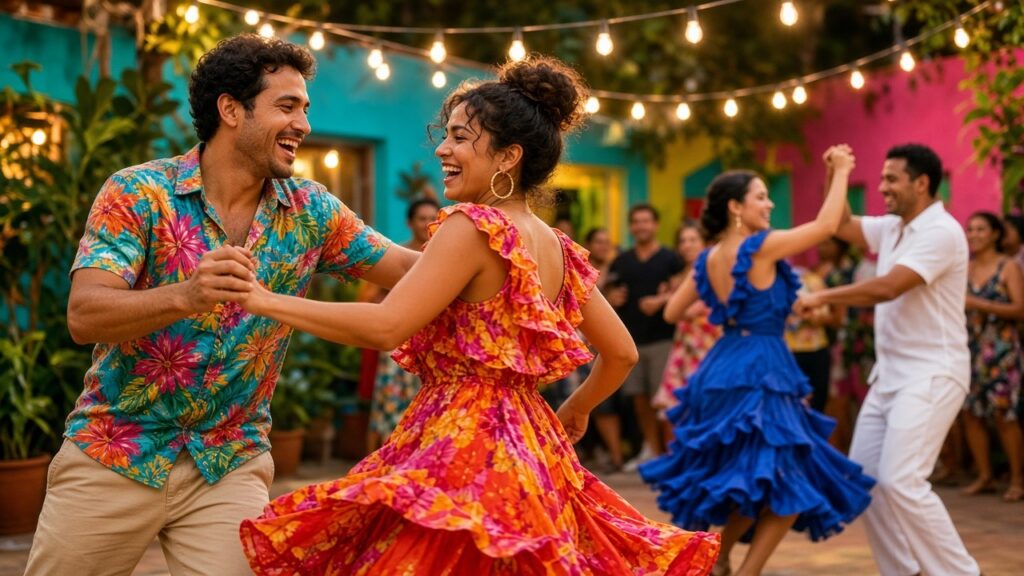
At a salsa social, you can sometimes spot the Cuban dancers from across the room: they’re circling each other, arms tangled into knots and untangled again, maybe forming a big circle where a caller shouts names of moves. Nearby, an LA-style couple is moving back and forth in a straight line, the follow spinning in a slot. Both are salsa, and both are fun. They come from different places and feel very different.
Cuban salsa, called casino, is danced in a circular pattern, with partners rotating around each other, many arm combinations, playful body movement and the group dance rueda de casino. LA-style salsa is linear, danced back and forth in a slot, usually On1, with an emphasis on clean spins and turn patterns. New York style is also linear but danced On2. Cuban salsa is usually danced “a tiempo” on the downbeat, so it’s closer to On1 in timing, but the shapes and technique differ.
I’m a Latin dancer who has danced both styles. Here’s what defines each one, a side-by-side table, whether you can dance Cuban with an On1 dancer, which to learn first and where to dance each in Chicago.
Cuban salsa vs LA salsa: the short answer
| Cuban salsa (casino) | LA style (On1) | New York style (On2) | |
|---|---|---|---|
| Shape | Circular; partners rotate around each other | Linear; a slot | Linear; a slot |
| Timing | Usually “a tiempo” (downbeat) or “contratiempo” | Break on 1 | Break on 2 |
| Basic | “Guapea,” a back-and-forth rock, often with a step back | Forward-back basic | Forward-back basic |
| Turns | Many arm combinations, fewer multiple spins | Fast spins, doubles and triples | Smooth spins, shines |
| Body movement | Earthy, Afro-Cuban influences, hips and shoulders | Posture and lines | Posture and shines |
| Group dance | Rueda de casino | Rare | Rare |
| Feel | Playful, social, grounded | Energetic, flashy | Smooth, groovy |
| Music | Timba, son, Cuban salsa and all salsa | All salsa | All salsa, often mambo-influenced |
Cuban salsa (casino)
Origins
Casino developed in Cuba in the mid-20th century, influenced by son, danzón and Afro-Cuban rhythms. The name comes from the social clubs (casinos deportivos) in Havana where people danced it. It traveled with Cubans worldwide and became a global style.
Circular movement
Instead of a slot, Cuban partners move around each other. In the key movement, dile que no, the couple changes places, and in vuelta, they rotate around a shared center. Patterns often keep the couple moving in a circle.
Arm combinations
Casino is famous for complex, intertwined arm patterns: partners pass hands behind backs, over heads and into “knots” that unwind. Moves have names like enchufla, sombrero and setenta, and dancers learn them as vocabulary.
Body movement
Cuban salsa often uses more torso and hip movement, with Afro-Cuban influences from rumba and son. Dancers frequently add “despelote,” playful body isolation, and shine improvisation.
Rueda de casino
Rueda is a group dance in a circle, where couples follow a caller who shouts the next move. Partners change constantly. It’s one of the most joyful things to see at a social and a great way to meet people. To join, you need to know the named moves.
Timing
Cuban salsa is commonly danced “a tiempo,” stepping on the downbeat, which is similar to On1 timing. Some dancers also dance “contratiempo,” on the offbeat. Cuban dancers often care more about feeling the music than about naming the count.
LA style (On1, slot, spins)
LA style grew up in the 1990s and 2000s in Los Angeles, influenced by mambo, ballroom, swing and show dancing. It’s linear: the follow moves forward and back in an imaginary slot, while the lead steps out of the way. Cross-body leads, quick turns, multiple spins, dips and tricks give it a flashy, energetic feel. Socially, most LA-style dancers keep it smooth and simple, focusing on clean turns and connection. For how to turn well, see how to spin in salsa.
New York style On2 (brief)
New York style is linear like LA, but breaks on 2, which gives it a smoother, groovier feel closely tied to the conga. Shines are a highlight. For a full comparison of the two linear styles, see salsa On1 vs On2.
Colombian salsa (brief)
Colombian, especially Cali-style salsa, is known for extremely fast footwork, small quick steps and kicks, often danced to fast songs. It’s neither circular like Cuban nor strictly slot-based like LA. It’s mostly seen in performances and among dancers who specialize in it.
Can you dance Cuban salsa with an On1 dancer?
Yes, with some adaptation.
- Timing usually matches. Both are commonly danced on the downbeat, so you’ll start on time together.
- Shapes differ. An On1 lead will lead a slot; a Cuban follow may expect to circle. Followers can usually adapt by following the lead’s direction.
- Patterns differ. Cuban arm combinations and LA cross-body leads use different vocabulary, so stick to simple turns and basics until you learn each other’s style.
- Rueda requires Cuban vocabulary. Learn the named moves before joining a circle.
- Be flexible. Ask “Cuban or linear?” before you start, then meet in the middle.
Many experienced social dancers learn both and switch depending on the partner.
Which to learn first
There’s no wrong answer. Consider:
- Your local scene. Learn the style most common where you dance.
- Your personality. If you love social, playful, group energy, try Cuban and rueda. If you love spins and lines, try LA style.
- Your music. If you love Cuban timba and son, casino may feel natural.
- Your goals. Want to perform? LA or New York styles dominate many showcases. Want to dance at Cuban parties? Learn casino.
For a beginner overview, see learn salsa dancing for beginners.
Learning path tips
- Start with a beginner series in one style for at least two months.
- Go to socials and watch how the dancers move.
- Add the other style later; it’ll be easier once you can hear the music.
- Learn rueda calls through a rueda class or practice group.
- Practice basics and footwork alone; see learn salsa without a partner.
Where to dance each in Chicago
Chicago has an active Latin dance scene with linear salsa (both On1 and On2), Cuban casino and rueda groups, and bachata. Linear On1 is common at many general Latin nights; Cuban dancers often gather at events and classes that focus on casino and rueda, and some socials play Cuban music sets or host rueda circles. Check event descriptions, follow local studios and ask other dancers; the scene changes often.
For an overview of venues and events, see salsa dancing in Chicago. If you’ve never been to a social, start with what is a salsa social, and for classes, adult dance classes in Chicago.
Basic Cuban moves to know
| Move | What happens | Why it matters |
|---|---|---|
| Guapea | The basic rock, back and forward in closed or open hold | Home base between moves |
| Dile que no | Partners change places | The most common transition |
| Enchufla | The follow turns under the lead’s arm as partners swap places | Appears in countless combinations |
| Vacílala | A turn for the follow, often playful | Easy first turn |
| Exhibe | A display-style turn | Adds flair |
| Sombrero | A “hat” pattern with arms over the follow’s head and behind the lead’s neck | Classic arm combination |
| Setenta | A longer combination with multiple wraps | Intermediate vocabulary |
| Dame | “Give me”: in rueda, switch to the next partner | The heart of rueda |
Names and exact versions vary from school to school, so learn your class’s version.
How rueda calls work
In rueda, a caller (usually an experienced dancer) shouts or signals the next move a few counts ahead, sometimes with hand gestures. Everyone executes it together. “Dame” moves you to a new partner, so you’ll dance with everyone in the circle. Beginners should join a beginner rueda class or a practice group first, because if one couple misses a call, it affects the whole circle. When you’re ready, the energy is wonderful.
Shoes and clothes for each style
Both styles need shoes that pivot: dance shoes with suede soles or smooth leather soles work best. Cuban dancers often like a lower, sturdier heel or flats for grounded movement and circling; LA-style follows frequently wear heels for spins and lines. Clothing should let your arms move freely, which matters in Cuban arm combinations. For more, see what to wear salsa dancing.
Etiquette notes for mixed floors
- Circular dancers need space. Cuban couples travel around a center; leads should check the floor.
- Rueda circles take room. Don’t dance through the middle; join only if you know the calls.
- Slot dancers move in lines. Avoid stepping into a couple’s slot.
- Ask about style before you start a dance.
Common confusions
- “Cuban salsa is On2.” Usually not; it’s typically danced on the downbeat. Some dancers dance contratiempo.
- “Casino is only rueda.” Rueda is a group form of casino; couples dance casino in pairs too.
- “LA style is only for performers.” Social LA style is simple and very popular.
- “You can’t mix styles.” You can, with communication and simple patterns.
Music for each style
Any salsa song can be danced in any style, but each style has favorites:
- Cuban: timba, son, Cuban salsa bands
- LA: classic and modern salsa, often bright and fast
- New York: salsa dura, mambo and Latin jazz influences
FAQ
Is Cuban salsa On1 or On2?
Cuban salsa is usually danced “a tiempo,” stepping on the downbeat, which is closest to On1 timing. Some dancers dance “contratiempo,” on the offbeat. But Cuban salsa isn’t linear, so it’s not described in On1/On2 terms by most Cuban dancers.
Is Cuban salsa easier than LA style?
They’re challenging in different ways. Many beginners find the Cuban basic and circular movement natural, but the arm combinations are complex. LA style’s basic is simple, but clean spins take practice.
What is rueda de casino?
A group form of Cuban salsa in which couples dance in a circle and follow a caller’s named moves, often switching partners. It’s fun, social and requires learning the move names.
Can I learn both styles?
Yes. Many dancers do, and it makes you a more versatile social dancer. Start with one, get comfortable, then add the other.
Do I need a partner for Cuban salsa classes?
No. Most group classes rotate partners, and rueda classes depend on it. Come alone and you’ll dance with everyone.
Is timba the same as salsa?
Timba is a modern Cuban music genre, developed in the late 1980s and 1990s, that blends son, salsa, funk, jazz and Afro-Cuban rhythms with complex breaks. Cuban dancers often dance casino to timba. It’s related to salsa but has its own sound, with frequent changes of groove that invite playful body movement.
Is LA style only danced in Los Angeles?
No. The name describes the style’s origins, but LA-style On1 is danced worldwide and is one of the most common linear styles at socials across the United States.