
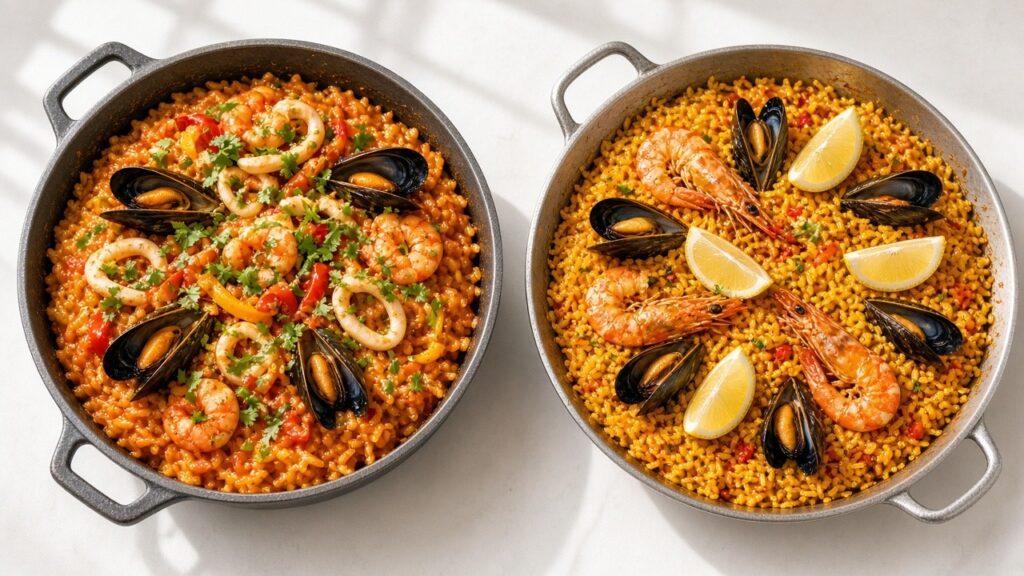
Order “arroz con mariscos” in Panama City, Lima or Cartagena and you’ll get a big plate of saucy, seafood-packed rice that’s nothing like the dry, golden paella you’d eat in Valencia. Both are rice cooked with seafood, both come from the Spanish rice tradition and both are celebration food. But the rice, the pan, the seasoning and the texture are different, and if you cook one expecting the other, you’ll be disappointed.
Arroz con mariscos is the Latin American seafood rice of Panama, Peru, Colombia and other countries: medium- or long-grain rice cooked with a sofrito, tomato or ají paste and lots of seafood (shrimp, squid, clams, mussels, octopus) into a moist, saucy, often stirred dish, usually made in a pot or caldero. Paella is Spain’s rice dish from Valencia: short-grain rice (bomba or similar) cooked in a single thin layer in a wide, shallow paella pan with saffron and broth, never stirred after the rice goes in, so it ends up dry with a crisp crust (socarrat) on the bottom. Paella can be made with chicken and rabbit (the Valencian original) or seafood; arroz con mariscos is always seafood.
Below: the short answer, what paella is, what arroz con mariscos is in Panama, Peru and Colombia, a side-by-side comparison of rice, broth, seasoning and texture, how both compare with arroz con pollo, whether you can use paella rice and answers to common questions. More Panamanian rice: Panamanian arroz con pollo.
Arroz con mariscos vs paella: the short answer
| Arroz con mariscos | Paella | |
|---|---|---|
| Where | Panama, Peru, Colombia, Ecuador and beyond | Valencia, Spain |
| Rice | Medium or long grain | Short/round grain: bomba, senia, bahía |
| Pan | Pot, caldero or deep skillet | Wide, shallow paella pan |
| Stirring | Often stirred | Not stirred once the rice is in |
| Texture | Moist, saucy, sometimes creamy | Dry, separate grains, crisp bottom (socarrat) |
| Color and flavor | Achiote, tomato, ají panca or ají amarillo, culantro, sofrito | Saffron, sweet paprika, tomato, olive oil |
| Protein | Always seafood | Chicken and rabbit (Valencian), seafood or mixed |
| Serving | Plated from the pot, with lime, hot sauce or salsa criolla | Often eaten from the pan |
What is paella? (Valencia, socarrat, the pan)
Valencia
Paella comes from the rice-growing region around Valencia on Spain’s east coast. The word paella means “pan” in Valencian, and originally referred to the pan, not the dish.
Paella valenciana, the traditional version, is made with chicken, rabbit, flat green beans, large white lima-type beans (garrofó), tomato, olive oil, saffron, sometimes snails and rosemary, and short-grain rice. Paella de marisco (seafood paella) and paella mixta (meat and seafood) are popular too, especially in restaurants and outside Valencia.
The pan
A paella pan is wide and shallow with sloping sides and two handles. The width matters: the rice cooks in a thin layer (often about a finger deep), so it cooks evenly and the liquid evaporates, leaving dry, separate grains.
Socarrat
Socarrat is the toasted, slightly crunchy layer of rice that forms on the bottom of the pan at the end of cooking. It’s considered the best part. You get it by turning up the heat for the last minute or two and listening for a gentle crackle.
The no-stir rule
Once the rice and broth go in, you don’t stir paella. Stirring releases starch (making it creamy, which is wrong for paella) and prevents socarrat.
What is arroz con mariscos? (Panama, Peru, Colombia styles)
Arroz con mariscos simply means “rice with seafood.” Many Latin American countries have their own version.
Panama
Panamanian arroz con mariscos is a coastal favorite. It typically starts with a sofrito of onion, garlic, bell pepper, ají dulce and culantro (see Panamanian sofrito), colored with achiote (annatto) and tomato paste. Rice is cooked in seafood or fish broth, then mixed with shrimp, squid, octopus, clams or mussels, and often finished with fresh culantro and a squeeze of lime. It’s moist and flavorful, sometimes made with a splash of coconut milk on the Caribbean side. It’s served with patacones, a salad and hot sauce. If you like seafood, also try Panamanian ceviche.
Peru
Peruvian arroz con mariscos is famous in cevicherías. It’s colored and flavored with ají panca and/or ají amarillo pastes, garlic, onion, white wine and sometimes a little parmesan or cream, with peas and red pepper. It’s moist, almost creamy, and served with salsa criolla (sliced red onion, lime and ají). It’s often compared to a Peruvian cousin of paella or risotto.
Colombia
On Colombia’s Caribbean coast, arroz con mariscos is moist and colorful, often with tomato, sofrito, achiote or a local seasoning, and sometimes coconut milk. It’s served with patacones (fried green plantains) and a salad.
Others
Ecuador, Venezuela, Costa Rica, Puerto Rico (where asopao de mariscos is a soupy relative) and other countries make their own versions.
Rice, broth, seasoning and texture compared
| Arroz con mariscos | Paella | |
|---|---|---|
| Rice type | Long or medium grain (Panama, Colombia), medium grain (Peru often) | Short-grain bomba, senia or bahía |
| Rice-to-liquid | More liquid; finish moist | Carefully measured liquid; finish dry |
| Broth | Seafood or fish stock, sometimes with wine, beer or coconut | Seafood stock (marisco) or chicken stock (valenciana) |
| Base | Sofrito with culantro, ají dulce, peppers | Sofrito of tomato, garlic and olive oil, with paprika |
| Color | Achiote, tomato or ají panca (orange-red) | Saffron (golden yellow), sometimes paprika |
| Seafood timing | Often added near the end and stirred in | Arranged on top to cook in the rice |
| Texture | Moist, saucy | Dry, separate grains, crust on the bottom |
Arroz con mariscos vs paella vs arroz con pollo
| Arroz con mariscos | Paella | Panamanian arroz con pollo | |
|---|---|---|---|
| Protein | Seafood | Chicken/rabbit or seafood | Chicken |
| Pan | Pot or caldero | Paella pan | Caldero or pot |
| Texture | Moist | Dry, crusty | Moist, tender, with peas and olives |
| Color | Orange-red | Golden yellow | Yellow-orange (achiote) |
| Signature | Lime, culantro, hot sauce | Socarrat | Capers, olives, peas, culantro |
Arroz con pollo is another descendant of Spanish rice traditions; in Panama it’s the dish of birthdays and family parties. See Panamanian arroz con pollo. For a broader rice comparison, see risotto vs paella vs arroz con pollo.
Can you use paella rice?
For arroz con mariscos: yes, if you want a moister, slightly creamier result, especially Peruvian-style. Bomba absorbs a lot of liquid without falling apart, so add a little more broth. For Panamanian and Colombian styles, regular long-grain or medium-grain rice is more typical.
For paella: use short-grain rice like bomba, senia or bahía, or Calasparra rice (a protected-origin bomba-type rice). Arborio works in a pinch but releases more starch and turns creamier. Long-grain rice doesn’t absorb enough flavor and won’t give the right texture.
How to make each (overview)
Arroz con mariscos (Panamanian-style overview)
- Make a seafood stock from shrimp shells, fish bones or store-bought fish stock.
- Cook the sofrito (onion, garlic, peppers, ají dulce, culantro) in oil with achiote until soft.
- Add tomato paste, then the rice, and stir to coat.
- Add hot stock, season and simmer covered until the rice is tender but still moist.
- Quickly sauté the seafood separately (shrimp, squid, octopus, mussels) so it doesn’t overcook.
- Fold the seafood into the rice with a splash of stock if needed, plus fresh culantro.
- Serve with lime, hot sauce and patacones.
Seafood paella (overview)
- Heat olive oil in a paella pan. Sear shrimp and set aside; sauté squid.
- Add grated tomato, garlic and sweet paprika, cooking until thick.
- Add hot seafood stock with saffron, bring to a boil and taste for salt (it should be slightly salty).
- Scatter the rice evenly across the pan. Don’t stir again.
- Cook on high heat for about 10 minutes, then lower the heat and cook until the liquid is absorbed, about 8 to 10 more minutes. Nestle mussels, clams and shrimp on top as it cooks.
- Make socarrat: turn up the heat for the last minute or two, listening for a crackle.
- Rest covered with a towel for 5 minutes. Serve with lemon wedges.
Other Spanish dishes that changed in Latin America
Arroz con mariscos is one of many dishes that arrived from Spain and became something new in Latin America:
- Empanadas: Galicia’s big pie-like empanada became the small, fried corn empanadas of Panama and Colombia and the baked beef empanadas of Argentina. See pierogi vs empanadas.
- Sofrito: Spain’s tomato-garlic-olive oil base became culantro- and ají dulce-heavy sofritos in Panama and the Caribbean.
- Arroz con pollo: a Spanish idea turned into a Latin American party staple.
- Flan and arroz con leche: Spanish desserts that every Latin American country now claims.
The pattern is the same: Spanish technique, local ingredients (achiote, ají, culantro, plantains, corn) and a few centuries of home cooks making it their own.
Arroz con mariscos in English
“Arroz con mariscos” translates to “seafood rice” or “rice with seafood.” On English menus you may see “seafood rice,” “Latin seafood rice” or “Peruvian seafood rice.” It’s sometimes loosely called “Latin paella,” but that’s not accurate: the technique and texture are different.
Tips for both
- Don’t overcook the seafood. Shrimp and squid turn rubbery quickly. Add them at the end or cook them separately.
- Use a flavorful stock. It’s where most of the flavor comes from.
- Buy seafood from a counter you trust and keep it cold. Frozen seafood mixes are fine; thaw them in the fridge.
- Season the liquid, not just the seafood.
- Rest the rice for a few minutes before serving.
Storage and reheating
Seafood rice is best fresh. Refrigerate leftovers within 2 hours and eat within 1 to 2 days. Reheat gently in a covered pan with a splash of stock until steaming hot. Rice and seafood both need care with food safety, so don’t leave them out at room temperature.
FAQ
Is arroz con mariscos wet or dry?
Moist. It’s saucier than paella, and Peruvian versions can be almost creamy. Paella is dry, with separate grains and a crispy bottom.
Which rice do I use for each?
Bomba or another short-grain Spanish rice for paella. Long- or medium-grain rice for Panamanian and Colombian arroz con mariscos; medium grain is common in Peru.
Is arroz con mariscos from Panama or Peru?
Both, and more. Many Latin American countries have their own arroz con mariscos. Peru’s version is the most famous internationally; Panama and Colombia have their own coastal styles.
Does paella always have seafood?
No. The original paella valenciana uses chicken and rabbit with green beans and lima-type beans. Seafood paella is a popular variation.
Do I need a paella pan?
For true paella, a wide, shallow pan gives the best result. A large, wide skillet works for small batches. For arroz con mariscos, a regular pot or caldero is fine.
Can I make arroz con mariscos with frozen seafood?
Yes. A frozen seafood mix works well. Thaw it in the fridge, pat it dry and add it near the end so it doesn’t overcook.
What do you serve with arroz con mariscos?
In Panama and Colombia: patacones (fried green plantains), a simple tomato-and-onion salad or avocado, lime wedges and hot sauce. In Peru: salsa criolla. A cold beer or a fresh fruit chicha is the classic drink.