
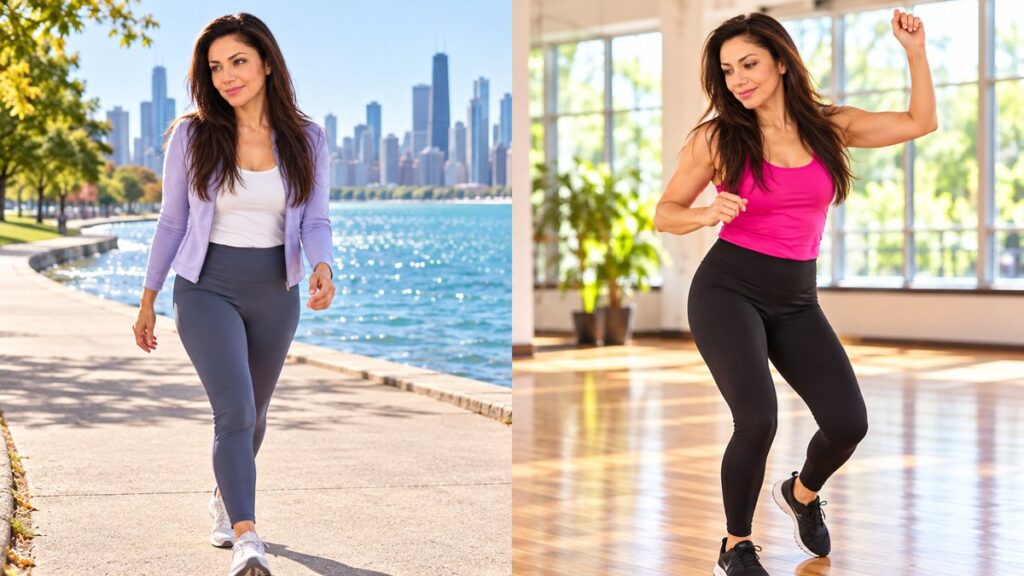
I walk almost every day and I take Zumba classes every week, so I get this question a lot: which one is better? My honest answer is that they’re different tools, and the best one is the one you’ll actually do. But there are real differences in intensity, impact, cost and fun, so here’s how they compare.
Zumba is usually more intense than walking: a class is mostly moderate to vigorous activity, while brisk walking is moderate. Walking is gentler, free and easy to do every day. Neither is “better” for everyone; many people do both, and both count toward weekly activity guidelines.
Zumba vs walking at a glance
| Zumba | Walking | |
|---|---|---|
| Intensity | Moderate to vigorous, with intervals of faster and slower songs | Usually moderate when brisk; light when slow |
| Impact | Higher: steps, turns, small jumps (you can modify) | Low |
| Coordination | Learning steps, rhythm and direction changes | Natural movement, little to learn |
| Social | Group class, music, instructor | Alone, with a friend, with a group |
| Cost | Class fees or gym membership; free online videos | Free |
| Where | Studio, gym, park district, home | Anywhere |
| Time | Classes usually 45–60 minutes | Any length, even 10 minutes |
| Fun factor | Party atmosphere with Latin music | Relaxing, a chance to think or listen |
| Best for | Energy, joy, coordination | Daily habit, recovery days, clearing the mind |
Intensity: which works the body harder?
Zumba alternates fast and slow songs, so it works like interval training. The Harvard T.H. Chan School of Public Health’s Nutrition Source describes Zumba as moderate to vigorous activity, depending on the class and how much effort you put in.
Walking intensity depends on pace. A leisurely stroll is light activity; brisk walking (where you can talk but not sing) is moderate. Walking uphill or carrying a backpack makes it harder.
In short: a Zumba class usually feels harder than a walk of the same length. But a long, brisk walk is still real exercise.
What the guidelines say
The U.S. Physical Activity Guidelines for adults recommend at least 150 minutes a week of moderate activity (or 75 minutes of vigorous activity, or a mix), plus muscle-strengthening activities on two or more days a week. Both brisk walking and Zumba count toward the aerobic minutes. Neither one alone fully covers strength training, which is why many people add the gym or a toning class.
Impact on the joints
Walking is low-impact: one foot is always on the ground. Zumba includes steps, pivots, quick direction changes and sometimes small jumps. Good instructors show low-impact options, and you can always keep your feet on the floor. Wearing the right shoes helps: here’s how to choose Zumba shoes.
If you have an injury or a health condition, ask your doctor which activity suits you.
Coordination, balance and the brain
Zumba asks you to follow choreography, remember combinations and react to cues. That mental challenge is part of the fun (and part of the frustration at the beginning!). Walking is more automatic, which is exactly why it’s a great time to think, talk with a friend or listen to an audiobook.
Mood and motivation
This is where the comparison is personal.
- Zumba is a party. The music, the group energy and the instructor make the time fly. Some people find it easier to work hard when they’re having fun.
- Walking is calm. It’s a way to be outside, see the lake, and clear your head. There’s no pressure, no choreography.
The best exercise is the one you’ll keep doing. If you love dancing, Zumba might be the habit that sticks. If you prefer peace and nature, walking will be.
Cost and convenience
- Walking is free, needs no equipment except comfortable shoes, and you can do it anytime: a lunch break, after dinner, on the way to work.
- Zumba usually costs money (classes, gym membership or park district programs), and follows a schedule. Online classes and videos are an option at home.
In Chicago, you have both: the Lakefront Trail for walking and Zumba classes in gyms, studios and park district field houses. Here’s my guide to Zumba classes in Chicago, and my favorite place to walk is the Lakefront Trail.
Who should choose Zumba?
- You love music and dancing.
- You want a more intense workout in a short time.
- You’re motivated by a group and an instructor.
- You want to work on coordination and rhythm.
New to it? Start with my Zumba for beginners guide.
Who should choose walking?
- You’re just starting to move more.
- You want something low-impact and free.
- You need flexibility in your schedule.
- You want time outside or time to think.
Looking for routes? Here are the best Chicago walks.
Why I do both
For me, they’re a team. Zumba gives me joy and energy; walking keeps me moving on the other days and lets me enjoy the city. A week can look like this:
| Day | Activity |
|---|---|
| Monday | Brisk walk, 30–45 minutes |
| Tuesday | Zumba class |
| Wednesday | Walk + strength (gym or toning) |
| Thursday | Zumba class |
| Friday | Easy walk |
| Saturday | Long walk on the lakefront or a dance class |
| Sunday | Rest or a gentle stroll |
This is just an example, not a prescription: adjust it to your life and your body. I also compared Zumba with gym workouts here: Is Zumba better than the gym?
How to make walking more challenging
- Walk faster, so you can talk but not sing.
- Add intervals: one minute fast, two minutes normal.
- Add hills, bridges or stairs.
- Swing your arms and walk tall.
- Walk longer as your stamina grows.
How to make Zumba easier
- Stay in the back row and follow the instructor’s low-impact options.
- Focus on the feet first, arms later.
- Take water breaks whenever you need them.
- Remember that nobody’s watching you: everyone’s busy with their own steps. Here’s how not to feel awkward dancing.
FAQ
Is Zumba more intense than walking?
Usually yes. Zumba is typically moderate to vigorous, while brisk walking is moderate. But intensity depends on your effort in both.
Can I do Zumba and walking on the same day?
Yes, many people walk to class or take an easy walk on Zumba days. Listen to your body and rest when you need to.
Is walking enough exercise?
Brisk walking counts toward the 150 weekly minutes of moderate activity in the guidelines. Add muscle-strengthening activities twice a week for a complete routine.
Is Zumba low-impact?
Not by default, but you can make it low-impact by keeping one foot on the floor and skipping jumps. Aqua Zumba is another gentle option.
Which is better for beginners?
Walking is the easiest place to start. Zumba is also beginner-friendly if you choose a beginner class and go at your own pace.
¡Camina, baila y disfruta! The best workout is the one that makes you want to come back.