
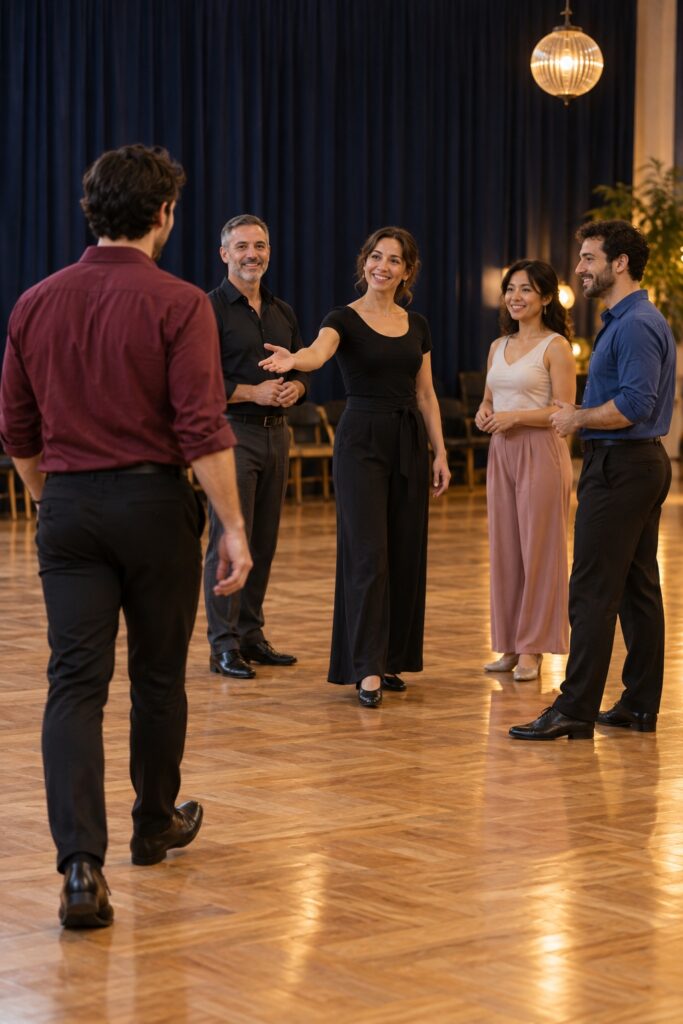
You can explore ballroom before finding a permanent dance partner. I’ll start there because “Who would come with me?” can otherwise stop the whole idea before you have asked a studio a single question.
USA Dance says most group classes accept singles. That is a reason to enquire, not a promise about every class. The important detail is how your chosen lesson includes people arriving alone.
If you are coming on your own
Tell the organiser plainly: “I’m a complete beginner and would attend without a partner. How does that work in this class?” Ask whether the teacher pairs people, whether rotation is used and what happens when numbers are uneven.
Check the role arrangement too. Can you choose the role you want to learn? Does the class teach both? Do not infer the answer from gender, clothing or the couples pictured on the website.
A specific reply lets you picture the evening. “Everyone is friendly” may be true, but it leaves the practical question unanswered.
If you are bringing someone
Coming together does not necessarily mean staying together during a group lesson. Confirm the rotation policy before booking. Then talk about your own expectations: a relaxed shared outing, a particular celebration or an ongoing learning project?
I would also settle one small agreement beforehand: let the instructor do the teaching. When a passage feels muddled, “Can you help us with this connection?” is more productive than appointing one of you the permanent corrector.
If one person cannot attend later, ask whether the other can still join. And if one becomes more enthusiastic than the other, you can discuss separate participation without treating a shared trial as a lifelong contract.
What does this ballroom course include?
Ask which dances and teaching system the course uses. USA Dance’s competitor guide distinguishes American and International syllabi, even where dance names overlap. You do not need to learn those syllabi before starting; you need the teacher to identify the actual material.
A survey of several dances and a course concentrating on one can both be worthwhile. The relevant comparison is what you want to do next. If you hope to attend a particular social, ask what is danced there. If you have chosen music for a celebration, give the teacher the exact recording version rather than only the song title.
Two different reasons to book
Here are two invented situations. Alex wants a regular social outing and has no partner. A beginner group course with confirmed solo arrangements and dances used at the local social answers his main questions.
Leila and Peter want to dance together at one family celebration. A defined, event-focused lesson may answer their questions more directly than a term-long survey. They can explain that they want simple material, no dips or lifts, and written pricing before considering further lessons.
Neither route is automatically better or faster. A private lesson is useful when its purpose is clear, not because buying more attention guarantees a particular result.
Comfort and cost belong in the conversation
Ask about suitable clothing, footwear, the floor and any access requirements before buying equipment. You should be able to say “Please give me more space” or “I need to stop” without a long explanation. Agreement to partner dancing does not cover every movement someone might introduce. My social-dance etiquette guide offers more wording for those moments.
Before paying for a package, check the normal lesson price, expiry, cancellation terms and whether events or other extras cost more. Take time to read the written offer. Enjoying a first lesson does not oblige you to buy a large commitment.
Afterward, ask whether the teacher explained clearly, respected your boundaries and gave you a realistic next step. You can begin with one well-chosen lesson. A permanent partner, competition outfit and polished routine can all stay off the shopping list.
MarGo! Moments is a non-medical lifestyle publication. This article offers general information, not individual medical advice or an exercise prescription. For health questions, consult an appropriately qualified healthcare professional.
MarGo! editorial feature · AI-assisted, in the MarGo! first-person voice. Not a personal experience or product test unless stated.