
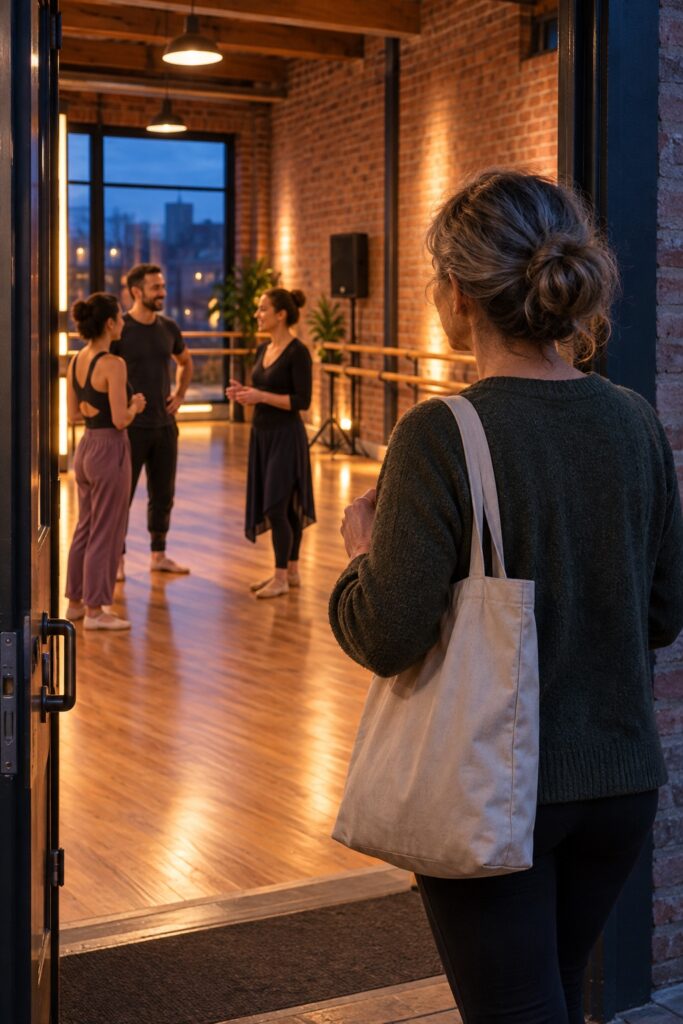
I want to make choosing a dance class a little less mysterious. Before comparing styles, I’ll start with a simpler question: what would make an evening of dancing worth your time? Moving to music, sharing a dance with someone, and understanding a new technique are all good answers. They point toward different classes.
You don’t need a grand reason to begin. Curiosity about the music counts. So does wanting an hour that belongs to you.
Three routes, three different invitations
Dance fitness: look here if you want to join in with movement and music. A follow-along session may keep going rather than pause for detailed instruction. Ask how newcomers learn and what happens when they lose the sequence. Zumba’s official class menu includes standard, Gold, chair and aquatic formats, so even a familiar brand needs a closer look.
Social dance: look here if you want to share dancing at an event or with a partner. A lesson teaches; a social provides a place to use the learning. They are not interchangeable bookings. USA Dance says most group classes accept singles, but the local pairing and rotation policy still needs checking. Coming alone does not necessarily mean dancing alone.
Technique-led dance: look here if learning the movement itself appeals to you. You might study ballet vocabulary, tap sounds or a jazz phrase. This need not involve examinations or performing. The Royal Academy of Dance’s adult programme distinguishes levels; another school may use the same names differently. Ask what a complete newcomer is expected to know.
These routes overlap. A social lesson can be technically detailed; a fitness teacher can explain carefully. I’m using them to help you ask about the balance of a real session, not to put every style in a box.
What does “beginner” mean here?
“Can I join with no previous lessons?” is more useful than “Will I be good enough?” Find out whether the course starts from zero, builds across a term, or welcomes drop-ins who already know some material. An available place halfway through a course is not proof that it is a sensible entry point.
Ask about the actual tasks too: partner contact, floorwork, travelling across the room, improvisation or learning a set routine. If you want to learn without performing, confirm that any showcase really is optional and has no unavoidable extra fee.
Make the practical questions specific
- Teaching: Can you see demonstrations, hear explanations and ask questions?
- Participation: What are the options for breaks, contact and any access needs you have?
- Building: Check the entrance, stairs or lift, toilets and journey home.
- Commitment: Add travel, parking, required shoes and membership charges to the fee. Check cancellation and missed-class terms.
“Everyone is welcome” is a lovely beginning, but it is not an answer about an essential facility. Candoco’s inclusive practice shows that teaching can be shaped around varied access needs; it does not establish what another provider can offer. Ask for the arrangement you would actually use. Where a health restriction affects participation, get individual advice rather than relying on a class label.
For online teaching, ask whether the instructor can see you, answer questions and provide the advertised feedback. A live video does not automatically mean individual supervision. Your room also needs to accommodate the intended activity.
A comparison that leads somewhere
Here is an invented example. Alex wants detailed teaching without a performance commitment. One listing offers continuous dance fitness; another offers introductory technique with an optional showing. The second is the closer lead, provided “optional” genuinely means Alex can take the course without performing.
If Alex instead wants uninterrupted movement to music after work, the first listing becomes more promising. Nothing about the classes changed. The purpose did.
After a trial, I’d bring the decision back to three questions: did the teaching make sense, were your choices respected, and did the practical arrangements work? New vocabulary can be a learning question. Unwanted contact or missing essential access is a different matter.
Follow the question you still have
For the next step, explore your first Zumba class, ballroom with or without a partner, choosing a salsa course or jazz, contemporary and musical theatre. Choose the guide that answers your remaining question rather than taking on an entire dance education before booking one lesson.
A first class is a starting place. You can return, change level, try another teacher or discover that another kind of dancing interests you more.
MarGo! Moments is a non-medical lifestyle publication. This article offers general information, not individual medical advice or an exercise prescription. For health questions, consult an appropriately qualified healthcare professional.
MarGo! editorial feature · AI-assisted, in the MarGo! first-person voice. Not a personal experience or product test unless stated.