
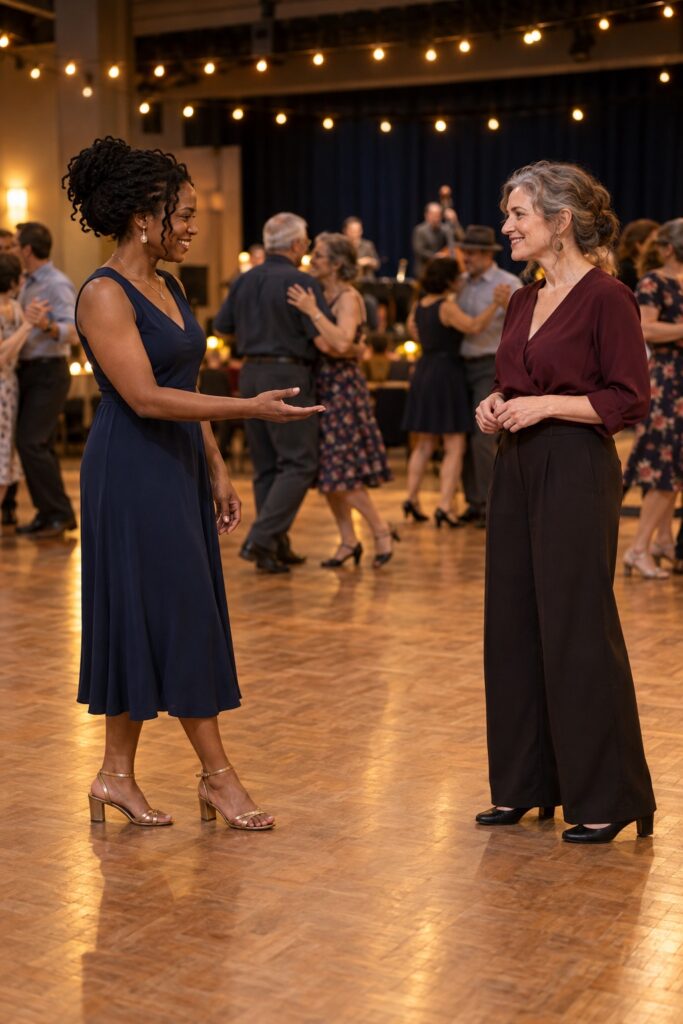
I want your first social dance to feel less like arriving halfway through a conversation. You may be learning the steps and the room’s customs at the same time. A few clear phrases can make the evening easier without turning it into an etiquette exam.
Start with this: an invitation needs a freely given answer, and either person can stop a dance. Experience does not give someone more claim to your time or your body.
Find the host before you need help
On arrival, ask, “It’s my first time here. How does the floor work, and who should I speak to if I need help?” Find the event’s code of conduct and check where people wait, leave bags and take breaks.
Local conventions matter. Ballroom, swing, salsa and tango events may organise invitations and floor movement differently. A rule from another community does not automatically describe this room.
Inviting and declining can both be simple
“Would you like to dance this song?” gives someone a clear choice. Wait for the answer before taking their hand. If words are difficult to hear, use an accessible way to communicate rather than grabbing or treating eye contact as a requirement.
“No, thank you” is enough to decline. You can explain that you are resting if you wish, but you do not owe a reason or a promise of the next song. If someone declines your invitation, “Of course” lets the moment end.
The Triangle Swing Dance Society’s code explicitly recognises declining or ending a dance without explanation. Its rule is a useful example; check your event’s own arrangements too. Another person dancing with someone else later does not create a debt to you.
A yes still leaves room for boundaries
I’ll give you a few phrases to borrow:
- “Which role would you like to dance?”
- “I’m new. Please keep it simple.”
- “I prefer more space.”
- “No dips or lifts for me.”
- “That grip is uncomfortable. Please stop.”
- “I need to stop now.”
Roles should not be assumed from someone’s appearance. Nor does accepting a dance mean accepting unexpected movements, close contact, flirting or an exchange of phone numbers.
Do not introduce unfamiliar partnered tricks on a shared social floor. Even agreement between two people cannot override the organiser’s restrictions or other dancers’ space. You do not need to finish a song before withdrawing.
Share the room, not unsolicited lessons
Ask about direction of travel, any lanes or slots, and where it is appropriate to enter and stop. Leave enough space for the dancing actually happening. If a familiar combination no longer fits a crowded floor, simplify together or sit that song out.
After a collision, check whether everyone is all right and involve staff if someone is hurt or the space has become hazardous. Arguing about who caused it can wait; repeating the same oversized movement should not be the next step.
There is also a difference between stating a boundary and teaching technique. “Please loosen that hold” communicates an immediate need. An unasked-for explanation of everything a beginner is doing wrong turns the social into a lesson they did not request. Triangle’s code discourages unsolicited teaching; so does Bachata Dominicana Copenhagen’s code.
Ask about cameras and reporting
Check the event’s recording policy before filming. A willing partner may still have other dancers behind them or reflected in a mirror. Permission for a private recording is not automatically permission to post it.
If a boundary is ignored, you can tell the host exactly what happened and what help you need: “I asked this person to stop holding my wrist and they continued. I don’t want further contact. Can you help?” You do not need a polished account before asking for assistance.
Ask who will receive a report and what may be shared. Do not assume confidentiality: Triangle’s published process expressly cannot guarantee anonymity. That says nothing about another venue’s policy, which needs its own check. Immediate danger calls for appropriate emergency help.
At the end of the evening, I’d focus on whether your choices were respected, not how many dances you accepted. One enjoyable song, a useful introduction or a look around can all be a worthwhile first visit.
MarGo! Moments is a non-medical lifestyle publication. This article offers general information, not individual medical advice or an exercise prescription. For health questions, consult an appropriately qualified healthcare professional.
MarGo! editorial feature · AI-assisted, in the MarGo! first-person voice. Not a personal experience or product test unless stated.