
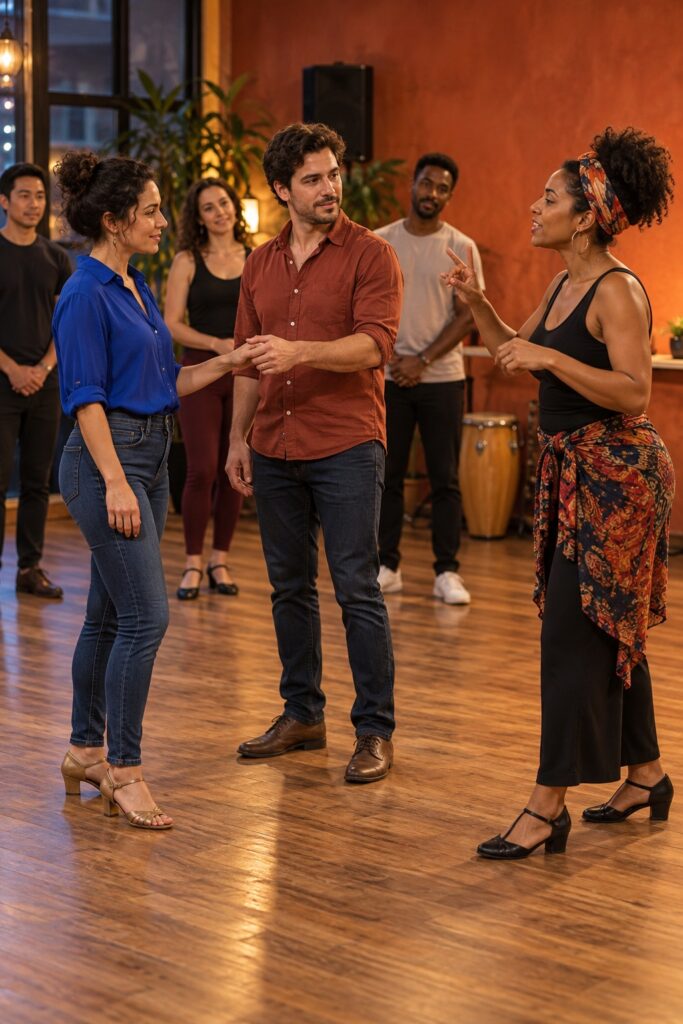
A salsa timetable can make a beginner feel behind before the first lesson. On1, On2, Casino, foundations, beginner one: I’ll separate the labels so you can choose a course without first teaching yourself salsa.
Start with where you hope to use it. Learning for a particular social, taking up a shared hobby and enjoying a solo dance-fitness session are different aims.
Style, timing and level are three separate questions
Style or structure tells you something about the dance being taught. Linear salsa and Casino are not simply different names for one identical partner arrangement; Rueda de Casino involves a group format with a caller. Dance Dojo’s style overview is a useful orientation, rather than a reason to rank traditions.
Timing concerns the relationship between the steps and the music. In the common systems explained by Dance Dojo’s timing guide, On1 places the basic pattern’s break steps, or directional changes, on counts 1 and 5; On2 places them on 2 and 6. There is more than one On2 stepping convention. “Start one beat later” is not an adequate explanation of them all.
Level tells you what the school expects you to know already. On2 is not a higher grade than On1. And “beginner” is not a universal first rung: a school may offer an introductory course before a class bearing that name.
The useful question is: “Which style and timing do you teach, and does this course start with no previous salsa experience?”
Choose the actual first lesson, not the most impressive syllabus
A long list of figures tells you little about how carefully they are explained. Look for teaching that connects the music, footwork and partner roles, with time to ask about the joins between them.
Salsa With Silvia’s published syllabus is an example of an Intro route followed by later levels. Use that distinction to inspect your local timetable, not to assume every provider uses the same sequence. Confirm current prerequisites and dates before paying.
“Drop-in” describes how you book. It does not promise that the teacher restarts from the beginning each week. If you would join midway through a series, ask what has already been taught and whether waiting for the next start is the better option.
How will partnering work?
Ask whether you choose a role, learn both roles or keep one throughout the course. Find out how solo attendees are included, whether partners rotate, what happens with uneven numbers and whether a couple can stay together. Policies vary.
Both people need an explanation of their task. When something goes wrong, the answer should involve instruction, not pulling harder or deciding whose fault it is. You can stop uncomfortable contact and ask the teacher for help.
If the evening itself is your concern, my guide to your first social dance covers invitations, boundaries and shared floor space.
Ask what happens after the lesson
A supervised practice, an extra taught class and an untaught social are different offers. Ask which one is intended for newcomers, whether its timing matches the course and whether admission is included. An “unlimited” package has little value if most sessions assume knowledge you have not learned.
For a hypothetical comparison, imagine you want to attend a local On2 social and have never taken salsa. Course A says only “beginners”; Course B says “On2 from zero” and names a beginner practice. B answers more of your present questions. A may still fit, but you need the missing information. If your interest were Casino instead, the shortlist would change.
I’d finish with one compact enquiry: “I’m new, I want to join this kind of dancing, and I can attend these dates. Which course should I start with, how do partners work, and where can I practise its material?” A clear answer is worth more than a dazzling performance clip.
MarGo! Moments is a non-medical lifestyle publication. This article offers general information, not individual medical advice or an exercise prescription. For health questions, consult an appropriately qualified healthcare professional.
MarGo! editorial feature · AI-assisted, in the MarGo! first-person voice. Not a personal experience or product test unless stated.