
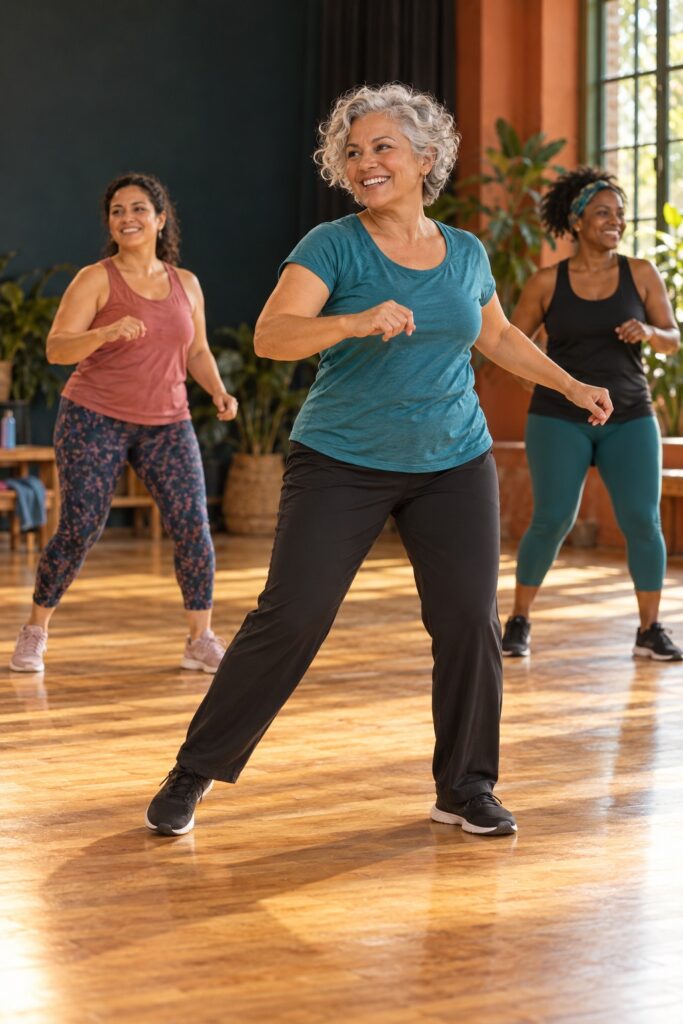
If your first Zumba class is on the calendar, I’ll help you sort the useful preparations from the things you can happily leave alone. You do not need to learn a playlist, buy a branded outfit or arrive looking as though you know the room.
The first visit can answer a smaller question: do you enjoy this class, and can you participate in a way that works for you?
Before you leave home
Check the exact format, not just the word Zumba. The official programme menu includes different formats, and your booking should make clear which one you are attending. Confirm the fee, cancellation terms, entrance and whether a completely new participant can join that session.
Here is a message you can adapt: “I’ve never followed a dance-fitness routine. How do you introduce newcomers, and what should I do when I lose the sequence?” If you need a clear sightline, nearby seat or accessible changing area, ask about that specific arrangement.
Pack comfortable clothing, water and footwear that meets the instructor’s advice and the venue’s floor rules. Ask before buying specialist shoes. The outfit’s job is to let you take part comfortably, not make you resemble a promotional photograph.
Give yourself time to learn the room
Arrive early enough to find the instructor before teaching starts. “This is my first class. Where can I see you clearly?” is a perfectly good introduction.
Find out where bags belong, where you can pause and how to leave without crossing the group’s path. The back corner may feel discreet but be a poor place to see the feet. Choose a usable view rather than a hiding place or an obligatory front-row challenge.
If you discussed an adjustment beforehand, check that the person teaching knows about it. A substitute instructor may not have received the message.
When everything seems to move at once
Zumba’s beginner guide suggests concentrating on the footwork before adding arms. That is one learning option, not an instruction to force a foot pattern that is unsuitable for you. Ask the instructor which simpler version to use and how to rejoin.
Imagine a newcomer who recognizes the beginning of a song but loses the turn. This is an illustrative example: she uses the option agreed with the teacher, watches for the familiar section and rejoins there. She does not have to hurry through every missed movement first.
I want to underline that last point: the music has moved on, and you can move on with it. Keep your space rather than chasing the person ahead. If you pause, do so outside the group’s travelling route.
Breaks do not need an apology
Knowing where to pause makes the choice simpler. You are not obliged to finish every track, match the instructor’s reach or explain yourself to everyone nearby. If a movement is painful or you feel unwell, stop and seek appropriate help rather than treating it as a test of determination.
Ask the instructor about teaching and participation options. Take individual health restrictions or unresolved symptoms to a qualified healthcare professional. Neither a beginner label nor an enthusiastic welcome provides medical clearance.
What to notice afterward
- Could you see and understand the cues?
- Were the participation options you discussed actually available?
- Was there music or a moment you wanted to return to?
- Did the journey, cost and timing fit an ordinary day?
“I couldn’t see past a pillar” suggests a different position. “I wanted detailed step instruction, but the class kept moving” may suggest a different kind of lesson. Neither means you failed.
If remembering the sequence is your main question, I explain that separately in remembering dance choreography. For now, one useful discovery about this particular class is plenty to bring home.
MarGo! Moments is a non-medical lifestyle publication. This article offers general information, not individual medical advice or an exercise prescription. For health questions, consult an appropriately qualified healthcare professional.
MarGo! editorial feature · AI-assisted, in the MarGo! first-person voice. Not a personal experience or product test unless stated.